





 Chat with AI


Accounting: What the Numbers Mean 9th Edition by Wayne W McManus, Daniel F Viele, David H Marshall
Edition 9ISBN: 0073527068Accounting: What the Numbers Mean 9th Edition by Wayne W McManus, Daniel F Viele, David H Marshall
Edition 9ISBN: 0073527068Cost-flow assumptions—FIFO and LIFO using periodic and perpetual systems The inventory records of Cushing, Inc., reflected the following information for the year ended December 31, 2010:
| Number of Units | Unit Cost | Total Cost |
Inventory, January 1 | 200 | $13 | $ 2,600 |
Purchases: |
|
|
|
May 30 | 320 | 15 | 4,800 |
September 28 | 400 | 16 | 6,400 |
Goods available for sale | 920 |
| $13,800 |
Sales: |
|
|
|
February 22 | (140) |
|
|
June 11 | (300) |
|
|
November 1 | (380) |
|
|
Inventory, December 31 | 100 |
|
|
Required:
a. Assume that Cushing, Inc., uses a periodic inventory system. Calculate cost of goods sold and ending inventory under FIFO and LIFO.
b. Assume that Cushing, Inc., uses a perpetual inventory system. Calculate cost of goods sold and ending inventory under FIFO and LIFO.
c. Explain why the FIFO results for cost of goods sold and ending inventory are the same in your answers to parts a and b, but the LIFO results are different.
d. Explain why the results from the LIFO periodic calculations in part a cannot possibly represent the actual physical flow of inventory items.
 Verified
Step 1 of 4
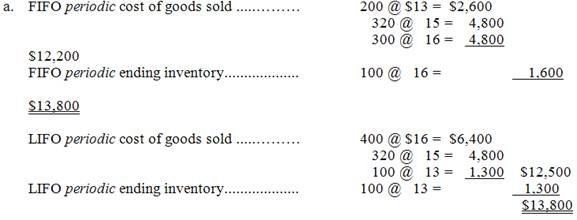
Step 2 of 4
Step 3 of 4
Step 4 of 4


Why don’t you like this exercise?
Other






