


expand icon
book Accounting: What the Numbers Mean 9th Edition by Wayne W McManus, Daniel F Viele, David H Marshall cover

Accounting: What the Numbers Mean 9th Edition by Wayne W McManus, Daniel F Viele, David H Marshall

Edition 9ISBN: 0073527068
book Accounting: What the Numbers Mean 9th Edition by Wayne W McManus, Daniel F Viele, David H Marshall cover

Accounting: What the Numbers Mean 9th Edition by Wayne W McManus, Daniel F Viele, David H Marshall

Edition 9ISBN: 0073527068
Exercise 82
Step-by-step solution
Verified
like image
like image

Step 1 of 2

a.Solution approach: Prepare a T-account to determine the Cash account balance, and then review the results of the horizontal model representations (or journal entries above).  Since there are a limited number of transactions in Problem 4.17., the balances of all of the other accounts should be easy to determine.
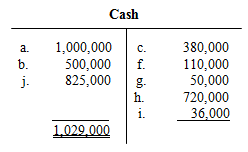
    <div class=answer> a.<span class=bold><span class=italics>Solution approach:</span> </span>Prepare a T-account to determine the Cash account balance, and then review the results of the horizontal model representations (or journal entries above).  Since there are a limited number of transactions in Problem 4.17., the balances of all of the other accounts should be easy to determine. <span class=bold>   </span> <table width=30% cellspacing=0 cellpadding=0 border=0>     <tbody>      <tr>       <td valign=top align=center><p align=center><span class=bold>KISSICK, CO.</span> </td>       <td valign=top align=center><p align=center>  </td>      </tr>      <tr>       <td valign=top align=center><p align=center><span class=bold>Income Statement</span> </td>       <td valign=top align=center><p align=center>  </td>      </tr>      <tr>       <td valign=top> Sales </td>       <td valign=top align=right><p align=right>$ 910,000 </td>      </tr>      <tr>       <td valign=top> Cost of goods sold </td>       <td valign=top align=right><p align=right><span class=underline>(580,000)</span> </td>      </tr>      <tr>       <td valign=top> Gross profit </td>       <td valign=top align=right><p align=right>$ 330,000 </td>      </tr>      <tr>       <td valign=top> Rent expense </td>       <td valign=top align=right><p align=right>(120,000) </td>      </tr>      <tr>       <td valign=top> Utilities expense </td>       <td valign=top align=right><p align=right>(36,000) </td>      </tr>      <tr>       <td valign=top> Salaries expense </td>       <td valign=top align=right><p align=right><span class=underline>(380,000)</span> </td>      </tr>      <tr>       <td valign=top> Loss from operations </td>       <td valign=top align=right><p align=right>$(206,000) </td>      </tr>      <tr>       <td valign=top> Interest expense </td>       <td valign=top align=right><p align=right><span class=underline>(60,000)</span> </td>      </tr>      <tr>       <td valign=top> Net loss (the problem ignores income taxes) </td>       <td valign=top align=right><p align=right><span class=underline>$(266,000</span>) </td>      </tr>     </tbody>    </table> ? <table width=30% cellspacing=0 cellpadding=0 border=0>     <tbody>      <tr>       <td valign=top> <span class=bold>KISSICK, CO.</span> </td>       <td valign=top>   </td>      </tr>      <tr>       <td valign=top> <span class=bold>Balance Sheet</span> </td>       <td valign=top>   </td>      </tr>      <tr>       <td valign=top> <span class=bold>Assets:</span> </td>       <td valign=top>   </td>      </tr>      <tr>       <td valign=top> Cash </td>       <td valign=top> $1,029,000 </td>      </tr>      <tr>       <td valign=top> Accounts receivable </td>       <td valign=top> 85,000 </td>      </tr>      <tr>       <td valign=top> Merchandise inventory </td>       <td valign=top> <span class=underline>60,000</span> </td>      </tr>      <tr>       <td valign=top> Total current assets </td>       <td valign=top> $1,174,000 </td>      </tr>      <tr>       <td valign=top> Equipment (the problem ignores depreciation) </td>       <td valign=top> <span class=underline>150,000</span> </td>      </tr>      <tr>       <td valign=top> Total assets </td>       <td valign=top> <span class=underline>$1,324,000</span> </td>      </tr>      <tr>       <td valign=top>   </td>       <td valign=top>   </td>      </tr>      <tr>       <td valign=top> <span class=bold>Liabilities:</span> </td>       <td valign=top>   </td>      </tr>      <tr>       <td valign=top> Accounts payable </td>       <td valign=top> d9fdc3ce_d298_4b5b_9fab_27c2440bde98_SMCC1495_11nbsp;    20,000 </td>      </tr>      <tr>       <td valign=top> Interest payable </td>       <td valign=top> 60,000 </td>      </tr>      <tr>       <td valign=top> Rent payable </td>       <td valign=top> <span class=underline>10,000</span> </td>      </tr>      <tr>       <td valign=top> Total current liabilities </td>       <td valign=top> d9fdc3ce_d298_4b5b_9fab_27c2440bde98_SMCC1495_11nbsp;    90,000 </td>      </tr>      <tr>       <td valign=top> Notes payable </td>       <td valign=top> <span class=underline>500,000</span>  </td>      </tr>      <tr>       <td valign=top> Total liabilities </td>       <td valign=top> <span class=underline>d9fdc3ce_d298_4b5b_9fab_27c2440bde98_SMCC1495_11nbsp;  590,000</span> </td>      </tr>      <tr>       <td valign=top>   </td>       <td valign=top>   </td>      </tr>      <tr>       <td valign=top> <span class=bold>Owners’ Equity:</span> </td>       <td valign=top>   </td>      </tr>      <tr>       <td valign=top> Common stock </td>       <td valign=top> $1,000,000 </td>      </tr>      <tr>       <td valign=top> Deficit * </td>       <td valign=top> <span class=underline>(266,000)</span> </td>      </tr>      <tr>       <td valign=top> Total owners’ equity </td>       <td valign=top> <span class=underline>d9fdc3ce_d298_4b5b_9fab_27c2440bde98_SMCC1495_11nbsp;  734,000</span> </td>      </tr>      <tr>       <td valign=top> Total liabilities and owners’ equity </td>       <td valign=top> <span class=underline>$1,324,000</span> </td>      </tr>     </tbody>    </table> Since this was the first year of operations, the Retained Earnings account would have a $0 beginning balance.  Thus, the net loss for the year creates a deficit.

KISSICK, CO.


Income Statement


Sales

$ 910,000

Cost of goods sold

(580,000)

Gross profit

$ 330,000

Rent expense

(120,000)

Utilities expense

(36,000)

Salaries expense

(380,000)

Loss from operations

$(206,000)

Interest expense

(60,000)

Net loss (the problem ignores income taxes)

$(266,000)

?

KISSICK, CO.


Balance Sheet


Assets:


Cash

$1,029,000

Accounts receivable

85,000

Merchandise inventory

60,000

Total current assets

$1,174,000

Equipment (the problem ignores depreciation)

150,000

Total assets

$1,324,000


Liabilities:


Accounts payable

$     20,000

Interest payable

60,000

Rent payable

10,000

Total current liabilities

$     90,000

Notes payable

500,000 

Total liabilities

$   590,000


Owners’ Equity:


Common stock

$1,000,000

Deficit *

(266,000)

Total owners’ equity

$   734,000

Total liabilities and owners’ equity

$1,324,000

Since this was the first year of operations, the Retained Earnings account would have a $0 beginning balance.  Thus, the net loss for the year creates a deficit.


Step 2 of 2

close menu
Accounting: What the Numbers Mean 9th Edition by Wayne W McManus, Daniel F Viele, David H Marshall
cross icon



