





 Chat with AI

Deck 4: The Study of Chemical Reactions
Full screen (f)

Question

Question
Question
Question
Question
Question
Question
Question
Question
Question
Write a detailed, stepwise mechanism for the following reaction. 
Question
Question
Question
Question
Question
Question
Question
Question
Question
Question
Question
Question
Question
Question
Question
Consider the reaction of A being converted into B at 25°C. If the ΔG° of this reaction is  the Keq is ________ and the % conversion is ________.
A) 0.18, 15%
B) 0.43, 30%
C) 1.0, 50%
D) 2.3, 70%
E) 5.4, 84%
the Keq is ________ and the % conversion is ________.A) 0.18, 15%
B) 0.43, 30%
C) 1.0, 50%
D) 2.3, 70%
E) 5.4, 84%
Question
Question
Question
Question
Question
Provided the following pKa values for the two acids below, draw an energy diagram
for the acid-base reaction. Be sure to label each axis correctly.
for the acid-base reaction. Be sure to label each axis correctly.
Question
Question
Question
Question
Given a DG° of 0.8 kJ/mol at 25°C for the equilibrium shown below, calculate the percentage of the axial conformer at 25°C. [R = 8.314 J/K∙ mol] ![Given a DG°<sup> </sup>of 0.8 kJ/mol at 25°C for the equilibrium shown below, calculate the percentage of the axial conformer at 25°C. [R = 8.314 J/K∙ mol] <div style=padding-top: 35px>](https://d2lvgg3v3hfg70.cloudfront.net/TB6198/11eab45f_cd80_46cf_acdb_6d6393cb3868_TB6198_00.jpg)
Question
Question
Question
Question
Question
Question
Question
Question
Question
Question
Question
Question
Consider the bond dissociation energies listed below in kcal/mol. 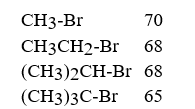
These data show that the carbon-bromine bond is weakest when bromine is bound to a ________.
A) methyl carbon
B) primary carbon
C) secondary carbon
D) tertiary carbon
E) quaternary carbon
These data show that the carbon-bromine bond is weakest when bromine is bound to a ________.
A) methyl carbon
B) primary carbon
C) secondary carbon
D) tertiary carbon
E) quaternary carbon
Question
Question
Question
Question
Which of the presented mechanisms would be the most energetically favorable and thus the most likely mechanism to actually occur for the following free radical chain reaction? (bond dissociation energies -- H-H = 104 kcal/mol; Cl-Cl = 58 kcal/mol; H-Cl = 103 kcal/mol)
H2 + Cl2
 2 HCl
2 HCl
A) H2
 H∙ + H∙
H∙ + Cl2 → Cl∙ + HCl
H∙ + Cl∙ → HCl
B) Cl2
 Cl∙ + Cl∙
Cl∙ + H2 → H∙ + HCl
H∙ + Cl2 → HCl + Cl∙
C) H2
 H∙ + H∙
H∙ + Cl2 → Cl∙ + HCl
Cl∙ + H2 → HCl + H∙
D) Cl2 Cl∙ + Cl∙
Cl∙ + H2 → H∙ + HCl
H∙ + Cl∙ → HCl
H2 + Cl2
2 HClA) H2
H∙ + H∙H∙ + Cl2 → Cl∙ + HCl
H∙ + Cl∙ → HCl
B) Cl2
Cl∙ + Cl∙Cl∙ + H2 → H∙ + HCl
H∙ + Cl2 → HCl + Cl∙
C) H2
H∙ + H∙H∙ + Cl2 → Cl∙ + HCl
Cl∙ + H2 → HCl + H∙
D) Cl2
Cl∙ + Cl∙Cl∙ + H2 → H∙ + HCl
H∙ + Cl∙ → HCl
Question
Predict the enthalpy (ΔH) value for the theoretical reaction below, and indicate whether it is endothermic or exothermic. The bond dissociation energy for each bond in Kcal/mol is shown below each reactant and product. 
A) +8 Kcal/mol, endothermic
B) -8 Kcal/mol, exothermic
C) +16 Kcal/mol, endothermic
D) +8 Kcal/mol, exothermic
A) +8 Kcal/mol, endothermic
B) -8 Kcal/mol, exothermic
C) +16 Kcal/mol, endothermic
D) +8 Kcal/mol, exothermic
Question
Question
Question
Question
Question
Question
Given the bond dissociation energies below (in kcal/mol), estimate the ΔH° for the propagation step 
CH3CH2CH2-H 98
(CH3)2CH-H 95
Cl-Cl 58
H-Cl 103
CH3CH2CH2-Cl 81
(CH3)2CH-Cl 80
A) -22 kcal/mol
B) +22 kcal/mol
C) -40 kcal/mol
D) +45 kcal/mol
CH3CH2CH2-H 98
(CH3)2CH-H 95
Cl-Cl 58
H-Cl 103
CH3CH2CH2-Cl 81
(CH3)2CH-Cl 80
A) -22 kcal/mol
B) +22 kcal/mol
C) -40 kcal/mol
D) +45 kcal/mol
Question
Question
Question
Question
Question
Question
Question
Question
In the hydrocarbon shown below, how many tertiary hydrogens are present? 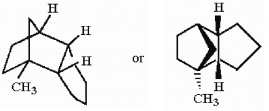
A) 0
B) 1
C) 2
D) 3
E) 4
A) 0
B) 1
C) 2
D) 3
E) 4
Question
Question
Consider the conversion of X to Z through the sole intermediate Y. Given the reaction-energy diagram shown below, which step is the rate-limiting step? Explain your reasoning. 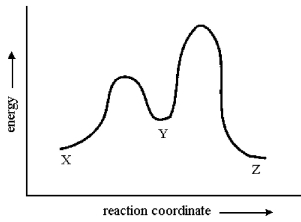
Question
Question
Question
Question
Question
Question
Question
Question
Question
Question
Question
Question
Question
The following reaction occurs readily:  Experimentally one finds that if the concentration of I- is doubled, the rate doubles. Also if the concentration of CH3Br is halved, the rate is halved. What is the rate equation for this reaction?
Experimentally one finds that if the concentration of I- is doubled, the rate doubles. Also if the concentration of CH3Br is halved, the rate is halved. What is the rate equation for this reaction?
Unlock Deck
Sign up to unlock the cards in this deck!
Unlock Deck
Unlock Deck
1/128

Play

Full screen (f)
Deck 4: The Study of Chemical Reactions
1
In the reaction of Cl2 with ethane and UV light, which of the following reactions would be a chain termination event(s)?
I. Cl∙ + CH3-CH3 → CH3-CH2-Cl + H∙
II. Cl∙ + CH3-CH3 → CH3-H2C∙ + HCl
III. Cl∙ + CH3-H2C∙ → CH3-CH2-Cl
IV. Cl2 + CH3-H2C∙ → CH3-CH2-Cl + Cl∙
V. Cl2 + UV light → C l∙ + Cl∙
A) reaction V
B) reactions I and IV
C) reactions III and IV
D) reactions I and II
E) reaction III
I. Cl∙ + CH3-CH3 → CH3-CH2-Cl + H∙
II. Cl∙ + CH3-CH3 → CH3-H2C∙ + HCl
III. Cl∙ + CH3-H2C∙ → CH3-CH2-Cl
IV. Cl2 + CH3-H2C∙ → CH3-CH2-Cl + Cl∙
V. Cl2 + UV light → C l∙ + Cl∙
A) reaction V
B) reactions I and IV
C) reactions III and IV
D) reactions I and II
E) reaction III
reaction III
2
Which of the following species is formed through a termination reaction in the chlorination of methane?
A) CH3Cl
B) HCl
C) H2
D) CH3CH3
A) CH3Cl
B) HCl
C) H2
D) CH3CH3
H2
3
Explain how the termination step in a free-radical chain reaction stops the chain.
In order for a free-radical chain to propagate, each mechanistic step must yield a free-radical species as one of its products. A mechanistic step that does not yield a free-radical stops the chain. Such a step is known as a termination step.
4
In the reaction of Cl2 with ethane and UV light, which of the following reactions would be a propagation event(s)?
I. Cl∙ + CH3-CH3 → CH3-CH2-Cl + H∙
II. Cl∙ + CH3-CH3 → CH3-H2C∙ + HCl
III. Cl∙ + CH3-H2C∙ → CH3-CH2-Cl
IV. Cl2 + CH3-H2C∙ → CH3-CH2-Cl + Cl∙
V. Cl2 + UV light → C l∙ + Cl∙
A) reactions I and V
B) reactions II, III and IV
C) reactions I and IV
D) reactions II and IV
E) reactions I, II and IV
I. Cl∙ + CH3-CH3 → CH3-CH2-Cl + H∙
II. Cl∙ + CH3-CH3 → CH3-H2C∙ + HCl
III. Cl∙ + CH3-H2C∙ → CH3-CH2-Cl
IV. Cl2 + CH3-H2C∙ → CH3-CH2-Cl + Cl∙
V. Cl2 + UV light → C l∙ + Cl∙
A) reactions I and V
B) reactions II, III and IV
C) reactions I and IV
D) reactions II and IV
E) reactions I, II and IV
Unlock Deck
Unlock for access to all 128 flashcards in this deck.
Unlock Deck
k this deck
5
________ is the study of reaction rates.
Unlock Deck
Unlock for access to all 128 flashcards in this deck.
Unlock Deck
k this deck
6
Species with unpaired electrons are called ________.
Unlock Deck
Unlock for access to all 128 flashcards in this deck.
Unlock Deck
k this deck
7
When the reaction between methane and chlorine is photochemically initiated, which of the following compounds be formed through a termination reaction?
A) CH3Cl
B) HCl
C) CH3CH3
D) Cl2
A) CH3Cl
B) HCl
C) CH3CH3
D) Cl2
Unlock Deck
Unlock for access to all 128 flashcards in this deck.
Unlock Deck
k this deck
8
What is meant by the of a chemical reaction?
Unlock Deck
Unlock for access to all 128 flashcards in this deck.
Unlock Deck
k this deck
9
Chlorination of methane can result in a mixture of chlorinated products. What experimental conditions should be used to favor the production of chloromethane over the other chlorinated products?
Unlock Deck
Unlock for access to all 128 flashcards in this deck.
Unlock Deck
k this deck
10
Write a detailed, stepwise mechanism for the following reaction.
Unlock Deck
Unlock for access to all 128 flashcards in this deck.
Unlock Deck
k this deck
11
Write an equation to describe the initiation step in the chlorination of methane.
Unlock Deck
Unlock for access to all 128 flashcards in this deck.
Unlock Deck
k this deck
12
Provide the two propagation steps in the free-radical chlorination of ethane.
Unlock Deck
Unlock for access to all 128 flashcards in this deck.
Unlock Deck
k this deck
13
Within the visible spectrum, it has been experimentally determined that blue light is the most effective in initiating the chlorination of methane. What is the mechanistic significance of this observation?
Unlock Deck
Unlock for access to all 128 flashcards in this deck.
Unlock Deck
k this deck
14
When light is shined on a mixture of chlorine and chloromethane, carbon tetrachloride is one of the components of the final reaction mixture. Propose a series of mechanistic steps which explain this observation.
Unlock Deck
Unlock for access to all 128 flashcards in this deck.
Unlock Deck
k this deck
15
Which of the following is a possible termination step in the free radical chlorination of methane?
A) ∙CH3 + Cl2 → CH3Cl + Cl∙
B) ∙CH3 + Cl∙ → CH3Cl
C) ∙CH3 + ∙CH3 → CH3CH3
D) ∙CH3 + wall → CH3-wall
E) Cl∙ + wall → Cl-wall
A) ∙CH3 + Cl2 → CH3Cl + Cl∙
B) ∙CH3 + Cl∙ → CH3Cl
C) ∙CH3 + ∙CH3 → CH3CH3
D) ∙CH3 + wall → CH3-wall
E) Cl∙ + wall → Cl-wall
Unlock Deck
Unlock for access to all 128 flashcards in this deck.
Unlock Deck
k this deck
16
The chlorination of methane is characterized by a high quantum yield. Explain what this means.
Unlock Deck
Unlock for access to all 128 flashcards in this deck.
Unlock Deck
k this deck
17
In the first propagation step of the free radical chlorination of methane, which of the following occurs?
A) Cl2 dissociates.
B) A chlorine radical abstracts a hydrogen.
C) A carbon radical reacts with Cl2.
D) A carbon radical reacts with a chlorine radical.
E) Two chlorine radicals combine.
A) Cl2 dissociates.
B) A chlorine radical abstracts a hydrogen.
C) A carbon radical reacts with Cl2.
D) A carbon radical reacts with a chlorine radical.
E) Two chlorine radicals combine.
Unlock Deck
Unlock for access to all 128 flashcards in this deck.
Unlock Deck
k this deck
18
For a given reaction, if ΔG° is greater than zero, then:
A) Keq < 0.
B) Keq = 0.
C) 0 < Keq < 1.
D) Keq = 1.
E) Keq > 1.
A) Keq < 0.
B) Keq = 0.
C) 0 < Keq < 1.
D) Keq = 1.
E) Keq > 1.
Unlock Deck
Unlock for access to all 128 flashcards in this deck.
Unlock Deck
k this deck
19
Which of the following is a propagation step in the free radical chlorination of dichloromethane?
A) ∙ CHCl2 + Cl2 → CHCl3 + Cl∙
B) ∙ CHCl2 + Cl∙ → CHCl3
C) CH2Cl2 + Cl∙ → CHCl3 + H∙
D) Cl2 + UV light → 2 Cl∙
E) ∙ CHCl2 + ∙ CHCl2 → CHCl2CHCl2
A) ∙ CHCl2 + Cl2 → CHCl3 + Cl∙
B) ∙ CHCl2 + Cl∙ → CHCl3
C) CH2Cl2 + Cl∙ → CHCl3 + H∙
D) Cl2 + UV light → 2 Cl∙
E) ∙ CHCl2 + ∙ CHCl2 → CHCl2CHCl2
Unlock Deck
Unlock for access to all 128 flashcards in this deck.
Unlock Deck
k this deck
20
If ΔG° for a given reaction at 25°C is less than zero, which of the following statements also correctly describes this reaction at this temperature?
A) The reaction must be exothermic.
B) The reaction must be endothermic.
C) Keq is greater than zero.
D) Both A and C are true.
E) Both B and C are true.
A) The reaction must be exothermic.
B) The reaction must be endothermic.
C) Keq is greater than zero.
D) Both A and C are true.
E) Both B and C are true.
Unlock Deck
Unlock for access to all 128 flashcards in this deck.
Unlock Deck
k this deck
21
Given a K of 0.45 at 25°C, calculate the corresponding DG° in kJ/mol. [R = 8.314 J/K∙ mol]
Unlock Deck
Unlock for access to all 128 flashcards in this deck.
Unlock Deck
k this deck
22
Which is a measure of the randomness of a system?
A) entropy
B) enthalpy
C) free energy
D) halogenation
E) stoichiometry
A) entropy
B) enthalpy
C) free energy
D) halogenation
E) stoichiometry
Unlock Deck
Unlock for access to all 128 flashcards in this deck.
Unlock Deck
k this deck
23
Given a K of 2.2 at 25°C, calculate the corresponding DG° in kJ/mol. [R = 8.314 J/K∙ mol]
Unlock Deck
Unlock for access to all 128 flashcards in this deck.
Unlock Deck
k this deck
24
Consider the reaction of A being converted into B at 25°C. If the ΔG° of this reaction is +0.5 kcal/mol, the Keq is ________ and the % conversion is ________.
A) 0.18, 15%
B) 0.43, 30%
C) 1.0, 50%
D) 2.3, 70%
E) 5.4, 84%
A) 0.18, 15%
B) 0.43, 30%
C) 1.0, 50%
D) 2.3, 70%
E) 5.4, 84%
Unlock Deck
Unlock for access to all 128 flashcards in this deck.
Unlock Deck
k this deck
25
Consider the reaction of A being converted into B at 25°C. If the ΔG° of this reaction is the Keq is ________ and the % conversion is ________.
A) 0.18, 15%
B) 0.43, 30%
C) 1.0, 50%
D) 2.3, 70%
E) 5.4, 84%
the Keq is ________ and the % conversion is ________.A) 0.18, 15%
B) 0.43, 30%
C) 1.0, 50%
D) 2.3, 70%
E) 5.4, 84%
Unlock Deck
Unlock for access to all 128 flashcards in this deck.
Unlock Deck
k this deck
26
If the equilibrium constant (Keq) of a reaction is 0.5 then which of the following that must be true?
A) The reaction will have an early transition state.
B) Reaction equilibrium will favor the products.
C) Gibbs free energy (G) is positive.
D) Gibbs free energy (G) is negative.
A) The reaction will have an early transition state.
B) Reaction equilibrium will favor the products.
C) Gibbs free energy (G) is positive.
D) Gibbs free energy (G) is negative.
Unlock Deck
Unlock for access to all 128 flashcards in this deck.
Unlock Deck
k this deck
27
For the reaction A + B → C + D, ΔG° = -5.00 kcal/mol. What is the corresponding equilibrium constant at 25°C? R = 1.987 cal/mol∙K.
Unlock Deck
Unlock for access to all 128 flashcards in this deck.
Unlock Deck
k this deck
28
Which of the following is true for the initiation step of a free radical chlorination reaction?
A) ΔH° > 0 and ΔS° > 0
B) ΔH° > 0 and ΔS° < 0
C) ΔH° < 0 and ΔS° > 0
D) ΔH° < 0 and ΔS° < 0
E) ΔH° = 0 and ΔS° = 0
A) ΔH° > 0 and ΔS° > 0
B) ΔH° > 0 and ΔS° < 0
C) ΔH° < 0 and ΔS° > 0
D) ΔH° < 0 and ΔS° < 0
E) ΔH° = 0 and ΔS° = 0
Unlock Deck
Unlock for access to all 128 flashcards in this deck.
Unlock Deck
k this deck
29
Consider the reaction of A being converted into B at 25°C. If the ΔG° of this reaction is -0.5 kcal/mol, the Keq is ________ and the % conversion is ________.
A) 0.18, 15%
B) 0.43, 30%
C) 1.0, 50%
D) 2.3, 70%
E) 5.4, 84%
A) 0.18, 15%
B) 0.43, 30%
C) 1.0, 50%
D) 2.3, 70%
E) 5.4, 84%
Unlock Deck
Unlock for access to all 128 flashcards in this deck.
Unlock Deck
k this deck
30
Provided the following pKa values for the two acids below, draw an energy diagram
for the acid-base reaction. Be sure to label each axis correctly.
for the acid-base reaction. Be sure to label each axis correctly.
Unlock Deck
Unlock for access to all 128 flashcards in this deck.
Unlock Deck
k this deck
31
If a reaction is exothermic, then:
A) ΔS° < 0.
B) ΔS° > 0.
C) ΔH° < 0.
D) ΔH° > 0.
E) both B and D
A) ΔS° < 0.
B) ΔS° > 0.
C) ΔH° < 0.
D) ΔH° > 0.
E) both B and D
Unlock Deck
Unlock for access to all 128 flashcards in this deck.
Unlock Deck
k this deck
32
Consider the transformation of A to B (i.e., A →
B). If at equilibrium at 25°C the concentration of A is 20% of the initial concentration of A, determine the value of ΔG° (in kcal/mol) for this reaction.
R = 1.987 cal/mol∙K.
B). If at equilibrium at 25°C the concentration of A is 20% of the initial concentration of A, determine the value of ΔG° (in kcal/mol) for this reaction.
R = 1.987 cal/mol∙K.
Unlock Deck
Unlock for access to all 128 flashcards in this deck.
Unlock Deck
k this deck
33
Which of the following correctly expresses the standard Gibbs free energy change of a reaction in terms of the changes in enthalpy and entropy?
A) ΔG° = ΔH° - TΔS°
B) ΔG° = ΔH° + TΔS°
C) ΔG° = ΔS° - TΔH°
D) ΔG° = ΔS° + TΔH°
E) none of the above
A) ΔG° = ΔH° - TΔS°
B) ΔG° = ΔH° + TΔS°
C) ΔG° = ΔS° - TΔH°
D) ΔG° = ΔS° + TΔH°
E) none of the above
Unlock Deck
Unlock for access to all 128 flashcards in this deck.
Unlock Deck
k this deck
34
Given a DG° of 0.8 kJ/mol at 25°C for the equilibrium shown below, calculate the percentage of the axial conformer at 25°C. [R = 8.314 J/K∙ mol]
Unlock Deck
Unlock for access to all 128 flashcards in this deck.
Unlock Deck
k this deck
35
Given a reaction in which reactant A is converted only to product B at 25°C, what Keq results if at equilibrium 80% of A has become B?
Unlock Deck
Unlock for access to all 128 flashcards in this deck.
Unlock Deck
k this deck
36
Which of the following statements correctly describes the contribution of ΔS° to ΔG°?
A) The entropy term makes a greater contribution to ΔG° at low temperatures.
B) The entropy term makes a greater contribution to ΔG° at high temperatures.
C) The entropy term makes a greater contribution to ΔG° in exothermic reactions.
D) The entropy term makes a greater contribution to ΔG° in endothermic reactions.
E) The entropy term always makes a more significant contribution to ΔG° than does the enthalpy term.
A) The entropy term makes a greater contribution to ΔG° at low temperatures.
B) The entropy term makes a greater contribution to ΔG° at high temperatures.
C) The entropy term makes a greater contribution to ΔG° in exothermic reactions.
D) The entropy term makes a greater contribution to ΔG° in endothermic reactions.
E) The entropy term always makes a more significant contribution to ΔG° than does the enthalpy term.
Unlock Deck
Unlock for access to all 128 flashcards in this deck.
Unlock Deck
k this deck
37
In an exothermic reaction, are stronger bonds broken and weaker bonds formed or are weaker bonds broken and stronger bonds formed?
Unlock Deck
Unlock for access to all 128 flashcards in this deck.
Unlock Deck
k this deck
38
Consider the following substitution reaction with a ΔG° value of -91.1 kJ/mole.
HO- + CH3Cl ↔ CH3OH + Cl-
Given this information which of the following statements must be true?
(R = 8.315 J/mole K)
A) The Keq at 25°C for this reaction is very large, in other words this reaction proceeds to near completion as written, left to right under standard conditions.
B) The Keq at 25°C for this reaction is very small (<1), in other words this reaction does not proceed from left to right but rather is favored from right to left under standard conditions .
C) At 250°C the equilibrium concentration is shifted right in favor of the products (CH3OH and Cl-). In other words there is more product than at 25°C.
D) At 250°C the equilibrium concentration of products and reactants is nearly the same.
E) Both A and C are correct.
HO- + CH3Cl ↔ CH3OH + Cl-
Given this information which of the following statements must be true?
(R = 8.315 J/mole K)
A) The Keq at 25°C for this reaction is very large, in other words this reaction proceeds to near completion as written, left to right under standard conditions.
B) The Keq at 25°C for this reaction is very small (<1), in other words this reaction does not proceed from left to right but rather is favored from right to left under standard conditions .
C) At 250°C the equilibrium concentration is shifted right in favor of the products (CH3OH and Cl-). In other words there is more product than at 25°C.
D) At 250°C the equilibrium concentration of products and reactants is nearly the same.
E) Both A and C are correct.
Unlock Deck
Unlock for access to all 128 flashcards in this deck.
Unlock Deck
k this deck
39
Given a DG° of -8.0 kJ/mol at 25°C, calculate the corresponding K. [R = 8.314 J/K∙ mol]
Unlock Deck
Unlock for access to all 128 flashcards in this deck.
Unlock Deck
k this deck
40
Assume the reaction A + B → C + D proceeds to equilibrium. Calculate the equilibrium concentration of D at 25°C, given that the starting concentrations of A and B are 2M and that ΔG° for the reaction is 1.0 kcal/mol. R = 1.987 cal/mol∙K.
A) 0.40M
B) 0.60M
C) 1.00M
D) 1.40M
E) 1.60M
A) 0.40M
B) 0.60M
C) 1.00M
D) 1.40M
E) 1.60M
Unlock Deck
Unlock for access to all 128 flashcards in this deck.
Unlock Deck
k this deck
41
Do you expect the initiation step in the free radical chlorination of 2,2-dimethylpropane to have a positive or negative DS? Explain briefly.
Unlock Deck
Unlock for access to all 128 flashcards in this deck.
Unlock Deck
k this deck
42
Energy is ________ when bonds are formed and is ________ when bonds are broken; therefore, bond dissociation energies are always ________.
A) released / consumed / exothermic
B) released / consumed / endothermic
C) consumed / released / exothermic
D) consumed / released / endothermic
E) consumed / released / isothermic
A) released / consumed / exothermic
B) released / consumed / endothermic
C) consumed / released / exothermic
D) consumed / released / endothermic
E) consumed / released / isothermic
Unlock Deck
Unlock for access to all 128 flashcards in this deck.
Unlock Deck
k this deck
43
If stronger bonds are formed and weaker bonds are broken, then the reaction is ________.
Unlock Deck
Unlock for access to all 128 flashcards in this deck.
Unlock Deck
k this deck
44
Does one expect ΔS° in a propagation step of the free-radical chlorination of methane to be greater than zero, less than zero, or approximately equal to zero? Briefly explain your choice.
Unlock Deck
Unlock for access to all 128 flashcards in this deck.
Unlock Deck
k this deck
45
Which of the following is true for the termination step of a free radical chlorination reaction?
A) ΔH° > 0 and ΔS° > 0
B) ΔH° > 0 and ΔS° < 0
C) ΔH° < 0 and ΔS° > 0
D) ΔH° < 0 and ΔS° < 0
E) ΔH° = 0 and ΔS° = 0
A) ΔH° > 0 and ΔS° > 0
B) ΔH° > 0 and ΔS° < 0
C) ΔH° < 0 and ΔS° > 0
D) ΔH° < 0 and ΔS° < 0
E) ΔH° = 0 and ΔS° = 0
Unlock Deck
Unlock for access to all 128 flashcards in this deck.
Unlock Deck
k this deck
46
Consider the bond dissociation energies listed below in kcal/mol.
These data show that the carbon-bromine bond is weakest when bromine is bound to a ________.
A) methyl carbon
B) primary carbon
C) secondary carbon
D) tertiary carbon
E) quaternary carbon
These data show that the carbon-bromine bond is weakest when bromine is bound to a ________.
A) methyl carbon
B) primary carbon
C) secondary carbon
D) tertiary carbon
E) quaternary carbon
Unlock Deck
Unlock for access to all 128 flashcards in this deck.
Unlock Deck
k this deck
47
Consider the elementary step in the solvolysis of isopropyl chloride shown below and write the rate equation for this step.
(CH3)2CHCl → (CH3)2CH+ + Cl-
(CH3)2CHCl → (CH3)2CH+ + Cl-
Unlock Deck
Unlock for access to all 128 flashcards in this deck.
Unlock Deck
k this deck
48
What reactive species is produced in the initiation step of the free radical chlorination of 2,2-dimethylpropane?
A) a chlorine atom
B) a chlorine radical anion
C) a carbon radical
D) a carbocation
A) a chlorine atom
B) a chlorine radical anion
C) a carbon radical
D) a carbocation
Unlock Deck
Unlock for access to all 128 flashcards in this deck.
Unlock Deck
k this deck
49
Predict the sign of DS° in the combustion of propane.
Unlock Deck
Unlock for access to all 128 flashcards in this deck.
Unlock Deck
k this deck
50
Which of the presented mechanisms would be the most energetically favorable and thus the most likely mechanism to actually occur for the following free radical chain reaction? (bond dissociation energies -- H-H = 104 kcal/mol; Cl-Cl = 58 kcal/mol; H-Cl = 103 kcal/mol)
H2 + Cl2
2 HCl
A) H2
H∙ + H∙
H∙ + Cl2 → Cl∙ + HCl
H∙ + Cl∙ → HCl
B) Cl2
Cl∙ + Cl∙
Cl∙ + H2 → H∙ + HCl
H∙ + Cl2 → HCl + Cl∙
C) H2
H∙ + H∙
H∙ + Cl2 → Cl∙ + HCl
Cl∙ + H2 → HCl + H∙
D) Cl2 Cl∙ + Cl∙
Cl∙ + H2 → H∙ + HCl
H∙ + Cl∙ → HCl
H2 + Cl2
2 HClA) H2
H∙ + H∙H∙ + Cl2 → Cl∙ + HCl
H∙ + Cl∙ → HCl
B) Cl2
Cl∙ + Cl∙Cl∙ + H2 → H∙ + HCl
H∙ + Cl2 → HCl + Cl∙
C) H2
H∙ + H∙H∙ + Cl2 → Cl∙ + HCl
Cl∙ + H2 → HCl + H∙
D) Cl2
Cl∙ + Cl∙Cl∙ + H2 → H∙ + HCl
H∙ + Cl∙ → HCl
Unlock Deck
Unlock for access to all 128 flashcards in this deck.
Unlock Deck
k this deck
51
Predict the enthalpy (ΔH) value for the theoretical reaction below, and indicate whether it is endothermic or exothermic. The bond dissociation energy for each bond in Kcal/mol is shown below each reactant and product.
A) +8 Kcal/mol, endothermic
B) -8 Kcal/mol, exothermic
C) +16 Kcal/mol, endothermic
D) +8 Kcal/mol, exothermic
A) +8 Kcal/mol, endothermic
B) -8 Kcal/mol, exothermic
C) +16 Kcal/mol, endothermic
D) +8 Kcal/mol, exothermic
Unlock Deck
Unlock for access to all 128 flashcards in this deck.
Unlock Deck
k this deck
52
The hydrogenation of acetylene to produce ethane is shown below. Is ΔS° for this reaction positive, negative, or impossible to predict? Explain your reasoning.
C2H2 (g) + 2H2 (g) → C2H6 (g)
C2H2 (g) + 2H2 (g) → C2H6 (g)
Unlock Deck
Unlock for access to all 128 flashcards in this deck.
Unlock Deck
k this deck
53
Which compound has the smaller bond dissociation energy for its carbon-chlorine bond, CH3Cl or (CH3)3CCl? Explain your reasoning.
Unlock Deck
Unlock for access to all 128 flashcards in this deck.
Unlock Deck
k this deck
54
Of the two C-H bonds shown, which has the smaller bond dissociation energy? Explain your choice.
(CH3)2CH-H vs. CH3CH2-H
(CH3)2CH-H vs. CH3CH2-H
Unlock Deck
Unlock for access to all 128 flashcards in this deck.
Unlock Deck
k this deck
55
Given the bond dissociation energies below (in kcal/mol), calculate the overall ΔH° for the following reaction:
(CH3)3CH + Br2 → (CH3)3CBr + HBr
(CH3)3C-H 91
(CH3)3C-Br 65
Br-Br 46
H-Br 88
CH3-Br 70
(CH3)3CH + Br2 → (CH3)3CBr + HBr
(CH3)3C-H 91
(CH3)3C-Br 65
Br-Br 46
H-Br 88
CH3-Br 70
Unlock Deck
Unlock for access to all 128 flashcards in this deck.
Unlock Deck
k this deck
56
Predict the signs of DH° and DS° in the reaction of cyclohexene with H2 to form cyclohexane.
Unlock Deck
Unlock for access to all 128 flashcards in this deck.
Unlock Deck
k this deck
57
Given the bond dissociation energies below (in kcal/mol), estimate the ΔH° for the propagation step
CH3CH2CH2-H 98
(CH3)2CH-H 95
Cl-Cl 58
H-Cl 103
CH3CH2CH2-Cl 81
(CH3)2CH-Cl 80
A) -22 kcal/mol
B) +22 kcal/mol
C) -40 kcal/mol
D) +45 kcal/mol
CH3CH2CH2-H 98
(CH3)2CH-H 95
Cl-Cl 58
H-Cl 103
CH3CH2CH2-Cl 81
(CH3)2CH-Cl 80
A) -22 kcal/mol
B) +22 kcal/mol
C) -40 kcal/mol
D) +45 kcal/mol
Unlock Deck
Unlock for access to all 128 flashcards in this deck.
Unlock Deck
k this deck
58
Do you expect the initiation step in the free radical chlorination of 2,2-dimethylpropane to be endo- or exothermic? Explain briefly, and comment on the sign of DH.
Unlock Deck
Unlock for access to all 128 flashcards in this deck.
Unlock Deck
k this deck
59
The bond dissociation energy is the amount of energy required to break a bond ________.
A) homolytically
B) heterolytically
C) so as to produce the more stable pair of ions
D) via hydrogenation
E) none of the above
A) homolytically
B) heterolytically
C) so as to produce the more stable pair of ions
D) via hydrogenation
E) none of the above
Unlock Deck
Unlock for access to all 128 flashcards in this deck.
Unlock Deck
k this deck
60
Given the chlorination of acetone shown below, choose the correct rate law. CH3COCH3 + Cl2 → CH3COCH2Cl + HCl
A) rate = [CH3COCH3]
B) rate = [Cl2]
C) rate = [CH3COCH3][Cl2]
D) rate = [CH3COCH3][Cl2]1/2
E) cannot be determined from stoichiometry; must be determined experimentally
A) rate = [CH3COCH3]
B) rate = [Cl2]
C) rate = [CH3COCH3][Cl2]
D) rate = [CH3COCH3][Cl2]1/2
E) cannot be determined from stoichiometry; must be determined experimentally
Unlock Deck
Unlock for access to all 128 flashcards in this deck.
Unlock Deck
k this deck
61
Explain the significance of the exponential factor e-Ea/RT in the Arrhenius equation.
Unlock Deck
Unlock for access to all 128 flashcards in this deck.
Unlock Deck
k this deck
62
The difference in energy between reactants and the transition state is known as ________.
Unlock Deck
Unlock for access to all 128 flashcards in this deck.
Unlock Deck
k this deck
63
Consider the one-step conversion of F to G. Given that the reaction is endothermic by 5 kcal/mol and that the energy difference between G and the transition state for the process is 15 kcal/mol, sketch a reaction-energy diagram for this reaction. Make sure to show how the given energy differences are consistent with your sketch.
Unlock Deck
Unlock for access to all 128 flashcards in this deck.
Unlock Deck
k this deck
64
Explain the significance of the frequency factor A in the Arrhenius equation.
Unlock Deck
Unlock for access to all 128 flashcards in this deck.
Unlock Deck
k this deck
65
In the hydrocarbon shown below, how many tertiary hydrogens are present?
A) 0
B) 1
C) 2
D) 3
E) 4
A) 0
B) 1
C) 2
D) 3
E) 4
Unlock Deck
Unlock for access to all 128 flashcards in this deck.
Unlock Deck
k this deck
66
Consider the conversion of C to D via a one-step mechanism. The activation energy of this conversion is 3 kcal/mol. The energy difference between D and the transition state of the reaction is 7 kcal/mol. Estimate ΔH° for the reaction C → D.
Unlock Deck
Unlock for access to all 128 flashcards in this deck.
Unlock Deck
k this deck
67
Consider the conversion of X to Z through the sole intermediate Y. Given the reaction-energy diagram shown below, which step is the rate-limiting step? Explain your reasoning.
Unlock Deck
Unlock for access to all 128 flashcards in this deck.
Unlock Deck
k this deck
68
Consider the three-step mechanism for the reaction of A through intermediates B and C to produce D shown below.
A → B Ea = 15 kcal/mol, ΔH° = 13 kcal/mol
B → C Ea = 10 kcal/mol, ΔH° = -6 kcal/mol
C → D Ea = 2 kcal/mol, ΔH° = -20 kcal/mol
Which of the three steps is rate-limiting?
A) The reaction of A to B.
B) The reaction of B to C.
C) The reaction of C to D.
D) All three steps occur at the same rate; there is no rate-limiting step.
E) The most exothermic step is rate-limiting.
A → B Ea = 15 kcal/mol, ΔH° = 13 kcal/mol
B → C Ea = 10 kcal/mol, ΔH° = -6 kcal/mol
C → D Ea = 2 kcal/mol, ΔH° = -20 kcal/mol
Which of the three steps is rate-limiting?
A) The reaction of A to B.
B) The reaction of B to C.
C) The reaction of C to D.
D) All three steps occur at the same rate; there is no rate-limiting step.
E) The most exothermic step is rate-limiting.
Unlock Deck
Unlock for access to all 128 flashcards in this deck.
Unlock Deck
k this deck
69
Consider the three-step mechanism for the reaction of A through intermediates B and C to produce D shown below.
A → B Ea = 15 kcal/mol, ΔH° = 13 kcal/mol
B → C Ea = 10 kcal/mol, ΔH° = -6 kcal/mol
C → D Ea = 2 kcal/mol, ΔH° = -20 kcal/mol
What's the enthalpy difference between reactant A and intermediate C?
A → B Ea = 15 kcal/mol, ΔH° = 13 kcal/mol
B → C Ea = 10 kcal/mol, ΔH° = -6 kcal/mol
C → D Ea = 2 kcal/mol, ΔH° = -20 kcal/mol
What's the enthalpy difference between reactant A and intermediate C?
Unlock Deck
Unlock for access to all 128 flashcards in this deck.
Unlock Deck
k this deck
70
Which of the following correctly expresses the standard Gibbs free energy change of a reaction in terms of the reaction temperature (T) and equilibrium constant (K)?
A) ΔG° = e-K/RT
B) ΔG° = eK/RT
C) ΔG° = RTlnK
D) ΔG° = -RTlnK
E) none of the above
A) ΔG° = e-K/RT
B) ΔG° = eK/RT
C) ΔG° = RTlnK
D) ΔG° = -RTlnK
E) none of the above
Unlock Deck
Unlock for access to all 128 flashcards in this deck.
Unlock Deck
k this deck
71
Consider the reaction: CH3CH2∙ + Br2 → CH3CH2Br + Br∙ .
Given that this reaction has an activation energy of +6 kcal/mol and a ΔH° of -22 kcal/mol, sketch a reaction-energy diagram for this reaction. Label the axes and show Ea and ΔH° on your drawing.
Given that this reaction has an activation energy of +6 kcal/mol and a ΔH° of -22 kcal/mol, sketch a reaction-energy diagram for this reaction. Label the axes and show Ea and ΔH° on your drawing.
Unlock Deck
Unlock for access to all 128 flashcards in this deck.
Unlock Deck
k this deck
72
Consider the reaction (CH3)3CBr + CH3CH2OH → (CH3) 3COCH2CH3 + HBr. Experimentally one finds that if the concentration of (CH3)3CBr is tripled, the rate of the reaction triples. One also finds that if the concentration of CH3CH2OH is doubled, the rate of the reaction is unchanged. Which of the following correctly describes the kinetics of this reaction?
A) The reaction is third order in (CH3)3CBr.
B) The reaction is first order in CH3CH2OH.
C) The reaction is second order overall.
D) The reaction is first order overall.
E) none of the above
A) The reaction is third order in (CH3)3CBr.
B) The reaction is first order in CH3CH2OH.
C) The reaction is second order overall.
D) The reaction is first order overall.
E) none of the above
Unlock Deck
Unlock for access to all 128 flashcards in this deck.
Unlock Deck
k this deck
73
What term describes the highest-energy structure in a molecular collision which leads to reaction?
Unlock Deck
Unlock for access to all 128 flashcards in this deck.
Unlock Deck
k this deck
74
Given that the theoretical reaction below was found to be second order and bimolecular, provide a rate equation for the reaction.
A-B + C-D → A-C + B-D
A-B + C-D → A-C + B-D
Unlock Deck
Unlock for access to all 128 flashcards in this deck.
Unlock Deck
k this deck
75
Given an activation energy of 15 kcal/mol, use the Arrhenius equation to estimate how much faster the reaction will occur if the temperature is increased from 100°C to 120°C. R = 1.987 cal/mol∙K.
Unlock Deck
Unlock for access to all 128 flashcards in this deck.
Unlock Deck
k this deck
76
________ is the minimum kinetic energy reacting molecules must possess to overcome the repulsions between their electron clouds when they collide.
Unlock Deck
Unlock for access to all 128 flashcards in this deck.
Unlock Deck
k this deck
77
The Arrhenius equation mathematically models which of the following statements?
A) The rate of a chemical reaction increases exponentially with increasing concentration of reactants.
B) The rate of a chemical reaction is directly related to the Ea and that increasing the temperature will alter the Ea for that reaction.
C) Increasing the temperature of a chemical reaction increases the number of particles in the reaction that have the minimum energy required to meet the Ea.
D) The rate of a chemical reaction is exponentially related to the Ea and relatively small differences in the Ea can dramatically affect the reaction rates of similar reactions at the same temperature.
E) both C and D
A) The rate of a chemical reaction increases exponentially with increasing concentration of reactants.
B) The rate of a chemical reaction is directly related to the Ea and that increasing the temperature will alter the Ea for that reaction.
C) Increasing the temperature of a chemical reaction increases the number of particles in the reaction that have the minimum energy required to meet the Ea.
D) The rate of a chemical reaction is exponentially related to the Ea and relatively small differences in the Ea can dramatically affect the reaction rates of similar reactions at the same temperature.
E) both C and D
Unlock Deck
Unlock for access to all 128 flashcards in this deck.
Unlock Deck
k this deck
78
The rate of a reaction typically increases as the temperature increases because:
A) the A term in the Arrhenius equation increases.
B) the fraction of molecules with kinetic energy greater than Ea increases.
C) the activation energy decreases.
D) the activation energy increases.
E) the molecules make more collisions with the wall of the reaction vessel.
A) the A term in the Arrhenius equation increases.
B) the fraction of molecules with kinetic energy greater than Ea increases.
C) the activation energy decreases.
D) the activation energy increases.
E) the molecules make more collisions with the wall of the reaction vessel.
Unlock Deck
Unlock for access to all 128 flashcards in this deck.
Unlock Deck
k this deck
79
Provide the structure of the transition state in the first propagation step of the free radical chlorination of ethane.
Unlock Deck
Unlock for access to all 128 flashcards in this deck.
Unlock Deck
k this deck
80
The following reaction occurs readily: Experimentally one finds that if the concentration of I- is doubled, the rate doubles. Also if the concentration of CH3Br is halved, the rate is halved. What is the rate equation for this reaction?
Experimentally one finds that if the concentration of I- is doubled, the rate doubles. Also if the concentration of CH3Br is halved, the rate is halved. What is the rate equation for this reaction? Unlock Deck
Unlock for access to all 128 flashcards in this deck.
Unlock Deck
k this deck
Unlock Deck
Unlock for access to all 128 flashcards in this deck.







