





 Chat with AI

Deck 45: Animal Behavior
Full screen (f)

Question

Question
Question
Question
Question
Question
Question
Question
Question
Question
Question
Question
Question
Question
Question
Question
Question
Question
Question
Question
Question
Question
Question
Question
Question
Question
Question
Question
Question
Question
Question
Question
Question
Question
Question
Question
Question
Question
Question
Question
Question
Question
Question
Question
Question
Question
Question
Question
Question
Question
Refer to Figure 45.5. Which of the statements below about sex-specific behaviors in Anolis carolinensis lizards is NOT correct? 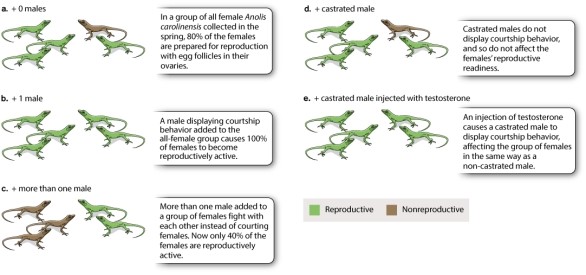
A)If Anolis carolinensis female lizards are housed in a laboratory under a spring light-dark cycle, they prepare for reproduction and 80% of the individuals have active egg follicles in the ovary.
B)In Anolis carolinensis lizards, if a single male is added to an all-female population under a spring light-dark cycle, then 100% have active egg follicles.
C)In Anolis carolinensis lizards, if a group of males is added to an all-female population, males become more interested in fighting than in mating and do not court.
D)If the courtship stimulus is not present, then ovarian development rate increases in Anolis carolinensis lizards.
E)In Anolis carolinensis lizards, castrated males, which do not produce testosterone, have no effect on rates of ovarian development in females.
A)If Anolis carolinensis female lizards are housed in a laboratory under a spring light-dark cycle, they prepare for reproduction and 80% of the individuals have active egg follicles in the ovary.
B)In Anolis carolinensis lizards, if a single male is added to an all-female population under a spring light-dark cycle, then 100% have active egg follicles.
C)In Anolis carolinensis lizards, if a group of males is added to an all-female population, males become more interested in fighting than in mating and do not court.
D)If the courtship stimulus is not present, then ovarian development rate increases in Anolis carolinensis lizards.
E)In Anolis carolinensis lizards, castrated males, which do not produce testosterone, have no effect on rates of ovarian development in females.
Question
Question
Refer to Figure 45.8, below. Which of the statements below about foraging behavior is NOT correct? 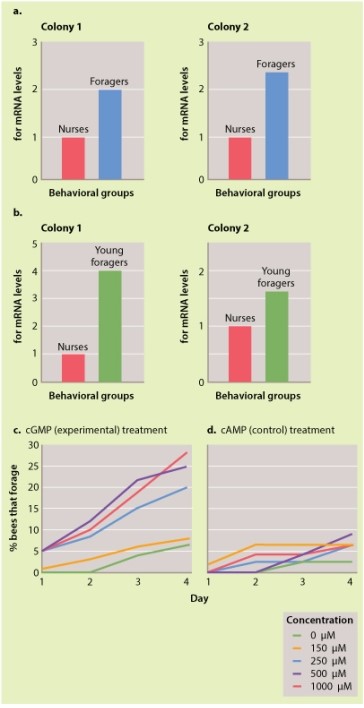
A)Levels of for mRNA are significantly higher in foragers compared to nurses.
B)cGMP and cAMP, cyclic nucleotides, were used as activators of cGMP-dependent protein kinase.
C)cGMP but not cAMP was capable of activating kinase in nurse bees who then showed a significant increase in foraging behavior.
D)cAMP was capable of activating a kinase that increased nurse bee behavior in foragers.
E)The increase in nurse bee foraging was directly related to the dose of cGMP.
A)Levels of for mRNA are significantly higher in foragers compared to nurses.
B)cGMP and cAMP, cyclic nucleotides, were used as activators of cGMP-dependent protein kinase.
C)cGMP but not cAMP was capable of activating kinase in nurse bees who then showed a significant increase in foraging behavior.
D)cAMP was capable of activating a kinase that increased nurse bee behavior in foragers.
E)The increase in nurse bee foraging was directly related to the dose of cGMP.
Question
Question
Question
Question
Question
Question
Question
Question
Question
Question
Question
Question
Question
Question
Question
Question
Question
Question
Question
Question
Question
Question
Question
Question
Question
Question
Question
Question

Unlock Deck
Sign up to unlock the cards in this deck!
Unlock Deck
Unlock Deck
1/186

Play

Full screen (f)
Deck 45: Animal Behavior
1
During their lifetime, many female birds establish a pair bond with a single male with whom they build a nest and rear young. Many of those females, however, also copulate with other males outside the pair bond; the young they raise are fathered by more than one male. If we want to understand the role of genes and the environment in shaping this behavior, we want to understand its:
A)causation.
B)development.
C)adaptive function.
D)evolutionary history.
E)genetic basis.
A)causation.
B)development.
C)adaptive function.
D)evolutionary history.
E)genetic basis.
B
2
Many female birds establish a pair bond with a single male with whom they build a nest and rear young. Many of those females, however, also copulate with other males outside the pair bond; the young they raise are fathered by more than one male. If we want to understand how this behavior originated and how it may have changed over time, we want to understand its:
A)causation.
B)development.
C)adaptive function.
D)evolutionary history.
E)genetic basis.
A)causation.
B)development.
C)adaptive function.
D)evolutionary history.
E)genetic basis.
D
3
Stimulus recognition is carried out by _____, specialized sensory receptors or groups of sensory receptors.
A)feature detectors
B)hormone receptors
C)key stimuli
D)supernormal stimuli
E)fixed action pattern
A)feature detectors
B)hormone receptors
C)key stimuli
D)supernormal stimuli
E)fixed action pattern
A
4
Male Australian bowerbirds build and decorate elaborate structures, called bowers, out of grasses and other vegetation. If we want to understand the physiological mechanism behind this behavior, we want to understand its:
A)causation.
B)development.
C)adaptive function.
D)evolutionary history.
E)causation and development.
A)causation.
B)development.
C)adaptive function.
D)evolutionary history.
E)causation and development.
Unlock Deck
Unlock for access to all 186 flashcards in this deck.
Unlock Deck
k this deck
5
Male peacocks have tail feathers that make up about 60% of their body length. During the mating season they contract muscles to shake these feathers in front of females; females evaluate the feather rustling as part of selecting their mate. The _____ is the mechanistic cause of this behavior; the _____ is the adaptive function of this behavior.
A)mate choice; ability to shake the tail
B)ability to shake the tail; mate choice
C)female evaluation of the behavior; ability to shake the tail
D)ability to shake the tail; female evaluation of the behavior
A)mate choice; ability to shake the tail
B)ability to shake the tail; mate choice
C)female evaluation of the behavior; ability to shake the tail
D)ability to shake the tail; female evaluation of the behavior
Unlock Deck
Unlock for access to all 186 flashcards in this deck.
Unlock Deck
k this deck
6
A researcher is trying to determine the role that genes play in social grooming in apes (where one individual will pick insects or parasites off another). This researcher is asking a question under which of Tinbergen's classifications?
A)causation
B)development
C)adaptive function
D)evolutionary history
E)This question would relate to all of Tinbergen's classifications.
A)causation
B)development
C)adaptive function
D)evolutionary history
E)This question would relate to all of Tinbergen's classifications.
Unlock Deck
Unlock for access to all 186 flashcards in this deck.
Unlock Deck
k this deck
7
From the moment that a behavior appears in a population, that behavior is always used for a certain function or purpose.
Unlock Deck
Unlock for access to all 186 flashcards in this deck.
Unlock Deck
k this deck
8
If bird song promotes an individual's ability to attract a mate and reproduce, then the song has a(n) _____ function.
A)causative
B)adaptive
C)mechanistic
D)assumptive
E)historical
A)causative
B)adaptive
C)mechanistic
D)assumptive
E)historical
Unlock Deck
Unlock for access to all 186 flashcards in this deck.
Unlock Deck
k this deck
9
When studying animal behavior, the mechanistic approaches that are used to evaluate causation and development are more useful than using an analysis of adaptive functions and evolutionary history.
Unlock Deck
Unlock for access to all 186 flashcards in this deck.
Unlock Deck
k this deck
10
Male peacocks have tail feathers that make up about 60% of their body length. During the mating season they shake these feathers in front of females. Longer feathers produce a larger volume of rustling sound for a given shaking rate, but they are also heavier, and thus require more energy to shake at a given rate than shorter feathers. This suggests that:
A)selective pressures will continue selection for longer and longer peacock tails.
B)selective pressures will always result in shorter peacock tails to reduce the energetic cost of shaking.
C)feather length is a compromise between the conflicting selective pressures against too long or too short of a tail.
D)tail length is completely random because there are selective pressures both for and against longer tails.
A)selective pressures will continue selection for longer and longer peacock tails.
B)selective pressures will always result in shorter peacock tails to reduce the energetic cost of shaking.
C)feather length is a compromise between the conflicting selective pressures against too long or too short of a tail.
D)tail length is completely random because there are selective pressures both for and against longer tails.
Unlock Deck
Unlock for access to all 186 flashcards in this deck.
Unlock Deck
k this deck
11
Imagine that you have a cat that is purring on your lap. Which of the following questions would Niko Tinbergen ask about this behavior?
A)Is there any relationship between the cat's larynx and purring? Does air move over the cat's larynx in a specific way to produce a "purr"?
B)Why did purring first evolve in cats? Was this behavior initially used by cat ancestors to attract mates? To communicate between female cats and their kittens?
C)Do cats that purr have a greater rate of survival than those that don't? Does purring in cats serve any reproductive purpose?
D)How many genes-if any-direct purring behavior in cats? Do cats learn to purr from their maternal parent? Their paternal parent?
E)Tinbergen would ask all of these questions regarding purring in cats.
A)Is there any relationship between the cat's larynx and purring? Does air move over the cat's larynx in a specific way to produce a "purr"?
B)Why did purring first evolve in cats? Was this behavior initially used by cat ancestors to attract mates? To communicate between female cats and their kittens?
C)Do cats that purr have a greater rate of survival than those that don't? Does purring in cats serve any reproductive purpose?
D)How many genes-if any-direct purring behavior in cats? Do cats learn to purr from their maternal parent? Their paternal parent?
E)Tinbergen would ask all of these questions regarding purring in cats.
Unlock Deck
Unlock for access to all 186 flashcards in this deck.
Unlock Deck
k this deck
12
Male Australian bowerbirds build and decorate elaborate structures, called bowers, out of grasses and other vegetation. If we want to understand how this behavior promotes a male bowerbird's ability to survive and reproduce, we want to understand its:
A)causation.
B)development.
C)adaptive function.
D)evolutionary history.
E)genetic basis.
A)causation.
B)development.
C)adaptive function.
D)evolutionary history.
E)genetic basis.
Unlock Deck
Unlock for access to all 186 flashcards in this deck.
Unlock Deck
k this deck
13
Which of the answers below best describes the class of questions that Insel and Young were addressing when they studied the effect of antidiuretic hormone on monogamous voles by experimentally increasing the number of receptors in the brain?
A)ultimate; mechanistic
B)ultimate; survival-value/adaptation
C)proximate; survival-value/adaptation
D)ultimate; developmental/ontogenetic
E)proximate; mechanistic
A)ultimate; mechanistic
B)ultimate; survival-value/adaptation
C)proximate; survival-value/adaptation
D)ultimate; developmental/ontogenetic
E)proximate; mechanistic
Unlock Deck
Unlock for access to all 186 flashcards in this deck.
Unlock Deck
k this deck
14
Male peacocks have tail feathers that make up 60% of their body length. During the mating season they fan their tails and shake these feathers in front of females. Females evaluate the tail-shaking behavior as part of selecting their mate. Which of the behaviors below is most likely to have been the original behavior that, through natural selection, resulted in this mate choice behavior of tail shaking?
A)flight
B)sound production with the larynx
C)grooming feathers with the beak
D)involuntary muscle contraction like shivering
E)head movement to make eye contact
A)flight
B)sound production with the larynx
C)grooming feathers with the beak
D)involuntary muscle contraction like shivering
E)head movement to make eye contact
Unlock Deck
Unlock for access to all 186 flashcards in this deck.
Unlock Deck
k this deck
15
Questions of causation and development are _____ explanations of behavior.
A)mechanistic
B)evolutionary
C)innate
D)learned
A)mechanistic
B)evolutionary
C)innate
D)learned
Unlock Deck
Unlock for access to all 186 flashcards in this deck.
Unlock Deck
k this deck
16
Some types of fish have specialized cells called electrocytes that generate an electric field around their body, with which they can communicate with other individuals of their own species. The electrocytes become functional when specialized Na+ channels are inserted into their plasma membrane. Because sodium channels are proteins, we can conclude that the behavior of generating an electrical field for communication:
A)has a genetic basis because proteins are produced through gene expression.
B)is a learned behavior.
C)is dependent on environmental conditions.
D)does not change regardless of input from the environment.
E)does not have a genetic basis because proteins are produced independent of the genome.
A)has a genetic basis because proteins are produced through gene expression.
B)is a learned behavior.
C)is dependent on environmental conditions.
D)does not change regardless of input from the environment.
E)does not have a genetic basis because proteins are produced independent of the genome.
Unlock Deck
Unlock for access to all 186 flashcards in this deck.
Unlock Deck
k this deck
17
Which of the following is one of Tinbergen's questions?
A)What is the cause of a certain behavior?
B)How does a certain behavior develop (i.e., through learning or genes)?
C)Does a behavior have any adaptive function?
D)What is the evolutionary history of a behavior?
E)All of these choices are correct.
A)What is the cause of a certain behavior?
B)How does a certain behavior develop (i.e., through learning or genes)?
C)Does a behavior have any adaptive function?
D)What is the evolutionary history of a behavior?
E)All of these choices are correct.
Unlock Deck
Unlock for access to all 186 flashcards in this deck.
Unlock Deck
k this deck
18
Golden-collared manakin birds perform an elaborate mating dance that includes jumping on perches and repeatedly hitting their wings together to make a popping noise. Data suggest that females select the fastest jumpers and those that make the popping noise more rapidly for mating. The _____ is the mechanistic explanation of this behavior; the _____ is the adaptive function of this behavior.
A)mate choice; ability to jump
B)ability to jump; mate choice
C)female evaluation of the behavior; ability to jump
D)ability to jump; female evaluation of the behavior
A)mate choice; ability to jump
B)ability to jump; mate choice
C)female evaluation of the behavior; ability to jump
D)ability to jump; female evaluation of the behavior
Unlock Deck
Unlock for access to all 186 flashcards in this deck.
Unlock Deck
k this deck
19
Which of the following mechanisms is a causal explanation for bird song?
A)Young males learned their song from their fathers.
B)Songs are used by males to attract a mate.
C)The ritualization of the vocalization became species-specific.
D)Air passing through a bird's specialized singing organ, the syrinx, vibrates the surrounding organs.
A)Young males learned their song from their fathers.
B)Songs are used by males to attract a mate.
C)The ritualization of the vocalization became species-specific.
D)Air passing through a bird's specialized singing organ, the syrinx, vibrates the surrounding organs.
Unlock Deck
Unlock for access to all 186 flashcards in this deck.
Unlock Deck
k this deck
20
According to Niko Tinbergen, which of the following defines-and helps researchers understand-an animal's behavior?
A)adaptive function
B)causation
C)development
D)evolutionary history
E)All of these choices are correct.
A)adaptive function
B)causation
C)development
D)evolutionary history
E)All of these choices are correct.
Unlock Deck
Unlock for access to all 186 flashcards in this deck.
Unlock Deck
k this deck
21
The ability to process information from the environment:
A)is a trait unique to multicellular organisms.
B)is a trait unique to eukaryotes.
C)requires a brain and spinal cord.
D)is characteristic of all types of organisms.
E)is unique to primates.
A)is a trait unique to multicellular organisms.
B)is a trait unique to eukaryotes.
C)requires a brain and spinal cord.
D)is characteristic of all types of organisms.
E)is unique to primates.
Unlock Deck
Unlock for access to all 186 flashcards in this deck.
Unlock Deck
k this deck
22
A fixed action pattern is a sequence of behaviors that, once triggered, is followed to completion.
Unlock Deck
Unlock for access to all 186 flashcards in this deck.
Unlock Deck
k this deck
23
_____ behaviors are instinctive and carried out regardless of earlier experience.
A)Innate
B)Learned
C)Imitated
D)Imprinted
A)Innate
B)Learned
C)Imitated
D)Imprinted
Unlock Deck
Unlock for access to all 186 flashcards in this deck.
Unlock Deck
k this deck
24
Males of different species of field crickets have specific songs. Females typically only respond to males exhibiting their species-specific calls, however hybrids can form. Hybrid females will choose hybrid males that sing a hybrid song that has components of the songs from both parental species. Females of either parent species will not choose males that sing a hybrid song. Which of the following statements is the MOST likely reason for differential responses to calls in non-hybrid and hybrid females?
A)The songs have a genetic basis and females respond to any calls they have heard while growing up.
B)The songs have a genetic basis and females respond to the calls based on specialized sensory receptors that result in recognition of their conspecifics' call.
C)The songs have no genetic basis and females respond to the calls they have learned from being around other conspecifics.
D)The songs have no genetic basis and females respond to the calls based on specialized sensory receptors that result in recognition of their conspecifics' call.
A)The songs have a genetic basis and females respond to any calls they have heard while growing up.
B)The songs have a genetic basis and females respond to the calls based on specialized sensory receptors that result in recognition of their conspecifics' call.
C)The songs have no genetic basis and females respond to the calls they have learned from being around other conspecifics.
D)The songs have no genetic basis and females respond to the calls based on specialized sensory receptors that result in recognition of their conspecifics' call.
Unlock Deck
Unlock for access to all 186 flashcards in this deck.
Unlock Deck
k this deck
25
Which of the following BEST describes the genetic basis of behavior?
A)All behaviors are influenced by many genes.
B)Most behaviors are strongly influenced by a single gene.
C)Most behaviors have no genetic basis at all.
D)Most behaviors are influenced by many genes, and a few behaviors are strongly influenced by a single gene.
E)A few behaviors are influenced by many genes, and most behaviors are strongly influenced by a single gene.
A)All behaviors are influenced by many genes.
B)Most behaviors are strongly influenced by a single gene.
C)Most behaviors have no genetic basis at all.
D)Most behaviors are influenced by many genes, and a few behaviors are strongly influenced by a single gene.
E)A few behaviors are influenced by many genes, and most behaviors are strongly influenced by a single gene.
Unlock Deck
Unlock for access to all 186 flashcards in this deck.
Unlock Deck
k this deck
26
Instinctive behaviors that are carried out regardless of earlier experience are called _____ behaviors and are a product of an individual's genotype.
A)innate
B)learned
C)nurtured
D)habituated
E)operant
A)innate
B)learned
C)nurtured
D)habituated
E)operant
Unlock Deck
Unlock for access to all 186 flashcards in this deck.
Unlock Deck
k this deck
27
What characteristic associated with male Anolis lizards caused a change in behavior in female Anolis lizards?
A)testosterone only
B)testosterone that causes courting behavior in males
C)testosterone that causes males to fight with each other
D)the presence of males, regardless of their behavior
A)testosterone only
B)testosterone that causes courting behavior in males
C)testosterone that causes males to fight with each other
D)the presence of males, regardless of their behavior
Unlock Deck
Unlock for access to all 186 flashcards in this deck.
Unlock Deck
k this deck
28
A behavior is shaped by:
A)environmental factors.
B)genetic factors.
C)both environmental and genetic factors.
A)environmental factors.
B)genetic factors.
C)both environmental and genetic factors.
Unlock Deck
Unlock for access to all 186 flashcards in this deck.
Unlock Deck
k this deck
29
Some types of fish can generate an electric field around their body to communicate with other individuals of the same species (like vocalization in birds). The electric field is generated by cells called electrocytes, which are modified muscle cells. This reflects the fact that:
A)physiological mechanisms are the basis of behaviors.
B)behaviors are influenced by the environment.
C)there is a genetic basis to many behaviors.
D)behaviors develop over time.
A)physiological mechanisms are the basis of behaviors.
B)behaviors are influenced by the environment.
C)there is a genetic basis to many behaviors.
D)behaviors develop over time.
Unlock Deck
Unlock for access to all 186 flashcards in this deck.
Unlock Deck
k this deck
30
Some types of fish have specialized cells called electrocytes that generate an electric field around their body with which the fish can communicate with other individuals of the same species and can stun prey. Researchers noticed that electrocytes generated more current when blood levels of a hormone called ACTH were high. Which of the following hypotheses BEST reflects that observation?
A)Increasing levels of ACTH increase current production by electrocytes.
B)Current production by electrocytes is independent of ACTH levels.
C)Increasing levels of ACTH decrease current production by electrocytes.
D)Current production by electrocytes is dependent on ACTH levels.
A)Increasing levels of ACTH increase current production by electrocytes.
B)Current production by electrocytes is independent of ACTH levels.
C)Increasing levels of ACTH decrease current production by electrocytes.
D)Current production by electrocytes is dependent on ACTH levels.
Unlock Deck
Unlock for access to all 186 flashcards in this deck.
Unlock Deck
k this deck
31
Cuckoo chicks manipulate the host parent by a number of strategies, one of which involves producing a call that mimics the call of an entire clutch of nestlings: This causes the host parent to feed it more. In this context, the call of the cuckoo is BEST described as a(n):
A)feature detector.
B)supernormal stimulus.
C)fixed action pattern.
D)associatively learned trait.
E)ancestral trait.
A)feature detector.
B)supernormal stimulus.
C)fixed action pattern.
D)associatively learned trait.
E)ancestral trait.
Unlock Deck
Unlock for access to all 186 flashcards in this deck.
Unlock Deck
k this deck
32
Many squirrel species cache food for consumption later. Even squirrels of a young age are able to dig and bury food, even if they have never watched another member of their species bury food. They are able to retrieve food that is buried very well, and it is thought they use landmarks around the burial site of the food to return to that spot and find their food. Based on this description, the burial of food is a(n) _____ behavior, and the retrieval of food is _____.
A)innate; innate
B)learned; learned
C)innate; learned
D)learned; innate
E)innate; a conditioned response
A)innate; innate
B)learned; learned
C)innate; learned
D)learned; innate
E)innate; a conditioned response
Unlock Deck
Unlock for access to all 186 flashcards in this deck.
Unlock Deck
k this deck
33
Displays are patterns of behavior that:
A)are species-specific.
B)are highly repeatable.
C)function as signals.
D)are species-specific and function as signals.
E)are species-specific, are highly stereotyped, and function as signals.
A)are species-specific.
B)are highly repeatable.
C)function as signals.
D)are species-specific and function as signals.
E)are species-specific, are highly stereotyped, and function as signals.
Unlock Deck
Unlock for access to all 186 flashcards in this deck.
Unlock Deck
k this deck
34
_____ behavior corresponds to an animal's "nature"; _____ behavior corresponds to its "nurture."
A)Innate; learned
B)Learned; innate
C)Innate; imprinted
D)Imprinted; innate
A)Innate; learned
B)Learned; innate
C)Innate; imprinted
D)Imprinted; innate
Unlock Deck
Unlock for access to all 186 flashcards in this deck.
Unlock Deck
k this deck
35
Some types of fish have specialized cells called electrocytes that generate an electric field around their body with which they communicate with other individuals of the same species and can stun prey. Researchers hypothesized that electrocytes produce the electric field in response to blood levels of a hormone called ACTH, and that it was a positive relationship (higher levels of hormone results in a stronger electric field). Which of the experiments below is the MOST direct test of this hypothesis?
A)While measuring the strength of a fish's electric field, inject it with ACTH.
B)Take a blood sample from a fish that is producing a strong electric field; inject the blood into a second fish and measure its electric field strength.
C)Take a blood sample from a fish that is producing a strong electric field and measure the ACTH levels.
D)Remove the pituitary gland, which secretes ACTH, from a fish and measure its electric field strength.
E)While measuring the strength of a fish's electric field, inject it with a saline solution.
A)While measuring the strength of a fish's electric field, inject it with ACTH.
B)Take a blood sample from a fish that is producing a strong electric field; inject the blood into a second fish and measure its electric field strength.
C)Take a blood sample from a fish that is producing a strong electric field and measure the ACTH levels.
D)Remove the pituitary gland, which secretes ACTH, from a fish and measure its electric field strength.
E)While measuring the strength of a fish's electric field, inject it with a saline solution.
Unlock Deck
Unlock for access to all 186 flashcards in this deck.
Unlock Deck
k this deck
36
In an expedition to a remote part of South America, you find two very closely related rodent species which build very different burrows: one is shaped like a corkscrew and the other is straight. Describe an experiment you would do to determine whether or not this burrowing pattern is a learned or an innate behavior.
Unlock Deck
Unlock for access to all 186 flashcards in this deck.
Unlock Deck
k this deck
37
Imagine a frog at a pond where multiple species are mating. Female frogs are able to discern males making their species-specific calls. How is she able to do this?
A)The visual cues of a male frog from her species allows her to go directly to that male.
B)The olfactory cues from a male frog of her species allows her to go directly to that male.
C)The female only hears calls from a male frog of her species, which results in her going to a male frog of her species.
D)The female frog hears all of the calls at the pond, but only male calls from her species excite a specific group of neurons which results in her going to a male frog of her species.
A)The visual cues of a male frog from her species allows her to go directly to that male.
B)The olfactory cues from a male frog of her species allows her to go directly to that male.
C)The female only hears calls from a male frog of her species, which results in her going to a male frog of her species.
D)The female frog hears all of the calls at the pond, but only male calls from her species excite a specific group of neurons which results in her going to a male frog of her species.
Unlock Deck
Unlock for access to all 186 flashcards in this deck.
Unlock Deck
k this deck
38
Certain species of digger wasps will dig a central channel straight down underground. After that they will dig a chamber off to the side where they will leave a cricket they have paralyzed to feed developing larvae. After the wasp hunts and captures a cricket, she paralyzes it and brings it back to the burrow. She will leave it a fixed distance from the burrow entrance and go down in her burrow to inspect the chamber one more time before bringing the cricket down. If an observer moves the cricket any distance from where she left it, she will place it at the same fixed distance from the burrow entrance and again go down to inspect the chamber before going back up to retrieve the cricket. This can go on for many iterations. This pattern of behavior is BEST described as a:
A)supernormal stimulus.
B)operant conditioning.
C)fixed action pattern.
D)learning.
A)supernormal stimulus.
B)operant conditioning.
C)fixed action pattern.
D)learning.
Unlock Deck
Unlock for access to all 186 flashcards in this deck.
Unlock Deck
k this deck
39
The trigger for a fixed action pattern is called the:
A)key stimulus.
B)signal.
C)releaser.
D)instigator.
A)key stimulus.
B)signal.
C)releaser.
D)instigator.
Unlock Deck
Unlock for access to all 186 flashcards in this deck.
Unlock Deck
k this deck
40
In an expedition to a remote part of South America, you find two very closely related rodent species that build very different burrows: one is shaped like a corkscrew and the other is straight. You cross individuals from the two species and observe their burrow-building behavior. Which of the following observations would allow you to conclude that this is an innate rather than a learned behavior?
A)Offspring make a burrow similar to that of their closest neighbor in the habitat.
B)Offspring make intermediate burrows that resemble those of neither parent.
C)Offspring make a burrow that is easiest to dig in the soil where they live.
D)Offspring make a burrow that is hardest for local predators to invade.
A)Offspring make a burrow similar to that of their closest neighbor in the habitat.
B)Offspring make intermediate burrows that resemble those of neither parent.
C)Offspring make a burrow that is easiest to dig in the soil where they live.
D)Offspring make a burrow that is hardest for local predators to invade.
Unlock Deck
Unlock for access to all 186 flashcards in this deck.
Unlock Deck
k this deck
41
Which of the statements below about antidiuretic hormone (ADH) in prairie and montane voles is NOT correct?
A)The receptor for ADH is found in the kidney where it contributes to water conservation and in the brain where it influences behavior.
B)Both the prairie vole and the montane vole produce ADH.
C)The ADH receptor differs between the prairie vole and the montane vole.
D)The ADH gene with its distinct regulatory region was taken from the prairie vole and inserted into a promiscuous mouse species. The mouse then became promiscuous.
E)The regulatory sequence and ADH coding region of the prairie vole was inserted into a promiscuous mouse species which then became more likely to pair bond.
A)The receptor for ADH is found in the kidney where it contributes to water conservation and in the brain where it influences behavior.
B)Both the prairie vole and the montane vole produce ADH.
C)The ADH receptor differs between the prairie vole and the montane vole.
D)The ADH gene with its distinct regulatory region was taken from the prairie vole and inserted into a promiscuous mouse species. The mouse then became promiscuous.
E)The regulatory sequence and ADH coding region of the prairie vole was inserted into a promiscuous mouse species which then became more likely to pair bond.
Unlock Deck
Unlock for access to all 186 flashcards in this deck.
Unlock Deck
k this deck
42
If the receptors for pheromones are activated, a mating will be guaranteed.
Unlock Deck
Unlock for access to all 186 flashcards in this deck.
Unlock Deck
k this deck
43
Frogs have evolved highly specific sensory receptors for different components of their own species-specific calls. In fact, each auditory nerve is "tuned" to be maximally responsive to distinct features of the call.
Unlock Deck
Unlock for access to all 186 flashcards in this deck.
Unlock Deck
k this deck
44
In the silkworm moth, Bombyx:
A)pheromones are released by the female so she can follow the trail back to where she lives.
B)pheromones are released by the female and a male can follow the trail to find a mate.
C)pheromones are released by the male so that he can follow his trail back to the same female multiple times.
D)pheromones are released by the male so that females can follow the trail to find a mate.
A)pheromones are released by the female so she can follow the trail back to where she lives.
B)pheromones are released by the female and a male can follow the trail to find a mate.
C)pheromones are released by the male so that he can follow his trail back to the same female multiple times.
D)pheromones are released by the male so that females can follow the trail to find a mate.
Unlock Deck
Unlock for access to all 186 flashcards in this deck.
Unlock Deck
k this deck
45
Differences in mating patterns of montane and prairie voles (promiscuous and monogamous, respectively) can be attributed to expression of a specific hormone receptor in certain cells of the brain. If researchers inserted this receptor's gene (and regulatory regions) so it was expressed in appropriate cells of the montane vole, which of the following would MOST likely occur?
A)Montane voles would remain promiscuous, because they express a gene for promiscuity.
B)Montane voles would become monogamous, because they would be able to receive hormone signals in the same way as prairie voles.
C)Montane voles would be promiscuous some of the time, and monogamous the rest of the time depending on the female vole.
D)Montane voles would not mate because the monogamy gene would cancel out the promiscuity gene.
A)Montane voles would remain promiscuous, because they express a gene for promiscuity.
B)Montane voles would become monogamous, because they would be able to receive hormone signals in the same way as prairie voles.
C)Montane voles would be promiscuous some of the time, and monogamous the rest of the time depending on the female vole.
D)Montane voles would not mate because the monogamy gene would cancel out the promiscuity gene.
Unlock Deck
Unlock for access to all 186 flashcards in this deck.
Unlock Deck
k this deck
46
Like Drosophila larva, the feeding behavior of honeybees also depends on the expression of the for gene. This suggests that this gene has been evolutionarily conserved.
Unlock Deck
Unlock for access to all 186 flashcards in this deck.
Unlock Deck
k this deck
47
Courtship displays are behaviors that will not be performed if members of a species have been raised in isolation.
Unlock Deck
Unlock for access to all 186 flashcards in this deck.
Unlock Deck
k this deck
48
Which of the sentences below best supports the claim that natural selection has shaped a species-specific behavior?
A)An individual avoids certain locations or substances associated with negative experiences.
B)A male responds to a female-produced pheromone.
C)Humans acquire a specific language.
D)Threatening silhouettes provoke defensive, crouching postures in chicks.
A)An individual avoids certain locations or substances associated with negative experiences.
B)A male responds to a female-produced pheromone.
C)Humans acquire a specific language.
D)Threatening silhouettes provoke defensive, crouching postures in chicks.
Unlock Deck
Unlock for access to all 186 flashcards in this deck.
Unlock Deck
k this deck
49
An airborne chemical that is used to communicate with members of the same species is called a:
A)paracrine signal.
B)growth factor.
C)pheromone.
D)supernormal stimulus.
E)neurotransmitter.
A)paracrine signal.
B)growth factor.
C)pheromone.
D)supernormal stimulus.
E)neurotransmitter.
Unlock Deck
Unlock for access to all 186 flashcards in this deck.
Unlock Deck
k this deck
50
Refer to Figure 45.5. Which of the statements below about sex-specific behaviors in Anolis carolinensis lizards is NOT correct?
A)If Anolis carolinensis female lizards are housed in a laboratory under a spring light-dark cycle, they prepare for reproduction and 80% of the individuals have active egg follicles in the ovary.
B)In Anolis carolinensis lizards, if a single male is added to an all-female population under a spring light-dark cycle, then 100% have active egg follicles.
C)In Anolis carolinensis lizards, if a group of males is added to an all-female population, males become more interested in fighting than in mating and do not court.
D)If the courtship stimulus is not present, then ovarian development rate increases in Anolis carolinensis lizards.
E)In Anolis carolinensis lizards, castrated males, which do not produce testosterone, have no effect on rates of ovarian development in females.
A)If Anolis carolinensis female lizards are housed in a laboratory under a spring light-dark cycle, they prepare for reproduction and 80% of the individuals have active egg follicles in the ovary.
B)In Anolis carolinensis lizards, if a single male is added to an all-female population under a spring light-dark cycle, then 100% have active egg follicles.
C)In Anolis carolinensis lizards, if a group of males is added to an all-female population, males become more interested in fighting than in mating and do not court.
D)If the courtship stimulus is not present, then ovarian development rate increases in Anolis carolinensis lizards.
E)In Anolis carolinensis lizards, castrated males, which do not produce testosterone, have no effect on rates of ovarian development in females.
Unlock Deck
Unlock for access to all 186 flashcards in this deck.
Unlock Deck
k this deck
51
Patterns of behavior that are species-specific and highly repeatable are called displays and are an example of a(n) _____ pattern.
A)key
B)nurture
C)fixed-action
D)supernormal
E)operant
A)key
B)nurture
C)fixed-action
D)supernormal
E)operant
Unlock Deck
Unlock for access to all 186 flashcards in this deck.
Unlock Deck
k this deck
52
Refer to Figure 45.8, below. Which of the statements below about foraging behavior is NOT correct?
A)Levels of for mRNA are significantly higher in foragers compared to nurses.
B)cGMP and cAMP, cyclic nucleotides, were used as activators of cGMP-dependent protein kinase.
C)cGMP but not cAMP was capable of activating kinase in nurse bees who then showed a significant increase in foraging behavior.
D)cAMP was capable of activating a kinase that increased nurse bee behavior in foragers.
E)The increase in nurse bee foraging was directly related to the dose of cGMP.
A)Levels of for mRNA are significantly higher in foragers compared to nurses.
B)cGMP and cAMP, cyclic nucleotides, were used as activators of cGMP-dependent protein kinase.
C)cGMP but not cAMP was capable of activating kinase in nurse bees who then showed a significant increase in foraging behavior.
D)cAMP was capable of activating a kinase that increased nurse bee behavior in foragers.
E)The increase in nurse bee foraging was directly related to the dose of cGMP.
Unlock Deck
Unlock for access to all 186 flashcards in this deck.
Unlock Deck
k this deck
53
Most genetically controlled behaviors are the product of the expression patterns of multiple genes.
Unlock Deck
Unlock for access to all 186 flashcards in this deck.
Unlock Deck
k this deck
54
Stimulus recognition is often carried out by specialized sensory receptors called _____ detectors.
A)operant
B)conditional
C)feature
D)innate
E)habituation
A)operant
B)conditional
C)feature
D)innate
E)habituation
Unlock Deck
Unlock for access to all 186 flashcards in this deck.
Unlock Deck
k this deck
55
Most human behaviors are a product of both nature and nurture, but this does not apply to neurologically relatively simple organisms such as the fruit fly.
Unlock Deck
Unlock for access to all 186 flashcards in this deck.
Unlock Deck
k this deck
56
In order to attract the opposite sex, sensory hairs in the silkworm moth, Bombyx, allow ion channel receptors to open, and ultimately electrical signals are conducted as action potentials following a response to airborne chemicals.
Unlock Deck
Unlock for access to all 186 flashcards in this deck.
Unlock Deck
k this deck
57
Which of the statements below about hormone effects on behavior is NOT true?
A)Most hormones are secreted into the circulation and thus have wide-ranging targets.
B)Hormones can affect multiple cells in the target simultaneously.
C)Compared to hormone action, neurons are much less specific in their actions.
D)Target tissues must have receptors for a particular hormone in order for a response to be elicited.
E)Hormone-mediated responses may be different between the sexes.
A)Most hormones are secreted into the circulation and thus have wide-ranging targets.
B)Hormones can affect multiple cells in the target simultaneously.
C)Compared to hormone action, neurons are much less specific in their actions.
D)Target tissues must have receptors for a particular hormone in order for a response to be elicited.
E)Hormone-mediated responses may be different between the sexes.
Unlock Deck
Unlock for access to all 186 flashcards in this deck.
Unlock Deck
k this deck
58
You observe a chimpanzee using a stick to dig termites from a nest. How could you determine if this digging behavior is learned or innate?
A)Take the stick away and see if the chimp picks up another one.
B)Show the chimp termite mounds of different sizes and see which one he or she chooses for digging.
C)Provide the chimp with lots of different foods and see if he or she still digs for termites.
D)Raise chimps in isolation from other chimps and see if the chimps still exhibit the behavior.
E)Raise chimps in groups and see if the chimps still exhibit the behavior.
A)Take the stick away and see if the chimp picks up another one.
B)Show the chimp termite mounds of different sizes and see which one he or she chooses for digging.
C)Provide the chimp with lots of different foods and see if he or she still digs for termites.
D)Raise chimps in isolation from other chimps and see if the chimps still exhibit the behavior.
E)Raise chimps in groups and see if the chimps still exhibit the behavior.
Unlock Deck
Unlock for access to all 186 flashcards in this deck.
Unlock Deck
k this deck
59
Behavioral variation between species may be attributed to differential responses to the same hormone.
Unlock Deck
Unlock for access to all 186 flashcards in this deck.
Unlock Deck
k this deck
60
Which of the statements below about the behavioral effects governed by forS and forR in Drosophila is NOT correct?
A)The for gene encodes a cGMP-dependent protein kinase.
B)This enzyme phosphorylates target proteins in the brain and affects neuronal activity.
C)In the absence of food, both sitters and rovers move about in search of food.
D)In the presence of food, sitters remain stationary and eat, whereas the rovers move all around the food and eat.
E)The sitter behavior is not adaptive because foragers will obtain all the food from the surrounding environment.
A)The for gene encodes a cGMP-dependent protein kinase.
B)This enzyme phosphorylates target proteins in the brain and affects neuronal activity.
C)In the absence of food, both sitters and rovers move about in search of food.
D)In the presence of food, sitters remain stationary and eat, whereas the rovers move all around the food and eat.
E)The sitter behavior is not adaptive because foragers will obtain all the food from the surrounding environment.
Unlock Deck
Unlock for access to all 186 flashcards in this deck.
Unlock Deck
k this deck
61
You observe a chimpanzee using a stick to dig termites from a nest. The chimpanzee then eats the termites. This type of behavior is an example of _____; the termites are the _____.
A)non-associative learning; stimulus
B)habituation; signal
C)sensitization; second stimulus
D)classical conditioning; neutral stimulus
E)operant conditioning; reward
A)non-associative learning; stimulus
B)habituation; signal
C)sensitization; second stimulus
D)classical conditioning; neutral stimulus
E)operant conditioning; reward
Unlock Deck
Unlock for access to all 186 flashcards in this deck.
Unlock Deck
k this deck
62
You observe two populations of chimpanzees using sticks to dig termites out from nests for food. One population uses long sticks; the second population uses short sticks. Which of the following observations would NOT support the hypothesis that the choice of stick length is a learned behavior?
A)There are equal numbers of short and long sticks in the environment of each population.
B)The population using long sticks has mostly long sticks in its environment.
C)The chimpanzees using short sticks have obtained them by breaking long sticks.
D)Young chimpanzees in both populations start out using sticks of many different sizes.
E)Individuals that don't use the common stick length for that population catch fewer termites.
A)There are equal numbers of short and long sticks in the environment of each population.
B)The population using long sticks has mostly long sticks in its environment.
C)The chimpanzees using short sticks have obtained them by breaking long sticks.
D)Young chimpanzees in both populations start out using sticks of many different sizes.
E)Individuals that don't use the common stick length for that population catch fewer termites.
Unlock Deck
Unlock for access to all 186 flashcards in this deck.
Unlock Deck
k this deck
63
The enhancement of a response to a stimulus following a novel pre-stimulus is called:
A)sensitization.
B)habituation.
C)imitation.
D)imprinting.
A)sensitization.
B)habituation.
C)imitation.
D)imprinting.
Unlock Deck
Unlock for access to all 186 flashcards in this deck.
Unlock Deck
k this deck
64
Lyre birds have their own species-specific songs that they sing. However, they are also known to produce vocalizations that sound very similar to sounds in their environment-a chainsaw, and a camera shutter opening and closing, for example. Their performance making these types of sounds is the result of:
A)habituation.
B)operant conditioning.
C)classical conditioning.
D)imitation.
A)habituation.
B)operant conditioning.
C)classical conditioning.
D)imitation.
Unlock Deck
Unlock for access to all 186 flashcards in this deck.
Unlock Deck
k this deck
65
As soon as forager honeybees emerge from the hive they go out on their first trip to find food. When they do, they return to the hive and do an appropriate circle or waggle dance to communicate the location of food to other conspecifics in the hive. The performance of the waggle and round dance is an example of what type of behavior in bees?
A)learned
B)fixed action pattern
C)innate
D)habituation
A)learned
B)fixed action pattern
C)innate
D)habituation
Unlock Deck
Unlock for access to all 186 flashcards in this deck.
Unlock Deck
k this deck
66
Lab mice have been used for behavioral studies for many years. One of the most common things mice are exposed to is a maze. Mice that are able to navigate a maze are given a reward when they are finished. After many trials the mouse is able to navigate the maze quickly, and receive a food reward. This is an example of:
A)innate behavior.
B)kin selection.
C)operant conditioning.
D)imprinting.
E)classical conditioning.
A)innate behavior.
B)kin selection.
C)operant conditioning.
D)imprinting.
E)classical conditioning.
Unlock Deck
Unlock for access to all 186 flashcards in this deck.
Unlock Deck
k this deck
67
Imprinting is MOST likely to occur:
A)during any point in an individual's lifetime.
B)when an organism is most at danger.
C)during a critical point in development.
D)when an organism is surrounded by conspecific individuals.
A)during any point in an individual's lifetime.
B)when an organism is most at danger.
C)during a critical point in development.
D)when an organism is surrounded by conspecific individuals.
Unlock Deck
Unlock for access to all 186 flashcards in this deck.
Unlock Deck
k this deck
68
You observe that chimps use sticks to collect termites for food. Which of the following would indicate that the use of the stick is a learned behavior?
A)The chimp is the only member of his or her population that exhibits this behavior.
B)The chimp prefers eating termites to other types of insects.
C)Food is abundant in the chimp's environment.
D)Chimpanzees raised in isolation do not use sticks.
A)The chimp is the only member of his or her population that exhibits this behavior.
B)The chimp prefers eating termites to other types of insects.
C)Food is abundant in the chimp's environment.
D)Chimpanzees raised in isolation do not use sticks.
Unlock Deck
Unlock for access to all 186 flashcards in this deck.
Unlock Deck
k this deck
69
Which of the following observations would suggest that Aplysia does NOT undergo sensitization to a touch stimulus to its siphon?
A)Aplysia withdraws its siphon more rapidly after an initial stimulus.
B)Aplysia withdraws its siphon at the same rate regardless of exposure to an initial stimulus.
C)Aplysia withdraws its siphon in response to local conspecifics withdrawing their siphon.
D)Aplysia stops withdrawing its siphon with repeated stimulus, touching, of the siphon.
A)Aplysia withdraws its siphon more rapidly after an initial stimulus.
B)Aplysia withdraws its siphon at the same rate regardless of exposure to an initial stimulus.
C)Aplysia withdraws its siphon in response to local conspecifics withdrawing their siphon.
D)Aplysia stops withdrawing its siphon with repeated stimulus, touching, of the siphon.
Unlock Deck
Unlock for access to all 186 flashcards in this deck.
Unlock Deck
k this deck
70
Each morning before work a cat owner opens the utensil drawer in the kitchen, grabs the can opener, and then shuts the drawer making a lot of noise. Each morning her new cat would run into the kitchen to be fed. After a few weeks, the cat owner notices that the cat runs into the kitchen whenever she hears the utensil drawer close. This is an example of:
A)operant conditioning.
B)classical conditioning.
C)habituation.
D)sensitization.
A)operant conditioning.
B)classical conditioning.
C)habituation.
D)sensitization.
Unlock Deck
Unlock for access to all 186 flashcards in this deck.
Unlock Deck
k this deck
71
A mouse learns to run the pattern of a maze after multiple attempts. Learning the pattern of the maze is an example of:
A)operant conditioning.
B)classical conditioning.
C)imprinting.
D)innate behavior.
A)operant conditioning.
B)classical conditioning.
C)imprinting.
D)innate behavior.
Unlock Deck
Unlock for access to all 186 flashcards in this deck.
Unlock Deck
k this deck
72
Many farmers place scarecrows out into their fields to keep the crows away. Initially the crows will stay out of the field when they see the "person" in the middle of the field. After a few weeks, the farmer notices the crows are perching in his cornfield. Why didn't placing the scarecrow in the field work over a long period of time?
A)Crows are too smart to be fooled by a scarecrow.
B)Crows will land on anything as long as it doesn't move.
C)Crows have become habituated to the scarecrow and no longer avoid it.
D)Crows grew too hungry and are willing to risk danger in order to eat.
A)Crows are too smart to be fooled by a scarecrow.
B)Crows will land on anything as long as it doesn't move.
C)Crows have become habituated to the scarecrow and no longer avoid it.
D)Crows grew too hungry and are willing to risk danger in order to eat.
Unlock Deck
Unlock for access to all 186 flashcards in this deck.
Unlock Deck
k this deck
73
Associative learning, also called conditioning, occurs when:
A)an animal learns that two events are correlated.
B)an animal learns a behavior without reward or punishment.
C)an animal's behavior is lessened or eliminated through repeated exposure to the stimulus.
D)an animal's response to a stimulus is enhanced when a strong or novel stimulus is presented first.
A)an animal learns that two events are correlated.
B)an animal learns a behavior without reward or punishment.
C)an animal's behavior is lessened or eliminated through repeated exposure to the stimulus.
D)an animal's response to a stimulus is enhanced when a strong or novel stimulus is presented first.
Unlock Deck
Unlock for access to all 186 flashcards in this deck.
Unlock Deck
k this deck
74
In the 1950s, Japanese scientists studying a group of macaques habituated the animals to their presence by providing them with sweet potatoes. A young female, who was given the name Imo by the scientists, began washing the sand and grit off her sweet potatoes by rinsing and rubbing them in a nearby stream. Now, 60 years later, all the macaques in the troop wash their sweet potatoes-only now they wash them in the ocean. This is likely an example of learning by:
A)classical conditioning.
B)imitation.
C)non-association.
D)habituation.
E)sensitization.
A)classical conditioning.
B)imitation.
C)non-association.
D)habituation.
E)sensitization.
Unlock Deck
Unlock for access to all 186 flashcards in this deck.
Unlock Deck
k this deck
75
Imprinting is a common phenomenon in ducks and geese. Assume that a baby duck sees a small dog during a critical period after hatching and thinks it is its mother. The duck follows the dog everywhere. What, if anything, could be done to help the duck recognize its real mother instead of the dog?
A)The dog should be left inside the farmhouse, and the duckling should be placed with an adult duck so it will start following the duck around.
B)The dog should be left inside the farmhouse, and the duckling should be placed with other ducklings so it can learn normal duckling behavior.
C)The duckling should be shown an adult duck so it will follow something that looks just like the duckling.
D)Nothing can be done because the duckling has already imprinted on the dog.
A)The dog should be left inside the farmhouse, and the duckling should be placed with an adult duck so it will start following the duck around.
B)The dog should be left inside the farmhouse, and the duckling should be placed with other ducklings so it can learn normal duckling behavior.
C)The duckling should be shown an adult duck so it will follow something that looks just like the duckling.
D)Nothing can be done because the duckling has already imprinted on the dog.
Unlock Deck
Unlock for access to all 186 flashcards in this deck.
Unlock Deck
k this deck
76
A behavior that depends on experience has been:
A)learned.
B)genetically determined.
C)determined by nerve action alone.
D)determined by genotype.
A)learned.
B)genetically determined.
C)determined by nerve action alone.
D)determined by genotype.
Unlock Deck
Unlock for access to all 186 flashcards in this deck.
Unlock Deck
k this deck
77
Which of the following would NOT be an example of associative learning?
A)classical conditioning
B)habituation
C)operant conditioning
D)imitation
A)classical conditioning
B)habituation
C)operant conditioning
D)imitation
Unlock Deck
Unlock for access to all 186 flashcards in this deck.
Unlock Deck
k this deck
78
Habituation and sensitization are forms of _____ learning, meaning that they occur in the absence of a particular outcome, such as a reward or punishment.
A)non-associative
B)associative
C)conditioned
D)imitated
A)non-associative
B)associative
C)conditioned
D)imitated
Unlock Deck
Unlock for access to all 186 flashcards in this deck.
Unlock Deck
k this deck
79
Juveniles of many different species are known to imprint on their parents. Which of the following is one of the necessary conditions in order for imprinting on parents to occur?
A)Imprinting requires repeated exposure to the parents over time.
B)Imprinting happens to the parents, so they recognize their young, but not to their offspring.
C)Imprinting only occurs in birds.
D)Imprinting requires exposure to the parents during a short window of time, called the critical period.
A)Imprinting requires repeated exposure to the parents over time.
B)Imprinting happens to the parents, so they recognize their young, but not to their offspring.
C)Imprinting only occurs in birds.
D)Imprinting requires exposure to the parents during a short window of time, called the critical period.
Unlock Deck
Unlock for access to all 186 flashcards in this deck.
Unlock Deck
k this deck
80
_____ is a form of learning typically seen in young animals and involves acquiring specific behaviors in response to key experiences during critical times called sensitive periods.
A)Imprinting
B)Imitation
C)Learning
D)Conditioning
A)Imprinting
B)Imitation
C)Learning
D)Conditioning
Unlock Deck
Unlock for access to all 186 flashcards in this deck.
Unlock Deck
k this deck
Unlock Deck
Unlock for access to all 186 flashcards in this deck.







