





 Chat with AI

Deck 20: Air Pollution- the Youngest Scientists: Kids on the Frontlines of Asthma Research
Full screen (f)

Question
Infographic 20.1.
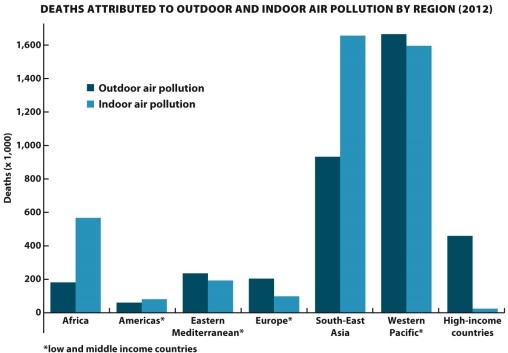
Refer to Infographic 20.1. The World Health Organization recognizes air pollution as a major threat to human health. Approximately how many people globally die each year from air pollution (indoor and outdoor)? Why do you think high-income countries have a higher percentage of deaths due to outdoor air pollution and low-income countries have a higher percentage of deaths due to indoor air pollution?
Refer to Infographic 20.1. The World Health Organization recognizes air pollution as a major threat to human health. Approximately how many people globally die each year from air pollution (indoor and outdoor)? Why do you think high-income countries have a higher percentage of deaths due to outdoor air pollution and low-income countries have a higher percentage of deaths due to indoor air pollution?

Question
Question
Question
Question
Question
Question
Question
Question
Question
Question
Question
Question
Question
Question
Question
Question
Question
Question
Question
Question
Question
Question
Question
Question
Question
Question
Question
Question
Question
Infographic 20.3.
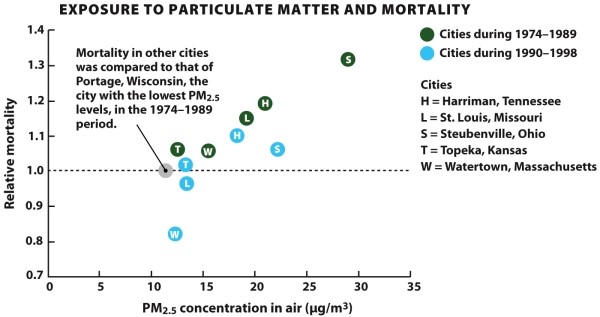
Refer to Infographic 20.3. Researchers at Harvard University compared death rates and particulate pollution levels in six U.S. cities. They found there was a link (correlation) between health and small particulate pollution. From this study, why is it only possible to show a correlation between health and small particulate pollution? What type of study is needed in order to show a direct cause-and-effect relationship?
Refer to Infographic 20.3. Researchers at Harvard University compared death rates and particulate pollution levels in six U.S. cities. They found there was a link (correlation) between health and small particulate pollution. From this study, why is it only possible to show a correlation between health and small particulate pollution? What type of study is needed in order to show a direct cause-and-effect relationship?
Question
Question
Question
Question
Question
Question
Question
Infographic 20.3.
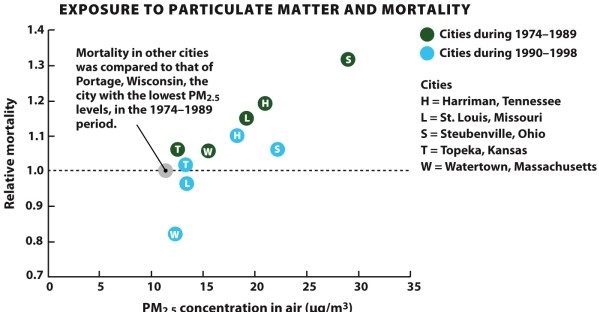
Refer to Infographic 20.3. Researchers looked at death rates (mortality) and particulate matter levels (PM₂.₅) in five cities compared with that of Portage, Wisconsin, (grey circle) during 1974-1989 and again in 1990-1998. The results are shown in the graph. Does there appear to be a link between health and small particulate pollution? What could have caused the reduction in air pollution in all of the cities studied in the later time interval?
Refer to Infographic 20.3. Researchers looked at death rates (mortality) and particulate matter levels (PM₂.₅) in five cities compared with that of Portage, Wisconsin, (grey circle) during 1974-1989 and again in 1990-1998. The results are shown in the graph. Does there appear to be a link between health and small particulate pollution? What could have caused the reduction in air pollution in all of the cities studied in the later time interval?
Question
Question
Question
Question
Question
Question
Question
Question
Question
Question
Question
Question
Question
Question
Question
Question
Question
Question
Question
Question
Question
Question
Question
Question
Question
Infographic 20.4.
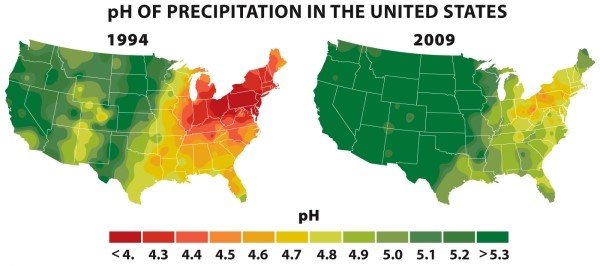
Refer to the pH values of precipitation in the United States map in Infographic 20.4. Why are pH values for precipitation lower (more acidic) in the eastern part of the United States? What has contributed to the improvement in conditions between 1994 and 2009?
Refer to the pH values of precipitation in the United States map in Infographic 20.4. Why are pH values for precipitation lower (more acidic) in the eastern part of the United States? What has contributed to the improvement in conditions between 1994 and 2009?
Question
Question

Unlock Deck
Sign up to unlock the cards in this deck!
Unlock Deck
Unlock Deck
1/64

Play

Full screen (f)
Deck 20: Air Pollution- the Youngest Scientists: Kids on the Frontlines of Asthma Research
1
Infographic 20.1.
Refer to Infographic 20.1. The World Health Organization recognizes air pollution as a major threat to human health. Approximately how many people globally die each year from air pollution (indoor and outdoor)? Why do you think high-income countries have a higher percentage of deaths due to outdoor air pollution and low-income countries have a higher percentage of deaths due to indoor air pollution?
Refer to Infographic 20.1. The World Health Organization recognizes air pollution as a major threat to human health. Approximately how many people globally die each year from air pollution (indoor and outdoor)? Why do you think high-income countries have a higher percentage of deaths due to outdoor air pollution and low-income countries have a higher percentage of deaths due to indoor air pollution?
Outdoor air pollution is responsible for at least 3.7 million deaths, and indoor air pollution accounts for at least 4.3 million premature deaths annually. In developing countries, such as many countries in Africa, indoor air pollution-caused death is higher due to the burning of wood, charcoal, and animal waste for heat and for cooking. Since the typical home is not very large in many of these communities, the density of smoke and particles in the small space is very high. For high-income countries, which are typically more developed, you see more outdoor air pollution-caused deaths due to vehicle and industrial emissions.
2
Particulate pollution includes all of the following EXCEPT for _______.
A) dust
B) soot
C) carbon dioxide
D) small, suspended droplets (aerosols)
E) pollen
A) dust
B) soot
C) carbon dioxide
D) small, suspended droplets (aerosols)
E) pollen
carbon dioxide
3
Air pollutants that are formed when primary air pollutants react with one another or other chemicals in the air are called _________.
A) nonpoint sources
B) point sources
C) primary air pollutants
D) secondary air pollutants
E) all of these answers
A) nonpoint sources
B) point sources
C) primary air pollutants
D) secondary air pollutants
E) all of these answers
secondary air pollutants
4
Choose the compound that is a secondary air pollutant.
A) sulfuric acid (H₂SO₄)
B) carbon dioxide (CO₂)
C) particulate matter
D) sulfur dioxide (SO₂)
E) carbon monoxide (CO)
A) sulfuric acid (H₂SO₄)
B) carbon dioxide (CO₂)
C) particulate matter
D) sulfur dioxide (SO₂)
E) carbon monoxide (CO)
Unlock Deck
Unlock for access to all 64 flashcards in this deck.
Unlock Deck
k this deck
5
________ is any material added to the atmosphere that harms organisms, affects the climate, or impacts structures.
A) Asthma
B) An environmental insult
C) Air pollution
D) Acid deposition
E) Airborne respiration
A) Asthma
B) An environmental insult
C) Air pollution
D) Acid deposition
E) Airborne respiration
Unlock Deck
Unlock for access to all 64 flashcards in this deck.
Unlock Deck
k this deck
6
You are driving a car. The emissions coming out of the automobile tailpipe are considered to be _________.
A) a point source
B) ozone
C) ground-level ozone
D) primary air pollutants
E) secondary air pollutants
A) a point source
B) ozone
C) ground-level ozone
D) primary air pollutants
E) secondary air pollutants
Unlock Deck
Unlock for access to all 64 flashcards in this deck.
Unlock Deck
k this deck
7
Which of the following choices is NOT a primary pollutant that can contribute to the formation of secondary air pollution?
A) forest fires
B) dust storms
C) agriculture
D) ground-level ozone
E) All of these answers contribute to the formation of secondary air pollution.
A) forest fires
B) dust storms
C) agriculture
D) ground-level ozone
E) All of these answers contribute to the formation of secondary air pollution.
Unlock Deck
Unlock for access to all 64 flashcards in this deck.
Unlock Deck
k this deck
8
Which of the following sources of outdoor air pollution is anthropogenic?
A) sandstorms
B) volcanic eruptions
C) controlled burns
D) wildfires
E) none of these answers
A) sandstorms
B) volcanic eruptions
C) controlled burns
D) wildfires
E) none of these answers
Unlock Deck
Unlock for access to all 64 flashcards in this deck.
Unlock Deck
k this deck
9
What is the biggest health problem associated with air pollution?
A) respiratory ailments
B) burns
C) flulike symptoms
D) birth defects
E) cancers
A) respiratory ailments
B) burns
C) flulike symptoms
D) birth defects
E) cancers
Unlock Deck
Unlock for access to all 64 flashcards in this deck.
Unlock Deck
k this deck
10
Which is FALSE regarding pollutants defined as hazardous by the EPA?
A) Even in small doses they can have adverse effects on human health.
B) They include volatile organic compounds (VOCs).
C) They may cause cancer or developmental defects.
D) A, B, and C are all true.
E) A, B, and C are all false.
A) Even in small doses they can have adverse effects on human health.
B) They include volatile organic compounds (VOCs).
C) They may cause cancer or developmental defects.
D) A, B, and C are all true.
E) A, B, and C are all false.
Unlock Deck
Unlock for access to all 64 flashcards in this deck.
Unlock Deck
k this deck
11
Why is ground-level ozone considered to be an air pollutant while stratospheric ozone is not? How is it formed?
Unlock Deck
Unlock for access to all 64 flashcards in this deck.
Unlock Deck
k this deck
12
________ is one of the most common chronic childhood diseases in the United States and other developed nations and a major cause of childhood disability.
A) Arthritis
B) Heart disease
C) Lung cancer
D) Asthma
E) None of these answers
A) Arthritis
B) Heart disease
C) Lung cancer
D) Asthma
E) None of these answers
Unlock Deck
Unlock for access to all 64 flashcards in this deck.
Unlock Deck
k this deck
13
Air pollutants released directly from any source are considered to be which of the following?
A) ozone
B) ground-level ozone
C) primary air pollutants
D) secondary air pollutants
E) none of these answers
A) ozone
B) ground-level ozone
C) primary air pollutants
D) secondary air pollutants
E) none of these answers
Unlock Deck
Unlock for access to all 64 flashcards in this deck.
Unlock Deck
k this deck
14
Which of the following is FALSE regarding asthma?
A) Developing nations are seeing a rise in asthma, especially in urban centers.
B) Asthma is a respiratory ailment marked by inflammation and constriction of the narrow airways of the lungs.
C) In the United States, asthma is the leading cause of school absences.
D) The United Kingdom and United States have the highest incidences of asthma, with more than 8% of their populations diagnosed in 2011.
E) None of these answers since all of these statements regarding asthma are true.
A) Developing nations are seeing a rise in asthma, especially in urban centers.
B) Asthma is a respiratory ailment marked by inflammation and constriction of the narrow airways of the lungs.
C) In the United States, asthma is the leading cause of school absences.
D) The United Kingdom and United States have the highest incidences of asthma, with more than 8% of their populations diagnosed in 2011.
E) None of these answers since all of these statements regarding asthma are true.
Unlock Deck
Unlock for access to all 64 flashcards in this deck.
Unlock Deck
k this deck
15
The World Health Organization estimates that more than _______ people die prematurely each year as a result of exposure to air pollution.
A) 500,000
B) 1 million
C) 4 million
D) 8 million
E) 15 million
A) 500,000
B) 1 million
C) 4 million
D) 8 million
E) 15 million
Unlock Deck
Unlock for access to all 64 flashcards in this deck.
Unlock Deck
k this deck
16
What are two anthropogenic sources of outdoor air pollution? What are two natural sources of outdoor air pollution? Also, list at least two of the major primary pollutants associated with these sources.
Unlock Deck
Unlock for access to all 64 flashcards in this deck.
Unlock Deck
k this deck
17
Which of the following air pollutants is NOT regulated by the EPA?
A) lead
B) ground-level ozone
C) volatile organic compounds (VOC)
D) mercury
E) none of these answers
A) lead
B) ground-level ozone
C) volatile organic compounds (VOC)
D) mercury
E) none of these answers
Unlock Deck
Unlock for access to all 64 flashcards in this deck.
Unlock Deck
k this deck
18
Which statement about VOCs is FALSE?
A) VOC stands for volatile organic compound.
B) VOCs readily evaporate and dissolve in water.
C) VOCs are released by bogs.
D) The main outdoor source of VOCs is fossil fuel combustion.
E) All of these answers are false.
A) VOC stands for volatile organic compound.
B) VOCs readily evaporate and dissolve in water.
C) VOCs are released by bogs.
D) The main outdoor source of VOCs is fossil fuel combustion.
E) All of these answers are false.
Unlock Deck
Unlock for access to all 64 flashcards in this deck.
Unlock Deck
k this deck
19
Sources of sulfur dioxide (SO₂) air pollution include __________.
A) point sources
B) nonpoint sources
C) volcanoes
D) coal-burning power plants
E) all of these answers
A) point sources
B) nonpoint sources
C) volcanoes
D) coal-burning power plants
E) all of these answers
Unlock Deck
Unlock for access to all 64 flashcards in this deck.
Unlock Deck
k this deck
20
Which of the following choices is a source of mercury pollution?
A) volcanoes
B) forest fires
C) mining
D) burning coal
E) all of these answers
A) volcanoes
B) forest fires
C) mining
D) burning coal
E) all of these answers
Unlock Deck
Unlock for access to all 64 flashcards in this deck.
Unlock Deck
k this deck
21
Air pollution can negatively affect organisms other than humans.
Unlock Deck
Unlock for access to all 64 flashcards in this deck.
Unlock Deck
k this deck
22
Acid deposition results from burning fossil fuels that release ___________ that react in the atmosphere to form acids that fall back to Earth as acid rain, snow, and fog.
A) sulfur and nitrogen oxides
B) lead and mercury
C) carbon monoxide and nitrogen oxides
D) VOC and sulfur oxides
E) lead and VOC
A) sulfur and nitrogen oxides
B) lead and mercury
C) carbon monoxide and nitrogen oxides
D) VOC and sulfur oxides
E) lead and VOC
Unlock Deck
Unlock for access to all 64 flashcards in this deck.
Unlock Deck
k this deck
23
Why are children of low-income families at a higher risk for asthma than those from wealthier families?
A) Their parents are less likely to be able to afford proper medical care.
B) Their homes and schools are often located near major roads or factories.
C) They have poor diets.
D) They purchase more products that contribute to indoor air pollution.
E) Their schools are poorly ventilated.
A) Their parents are less likely to be able to afford proper medical care.
B) Their homes and schools are often located near major roads or factories.
C) They have poor diets.
D) They purchase more products that contribute to indoor air pollution.
E) Their schools are poorly ventilated.
Unlock Deck
Unlock for access to all 64 flashcards in this deck.
Unlock Deck
k this deck
24
Which of the following is NOT a respiratory irritant?
A) sulfur dioxide (SO₂)
B) nitrogen oxides (NOₓ)
C) ground-level ozone (O₃)
D) particulate matter
E) lead (Pb)
A) sulfur dioxide (SO₂)
B) nitrogen oxides (NOₓ)
C) ground-level ozone (O₃)
D) particulate matter
E) lead (Pb)
Unlock Deck
Unlock for access to all 64 flashcards in this deck.
Unlock Deck
k this deck
25
Which of the following is a consequence of acid deposition?
A) reduced nutrient uptake by plants
B) acidified lakes
C) dying forests
D) released aluminum from soils
E) all of these answers
A) reduced nutrient uptake by plants
B) acidified lakes
C) dying forests
D) released aluminum from soils
E) all of these answers
Unlock Deck
Unlock for access to all 64 flashcards in this deck.
Unlock Deck
k this deck
26
The finding that minority communities face more exposure to pollution than their socioeconomically identical Caucasian counterparts is an example of:
A) environmental justice.
B) EPA protocol.
C) environmental racism.
D) EPA-criteria pollutants.
E) poor city planning.
A) environmental justice.
B) EPA protocol.
C) environmental racism.
D) EPA-criteria pollutants.
E) poor city planning.
Unlock Deck
Unlock for access to all 64 flashcards in this deck.
Unlock Deck
k this deck
27
Air pollution can cause which of the following conditions?
A) ground-level ozone
B) water pollution
C) asthma
D) property damage
E) all of these answers
A) ground-level ozone
B) water pollution
C) asthma
D) property damage
E) all of these answers
Unlock Deck
Unlock for access to all 64 flashcards in this deck.
Unlock Deck
k this deck
28
Which nutrients are leached from the soil due to acid rain?
A) aluminum
B) potassium
C) ozone
D) nitrogen
E) all of these answers
A) aluminum
B) potassium
C) ozone
D) nitrogen
E) all of these answers
Unlock Deck
Unlock for access to all 64 flashcards in this deck.
Unlock Deck
k this deck
29
Why do lower income or minority areas often have some of the worst outdoor air quality?
Unlock Deck
Unlock for access to all 64 flashcards in this deck.
Unlock Deck
k this deck
30
Infographic 20.3.
Refer to Infographic 20.3. Researchers at Harvard University compared death rates and particulate pollution levels in six U.S. cities. They found there was a link (correlation) between health and small particulate pollution. From this study, why is it only possible to show a correlation between health and small particulate pollution? What type of study is needed in order to show a direct cause-and-effect relationship?
Refer to Infographic 20.3. Researchers at Harvard University compared death rates and particulate pollution levels in six U.S. cities. They found there was a link (correlation) between health and small particulate pollution. From this study, why is it only possible to show a correlation between health and small particulate pollution? What type of study is needed in order to show a direct cause-and-effect relationship?
Unlock Deck
Unlock for access to all 64 flashcards in this deck.
Unlock Deck
k this deck
31
Power plants are often built in neighborhoods where residents have less ability to fight for their rights. This is a violation of ___________.
A) environmental regulations
B) EPA protocol
C) environmental justice
D) transboundary jurisdiction
E) deposition principles
A) environmental regulations
B) EPA protocol
C) environmental justice
D) transboundary jurisdiction
E) deposition principles
Unlock Deck
Unlock for access to all 64 flashcards in this deck.
Unlock Deck
k this deck
32
Even the most isolated regions on Earth are vulnerable to the effects of air pollution because atmospheric and hydrologic circulation moves chemical and particulate pollutants around the globe. This is an example of ___________.
A) environmental injustice
B) transboundary pollution
C) environmental racism
D) internal costs
E) none of these answers
A) environmental injustice
B) transboundary pollution
C) environmental racism
D) internal costs
E) none of these answers
Unlock Deck
Unlock for access to all 64 flashcards in this deck.
Unlock Deck
k this deck
33
Particulate matter is a leading cause of respiratory disease because it:
A) alters the DNA in the lung cells and causes cancer.
B) irritates the lining of the respiratory system and causes inflammation.
C) physically blocks the lungs from properly processing oxygen.
D) causes red blood cells to not take up oxygen as efficiently.
E) can enter the circulatory system and physically block blood flow.
A) alters the DNA in the lung cells and causes cancer.
B) irritates the lining of the respiratory system and causes inflammation.
C) physically blocks the lungs from properly processing oxygen.
D) causes red blood cells to not take up oxygen as efficiently.
E) can enter the circulatory system and physically block blood flow.
Unlock Deck
Unlock for access to all 64 flashcards in this deck.
Unlock Deck
k this deck
34
Smaller-sized particulate matter has more potential to induce health problems than larger-sized particulate matter.
Unlock Deck
Unlock for access to all 64 flashcards in this deck.
Unlock Deck
k this deck
35
Which of the following air pollutants can cause damage to the nervous, excretory, immune, reproductive, and cardiovascular systems; biomagnify in food chains; and was officially banned from the U.S. gas supply in 1996?
A) carbon monoxide
B) mercury
C) lead (Pb)
D) VOCs
E) sulfur dioxide
A) carbon monoxide
B) mercury
C) lead (Pb)
D) VOCs
E) sulfur dioxide
Unlock Deck
Unlock for access to all 64 flashcards in this deck.
Unlock Deck
k this deck
36
What is it about the nature of the human lung that makes it so vulnerable to air pollution? Further, how does damage to respiratory tissue serve as a gateway to other kinds of human health problems?
Unlock Deck
Unlock for access to all 64 flashcards in this deck.
Unlock Deck
k this deck
37
Infographic 20.3.
Refer to Infographic 20.3. Researchers looked at death rates (mortality) and particulate matter levels (PM₂.₅) in five cities compared with that of Portage, Wisconsin, (grey circle) during 1974-1989 and again in 1990-1998. The results are shown in the graph. Does there appear to be a link between health and small particulate pollution? What could have caused the reduction in air pollution in all of the cities studied in the later time interval?
Refer to Infographic 20.3. Researchers looked at death rates (mortality) and particulate matter levels (PM₂.₅) in five cities compared with that of Portage, Wisconsin, (grey circle) during 1974-1989 and again in 1990-1998. The results are shown in the graph. Does there appear to be a link between health and small particulate pollution? What could have caused the reduction in air pollution in all of the cities studied in the later time interval?
Unlock Deck
Unlock for access to all 64 flashcards in this deck.
Unlock Deck
k this deck
38
Which of the following air pollutants can affect crop health?
A) smog
B) ozone
C) carbon dioxide
D) both A and B
E) A, B, and C
A) smog
B) ozone
C) carbon dioxide
D) both A and B
E) A, B, and C
Unlock Deck
Unlock for access to all 64 flashcards in this deck.
Unlock Deck
k this deck
39
Increased rates of ______ and _______ have been observed in children living in cities compared with children living in rural areas.
A) acne; allergies
B) allergies; digestive problems
C) asthma; attendance
D) asthma; allergies
E) digestive problems; infectious disease
A) acne; allergies
B) allergies; digestive problems
C) asthma; attendance
D) asthma; allergies
E) digestive problems; infectious disease
Unlock Deck
Unlock for access to all 64 flashcards in this deck.
Unlock Deck
k this deck
40
Which form of air pollution is acid rain?
A) secondary air pollutant
B) primary air pollutant
C) point source
D) nonpoint source
E) ground-level pollution
A) secondary air pollutant
B) primary air pollutant
C) point source
D) nonpoint source
E) ground-level pollution
Unlock Deck
Unlock for access to all 64 flashcards in this deck.
Unlock Deck
k this deck
41
Which statement about acid deposition is TRUE?
A) Acid deposition is a local problem in that only areas that produce air pollution feel the effects of acid deposition.
B) Acid deposition only occurs through rain, snow, or fog.
C) Acid deposition causes plants to take up the now available aluminum, which is detrimental to the plant.
D) Acid deposition causes the pH level to rise in affected lakes.
E) All of these answers are true statements.
A) Acid deposition is a local problem in that only areas that produce air pollution feel the effects of acid deposition.
B) Acid deposition only occurs through rain, snow, or fog.
C) Acid deposition causes plants to take up the now available aluminum, which is detrimental to the plant.
D) Acid deposition causes the pH level to rise in affected lakes.
E) All of these answers are true statements.
Unlock Deck
Unlock for access to all 64 flashcards in this deck.
Unlock Deck
k this deck
42
According to Kirk Smith, a professor of environmental health at the University of California, Berkeley, "Current estimates are that indoor fires cause the premature death of 1.5 to 2 million women and children per year." What simple solution is being widely promoted to reduce this risk of death?
A) preparing meals using solar cookers
B) switching from wood to burning crop waste as a fuel source
C) adding more windows to houses as a source of ventilation
D) passing a green tax to make homeowners pay for their pollution
E) providing asthma inhalers to children under the age of 12
A) preparing meals using solar cookers
B) switching from wood to burning crop waste as a fuel source
C) adding more windows to houses as a source of ventilation
D) passing a green tax to make homeowners pay for their pollution
E) providing asthma inhalers to children under the age of 12
Unlock Deck
Unlock for access to all 64 flashcards in this deck.
Unlock Deck
k this deck
43
Air pollution caused by heavy traffic in Los Angeles California could not affect bullfrog populations in Canada.
Unlock Deck
Unlock for access to all 64 flashcards in this deck.
Unlock Deck
k this deck
44
Which of the following would be part of a technological solution to reducing air pollution?
A) providing tax credits for commuters who ride buses that run on compressed natural gas
B) installing a carbon monoxide detector in your home
C) pricing the pollution-generating product or service such that costs associated with pollution and resource depletion are accounted for
D) allowing polluters to sell their excess pollution credits for a profit
E) installing smokestack scrubbers to keep air pollutants from being released
A) providing tax credits for commuters who ride buses that run on compressed natural gas
B) installing a carbon monoxide detector in your home
C) pricing the pollution-generating product or service such that costs associated with pollution and resource depletion are accounted for
D) allowing polluters to sell their excess pollution credits for a profit
E) installing smokestack scrubbers to keep air pollutants from being released
Unlock Deck
Unlock for access to all 64 flashcards in this deck.
Unlock Deck
k this deck
45
In developing countries, the main source(s) of indoor air pollution is(are) _______.
A) particulates like soot as a result of cooking with wood or charcoal
B) mold
C) toxic chemicals
D) radon from the decay of uranium in rock that seeps through the foundations
E) lead
A) particulates like soot as a result of cooking with wood or charcoal
B) mold
C) toxic chemicals
D) radon from the decay of uranium in rock that seeps through the foundations
E) lead
Unlock Deck
Unlock for access to all 64 flashcards in this deck.
Unlock Deck
k this deck
46
Which of the following indoor air pollutants is correctly matched to its source?
A) radon―tobacco smoke
B) cooking―particulates
C) VOCs―poorly ventilated furnaces
D) chlorine―damp basements
E) carbon monoxide―soaps and cleaners
A) radon―tobacco smoke
B) cooking―particulates
C) VOCs―poorly ventilated furnaces
D) chlorine―damp basements
E) carbon monoxide―soaps and cleaners
Unlock Deck
Unlock for access to all 64 flashcards in this deck.
Unlock Deck
k this deck
47
Reducing air pollution improves our environmental well-being and is a cost saver in the long term, as we rely on many ecosystem services. Which of the following statements correctly reflects the environmental benefit based on reducing air pollution?
A) Since lead can damage a leaf's ability to photosynthesize, preventing lead pollution will allow for healthy plant growth and improved crop yields.
B) Since smog eats away at limestone and marble structures and damages steel and concrete, reducing smog provides protection for buildings and monuments, especially those made of marble and limestone.
C) Reducing acid rain will improve salmon fisheries, as acidified water causes aluminum to build up in water to levels that are toxic to juvenile salmon.
D) Mercury emissions create haze; thus, reducing such emissions improves visibility, a significant matter in tourist destinations.
E) Sulfur dioxide bioaccumulates in individuals and biomagnifies up food chains; thus, reducing such emissions protects our meat supply, which otherwise could become too toxic to eat.
A) Since lead can damage a leaf's ability to photosynthesize, preventing lead pollution will allow for healthy plant growth and improved crop yields.
B) Since smog eats away at limestone and marble structures and damages steel and concrete, reducing smog provides protection for buildings and monuments, especially those made of marble and limestone.
C) Reducing acid rain will improve salmon fisheries, as acidified water causes aluminum to build up in water to levels that are toxic to juvenile salmon.
D) Mercury emissions create haze; thus, reducing such emissions improves visibility, a significant matter in tourist destinations.
E) Sulfur dioxide bioaccumulates in individuals and biomagnifies up food chains; thus, reducing such emissions protects our meat supply, which otherwise could become too toxic to eat.
Unlock Deck
Unlock for access to all 64 flashcards in this deck.
Unlock Deck
k this deck
48
In 1963, the United States passed the ______, which sets a maximum amount for emissions of pollutants or the presence of pollutants in ambient air.
A) Safe Air Act
B) Safe Air Law
C) Clean Air Act
D) Clear Air Law
E) Safe and Clean Air Act
A) Safe Air Act
B) Safe Air Law
C) Clean Air Act
D) Clear Air Law
E) Safe and Clean Air Act
Unlock Deck
Unlock for access to all 64 flashcards in this deck.
Unlock Deck
k this deck
49
For most people in developed countries, the greatest exposure to air pollution comes from being indoors where structures tend to trap pollutants, keeping concentrations high. How can exposure to these indoor pollutants be reduced?
Unlock Deck
Unlock for access to all 64 flashcards in this deck.
Unlock Deck
k this deck
50
Compare and contrast the health risks associated with indoor air pollution in developed versus developing countries.
Unlock Deck
Unlock for access to all 64 flashcards in this deck.
Unlock Deck
k this deck
51
Go to the EPA's Air Quality Index (http://www.airnow.gov/) Look at the air quality for the area in which you live (both current and archived). Does any of this information surprise you? Now, research an area that you think would have a high level of air pollution and one that you think would have a low level. Do the results surprise you?
Unlock Deck
Unlock for access to all 64 flashcards in this deck.
Unlock Deck
k this deck
52
Which statement(s) about the Clean Air Act is(are) TRUE?
A) The Clean Air Act is evidence that regulations can be effective as a pollution-reduction tool because the United States has seen major reductions in common air pollutants.
B) Under the Clean Air Act, the EPA sets air quality standards for ambient air, with the states being responsible for monitoring and enforcing compliance.
C) The Clean Air Act is subject to political wrangling, as evidenced by the introduction of several congressional bills designed to limit the EPA's ability to regulate air quality, specifically carbon dioxide (CO₂).
D) Under the auspices of the Clean Air Act, the EPA approved greenhouse gas emission standards for light-duty vehicles (cars and trucks) that will require new vehicles to produce less greenhouse gas emissions.
E) All of these answers are true.
A) The Clean Air Act is evidence that regulations can be effective as a pollution-reduction tool because the United States has seen major reductions in common air pollutants.
B) Under the Clean Air Act, the EPA sets air quality standards for ambient air, with the states being responsible for monitoring and enforcing compliance.
C) The Clean Air Act is subject to political wrangling, as evidenced by the introduction of several congressional bills designed to limit the EPA's ability to regulate air quality, specifically carbon dioxide (CO₂).
D) Under the auspices of the Clean Air Act, the EPA approved greenhouse gas emission standards for light-duty vehicles (cars and trucks) that will require new vehicles to produce less greenhouse gas emissions.
E) All of these answers are true.
Unlock Deck
Unlock for access to all 64 flashcards in this deck.
Unlock Deck
k this deck
53
Improving air quality using command and control methods means:
A) paying a tax to the government on environmentally undesirable activities or enjoying a reduction in the tax in exchange for some desirable action.
B) building tall smokestacks to send emissions high into the atmosphere so that they disperse and do not pool at the site of production.
C) following regulations that set an upper allowable limit of pollution release, which is enforced with fines and/or incarceration.
D) using free government money or resources intended to promote desired activities.
E) following regulations that set upper limits for pollution release based on which producers are issued permits that allow them to release a portion of that amount; if they release less, they can sell their remaining allotment to others who did not reduce their emissions enough.
A) paying a tax to the government on environmentally undesirable activities or enjoying a reduction in the tax in exchange for some desirable action.
B) building tall smokestacks to send emissions high into the atmosphere so that they disperse and do not pool at the site of production.
C) following regulations that set an upper allowable limit of pollution release, which is enforced with fines and/or incarceration.
D) using free government money or resources intended to promote desired activities.
E) following regulations that set upper limits for pollution release based on which producers are issued permits that allow them to release a portion of that amount; if they release less, they can sell their remaining allotment to others who did not reduce their emissions enough.
Unlock Deck
Unlock for access to all 64 flashcards in this deck.
Unlock Deck
k this deck
54
_______ is a naturally occurring radioactive gas that is produced from the decay of uranium in rock. After seeping through foundations, it can accumulate in basements and lead to lung cancer.
A) Mercury
B) Lead
C) VOC
D) Radon
E) Carbon dioxide
A) Mercury
B) Lead
C) VOC
D) Radon
E) Carbon dioxide
Unlock Deck
Unlock for access to all 64 flashcards in this deck.
Unlock Deck
k this deck
55
Why is looking at the local air pollution level not a good indicator of the health of various ecosystems in that area?
Unlock Deck
Unlock for access to all 64 flashcards in this deck.
Unlock Deck
k this deck
56
Paints can release _______ while drying, and one way to prevent these pollutants from accumulating indoors is by _________.
A) VOCs; providing good ventilation
B) chlorine; using a HEPA filter
C) particulates; using low VOC paints
D) toxic chemicals; removing your shoes while painting
E) radon; limiting the use of carpets
A) VOCs; providing good ventilation
B) chlorine; using a HEPA filter
C) particulates; using low VOC paints
D) toxic chemicals; removing your shoes while painting
E) radon; limiting the use of carpets
Unlock Deck
Unlock for access to all 64 flashcards in this deck.
Unlock Deck
k this deck
57
Which of the following is a source of indoor air pollution?
A) mold
B) dust mites
C) radon
D) cigarette smoke
E) all of these answers
A) mold
B) dust mites
C) radon
D) cigarette smoke
E) all of these answers
Unlock Deck
Unlock for access to all 64 flashcards in this deck.
Unlock Deck
k this deck
58
Which of the reasons does NOT explain why indoor air pollution may pose a bigger threat than outdoor air pollution in some locations?
A) We breathe more air indoors because we spend so much time in homes, schools, or the workplace.
B) Items in our home, like paint, cleaners, and furniture, release VOCs, which can cause health problems.
C) Outdoor pollutants, such as radon, can also find their way into our buildings and concentrate in enclosed areas.
D) Secondary pollutants form and accumulate more easily in indoor environments.
E) All of these answers explain why indoor air pollution may pose a bigger threat than outdoor air pollution.
A) We breathe more air indoors because we spend so much time in homes, schools, or the workplace.
B) Items in our home, like paint, cleaners, and furniture, release VOCs, which can cause health problems.
C) Outdoor pollutants, such as radon, can also find their way into our buildings and concentrate in enclosed areas.
D) Secondary pollutants form and accumulate more easily in indoor environments.
E) All of these answers explain why indoor air pollution may pose a bigger threat than outdoor air pollution.
Unlock Deck
Unlock for access to all 64 flashcards in this deck.
Unlock Deck
k this deck
59
Which of the following is NOT a source of indoor air pollution?
A) cigarettes
B) cleaners
C) furniture
D) paint
E) foundation cement
A) cigarettes
B) cleaners
C) furniture
D) paint
E) foundation cement
Unlock Deck
Unlock for access to all 64 flashcards in this deck.
Unlock Deck
k this deck
60
The World Health Organization estimates that indoor air pollution may be responsible for up to ______ or more premature deaths of women and children each year, mostly in developing nations.
A) 500,000
B) 1 million
C) 2 million
D) 3 million
E) 50 million
A) 500,000
B) 1 million
C) 2 million
D) 3 million
E) 50 million
Unlock Deck
Unlock for access to all 64 flashcards in this deck.
Unlock Deck
k this deck
61
U.S. law authorizes _____ to set standards for dangerous air pollutants.
A) the Environmental Protection Agency
B) states
C) the Department of Environmental Protection
D) the Food and Drug Administration
E) the World Health Organization
A) the Environmental Protection Agency
B) states
C) the Department of Environmental Protection
D) the Food and Drug Administration
E) the World Health Organization
Unlock Deck
Unlock for access to all 64 flashcards in this deck.
Unlock Deck
k this deck
62
Infographic 20.4.
Refer to the pH values of precipitation in the United States map in Infographic 20.4. Why are pH values for precipitation lower (more acidic) in the eastern part of the United States? What has contributed to the improvement in conditions between 1994 and 2009?
Refer to the pH values of precipitation in the United States map in Infographic 20.4. Why are pH values for precipitation lower (more acidic) in the eastern part of the United States? What has contributed to the improvement in conditions between 1994 and 2009?
Unlock Deck
Unlock for access to all 64 flashcards in this deck.
Unlock Deck
k this deck
63
If a car company wanted to reduce the air pollution created by its cars, how could it apply tools such as subsidies, tax credits, and cap-and-trade regulations in its efforts? Be sure to define each term as part of your response.
Unlock Deck
Unlock for access to all 64 flashcards in this deck.
Unlock Deck
k this deck
64
There is often a resistance to implementing solutions to reduce air pollution because of the economic costs. What are these economic costs? Make a case for why, despite these financial costs, solutions for air pollution should be implemented. In other words, what are the costs of not implementing these solutions? Provide two examples: one from the developing and one from the developed world.
Unlock Deck
Unlock for access to all 64 flashcards in this deck.
Unlock Deck
k this deck
Unlock Deck
Unlock for access to all 64 flashcards in this deck.







