





 Chat with AI

Deck 6: Capital Investment Decisions
Full screen (f)

Question

Question
Question
Question
Question
Question
Question
Question
Question
Question
Question
Question
A firm is considering two projects with the following cash flows: Each project requires an investment of £120,000.
Which project will have the higher net present value?

A) Project A
B) Project B
C) Project A and Project B will have the same net present value.
D) The question cannot be answered from the information provided.
Which project will have the higher net present value?
A) Project A
B) Project B
C) Project A and Project B will have the same net present value.
D) The question cannot be answered from the information provided.
Question
Question
Question
Question
Question
Question
Question
Question
Question
Question
Lewis Manufacturing Company is planning to invest in equipment costing £240,000. The estimated cash flows from this equipment are expected to be as follows: Assume that the cash inflows occur evenly over the year. The payback period for this investment is

A) 3.75 years
B) 3.25 years
C) 2.4 years
D) 1.3 years
A) 3.75 years
B) 3.25 years
C) 2.4 years
D) 1.3 years
Question
Question
Question
Question
Question
Question
Question
Question
Question
Question
Question
Question
Question
Question
Question
Question
Question
Question
Question
Question
Figure 4
A capital investment project requires an investment of £60,000 and has an expected life of four years. Annual cash flows, which occur evenly throughout the year, are expected to be as follows:

Refer to Figure 4. The net present value of the project using a 6 percent discount rate is
A) £40,960
B) £43,950
C) £53,160
D) £35,040
A capital investment project requires an investment of £60,000 and has an expected life of four years. Annual cash flows, which occur evenly throughout the year, are expected to be as follows:
Refer to Figure 4. The net present value of the project using a 6 percent discount rate is
A) £40,960
B) £43,950
C) £53,160
D) £35,040
Question
Question
Question
Figure 2
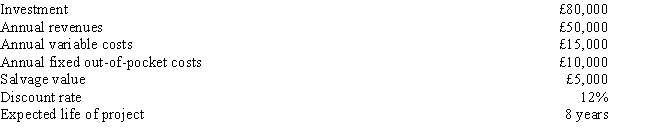
Refer to Figure 2. The present value of the salvage value is
A) £2,020
B) £2,391
C) £2,595
D) £2,687
Refer to Figure 2. The present value of the salvage value is
A) £2,020
B) £2,391
C) £2,595
D) £2,687
Question
Question
Question
Figure 4
A capital investment project requires an investment of £60,000 and has an expected life of four years. Annual cash flows, which occur evenly throughout the year, are expected to be as follows:
Refer to Figure 5. The net present value of the project is
A) (£3,215)
B) £393
C) £6,102
D) £6,412
A capital investment project requires an investment of £60,000 and has an expected life of four years. Annual cash flows, which occur evenly throughout the year, are expected to be as follows:
Refer to Figure 5. The net present value of the project is
A) (£3,215)
B) £393
C) £6,102
D) £6,412
Question
Question
Question
Question
Figure 4
A capital investment project requires an investment of £60,000 and has an expected life of four years. Annual cash flows, which occur evenly throughout the year, are expected to be as follows:
Refer to Figure 4. Payback for the project is
A) 2.25 years
B) 2.5 years
C) 3 years
D) 2 years
A capital investment project requires an investment of £60,000 and has an expected life of four years. Annual cash flows, which occur evenly throughout the year, are expected to be as follows:
Refer to Figure 4. Payback for the project is
A) 2.25 years
B) 2.5 years
C) 3 years
D) 2 years
Question
Question
Question
Question
Figure 2
Refer to Figure 2. The present value of the annual net cash inflows from operations is
A) £77,740
B) £86,669
C) £116,411
D) £124,200
Refer to Figure 2. The present value of the annual net cash inflows from operations is
A) £77,740
B) £86,669
C) £116,411
D) £124,200
Question
Question
Question
Figure 2
Refer to Figure 2. The net present value of the project is
A) £24,500
B) £36,411
C) £44,200
D) £46,220
Refer to Figure 2. The net present value of the project is
A) £24,500
B) £36,411
C) £44,200
D) £46,220
Question
Question
Question
Question
Question
Question
Question
Jolly Corporation is considering an investment in equipment for £25,000. Data related to the investment are as follows: Jolly claims capital allowances using the straight-line method of depreciation . In addition, its tax rate is 40 percent, and the life of the equipment is four years with no salvage value. Cost of capital is 12 percent.
What is the net present value of the investment?

A) £30,370
B) £(2,222)
C) £12,962
D) £5,370
What is the net present value of the investment?
A) £30,370
B) £(2,222)
C) £12,962
D) £5,370
Question
Question
Question
Question
Question
Question
Five mutually exclusive projects had the following information: Which project is preferred?

A) Project A
B) Project B
C) Project C
D) Project D
A) Project A
B) Project B
C) Project C
D) Project D
Question
Question
Question
Question
Question
Question
Question
Question
Houston Corporation is considering an investment in equipment for £45,000. Data related to the investment are as follows: Cost of capital is 18 percent.
Houston claims capital allowances (WDV's) using the straight-line method of depreciation . In addition, their tax rate is 40 percent, and the life of the equipment is five years with no salvage value.
What is the net present value of the investment?

A) £67,543
B) £22,543
C) £48,810
D) £11,286
Houston claims capital allowances (WDV's) using the straight-line method of depreciation . In addition, their tax rate is 40 percent, and the life of the equipment is five years with no salvage value.
What is the net present value of the investment?
A) £67,543
B) £22,543
C) £48,810
D) £11,286

Unlock Deck
Sign up to unlock the cards in this deck!
Unlock Deck
Unlock Deck
1/110

Play

Full screen (f)
Deck 6: Capital Investment Decisions
1
_____ are capital budgeting models that identify criteria for accepting or rejecting projects without considering the time value of money.
A) Net present value models
B) Nondiscounting models
C) Discounting models
D) Capital return models
A) Net present value models
B) Nondiscounting models
C) Discounting models
D) Capital return models
B
2
If a project has a net present value of £0 when a discount rate of 10 percent is used, what can be concluded about the rate of return of the project?
A) The rate of return is greater than 10 percent.
B) The rate of return is less than 10 percent.
C) The rate of return equals 10 percent.
D) The rate of return is 0.
A) The rate of return is greater than 10 percent.
B) The rate of return is less than 10 percent.
C) The rate of return equals 10 percent.
D) The rate of return is 0.
C
3
Future cash flows expressed in present value terms are
A) compounded cash flows
B) extended cash flows
C) budgeted cash flows
D) discounted cash flows
A) compounded cash flows
B) extended cash flows
C) budgeted cash flows
D) discounted cash flows
D
4
Firms may select projects with short paybacks because
A) projects with longer paybacks may be riskier
B) shorter paybacks may help reduce liquidity problems
C) if the risk of obsolescence is high, the firm may want to recover the funds rapidly
D) All of the above are correct.
A) projects with longer paybacks may be riskier
B) shorter paybacks may help reduce liquidity problems
C) if the risk of obsolescence is high, the firm may want to recover the funds rapidly
D) All of the above are correct.
Unlock Deck
Unlock for access to all 110 flashcards in this deck.
Unlock Deck
k this deck
5
Which of the following methods assumes a reinvestment rate equal to the discount rate?
A) payback
B) accounting rate of return
C) net present value
D) internal rate of return
A) payback
B) accounting rate of return
C) net present value
D) internal rate of return
Unlock Deck
Unlock for access to all 110 flashcards in this deck.
Unlock Deck
k this deck
6
A firm is evaluating a project that has a net present value of £0 when a discount rate of 8 percent is used. A discount rate of 10 percent will result in
A) a negative net present value
B) a positive net present value
C) a net present value of £0
D) The question cannot be answered based upon the information provided.
A) a negative net present value
B) a positive net present value
C) a net present value of £0
D) The question cannot be answered based upon the information provided.
Unlock Deck
Unlock for access to all 110 flashcards in this deck.
Unlock Deck
k this deck
7
Which of the following methods consider the time value of money?
A) payback and accounting rate of return
B) payback and internal rate of return
C) internal rate of return and accounting rate of return
D) internal rate of return and net present value
A) payback and accounting rate of return
B) payback and internal rate of return
C) internal rate of return and accounting rate of return
D) internal rate of return and net present value
Unlock Deck
Unlock for access to all 110 flashcards in this deck.
Unlock Deck
k this deck
8
If the annual cash flows are an annuity (equal each period), payback is calculated as
A) Annual net cash inflows/Capital investment
B) Capital investment/Annual net cash inflows
C) Annual net cash inflows/Present value factor
D) (Annual net cash inflows - Annual depreciation)/Capital investment
A) Annual net cash inflows/Capital investment
B) Capital investment/Annual net cash inflows
C) Annual net cash inflows/Present value factor
D) (Annual net cash inflows - Annual depreciation)/Capital investment
Unlock Deck
Unlock for access to all 110 flashcards in this deck.
Unlock Deck
k this deck
9
The accounting rate of return is calculated as
A) Investment/Income
B) Income/Debt
C) Income/Investment
D) Assets/Debt
A) Investment/Income
B) Income/Debt
C) Income/Investment
D) Assets/Debt
Unlock Deck
Unlock for access to all 110 flashcards in this deck.
Unlock Deck
k this deck
10
When the discount rate is decreased,
A) the present value of future cash flows increases
B) the present value of future cash flows decreases
C) there is no change in the present value
D) net present value would equal zero
A) the present value of future cash flows increases
B) the present value of future cash flows decreases
C) there is no change in the present value
D) net present value would equal zero
Unlock Deck
Unlock for access to all 110 flashcards in this deck.
Unlock Deck
k this deck
11
A firm is evaluating a project that has a net present value of £0 when a discount rate of 8 percent is used. A discount rate of 6 percent will result in
A) a negative net present value
B) a positive net present value
C) a net present value of £0
D) The question cannot be answered based upon the information provided.
A) a negative net present value
B) a positive net present value
C) a net present value of £0
D) The question cannot be answered based upon the information provided.
Unlock Deck
Unlock for access to all 110 flashcards in this deck.
Unlock Deck
k this deck
12
A firm is considering two projects with the following cash flows: Each project requires an investment of £120,000.
Which project will have the higher net present value?
A) Project A
B) Project B
C) Project A and Project B will have the same net present value.
D) The question cannot be answered from the information provided.
Which project will have the higher net present value?
A) Project A
B) Project B
C) Project A and Project B will have the same net present value.
D) The question cannot be answered from the information provided.
Unlock Deck
Unlock for access to all 110 flashcards in this deck.
Unlock Deck
k this deck
13
Why would a company use the accounting rate of return?
A) to ensure that a new investment will not adversely affect accounting income
B) because it does not consider the time value of money
C) because it is a measure of liquidity
D) all of the above
A) to ensure that a new investment will not adversely affect accounting income
B) because it does not consider the time value of money
C) because it is a measure of liquidity
D) all of the above
Unlock Deck
Unlock for access to all 110 flashcards in this deck.
Unlock Deck
k this deck
14
What is a weakness of the payback method?
A) It emphasizes projects with possible liquidity problems.
B) It ignores the profitability of investments beyond the payback period.
C) It can be used in conjunction with discounted cash flow methods.
D) both a and b above
A) It emphasizes projects with possible liquidity problems.
B) It ignores the profitability of investments beyond the payback period.
C) It can be used in conjunction with discounted cash flow methods.
D) both a and b above
Unlock Deck
Unlock for access to all 110 flashcards in this deck.
Unlock Deck
k this deck
15
Projects that, if accepted or rejected, will not affect the cash flows of another project are
A) priority projects
B) mutually exclusive projects
C) independent projects
D) equity projects
A) priority projects
B) mutually exclusive projects
C) independent projects
D) equity projects
Unlock Deck
Unlock for access to all 110 flashcards in this deck.
Unlock Deck
k this deck
16
The time required for a project to return its investment is the
A) accounting rate of return
B) interest
C) net present value
D) payback period
A) accounting rate of return
B) interest
C) net present value
D) payback period
Unlock Deck
Unlock for access to all 110 flashcards in this deck.
Unlock Deck
k this deck
17
A _____ is a capital budgeting model that considers the time value of money when evaluating proposed projects.
A) cash flow model
B) nondiscounting model
C) discounting model
D) rate of return model
A) cash flow model
B) nondiscounting model
C) discounting model
D) rate of return model
Unlock Deck
Unlock for access to all 110 flashcards in this deck.
Unlock Deck
k this deck
18
Projects that, if accepted, preclude the acceptance of competing projects are
A) priority projects
B) mutually exclusive projects
C) independent projects
D) equity projects
A) priority projects
B) mutually exclusive projects
C) independent projects
D) equity projects
Unlock Deck
Unlock for access to all 110 flashcards in this deck.
Unlock Deck
k this deck
19
If the annual cash flows are not an annuity (equal each period), payback is calculated by
A) dividing the investment required by the average annual cash inflow
B) dividing the average annual cash inflow by the investment required
C) accumulating the net cash flows until they equal the initial investment
D) Payback cannot be calculated for a project with unequal cash flows.
A) dividing the investment required by the average annual cash inflow
B) dividing the average annual cash inflow by the investment required
C) accumulating the net cash flows until they equal the initial investment
D) Payback cannot be calculated for a project with unequal cash flows.
Unlock Deck
Unlock for access to all 110 flashcards in this deck.
Unlock Deck
k this deck
20
Which of the following methods uses income instead of cash flows?
A) payback
B) accounting rate of return
C) internal rate of return
D) net present value
A) payback
B) accounting rate of return
C) internal rate of return
D) net present value
Unlock Deck
Unlock for access to all 110 flashcards in this deck.
Unlock Deck
k this deck
21
A firm is considering a project with annual cash flows of £40,000. The project would have a 10-year life, and the company uses a discount rate of 8 percent. What is the maximum amount the company could invest in the project and the project still be acceptable?
A) £400,000
B) £268,400
C) £203,200
D) £363,600
A) £400,000
B) £268,400
C) £203,200
D) £363,600
Unlock Deck
Unlock for access to all 110 flashcards in this deck.
Unlock Deck
k this deck
22
Lewis Manufacturing Company is planning to invest in equipment costing £240,000. The estimated cash flows from this equipment are expected to be as follows: Assume that the cash inflows occur evenly over the year. The payback period for this investment is
A) 3.75 years
B) 3.25 years
C) 2.4 years
D) 1.3 years
A) 3.75 years
B) 3.25 years
C) 2.4 years
D) 1.3 years
Unlock Deck
Unlock for access to all 110 flashcards in this deck.
Unlock Deck
k this deck
23
Kaylin Company purchased a piece of equipment for £100,000 that had a useful life of 5 years. The equipment had no salvage value. It saves the company £40,000 a year and costs the company £5,000 a year to operate. What is the accounting rate of return on the equipment?
A) 30%
B) 15%
C) 40%
D) 35%
A) 30%
B) 15%
C) 40%
D) 35%
Unlock Deck
Unlock for access to all 110 flashcards in this deck.
Unlock Deck
k this deck
24
The present value of £2,000 to be received each year for three years and earning a 10 percent return is
A) £5,560
B) £4,974
C) £4,922
D) £4,600
A) £5,560
B) £4,974
C) £4,922
D) £4,600
Unlock Deck
Unlock for access to all 110 flashcards in this deck.
Unlock Deck
k this deck
25
A firm is considering a project with annual cash flows of £75,000. The project would have a 7-year life, and the company uses a discount rate of 10 percent. What is the maximum amount the company could invest in the project and the project still be acceptable?
A) £525,000
B) £365,100
C) £269,325
D) none of the above
A) £525,000
B) £365,100
C) £269,325
D) none of the above
Unlock Deck
Unlock for access to all 110 flashcards in this deck.
Unlock Deck
k this deck
26
A firm is considering a project requiring an investment of £100,000. The project would generate annual cash inflows of £26,380 per year for the next five years. The approximate internal rate of return for the project is
A) 8%
B) 10%
C) 12%
D) 16%
A) 8%
B) 10%
C) 12%
D) 16%
Unlock Deck
Unlock for access to all 110 flashcards in this deck.
Unlock Deck
k this deck
27
A firm is considering a project with annual cash flows of £120,000. The project would have an 8-year life, and the company uses a discount rate of 12 percent. What is the maximum amount the company could invest in the project and the project still be acceptable?
A) £488,740
B) £562,614
C) £580,291
D) £596,160
A) £488,740
B) £562,614
C) £580,291
D) £596,160
Unlock Deck
Unlock for access to all 110 flashcards in this deck.
Unlock Deck
k this deck
28
A firm is considering a project requiring an investment of £14,150. The project would generate annual cash inflows of £3,300 per year for the next seven years. The approximate internal rate of return for the project is
A) 6%
B) 8%
C) 12%
D) 14%
A) 6%
B) 8%
C) 12%
D) 14%
Unlock Deck
Unlock for access to all 110 flashcards in this deck.
Unlock Deck
k this deck
29
The present value of £2,000 to be received three years from now and earning a 12 percent return is
A) £1,424
B) £1,760
C) £2,440
D) £2,720
A) £1,424
B) £1,760
C) £2,440
D) £2,720
Unlock Deck
Unlock for access to all 110 flashcards in this deck.
Unlock Deck
k this deck
30
Ducky Pizza Restaurant purchases a van to deliver pizzas to their customers. The van costs £28,000 and is projected to increase revenues by £10,000 a year and to increase costs by £4,500. The payback period for this van is
A) 2.8 years
B) 6.2 years
C) 5.1 years
D) 0.4 years
A) 2.8 years
B) 6.2 years
C) 5.1 years
D) 0.4 years
Unlock Deck
Unlock for access to all 110 flashcards in this deck.
Unlock Deck
k this deck
31
The internal rate of return is the
A) rate of return that sets the project's net present value equal to zero
B) hurdle rate
C) cost of capital
D) required rate of return
A) rate of return that sets the project's net present value equal to zero
B) hurdle rate
C) cost of capital
D) required rate of return
Unlock Deck
Unlock for access to all 110 flashcards in this deck.
Unlock Deck
k this deck
32
The Bradshaw Company is considering purchasing equipment for £78,000. This equipment will save the company £22,000 in operating costs annually. The payback period for this equipment is
A) 3.5 years
B) 4 years
C) 2.2 years
D) 0.3 years
A) 3.5 years
B) 4 years
C) 2.2 years
D) 0.3 years
Unlock Deck
Unlock for access to all 110 flashcards in this deck.
Unlock Deck
k this deck
33
If NPV and IRR produce different rankings, which method should be used in choosing investment projects?
A) payback
B) accounting rate of return
C) net present value
D) internal rate of return
A) payback
B) accounting rate of return
C) net present value
D) internal rate of return
Unlock Deck
Unlock for access to all 110 flashcards in this deck.
Unlock Deck
k this deck
34
Brooks Company invested in a project that is expected to have an annual cash flow of £10,000. The project's life is five years and has an IRR of 14 percent. How much was the initial investment in the project?
A) £34,330
B) £50,000
C) £36,050
D) £29,140
A) £34,330
B) £50,000
C) £36,050
D) £29,140
Unlock Deck
Unlock for access to all 110 flashcards in this deck.
Unlock Deck
k this deck
35
Which of the following is NOT included in the calculation of net present value of a proposed project? (Ignore income taxes.)
A) salvage value
B) working capital
C) discount rate
D) depreciation expense
A) salvage value
B) working capital
C) discount rate
D) depreciation expense
Unlock Deck
Unlock for access to all 110 flashcards in this deck.
Unlock Deck
k this deck
36
The present value of £8,000 to be received each year for ten years and earning a 16 percent return is
A) £1,655
B) £1,816
C) £35,242
D) £38,664
A) £1,655
B) £1,816
C) £35,242
D) £38,664
Unlock Deck
Unlock for access to all 110 flashcards in this deck.
Unlock Deck
k this deck
37
The present value of £10,000 to be received five years from now and earning a 12 percent return is
A) £2,774
B) £5,670
C) £17,637
D) £36,050
A) £2,774
B) £5,670
C) £17,637
D) £36,050
Unlock Deck
Unlock for access to all 110 flashcards in this deck.
Unlock Deck
k this deck
38
If the investment's internal rate of return is more than the required rate of return, the investment should be
A) accepted
B) rejected
C) put on hold
D) None of the above are correct.
A) accepted
B) rejected
C) put on hold
D) None of the above are correct.
Unlock Deck
Unlock for access to all 110 flashcards in this deck.
Unlock Deck
k this deck
39
How is working capital needed in the operations of investments treated in discounted cash flow analysis?
A) added to cost of the investment
B) added to cash inflows when recovery occurs
C) both a and b
D) none of the above
A) added to cost of the investment
B) added to cash inflows when recovery occurs
C) both a and b
D) none of the above
Unlock Deck
Unlock for access to all 110 flashcards in this deck.
Unlock Deck
k this deck
40
Why do the NPV method and the IRR method sometimes produce different rankings of mutually exclusive investment projects?
A) The NPV method does not assume reinvestment of cash flows, while the IRR method assumes the cash flows will be reinvested at the internal rate of return.
B) The NPV method assumes a reinvestment rate equal to the discount rate, while the IRR method assumes a reinvestment rate equal to the internal rate of return.
C) The IRR method does not assume reinvestment of the cash flows, while the NPV method assumes the reinvestment rate is equal to the discount rate.
D) The NPV method assumes a reinvestment rate equal to the bank loan interest rate, while the IRR method assumes a reinvestment rate equal to the discount rate.
A) The NPV method does not assume reinvestment of cash flows, while the IRR method assumes the cash flows will be reinvested at the internal rate of return.
B) The NPV method assumes a reinvestment rate equal to the discount rate, while the IRR method assumes a reinvestment rate equal to the internal rate of return.
C) The IRR method does not assume reinvestment of the cash flows, while the NPV method assumes the reinvestment rate is equal to the discount rate.
D) The NPV method assumes a reinvestment rate equal to the bank loan interest rate, while the IRR method assumes a reinvestment rate equal to the discount rate.
Unlock Deck
Unlock for access to all 110 flashcards in this deck.
Unlock Deck
k this deck
41
Figure 6
JD, Inc., is considering the purchase of production equipment that costs £400,000. The equipment is expected to generate annual cash inflows of £125,000. The equipment is expected to have a useful life of five years with no salvage value. The firm's cost of capital is 12 percent.
Refer to Figure 6. Based on quantitative factors, should JD accept, reject, or wait on the project?
A) accept
B) reject
C) wait
JD, Inc., is considering the purchase of production equipment that costs £400,000. The equipment is expected to generate annual cash inflows of £125,000. The equipment is expected to have a useful life of five years with no salvage value. The firm's cost of capital is 12 percent.
Refer to Figure 6. Based on quantitative factors, should JD accept, reject, or wait on the project?
A) accept
B) reject
C) wait
Unlock Deck
Unlock for access to all 110 flashcards in this deck.
Unlock Deck
k this deck
42
Figure 4
A capital investment project requires an investment of £60,000 and has an expected life of four years. Annual cash flows, which occur evenly throughout the year, are expected to be as follows:
Refer to Figure 4. The net present value of the project using a 6 percent discount rate is
A) £40,960
B) £43,950
C) £53,160
D) £35,040
A capital investment project requires an investment of £60,000 and has an expected life of four years. Annual cash flows, which occur evenly throughout the year, are expected to be as follows:
Refer to Figure 4. The net present value of the project using a 6 percent discount rate is
A) £40,960
B) £43,950
C) £53,160
D) £35,040
Unlock Deck
Unlock for access to all 110 flashcards in this deck.
Unlock Deck
k this deck
43
Figure 6
JD, Inc., is considering the purchase of production equipment that costs £400,000. The equipment is expected to generate annual cash inflows of £125,000. The equipment is expected to have a useful life of five years with no salvage value. The firm's cost of capital is 12 percent.
Refer to Figure 6. JD's payback for the project is
A) 2.9 years
B) 3.2 years
C) 3.25 years
D) 4.2 years
JD, Inc., is considering the purchase of production equipment that costs £400,000. The equipment is expected to generate annual cash inflows of £125,000. The equipment is expected to have a useful life of five years with no salvage value. The firm's cost of capital is 12 percent.
Refer to Figure 6. JD's payback for the project is
A) 2.9 years
B) 3.2 years
C) 3.25 years
D) 4.2 years
Unlock Deck
Unlock for access to all 110 flashcards in this deck.
Unlock Deck
k this deck
44
Figure 6
JD, Inc., is considering the purchase of production equipment that costs £400,000. The equipment is expected to generate annual cash inflows of £125,000. The equipment is expected to have a useful life of five years with no salvage value. The firm's cost of capital is 12 percent.
Refer to Figure 6. JD's net present value of the project is
A) £40,480
B) £48,625
C) £50,625
D) £54,450
JD, Inc., is considering the purchase of production equipment that costs £400,000. The equipment is expected to generate annual cash inflows of £125,000. The equipment is expected to have a useful life of five years with no salvage value. The firm's cost of capital is 12 percent.
Refer to Figure 6. JD's net present value of the project is
A) £40,480
B) £48,625
C) £50,625
D) £54,450
Unlock Deck
Unlock for access to all 110 flashcards in this deck.
Unlock Deck
k this deck
45
Figure 2
Refer to Figure 2. The present value of the salvage value is
A) £2,020
B) £2,391
C) £2,595
D) £2,687
Refer to Figure 2. The present value of the salvage value is
A) £2,020
B) £2,391
C) £2,595
D) £2,687
Unlock Deck
Unlock for access to all 110 flashcards in this deck.
Unlock Deck
k this deck
46
Figure 1
A project requires an investment of £90,000 in equipment. Annual cash inflows of £15,000 are expected to occur for the next ten years. No salvage value is expected.
Refer to Figure 1. Using the initial capital investment, the accounting rate of return for the project would be
A) 6.25%
B) 6.67%
C) 16.67%
D) 26.67%
A project requires an investment of £90,000 in equipment. Annual cash inflows of £15,000 are expected to occur for the next ten years. No salvage value is expected.
Refer to Figure 1. Using the initial capital investment, the accounting rate of return for the project would be
A) 6.25%
B) 6.67%
C) 16.67%
D) 26.67%
Unlock Deck
Unlock for access to all 110 flashcards in this deck.
Unlock Deck
k this deck
47
Figure 1
A project requires an investment of £90,000 in equipment. Annual cash inflows of £15,000 are expected to occur for the next ten years. No salvage value is expected.
Refer to Figure 1. If the annual cash inflows occur throughout the year, payback for the project would be
A) 4.5 years
B) 4.8 years
C) 5 years
D) 6 years
A project requires an investment of £90,000 in equipment. Annual cash inflows of £15,000 are expected to occur for the next ten years. No salvage value is expected.
Refer to Figure 1. If the annual cash inflows occur throughout the year, payback for the project would be
A) 4.5 years
B) 4.8 years
C) 5 years
D) 6 years
Unlock Deck
Unlock for access to all 110 flashcards in this deck.
Unlock Deck
k this deck
48
Figure 4
A capital investment project requires an investment of £60,000 and has an expected life of four years. Annual cash flows, which occur evenly throughout the year, are expected to be as follows:
Refer to Figure 5. The net present value of the project is
A) (£3,215)
B) £393
C) £6,102
D) £6,412
A capital investment project requires an investment of £60,000 and has an expected life of four years. Annual cash flows, which occur evenly throughout the year, are expected to be as follows:
Refer to Figure 5. The net present value of the project is
A) (£3,215)
B) £393
C) £6,102
D) £6,412
Unlock Deck
Unlock for access to all 110 flashcards in this deck.
Unlock Deck
k this deck
49
Figure 3
Glady, Inc., is considering the purchase of production equipment that costs £800,000. The equipment is expected to generate annual cash inflows of £250,000. The equipment is expected to have a useful life of five years with no salvage value. The firm's cost of capital is 14 percent.
Refer to Figure 3. Excluding the effect of income taxes, Glady's net present value of the project is
A) £165,200
B) £450,000
C) £58,250
D) £233,550
Glady, Inc., is considering the purchase of production equipment that costs £800,000. The equipment is expected to generate annual cash inflows of £250,000. The equipment is expected to have a useful life of five years with no salvage value. The firm's cost of capital is 14 percent.
Refer to Figure 3. Excluding the effect of income taxes, Glady's net present value of the project is
A) £165,200
B) £450,000
C) £58,250
D) £233,550
Unlock Deck
Unlock for access to all 110 flashcards in this deck.
Unlock Deck
k this deck
50
Figure 3
Glady, Inc., is considering the purchase of production equipment that costs £800,000. The equipment is expected to generate annual cash inflows of £250,000. The equipment is expected to have a useful life of five years with no salvage value. The firm's cost of capital is 14 percent.
Refer to Figure 3. The approximate internal rate of return of Glady's project is
A) 16%
B) 20%
C) 24%
D) 25%
Glady, Inc., is considering the purchase of production equipment that costs £800,000. The equipment is expected to generate annual cash inflows of £250,000. The equipment is expected to have a useful life of five years with no salvage value. The firm's cost of capital is 14 percent.
Refer to Figure 3. The approximate internal rate of return of Glady's project is
A) 16%
B) 20%
C) 24%
D) 25%
Unlock Deck
Unlock for access to all 110 flashcards in this deck.
Unlock Deck
k this deck
51
Figure 3
Glady, Inc., is considering the purchase of production equipment that costs £800,000. The equipment is expected to generate annual cash inflows of £250,000. The equipment is expected to have a useful life of five years with no salvage value. The firm's cost of capital is 14 percent.
Refer to Figure 3. If depreciation is £190,000 per year, Glady's accounting rate of return based on the average investment would be
A) 15.0%
B) 7.5%
C) 6.25%
D) 5.5%
Glady, Inc., is considering the purchase of production equipment that costs £800,000. The equipment is expected to generate annual cash inflows of £250,000. The equipment is expected to have a useful life of five years with no salvage value. The firm's cost of capital is 14 percent.
Refer to Figure 3. If depreciation is £190,000 per year, Glady's accounting rate of return based on the average investment would be
A) 15.0%
B) 7.5%
C) 6.25%
D) 5.5%
Unlock Deck
Unlock for access to all 110 flashcards in this deck.
Unlock Deck
k this deck
52
Figure 4
A capital investment project requires an investment of £60,000 and has an expected life of four years. Annual cash flows, which occur evenly throughout the year, are expected to be as follows:
Refer to Figure 4. Payback for the project is
A) 2.25 years
B) 2.5 years
C) 3 years
D) 2 years
A capital investment project requires an investment of £60,000 and has an expected life of four years. Annual cash flows, which occur evenly throughout the year, are expected to be as follows:
Refer to Figure 4. Payback for the project is
A) 2.25 years
B) 2.5 years
C) 3 years
D) 2 years
Unlock Deck
Unlock for access to all 110 flashcards in this deck.
Unlock Deck
k this deck
53
Figure 1
A project requires an investment of £90,000 in equipment. Annual cash inflows of £15,000 are expected to occur for the next ten years. No salvage value is expected.
Refer to Figure 1. If the cash inflows occur at the end of each year, the net present value of the project using a 12 percent discount rate would be
A) (£12,210)
B) £5,250
C) (£5,250)
D) £12,210
A project requires an investment of £90,000 in equipment. Annual cash inflows of £15,000 are expected to occur for the next ten years. No salvage value is expected.
Refer to Figure 1. If the cash inflows occur at the end of each year, the net present value of the project using a 12 percent discount rate would be
A) (£12,210)
B) £5,250
C) (£5,250)
D) £12,210
Unlock Deck
Unlock for access to all 110 flashcards in this deck.
Unlock Deck
k this deck
54
Lake Kariba Company is considering buying a new boat that would cost £120,000. The accountant determined that the boat promises an internal rate of return of 10 percent and has a life of four years. The accountant resigned and the president wanted to check her calculations. What were the approximate annual net cash inflows from the project?
A) £20,490
B) £30,000
C) £37,855
D) Net cash inflows cannot be determined from the information given.
A) £20,490
B) £30,000
C) £37,855
D) Net cash inflows cannot be determined from the information given.
Unlock Deck
Unlock for access to all 110 flashcards in this deck.
Unlock Deck
k this deck
55
Figure 3
Glady, Inc., is considering the purchase of production equipment that costs £800,000. The equipment is expected to generate annual cash inflows of £250,000. The equipment is expected to have a useful life of five years with no salvage value. The firm's cost of capital is 14 percent.
Refer to Figure 3. Payback for Glady's project is
A) 5 years
B) 3.2 years
C) 4 years
D) 3.125 years
Glady, Inc., is considering the purchase of production equipment that costs £800,000. The equipment is expected to generate annual cash inflows of £250,000. The equipment is expected to have a useful life of five years with no salvage value. The firm's cost of capital is 14 percent.
Refer to Figure 3. Payback for Glady's project is
A) 5 years
B) 3.2 years
C) 4 years
D) 3.125 years
Unlock Deck
Unlock for access to all 110 flashcards in this deck.
Unlock Deck
k this deck
56
Figure 2
Refer to Figure 2. The present value of the annual net cash inflows from operations is
A) £77,740
B) £86,669
C) £116,411
D) £124,200
Refer to Figure 2. The present value of the annual net cash inflows from operations is
A) £77,740
B) £86,669
C) £116,411
D) £124,200
Unlock Deck
Unlock for access to all 110 flashcards in this deck.
Unlock Deck
k this deck
57
Figure 6
JD, Inc., is considering the purchase of production equipment that costs £400,000. The equipment is expected to generate annual cash inflows of £125,000. The equipment is expected to have a useful life of five years with no salvage value. The firm's cost of capital is 12 percent.
Refer to Figure 6. JD's approximate internal rate of return of the project is
A) 17%
B) 15%
C) 13%
D) 12%
JD, Inc., is considering the purchase of production equipment that costs £400,000. The equipment is expected to generate annual cash inflows of £125,000. The equipment is expected to have a useful life of five years with no salvage value. The firm's cost of capital is 12 percent.
Refer to Figure 6. JD's approximate internal rate of return of the project is
A) 17%
B) 15%
C) 13%
D) 12%
Unlock Deck
Unlock for access to all 110 flashcards in this deck.
Unlock Deck
k this deck
58
Matusadona Company plans to invest £450,000 in a new factory. With a discount rate of 14 percent, the present value from the factory is £483,000. To yield a 14 percent internal rate of return, the actual investment cost cannot exceed the £450,000 estimate by more than
A) £63,000
B) £33,000
C) £16,500
D) This cannot be determined from the information given.
A) £63,000
B) £33,000
C) £16,500
D) This cannot be determined from the information given.
Unlock Deck
Unlock for access to all 110 flashcards in this deck.
Unlock Deck
k this deck
59
Figure 2
Refer to Figure 2. The net present value of the project is
A) £24,500
B) £36,411
C) £44,200
D) £46,220
Refer to Figure 2. The net present value of the project is
A) £24,500
B) £36,411
C) £44,200
D) £46,220
Unlock Deck
Unlock for access to all 110 flashcards in this deck.
Unlock Deck
k this deck
60
Figure 6
JD, Inc., is considering the purchase of production equipment that costs £400,000. The equipment is expected to generate annual cash inflows of £125,000. The equipment is expected to have a useful life of five years with no salvage value. The firm's cost of capital is 12 percent.
Refer to Figure 6. If depreciation is £90,000 per year, JD's accounting rate of return based on the average investment would be
A) 12.0%
B) 14.5%
C) 17.0%
D) 17.5%
JD, Inc., is considering the purchase of production equipment that costs £400,000. The equipment is expected to generate annual cash inflows of £125,000. The equipment is expected to have a useful life of five years with no salvage value. The firm's cost of capital is 12 percent.
Refer to Figure 6. If depreciation is £90,000 per year, JD's accounting rate of return based on the average investment would be
A) 12.0%
B) 14.5%
C) 17.0%
D) 17.5%
Unlock Deck
Unlock for access to all 110 flashcards in this deck.
Unlock Deck
k this deck
61
If the tax rate is 35 percent, a tax depreciation deduction (WDA)of £75,000 would result in a tax savings of
A) £25,000
B) £26,250
C) £48,750
D) £50,000
A) £25,000
B) £26,250
C) £48,750
D) £50,000
Unlock Deck
Unlock for access to all 110 flashcards in this deck.
Unlock Deck
k this deck
62
Which of the following is a capital investment criterion, but NOT captured in any of the basic capital budgeting models examined in the text?
A) the period of time required to recoup an initial investment
B) various non-quantitative factors
C) the time value of money
D) the company's discount rate
A) the period of time required to recoup an initial investment
B) various non-quantitative factors
C) the time value of money
D) the company's discount rate
Unlock Deck
Unlock for access to all 110 flashcards in this deck.
Unlock Deck
k this deck
63
A firm is considering a project with an annual cash flow of £240,000. The project would have an 8-year life, and the company uses a discount rate of 12 percent. Ignoring income taxes, what is the maximum amount the company could invest in the project and have the project still be acceptable (rounded)?
A) £977,480
B) £1,125,228
C) £1,160,582
D) £1,192,320
A) £977,480
B) £1,125,228
C) £1,160,582
D) £1,192,320
Unlock Deck
Unlock for access to all 110 flashcards in this deck.
Unlock Deck
k this deck
64
The internal rate of return model assumes that all net cash inflows are reinvested at the:
A) project's internal rate of return
B) discount rate
C) prime rate
D) none of the above
A) project's internal rate of return
B) discount rate
C) prime rate
D) none of the above
Unlock Deck
Unlock for access to all 110 flashcards in this deck.
Unlock Deck
k this deck
65
After-tax cash flows from operations are calculated as
A) Pre-tax cash flow from operations x Tax rate
B) Pre-tax cash flow from operations x (1 - Tax rate)
C) Pre-tax cash flows - Depreciation deduction
D) Pre-tax cash flows x (1 + Tax rate)
A) Pre-tax cash flow from operations x Tax rate
B) Pre-tax cash flow from operations x (1 - Tax rate)
C) Pre-tax cash flows - Depreciation deduction
D) Pre-tax cash flows x (1 + Tax rate)
Unlock Deck
Unlock for access to all 110 flashcards in this deck.
Unlock Deck
k this deck
66
Jolly Corporation is considering an investment in equipment for £25,000. Data related to the investment are as follows: Jolly claims capital allowances using the straight-line method of depreciation . In addition, its tax rate is 40 percent, and the life of the equipment is four years with no salvage value. Cost of capital is 12 percent.
What is the net present value of the investment?
A) £30,370
B) £(2,222)
C) £12,962
D) £5,370
What is the net present value of the investment?
A) £30,370
B) £(2,222)
C) £12,962
D) £5,370
Unlock Deck
Unlock for access to all 110 flashcards in this deck.
Unlock Deck
k this deck
67
If the tax rate is 40 percent and a company has £400,000 of income, a tax allowable depreciation deduction (WDA) of £80,000 would result in a tax savings of
A) £52,800
B) £48,000
C) £32,000
D) £27,200
A) £52,800
B) £48,000
C) £32,000
D) £27,200
Unlock Deck
Unlock for access to all 110 flashcards in this deck.
Unlock Deck
k this deck
68
A company invests in a project that realizes an internal rate of return equal to its cost of capital. This project should:
A) increase the value of the company.
B) have little or no effect on the value of the company.
C) decrease the value of the company.
D) cause the company to realize an infinite net present value.
A) increase the value of the company.
B) have little or no effect on the value of the company.
C) decrease the value of the company.
D) cause the company to realize an infinite net present value.
Unlock Deck
Unlock for access to all 110 flashcards in this deck.
Unlock Deck
k this deck
69
A firm is considering a project with an annual cash flow of £200,000. The project would have a 7-year life, and the company uses a discount rate of 10 percent. Ignoring income taxes, what is the maximum amount the company could invest in the project and have the project still be acceptable?
A) £718,200
B) £1,400,000
C) £973,600
D) £200,000
A) £718,200
B) £1,400,000
C) £973,600
D) £200,000
Unlock Deck
Unlock for access to all 110 flashcards in this deck.
Unlock Deck
k this deck
70
If the tax rate is 40 percent and a company has pre-tax cash inflows from operations of £600,000, the company's after-tax net cash inflow from operations would be
A) £396,000
B) £360,000
C) £240,000
D) £204,000
A) £396,000
B) £360,000
C) £240,000
D) £204,000
Unlock Deck
Unlock for access to all 110 flashcards in this deck.
Unlock Deck
k this deck
71
Tax savings from tax allowable depreciation (i.e. writing down allowances) is calculated as
A) Depreciation deduction x Tax rate
B) Depreciation deduction x (1 - Tax rate)
C) Asset cost x MACRS percentage
D) Depreciation is not a cash flow; therefore, there is no tax savings from depreciation.
A) Depreciation deduction x Tax rate
B) Depreciation deduction x (1 - Tax rate)
C) Asset cost x MACRS percentage
D) Depreciation is not a cash flow; therefore, there is no tax savings from depreciation.
Unlock Deck
Unlock for access to all 110 flashcards in this deck.
Unlock Deck
k this deck
72
Five mutually exclusive projects had the following information: Which project is preferred?
A) Project A
B) Project B
C) Project C
D) Project D
A) Project A
B) Project B
C) Project C
D) Project D
Unlock Deck
Unlock for access to all 110 flashcards in this deck.
Unlock Deck
k this deck
73
In computing the net present value of a project, a manager uses a cost of capital number that is too low. This error causes the manager to compute a net present value that:
A) is lower that what it in fact should be.
B) is higher that what it in fact should be.
C) has no effect on the net present value computation.
D) is undefined in mathematical terms.
A) is lower that what it in fact should be.
B) is higher that what it in fact should be.
C) has no effect on the net present value computation.
D) is undefined in mathematical terms.
Unlock Deck
Unlock for access to all 110 flashcards in this deck.
Unlock Deck
k this deck
74
Springer Company is considering the purchase of a new machine for £80,000. The machine would generate an annual cash flow before depreciation and taxes of £28,778 for five years. At the end of five years, the machine would have no salvage value. The company's cost of capital is 12 percent. The company claims capital allowances based on straight-line depreciation and has a 40 percent tax rate. What is the net present value for the machine?
A) £5,318
B) £-0-
C) £85,318
D) £23,744
A) £5,318
B) £-0-
C) £85,318
D) £23,744
Unlock Deck
Unlock for access to all 110 flashcards in this deck.
Unlock Deck
k this deck
75
A company has pre-tax cash inflows from operations of £500,000. If the company's tax rate is 35 percent, the company's after-tax net cash inflow from operations would be
A) £166,667
B) £175,000
C) £325,000
D) £333,333
A) £166,667
B) £175,000
C) £325,000
D) £333,333
Unlock Deck
Unlock for access to all 110 flashcards in this deck.
Unlock Deck
k this deck
76
If an asset is sold for less than its tax written down value,
A) a gain results and additional taxes are incurred
B) a gain and tax savings result
C) a loss results and additional taxes are incurred
D) a loss and tax savings result
A) a gain results and additional taxes are incurred
B) a gain and tax savings result
C) a loss results and additional taxes are incurred
D) a loss and tax savings result
Unlock Deck
Unlock for access to all 110 flashcards in this deck.
Unlock Deck
k this deck
77
The problem with the accounting rate of return is that it fails to consider the:
A) profitability of the project
B) life of the project
C) timing of cash flows
D) effect on net income
A) profitability of the project
B) life of the project
C) timing of cash flows
D) effect on net income
Unlock Deck
Unlock for access to all 110 flashcards in this deck.
Unlock Deck
k this deck
78
Which of the following capital investment models would be preferred when choosing among mutually exclusive alternatives?
A) payback period
B) accounting rate of return
C) IRR
D) NPV
A) payback period
B) accounting rate of return
C) IRR
D) NPV
Unlock Deck
Unlock for access to all 110 flashcards in this deck.
Unlock Deck
k this deck
79
If an asset is sold for more than its tax written down value,
A) a gain results and additional taxes are incurred
B) a gain and tax savings result
C) a loss results and additional taxes are incurred
D) a loss and tax savings result
A) a gain results and additional taxes are incurred
B) a gain and tax savings result
C) a loss results and additional taxes are incurred
D) a loss and tax savings result
Unlock Deck
Unlock for access to all 110 flashcards in this deck.
Unlock Deck
k this deck
80
Houston Corporation is considering an investment in equipment for £45,000. Data related to the investment are as follows: Cost of capital is 18 percent.
Houston claims capital allowances (WDV's) using the straight-line method of depreciation . In addition, their tax rate is 40 percent, and the life of the equipment is five years with no salvage value.
What is the net present value of the investment?
A) £67,543
B) £22,543
C) £48,810
D) £11,286
Houston claims capital allowances (WDV's) using the straight-line method of depreciation . In addition, their tax rate is 40 percent, and the life of the equipment is five years with no salvage value.
What is the net present value of the investment?
A) £67,543
B) £22,543
C) £48,810
D) £11,286
Unlock Deck
Unlock for access to all 110 flashcards in this deck.
Unlock Deck
k this deck
Unlock Deck
Unlock for access to all 110 flashcards in this deck.







