





 Chat with AI

Deck 22: Neonatal and Pediatric Ventilation
Full screen (f)

Question

Question
Question
Question
Question
Question
Question
Question
Question
Question
Question
Question
Question
Question
Question
Question
Question
Question
Question
Question
Question
Question
Question
Question
Question
Question
Question
During HFOV,oxygenation can be improved by making which of the following changes?
1)Increasing the FIO2
2)Decreasing the amplitude
3)Increasing the
4)Increasing the frequency
A) 1 and 2
B) 1 and 3
C) 2 and 3
D) 2 and 4
1)Increasing the FIO2
2)Decreasing the amplitude
3)Increasing the
4)Increasing the frequency
A) 1 and 2
B) 1 and 3
C) 2 and 3
D) 2 and 4
Question
Question
Question
Question
Question
Question
Question
A preterm neonate is being supported with nasal SiPAP.The baseline CPAP level is set at 6 cm H2O,the high CPAP level at 10 cm H2O,the rate is 20 "sigh" breaths,and the FIO2 is 0.8.The baby's PaO2 on these settings has been steadily declining and is now 48 mm Hg.The physician and respiratory therapist decided to use nasal HFV before intubating and using mechanical ventilation.The initial settings for NHFV for this patient should include which of the following?
A) = 10 cm H2O;frequency = 8 Hz;FIO2 = 1.0
B) 11ec6bb5_55b1_7aba_9e38_819835ae16b2_TB1877_00= 10 cm H2O;frequency = 10 Hz;FIO2 = 0.8
C) 11ec6bb5_55b1_7aba_9e38_819835ae16b2_TB1877_00= 6 cm H2O;frequency = 8 Hz;FIO2 = 0.8
D) 11ec6bb5_55b1_7aba_9e38_819835ae16b2_TB1877_00
= 6 cm H2O; frequency = 10 Hz; FIO2 = 1.0
A)
= 10 cm H2O;frequency = 8 Hz;FIO2 = 1.0B) 11ec6bb5_55b1_7aba_9e38_819835ae16b2_TB1877_00= 10 cm H2O;frequency = 10 Hz;FIO2 = 0.8
C) 11ec6bb5_55b1_7aba_9e38_819835ae16b2_TB1877_00= 6 cm H2O;frequency = 8 Hz;FIO2 = 0.8
D) 11ec6bb5_55b1_7aba_9e38_819835ae16b2_TB1877_00
= 6 cm H2O; frequency = 10 Hz; FIO2 = 1.0
Question
A pediatric patient with air leak syndrome is being ventilated with PC-CMV.The settings are: rate = 20 breaths/min,TI = 0.8 sec,PIP = 30 cm H2O,PEEP = 8 cm H2O,FIO2 = 0.8,  = 14 cm H2O.The patient is to be switched to HFOV.What
  range is appropriate for this patient?
A) 8 to 10 cm H2O
B) 10 to 12 cm H2O
C) 12 to 14 cm H2O
D) 14 to 16 cm H2O
= 14 cm H2O.The patient is to be switched to HFOV.What range is appropriate for this patient?A) 8 to 10 cm H2O
B) 10 to 12 cm H2O
C) 12 to 14 cm H2O
D) 14 to 16 cm H2O
Question
Question
Question
An 835 g newborn is receiving HFOV with the following settings:  = 10 cm H2O;FIO2 = 0.6;frequency = 10 Hz;amplitude (P)= 20 cm H2O.The ABG values are: pH = 7.35,PaCO2 = 40 mm Hg,PaO2 = 40 mm Hg.Based on these data,which of the following is the most appropriate action?
A) Increase the frequency.
B) Increase the.
C) Decrease the amplitude.
D) Decrease the bias flow.
= 10 cm H2O;FIO2 = 0.6;frequency = 10 Hz;amplitude (P)= 20 cm H2O.The ABG values are: pH = 7.35,PaCO2 = 40 mm Hg,PaO2 = 40 mm Hg.Based on these data,which of the following is the most appropriate action?A) Increase the frequency.
B) Increase the.
C) Decrease the amplitude.
D) Decrease the bias flow.
Question
Question
The pressure manometer should be placed at which point in the following CPAP system? 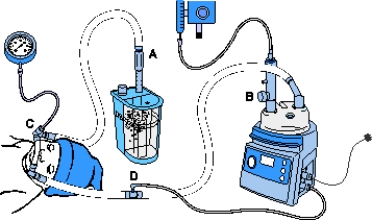
A) Point A
B) Point B
C) Point C
D) Point D
A) Point A
B) Point B
C) Point C
D) Point D

Unlock Deck
Sign up to unlock the cards in this deck!
Unlock Deck
Unlock Deck
1/40

Play

Full screen (f)
Deck 22: Neonatal and Pediatric Ventilation
1
Nasal CPAP should be administered to a neonate with _______________.
A) cleft palate
B) choanal atresia
C) apnea of prematurity
D) tracheoesophageal fistula
A) cleft palate
B) choanal atresia
C) apnea of prematurity
D) tracheoesophageal fistula
apnea of prematurity
2
A newborn with which of the following clinical manifestations should receive nasal CPAP?
A) Substernal retractions,PaCO2 = 65 mm Hg,PaO2 = 48 mm Hg,FIO2 = 0.4.
B) Tachypnea,nasal flaring,PaCO2 = 50 mm Hg,PaO2 = 50 mm Hg,FIO2 = 0.6.
C) Grunting,substernal retractions,pH = 7.20,PaCO2 = 70 mm Hg,PaO2 = 40 mm Hg,FIO2 = 0.7.
D) Tachypnea,pale skin,pH = 7.32,PaCO2 = 45 mm Hg,PaO2 = 75 mm Hg,FIO2 = 0.21.
A) Substernal retractions,PaCO2 = 65 mm Hg,PaO2 = 48 mm Hg,FIO2 = 0.4.
B) Tachypnea,nasal flaring,PaCO2 = 50 mm Hg,PaO2 = 50 mm Hg,FIO2 = 0.6.
C) Grunting,substernal retractions,pH = 7.20,PaCO2 = 70 mm Hg,PaO2 = 40 mm Hg,FIO2 = 0.7.
D) Tachypnea,pale skin,pH = 7.32,PaCO2 = 45 mm Hg,PaO2 = 75 mm Hg,FIO2 = 0.21.
Tachypnea,nasal flaring,PaCO2 = 50 mm Hg,PaO2 = 50 mm Hg,FIO2 = 0.6.
3
A full-term neonate shows signs of respiratory distress after delivery by cesarean section.The baby is placed on nasal CPAP at 4 cm H2O with an FIO2 of 0.6.The ABG results on these settings are: pH = 7.32,PaCO2 = 45 mm Hg,PaO2 = 48 mm Hg,SaO2 = 70%,HCO3- = 22 mEq/L.The respiratory therapist should recommend which of the following?
A) Switch to NIPPV.
B) Increase the FIO2 to 0.7.
C) Increase the CPAP to 6 cm H2O.
D) Intubate and use ventilator CPAP.
A) Switch to NIPPV.
B) Increase the FIO2 to 0.7.
C) Increase the CPAP to 6 cm H2O.
D) Intubate and use ventilator CPAP.
Increase the CPAP to 6 cm H2O.
4
Bubble CPAP should _________________.
A) bubble only on expiration
B) bubble only on inspiration
C) bubble on inspiration and expiration
D) have a gas flow setting of 10 L/min
A) bubble only on expiration
B) bubble only on inspiration
C) bubble on inspiration and expiration
D) have a gas flow setting of 10 L/min
Unlock Deck
Unlock for access to all 40 flashcards in this deck.
Unlock Deck
k this deck
5
Oxygen delivery and tissue perfusion may be evaluated clinically by which of the following?
A) Mucus membrane color
B) Skin color and tone
C) Capillary refill
D) Chest x-ray
A) Mucus membrane color
B) Skin color and tone
C) Capillary refill
D) Chest x-ray
Unlock Deck
Unlock for access to all 40 flashcards in this deck.
Unlock Deck
k this deck
6
A neonate of 30 weeks' gestation shows signs of respiratory distress after delivery,including grunting,nasal flaring,and cyanosis.The baby is placed on nasal CPAP at 6 cm H2O with an FIO2 of 0.6.The grunting and nasal flaring are alleviated,and the ABG results on these settings are: pH = 7.20,PaCO2 = 64 mm Hg,PaO2 = 48 mm Hg,SaO2 = 70%,HCO3- = 21 mEq/L.The respiratory therapist should recommend which of the following?
A) Increase the CPAP to 8 cm H2O and the FIO2 to 0.7.
B) Switch to nasal IMV,an inspiratory pressure of 18 cm H2O,PEEP of 4 cm H2O,and an FIO2 of 0.8.
C) Continue with the current settings and monitor the patient closely.
D) Intubate and use PC-IMV,an inspiratory pressure of 16 cm H2O,PEEP of 5 cm H2O,and an FIO2 of 0.8.
A) Increase the CPAP to 8 cm H2O and the FIO2 to 0.7.
B) Switch to nasal IMV,an inspiratory pressure of 18 cm H2O,PEEP of 4 cm H2O,and an FIO2 of 0.8.
C) Continue with the current settings and monitor the patient closely.
D) Intubate and use PC-IMV,an inspiratory pressure of 16 cm H2O,PEEP of 5 cm H2O,and an FIO2 of 0.8.
Unlock Deck
Unlock for access to all 40 flashcards in this deck.
Unlock Deck
k this deck
7
The most common interface for infants receiving CPAP is which of the following?
A) Nasopharyngeal tube
B) Binasal prongs
C) Nasal mask
D) Endotracheal tube
A) Nasopharyngeal tube
B) Binasal prongs
C) Nasal mask
D) Endotracheal tube
Unlock Deck
Unlock for access to all 40 flashcards in this deck.
Unlock Deck
k this deck
8
Respiratory failure is imminent in infants who demonstrate which of the following?
A) Substernal retractions
B) Tachypnea
C) Grunting
D) Nasal flaring
A) Substernal retractions
B) Tachypnea
C) Grunting
D) Nasal flaring
Unlock Deck
Unlock for access to all 40 flashcards in this deck.
Unlock Deck
k this deck
9
The mode of ventilation that allows a neonate to breathe at a high and a low CPAP setting is which of the following?
A) Nasal SiPAP
B) NIPPV
C) Nasal IMV
D) Nasal HFV
A) Nasal SiPAP
B) NIPPV
C) Nasal IMV
D) Nasal HFV
Unlock Deck
Unlock for access to all 40 flashcards in this deck.
Unlock Deck
k this deck
10
A newborn of 32 weeks' gestation currently is receiving nasal CPAP.The respiratory therapist recently increased the CPAP level from 8 to 10 cm H2O;the FIO2 is 0.6.On the new setting,the PaO2 is 52 mm Hg and the PaCO2 increased from 48 to 55 mm Hg.The most likely cause of this is which of the following?
A) Barotrauma
B) Alveolar overdistention
C) Ventilator-induced lung injury
D) Increased pulmonary vascular resistance
A) Barotrauma
B) Alveolar overdistention
C) Ventilator-induced lung injury
D) Increased pulmonary vascular resistance
Unlock Deck
Unlock for access to all 40 flashcards in this deck.
Unlock Deck
k this deck
11
Pressure support should not be used in neonates receiving nasal IMV because of which of the following?
1)Large airway leaks
2)Ineffectiveness of triggering
3)Increased risk of volutrauma
4)Hypocapnia from excessive triggering
A) 1 and 2
B) 1 and 3
C) 2 and 3
D) 4
1)Large airway leaks
2)Ineffectiveness of triggering
3)Increased risk of volutrauma
4)Hypocapnia from excessive triggering
A) 1 and 2
B) 1 and 3
C) 2 and 3
D) 4
Unlock Deck
Unlock for access to all 40 flashcards in this deck.
Unlock Deck
k this deck
12
The minimum acceptable pH for a premature or term newborn is which of the following?
A) 7.20
B) 7.25
C) 7.30
D) 7.35
A) 7.20
B) 7.25
C) 7.30
D) 7.35
Unlock Deck
Unlock for access to all 40 flashcards in this deck.
Unlock Deck
k this deck
13
Infants with which of the following problems would benefit from nasal CPAP?
A) Cleft palate
B) Choanal atresia
C) Patent ductus arteriosus
D) Tracheoesophageal fistula
A) Cleft palate
B) Choanal atresia
C) Patent ductus arteriosus
D) Tracheoesophageal fistula
Unlock Deck
Unlock for access to all 40 flashcards in this deck.
Unlock Deck
k this deck
14
Potential harmful effects of nasal CPAP include which of the following?
A) Volutrauma
B) CO2 retention
C) Oxygen toxicity
D) Ventilator-induced lung injury
A) Volutrauma
B) CO2 retention
C) Oxygen toxicity
D) Ventilator-induced lung injury
Unlock Deck
Unlock for access to all 40 flashcards in this deck.
Unlock Deck
k this deck
15
NIPPV can be used successfully in neonates for which of the following?
A) Severe ventilatory impairment
B) Persistent apnea
C) After extubation
D) Cleft palate
A) Severe ventilatory impairment
B) Persistent apnea
C) After extubation
D) Cleft palate
Unlock Deck
Unlock for access to all 40 flashcards in this deck.
Unlock Deck
k this deck
16
The gas flow rate for a noncommercial bubble CPAP device should be set at _______ L/min.
A) 3
B) 5
C) 8
D) 10
A) 3
B) 5
C) 8
D) 10
Unlock Deck
Unlock for access to all 40 flashcards in this deck.
Unlock Deck
k this deck
17
The primary goals of mechanical ventilatory support in newborns and pediatric patients include all of the following except ____________________.
A) improving lung compliance
B) eliminating airway resistance
C) achieving adequate lung volume
D) limiting lung injury
A) improving lung compliance
B) eliminating airway resistance
C) achieving adequate lung volume
D) limiting lung injury
Unlock Deck
Unlock for access to all 40 flashcards in this deck.
Unlock Deck
k this deck
18
Neonatal patients are more vulnerable to rapid deterioration because of ________________.
A) high chest wall compliance
B) low functional residual capacity
C) smaller surface area for gas exchange
D) presence of fetal hemoglobin
A) high chest wall compliance
B) low functional residual capacity
C) smaller surface area for gas exchange
D) presence of fetal hemoglobin
Unlock Deck
Unlock for access to all 40 flashcards in this deck.
Unlock Deck
k this deck
19
A 5-year-old patient diagnosed with tracheomalacia after a long intubation has had numerous failures to wean and extubate.What should the respiratory therapist recommend to help alleviate spontaneous breathing problems associated with tracheomalacia until a stent can be placed in the airway?
A) BiPAP
B) Nasal HFV
C) Nasal SiPAP
D) Tracheostomy and CPAP
A) BiPAP
B) Nasal HFV
C) Nasal SiPAP
D) Tracheostomy and CPAP
Unlock Deck
Unlock for access to all 40 flashcards in this deck.
Unlock Deck
k this deck
20
The pressure manometer in-line with a bubble CPAP setup is reading higher than the depth of the expiratory limb in the liquid-filled bottle.This is most likely caused by which of the following?
A) Set flow rate above 5 L/min
B) Set flow rate below 5 L/min
C) Fluid in the inspiratory line
D) Improperly placed manometer
A) Set flow rate above 5 L/min
B) Set flow rate below 5 L/min
C) Fluid in the inspiratory line
D) Improperly placed manometer
Unlock Deck
Unlock for access to all 40 flashcards in this deck.
Unlock Deck
k this deck
21
Calculate the percent leak when the VTinsp is 45 mL and the VTexp is 37 mL.
A) 0.8%
B) 1.2%
C) 17.8%
D) 21.6%
A) 0.8%
B) 1.2%
C) 17.8%
D) 21.6%
Unlock Deck
Unlock for access to all 40 flashcards in this deck.
Unlock Deck
k this deck
22
A mechanically ventilated pediatric patient in the process of being weaned is switched to PC-IMV with PS.The respiratory therapist notes that every PS breath is being time cycled.The most likely cause of this is which of the following?
A) The PS setting is too high.
B) The flow cycle setting is too low.
C) This is the normal cycle for PS.
D) A large leak is present around the cuffless ET tube.
A) The PS setting is too high.
B) The flow cycle setting is too low.
C) This is the normal cycle for PS.
D) A large leak is present around the cuffless ET tube.
Unlock Deck
Unlock for access to all 40 flashcards in this deck.
Unlock Deck
k this deck
23
The patient with which of the following conditions should be considered for HFV?
A) Status asthmaticus
B) Bronchopleural fistula
C) Meconium aspiration
D) Cystic fibrosis
A) Status asthmaticus
B) Bronchopleural fistula
C) Meconium aspiration
D) Cystic fibrosis
Unlock Deck
Unlock for access to all 40 flashcards in this deck.
Unlock Deck
k this deck
24
A pediatric patient intubated with a 3.5 mm endotracheal tube is receiving pressure support ventilation.The respiratory therapist notes patient-ventilator asynchrony and a rapid deceleration of flow that prematurely ends inspiration.The most appropriate action to alleviate this is which of the following?
A) Increase the PS level.
B) Increase the rise time.
C) Decrease the PS level.
D) Increase the flow cycle.
A) Increase the PS level.
B) Increase the rise time.
C) Decrease the PS level.
D) Increase the flow cycle.
Unlock Deck
Unlock for access to all 40 flashcards in this deck.
Unlock Deck
k this deck
25
Which type of trigger allows for better synchronization during neonatal ventilation?
A) Flow
B) Time
C) Volume
D) Pressure
A) Flow
B) Time
C) Volume
D) Pressure
Unlock Deck
Unlock for access to all 40 flashcards in this deck.
Unlock Deck
k this deck
26
Neurally adjusted ventilator assist (NAVA)is particularly useful with newborns because it ___________________.
A) reduces gas trapping.
B) is not affected by leaks.
C) decreases the development of VILA.
D) is sensitive to changes in respiratory drive.
A) reduces gas trapping.
B) is not affected by leaks.
C) decreases the development of VILA.
D) is sensitive to changes in respiratory drive.
Unlock Deck
Unlock for access to all 40 flashcards in this deck.
Unlock Deck
k this deck
27
During HFOV,oxygenation can be improved by making which of the following changes?
1)Increasing the FIO2
2)Decreasing the amplitude
3)Increasing the
4)Increasing the frequency
A) 1 and 2
B) 1 and 3
C) 2 and 3
D) 2 and 4
1)Increasing the FIO2
2)Decreasing the amplitude
3)Increasing the
4)Increasing the frequency
A) 1 and 2
B) 1 and 3
C) 2 and 3
D) 2 and 4
Unlock Deck
Unlock for access to all 40 flashcards in this deck.
Unlock Deck
k this deck
28
Both inspiration and expiration are active in which type of high-frequency ventilation?
A) High-frequency positive pressure ventilation
B) High-frequency oscillatory ventilation
C) High-frequency jet ventilation
D) High-frequency percussive ventilation
A) High-frequency positive pressure ventilation
B) High-frequency oscillatory ventilation
C) High-frequency jet ventilation
D) High-frequency percussive ventilation
Unlock Deck
Unlock for access to all 40 flashcards in this deck.
Unlock Deck
k this deck
29
The number of time constants for almost complete equilibration of alveolar pressure in a normal infant's lungs is___________.
A) 1 to 3
B) 2 to 4
C) 3 to 5
D) 4 to 7
A) 1 to 3
B) 2 to 4
C) 3 to 5
D) 4 to 7
Unlock Deck
Unlock for access to all 40 flashcards in this deck.
Unlock Deck
k this deck
30
The inspiratory time setting for an infant with bronchopulmonary dysplasia (BPD),airway resistance of 45 cm H2O/L/sec,and lung compliance of 0.004 L/cm H2O should be which of the following?
A) 0.25 sec
B) 0.45 sec
C) 0.6 sec
D) 0.9 sec
A) 0.25 sec
B) 0.45 sec
C) 0.6 sec
D) 0.9 sec
Unlock Deck
Unlock for access to all 40 flashcards in this deck.
Unlock Deck
k this deck
31
A neonate is being ventilated with PRVC.The respiratory therapist responds to a low volume alarm.After checking the patient and the ventilator,the respiratory therapist finds no disconnects.The most appropriate action is which of the following?
A) Draw a sample for arterial blood gas evaluation.
B) Increase the target volume.
C) Put the patient in the PC-CMV mode.
D) Recommend surfactant replacement therapy.
A) Draw a sample for arterial blood gas evaluation.
B) Increase the target volume.
C) Put the patient in the PC-CMV mode.
D) Recommend surfactant replacement therapy.
Unlock Deck
Unlock for access to all 40 flashcards in this deck.
Unlock Deck
k this deck
32
A pediatric patient with a 5 mm ET tube is ready to be switched to PSV.What minimum PS level should be used for this patient?
A) 4 cm H2O
B) 6 cm H2O
C) 8 cm H2O
D) 10 cm H2O
A) 4 cm H2O
B) 6 cm H2O
C) 8 cm H2O
D) 10 cm H2O
Unlock Deck
Unlock for access to all 40 flashcards in this deck.
Unlock Deck
k this deck
33
A 3-month-old,6.4 kg infant with ARDS is receiving ventilatory support.The initial settings are: PC-CMV,PIP = 22 cm H2O,PEEP = 5 cm H2O,rate = 30 breaths/min,FIO2 = 0.6.The ABG results show a PaO2 of 48 mm Hg.The respiratory therapist increases the PEEP to 8 cm H2O.The pressure-volume loops below show the change that occurs after this increase.(Loop A(solid line)was generated from the initial settings.Loop B (dashed line)was generated from the increase in PEEP). The respiratory therapist's most appropriate action is which of the following?
A) Decrease the PEEP to 5 cm H2O.
B) Keep the PEEP at 8 cm H2O.
C) Decrease the PIP to 20 cm H2O.
D) Increase the PIP to 24 cm H2O.
A) Decrease the PEEP to 5 cm H2O.
B) Keep the PEEP at 8 cm H2O.
C) Decrease the PIP to 20 cm H2O.
D) Increase the PIP to 24 cm H2O.
Unlock Deck
Unlock for access to all 40 flashcards in this deck.
Unlock Deck
k this deck
34
A preterm neonate is being supported with nasal SiPAP.The baseline CPAP level is set at 6 cm H2O,the high CPAP level at 10 cm H2O,the rate is 20 "sigh" breaths,and the FIO2 is 0.8.The baby's PaO2 on these settings has been steadily declining and is now 48 mm Hg.The physician and respiratory therapist decided to use nasal HFV before intubating and using mechanical ventilation.The initial settings for NHFV for this patient should include which of the following?
A) = 10 cm H2O;frequency = 8 Hz;FIO2 = 1.0
B) 11ec6bb5_55b1_7aba_9e38_819835ae16b2_TB1877_00= 10 cm H2O;frequency = 10 Hz;FIO2 = 0.8
C) 11ec6bb5_55b1_7aba_9e38_819835ae16b2_TB1877_00= 6 cm H2O;frequency = 8 Hz;FIO2 = 0.8
D) 11ec6bb5_55b1_7aba_9e38_819835ae16b2_TB1877_00
= 6 cm H2O; frequency = 10 Hz; FIO2 = 1.0
A)
= 10 cm H2O;frequency = 8 Hz;FIO2 = 1.0B) 11ec6bb5_55b1_7aba_9e38_819835ae16b2_TB1877_00= 10 cm H2O;frequency = 10 Hz;FIO2 = 0.8
C) 11ec6bb5_55b1_7aba_9e38_819835ae16b2_TB1877_00= 6 cm H2O;frequency = 8 Hz;FIO2 = 0.8
D) 11ec6bb5_55b1_7aba_9e38_819835ae16b2_TB1877_00
= 6 cm H2O; frequency = 10 Hz; FIO2 = 1.0
Unlock Deck
Unlock for access to all 40 flashcards in this deck.
Unlock Deck
k this deck
35
A pediatric patient with air leak syndrome is being ventilated with PC-CMV.The settings are: rate = 20 breaths/min,TI = 0.8 sec,PIP = 30 cm H2O,PEEP = 8 cm H2O,FIO2 = 0.8, = 14 cm H2O.The patient is to be switched to HFOV.What range is appropriate for this patient?
A) 8 to 10 cm H2O
B) 10 to 12 cm H2O
C) 12 to 14 cm H2O
D) 14 to 16 cm H2O
= 14 cm H2O.The patient is to be switched to HFOV.What range is appropriate for this patient?A) 8 to 10 cm H2O
B) 10 to 12 cm H2O
C) 12 to 14 cm H2O
D) 14 to 16 cm H2O
Unlock Deck
Unlock for access to all 40 flashcards in this deck.
Unlock Deck
k this deck
36
Newer ventilators allow neonates to use what type of trigger for better synchronization with the ventilator?
A) Time
B) Flow
C) Pressure
D) Volume
A) Time
B) Flow
C) Pressure
D) Volume
Unlock Deck
Unlock for access to all 40 flashcards in this deck.
Unlock Deck
k this deck
37
The maximum percent leak that may be allowed around a cuffless endotracheal tube is which of the following?
A) 6%
B) 12%
C) 19%
D) 25%
A) 6%
B) 12%
C) 19%
D) 25%
Unlock Deck
Unlock for access to all 40 flashcards in this deck.
Unlock Deck
k this deck
38
An 835 g newborn is receiving HFOV with the following settings: = 10 cm H2O;FIO2 = 0.6;frequency = 10 Hz;amplitude (P)= 20 cm H2O.The ABG values are: pH = 7.35,PaCO2 = 40 mm Hg,PaO2 = 40 mm Hg.Based on these data,which of the following is the most appropriate action?
A) Increase the frequency.
B) Increase the.
C) Decrease the amplitude.
D) Decrease the bias flow.
= 10 cm H2O;FIO2 = 0.6;frequency = 10 Hz;amplitude (P)= 20 cm H2O.The ABG values are: pH = 7.35,PaCO2 = 40 mm Hg,PaO2 = 40 mm Hg.Based on these data,which of the following is the most appropriate action?A) Increase the frequency.
B) Increase the.
C) Decrease the amplitude.
D) Decrease the bias flow.
Unlock Deck
Unlock for access to all 40 flashcards in this deck.
Unlock Deck
k this deck
39
The inspiratory time setting for an infant with RDS,airway resistance of 30 cm H2O/L/sec,and lung compliance of 0.002 L/cm H2O should be which of the following?
A) 0.25 sec
B) 0.30 sec
C) 0.45 sec
D) 0.55 sec
A) 0.25 sec
B) 0.30 sec
C) 0.45 sec
D) 0.55 sec
Unlock Deck
Unlock for access to all 40 flashcards in this deck.
Unlock Deck
k this deck
40
The pressure manometer should be placed at which point in the following CPAP system?
A) Point A
B) Point B
C) Point C
D) Point D
A) Point A
B) Point B
C) Point C
D) Point D
Unlock Deck
Unlock for access to all 40 flashcards in this deck.
Unlock Deck
k this deck
Unlock Deck
Unlock for access to all 40 flashcards in this deck.







