





 Chat with AI

Deck 4: Tissues
Full screen (f)

Question

Question
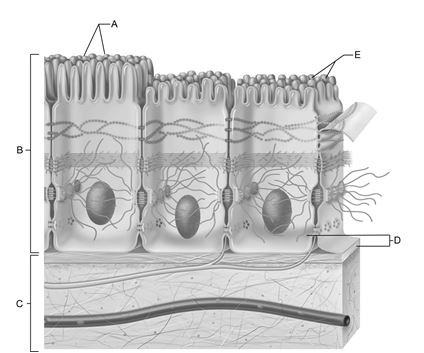
Figure 4.1
Use the diagram above to answer the following questions.
Which letter indicates the connective tissue layer?
A) A
B) B
C) C
D) D
E) E
Question
Question
Question
Question
Question
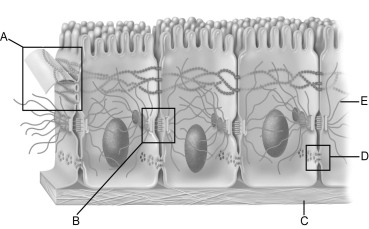
Figure 4.2
Use the diagram above to answer the following questions.
Which letter indicates the acellular layer that acts as a selective filter and a scaffold for regenerating epithelial cells?
A) A
B) B
C) C
D) D
E) E
Question
Question
Figure 4.2
Use the diagram above to answer the following questions.
Which letter indicates junctions commonly associated with tissues under mechanical stress?
A) A
B) B
C) C
D) D
E) E
Question
Figure 4.1
Use the diagram above to answer the following questions.
Which letter indicates microvilli?
A) A
B) B
C) C
D) D
E) E
Question
Figure 4.2
Use the diagram above to answer the following questions.
Which letter indicates tunnel-like junctions in the lateral membranes of adjacent epithelial cells?
A) A
B) B
C) C
D) D
E) E
Question
Figure 4.2
Use the diagram above to answer the following questions.
Which letter indicates a cellular junction that prevents molecules from passing between epithelial cells?
A) A
B) B
C) C
D) D
E) E
Question
Figure 4.1
Use the diagram above to answer the following questions.
Which letter indicates the epithelium?
A) A
B) B
C) C
D) D
E) E
Question
Figure 4.1
Use the diagram above to answer the following questions.
Which letter on the diagram indicates motile structural elements of the epithelial membrane?
A) A
B) B
C) C
D) D
E) E
Question
Question
Figure 4.2
Use the diagram above to answer the following questions.
Which letter indicates the cytoplasmic protein fiber that connects desmosomes?
A) A
B) B
C) C
D) D
E) E
Question
Question
Figure 4.1
Use the diagram above to answer the following questions.
Which letter indicates the basement membrane?
A) A
B) B
C) C
D) D
E) E
Question
Question
Question
Question
Question
Question
Question
Question
Question
Question
Question
Question
Question
Question
Question
Question
Question
Question
Question
Question
Question
Question
Question
Question
Question
Question
Question
Question
Question
Question
Question
Question
Question
Question
Question
Question
Question
Question
Question
Question
Question
Question
Question
Question
Question
Question
Question
Question
Question
Question
Question
Question
Question
Question
Question
Question
Question
Question
Question
Question
Question
Question

Unlock Deck
Sign up to unlock the cards in this deck!
Unlock Deck
Unlock Deck
1/110

Play

Full screen (f)
Deck 4: Tissues
1
Which major category of tissues has the most diverse and most numerous types of tissue?
A) muscle
B) nervous
C) connective
D) epithelial
A) muscle
B) nervous
C) connective
D) epithelial
C
2
Figure 4.1
Use the diagram above to answer the following questions.
Which letter indicates the connective tissue layer?
A) A
B) B
C) C
D) D
E) E
C
3
Pseudostratified columnar is one of the tissues of this category.
A) muscle
B) nervous
C) connective
D) epithelial
A) muscle
B) nervous
C) connective
D) epithelial
D
4
Histologists consider blood to be an example of what primary tissue category?
A) muscle
B) nervous
C) connective
D) epithelial
A) muscle
B) nervous
C) connective
D) epithelial
Unlock Deck
Unlock for access to all 110 flashcards in this deck.
Unlock Deck
k this deck
5
Which category of tissue is characterized by cells that have adhesion proteins and specialized cell-to-cell junctions?
A) muscle
B) nervous
C) connective
D) epithelial
A) muscle
B) nervous
C) connective
D) epithelial
Unlock Deck
Unlock for access to all 110 flashcards in this deck.
Unlock Deck
k this deck
6
Which tissue category contains tissues comprised of cells containing myofilaments?
A) muscle
B) nervous
C) connective
D) epithelial
A) muscle
B) nervous
C) connective
D) epithelial
Unlock Deck
Unlock for access to all 110 flashcards in this deck.
Unlock Deck
k this deck
7
Figure 4.2
Use the diagram above to answer the following questions.
Which letter indicates the acellular layer that acts as a selective filter and a scaffold for regenerating epithelial cells?
A) A
B) B
C) C
D) D
E) E
Unlock Deck
Unlock for access to all 110 flashcards in this deck.
Unlock Deck
k this deck
8
Bone and cartilage are examples of tissues in this category.
A) muscle
B) nervous
C) connective
D) epithelial
A) muscle
B) nervous
C) connective
D) epithelial
Unlock Deck
Unlock for access to all 110 flashcards in this deck.
Unlock Deck
k this deck
9
Figure 4.2
Use the diagram above to answer the following questions.
Which letter indicates junctions commonly associated with tissues under mechanical stress?
A) A
B) B
C) C
D) D
E) E
Unlock Deck
Unlock for access to all 110 flashcards in this deck.
Unlock Deck
k this deck
10
Figure 4.1
Use the diagram above to answer the following questions.
Which letter indicates microvilli?
A) A
B) B
C) C
D) D
E) E
Unlock Deck
Unlock for access to all 110 flashcards in this deck.
Unlock Deck
k this deck
11
Figure 4.2
Use the diagram above to answer the following questions.
Which letter indicates tunnel-like junctions in the lateral membranes of adjacent epithelial cells?
A) A
B) B
C) C
D) D
E) E
Unlock Deck
Unlock for access to all 110 flashcards in this deck.
Unlock Deck
k this deck
12
Figure 4.2
Use the diagram above to answer the following questions.
Which letter indicates a cellular junction that prevents molecules from passing between epithelial cells?
A) A
B) B
C) C
D) D
E) E
Unlock Deck
Unlock for access to all 110 flashcards in this deck.
Unlock Deck
k this deck
13
Figure 4.1
Use the diagram above to answer the following questions.
Which letter indicates the epithelium?
A) A
B) B
C) C
D) D
E) E
Unlock Deck
Unlock for access to all 110 flashcards in this deck.
Unlock Deck
k this deck
14
Figure 4.1
Use the diagram above to answer the following questions.
Which letter on the diagram indicates motile structural elements of the epithelial membrane?
A) A
B) B
C) C
D) D
E) E
Unlock Deck
Unlock for access to all 110 flashcards in this deck.
Unlock Deck
k this deck
15
This tissue type, in addition to certain muscle tissues, is capable of generating electrical impulses.
A) muscle
B) nervous
C) connective
D) epithelial
A) muscle
B) nervous
C) connective
D) epithelial
Unlock Deck
Unlock for access to all 110 flashcards in this deck.
Unlock Deck
k this deck
16
Figure 4.2
Use the diagram above to answer the following questions.
Which letter indicates the cytoplasmic protein fiber that connects desmosomes?
A) A
B) B
C) C
D) D
E) E
Unlock Deck
Unlock for access to all 110 flashcards in this deck.
Unlock Deck
k this deck
17
Cells lining the digestive tube are characteristic of this tissue category.
A) muscle
B) nervous
C) connective
D) epithelial
A) muscle
B) nervous
C) connective
D) epithelial
Unlock Deck
Unlock for access to all 110 flashcards in this deck.
Unlock Deck
k this deck
18
Figure 4.1
Use the diagram above to answer the following questions.
Which letter indicates the basement membrane?
A) A
B) B
C) C
D) D
E) E
Unlock Deck
Unlock for access to all 110 flashcards in this deck.
Unlock Deck
k this deck
19
Which major tissue category includes tissues that function in secretion, absorption, and filtration?
A) muscle
B) nervous
C) connective
D) epithelial
A) muscle
B) nervous
C) connective
D) epithelial
Unlock Deck
Unlock for access to all 110 flashcards in this deck.
Unlock Deck
k this deck
20
The primary contractile tissue of the heart characterizes tissues in this category.
A) muscle
B) nervous
C) connective
D) epithelial
A) muscle
B) nervous
C) connective
D) epithelial
Unlock Deck
Unlock for access to all 110 flashcards in this deck.
Unlock Deck
k this deck
21
The brain and spinal cord are composed primarily of this tissue type.
A) muscle
B) nervous
C) connective
D) epithelial
A) muscle
B) nervous
C) connective
D) epithelial
Unlock Deck
Unlock for access to all 110 flashcards in this deck.
Unlock Deck
k this deck
22
A structure that secretes hormones into the blood is
A) a plasma cell.
B) a goblet cell.
C) an endocrine gland.
D) an exocrine gland.
A) a plasma cell.
B) a goblet cell.
C) an endocrine gland.
D) an exocrine gland.
Unlock Deck
Unlock for access to all 110 flashcards in this deck.
Unlock Deck
k this deck
23
Which of the following provides the least resistance to diffusion?
A) simple columnar epithelium
B) simple cuboidal epithelium
C) simple squamous epithelium
D) stratified squamous epithelium
A) simple columnar epithelium
B) simple cuboidal epithelium
C) simple squamous epithelium
D) stratified squamous epithelium
Unlock Deck
Unlock for access to all 110 flashcards in this deck.
Unlock Deck
k this deck
24
This type of tissue includes smooth and cardiac.
A) muscle
B) nervous
C) connective
D) epithelial
A) muscle
B) nervous
C) connective
D) epithelial
Unlock Deck
Unlock for access to all 110 flashcards in this deck.
Unlock Deck
k this deck
25
The major function of pseudostratified columnar epithelium is
A) secretion.
B) filtration.
C) protection.
D) absorption.
A) secretion.
B) filtration.
C) protection.
D) absorption.
Unlock Deck
Unlock for access to all 110 flashcards in this deck.
Unlock Deck
k this deck
26
Which of the following is not a characteristic of epithelia?
A) highly cellular with little extracellular matrix
B) innervated
C) specialized cell-cell junctions
D) vascular
A) highly cellular with little extracellular matrix
B) innervated
C) specialized cell-cell junctions
D) vascular
Unlock Deck
Unlock for access to all 110 flashcards in this deck.
Unlock Deck
k this deck
27
What do goblet cells secrete?
A) enzymes
B) histamine
C) mucin
D) antibodies
A) enzymes
B) histamine
C) mucin
D) antibodies
Unlock Deck
Unlock for access to all 110 flashcards in this deck.
Unlock Deck
k this deck
28
A highly branched gland whose walls do not balloon into spherical sacs is called
A) compound alveolar.
B) compound tubular.
C) compound tubuloalveolar.
D) simple branched alveolar.
A) compound alveolar.
B) compound tubular.
C) compound tubuloalveolar.
D) simple branched alveolar.
Unlock Deck
Unlock for access to all 110 flashcards in this deck.
Unlock Deck
k this deck
29
Adipocytes are found in tissues belonging to this category.
A) muscle
B) nervous
C) connective
D) epithelial
A) muscle
B) nervous
C) connective
D) epithelial
Unlock Deck
Unlock for access to all 110 flashcards in this deck.
Unlock Deck
k this deck
30
The major function of stratified squamous epithelium is
A) diffusion.
B) absorption.
C) filtration.
D) protection from abrasion.
A) diffusion.
B) absorption.
C) filtration.
D) protection from abrasion.
Unlock Deck
Unlock for access to all 110 flashcards in this deck.
Unlock Deck
k this deck
31
Which one of the following basic types of tissues functions to control the body?
A) epithelial
B) connective
C) muscle
D) nervous
A) epithelial
B) connective
C) muscle
D) nervous
Unlock Deck
Unlock for access to all 110 flashcards in this deck.
Unlock Deck
k this deck
32
Which of the following is not associated with connective tissue?
A) areolar
B) collagen
C) goblet cells
D) chondrocytes
A) areolar
B) collagen
C) goblet cells
D) chondrocytes
Unlock Deck
Unlock for access to all 110 flashcards in this deck.
Unlock Deck
k this deck
33
A stratified epithelium that thins and flattens as the tissue stretches is a
A) pseudostratified epithelium.
B) stratified cuboidal epithelium.
C) stratified squamous epithelium.
D) transitional epithelium.
A) pseudostratified epithelium.
B) stratified cuboidal epithelium.
C) stratified squamous epithelium.
D) transitional epithelium.
Unlock Deck
Unlock for access to all 110 flashcards in this deck.
Unlock Deck
k this deck
34
A type of connective tissue that is not a connective tissue proper is
A) dense irregular connective tissue.
B) areolar tissue.
C) adipose tissue.
D) cartilage.
A) dense irregular connective tissue.
B) areolar tissue.
C) adipose tissue.
D) cartilage.
Unlock Deck
Unlock for access to all 110 flashcards in this deck.
Unlock Deck
k this deck
35
Only one type of fiber in connective tissue can be stretched and then recoil-return to its original length and shape. This fiber is the
Unlock Deck
Unlock for access to all 110 flashcards in this deck.
Unlock Deck
k this deck
36
Of the types of lining and covering membranes, the only one that is drier than the others is
A) cutaneous.
B) serous.
C) mucous.
D) parietal.
A) cutaneous.
B) serous.
C) mucous.
D) parietal.
Unlock Deck
Unlock for access to all 110 flashcards in this deck.
Unlock Deck
k this deck
37
Tissues in this category are characterized by an extracellular matrix that holds some amount of fluid.
A) muscle
B) nervous
C) connective
D) epithelial
A) muscle
B) nervous
C) connective
D) epithelial
Unlock Deck
Unlock for access to all 110 flashcards in this deck.
Unlock Deck
k this deck
38
Simple squamous epithelia would not provide
A) protection from abrasion.
B) diffusion.
C) filtration.
D) secretion.
A) protection from abrasion.
B) diffusion.
C) filtration.
D) secretion.
Unlock Deck
Unlock for access to all 110 flashcards in this deck.
Unlock Deck
k this deck
39
The difference between a basal lamina and a basement membrane is that
A) the basal lamina is thicker.
B) they lie on opposite surfaces of the epithelium.
C) a basal lamina plus a layer of reticular fibers equals a basement membrane.
D) only the basal lamina can be seen by light microscopy.
A) the basal lamina is thicker.
B) they lie on opposite surfaces of the epithelium.
C) a basal lamina plus a layer of reticular fibers equals a basement membrane.
D) only the basal lamina can be seen by light microscopy.
Unlock Deck
Unlock for access to all 110 flashcards in this deck.
Unlock Deck
k this deck
40
Ligaments are examples of tissues in this category.
A) muscle
B) nervous
C) connective
D) epithelial
A) muscle
B) nervous
C) connective
D) epithelial
Unlock Deck
Unlock for access to all 110 flashcards in this deck.
Unlock Deck
k this deck
41
All lining and covering membranes consist of
A) an epithelium only.
B) a serosa.
C) an epithelium, a connective tissue, and smooth muscle.
D) epithelium and connective tissue.
A) an epithelium only.
B) a serosa.
C) an epithelium, a connective tissue, and smooth muscle.
D) epithelium and connective tissue.
Unlock Deck
Unlock for access to all 110 flashcards in this deck.
Unlock Deck
k this deck
42
Microvilli can perform all of the following functions except
A) enhance the rate of absorption.
B) enhance the rate of secretion.
C) moving and propelling fluids.
D) anchoring mucus.
A) enhance the rate of absorption.
B) enhance the rate of secretion.
C) moving and propelling fluids.
D) anchoring mucus.
Unlock Deck
Unlock for access to all 110 flashcards in this deck.
Unlock Deck
k this deck
43
Ligaments consist primarily of which kind of connective tissue?
A) loose areolar
B) dense irregular
C) cartilage
D) dense regular
A) loose areolar
B) dense irregular
C) cartilage
D) dense regular
Unlock Deck
Unlock for access to all 110 flashcards in this deck.
Unlock Deck
k this deck
44
Which of the following is not a characteristic of the inflammatory response?
A) attacks and eliminates specific foreign molecules
B) involves release of chemicals that cause local vasodilation
C) occurs within connective tissue
D) results in edema and delivery of chemicals needed for repair
A) attacks and eliminates specific foreign molecules
B) involves release of chemicals that cause local vasodilation
C) occurs within connective tissue
D) results in edema and delivery of chemicals needed for repair
Unlock Deck
Unlock for access to all 110 flashcards in this deck.
Unlock Deck
k this deck
45
Use logic to deduce which of the following tissues is on the anterior surface of a person's eyeball.
A) epithelial
B) connective
C) muscle
D) nervous
A) epithelial
B) connective
C) muscle
D) nervous
Unlock Deck
Unlock for access to all 110 flashcards in this deck.
Unlock Deck
k this deck
46
Glycosaminoglycans and proteoglycans are components of
A) blood.
B) inflammation.
C) ground substance.
D) reticular fibers.
A) blood.
B) inflammation.
C) ground substance.
D) reticular fibers.
Unlock Deck
Unlock for access to all 110 flashcards in this deck.
Unlock Deck
k this deck
47
Fat is a form of ________ tissue.
A) epithelial
B) connective
C) muscle
D) nervous
A) epithelial
B) connective
C) muscle
D) nervous
Unlock Deck
Unlock for access to all 110 flashcards in this deck.
Unlock Deck
k this deck
48
During repair of a scrape or cut through the skin, a blood clot is replaced with collagen-rich granulation tissue in a process called
A) inflammation.
B) organization.
C) repair.
D) regeneration.
A) inflammation.
B) organization.
C) repair.
D) regeneration.
Unlock Deck
Unlock for access to all 110 flashcards in this deck.
Unlock Deck
k this deck
49
An epithelium in which the basal layer of cells is cuboidal and the apical layer has cells that are thin, flat and irregular in shaper is a ________ epithelium.
A) stratified squamous
B) simple columnar
C) stratified cuboidal
D) simple cuboidal
A) stratified squamous
B) simple columnar
C) stratified cuboidal
D) simple cuboidal
Unlock Deck
Unlock for access to all 110 flashcards in this deck.
Unlock Deck
k this deck
50
The thinnest type of epithelium is
A) simple squamous.
B) pseudostratified columnar.
C) stratified squamous.
D) stratified columnar.
A) simple squamous.
B) pseudostratified columnar.
C) stratified squamous.
D) stratified columnar.
Unlock Deck
Unlock for access to all 110 flashcards in this deck.
Unlock Deck
k this deck
51
Which one of the following basic types of tissues has an extracellular matrix?
A) epithelial
B) connective
C) muscle
D) nervous
A) epithelial
B) connective
C) muscle
D) nervous
Unlock Deck
Unlock for access to all 110 flashcards in this deck.
Unlock Deck
k this deck
52
Connective tissue that must resist forces pulling it from many different directions without stretching would most likely be
A) areolar connective tissue.
B) dense irregular connective tissue.
C) dense regular connective tissue.
D) reticular connective tissues.
A) areolar connective tissue.
B) dense irregular connective tissue.
C) dense regular connective tissue.
D) reticular connective tissues.
Unlock Deck
Unlock for access to all 110 flashcards in this deck.
Unlock Deck
k this deck
53
It might be argued that all the defense mechanisms in areolar connective tissue act to prevent infection from reaching which other tissue type?
A) bone
B) epithelium
C) blood
D) muscle
A) bone
B) epithelium
C) blood
D) muscle
Unlock Deck
Unlock for access to all 110 flashcards in this deck.
Unlock Deck
k this deck
54
Despite their name, many types of cell junction are not very strong at joining and holding cells together. The cell junctions that best keep cells from being pulled apart are
A) tight junctions.
B) gap junctions.
C) desmosomes.
D) zonula occludens.
A) tight junctions.
B) gap junctions.
C) desmosomes.
D) zonula occludens.
Unlock Deck
Unlock for access to all 110 flashcards in this deck.
Unlock Deck
k this deck
55
The distinguishing characteristic between tight junctions and adherens junctions is that
A) adherens junctions attach to the actin myofilaments of the cytoskeleton, whereas tight junctions do not.
B) adherens junctions involve integral membrane proteins, whereas tight junctions do not.
C) tight junctions are present near apical lateral borders, whereas adherens junctions are located near basal lateral borders.
D) tight junctions involve fusion of proteins on adjacent cells, whereas adherens junctions create tunnels between adjacent cells.
A) adherens junctions attach to the actin myofilaments of the cytoskeleton, whereas tight junctions do not.
B) adherens junctions involve integral membrane proteins, whereas tight junctions do not.
C) tight junctions are present near apical lateral borders, whereas adherens junctions are located near basal lateral borders.
D) tight junctions involve fusion of proteins on adjacent cells, whereas adherens junctions create tunnels between adjacent cells.
Unlock Deck
Unlock for access to all 110 flashcards in this deck.
Unlock Deck
k this deck
56
The type of cell junction that permits small sugar molecules and ions to pass from the cytoplasm of one cell to that of another is a
A) tight junction.
B) gap junction.
C) desmosome.
D) zonula occludens.
A) tight junction.
B) gap junction.
C) desmosome.
D) zonula occludens.
Unlock Deck
Unlock for access to all 110 flashcards in this deck.
Unlock Deck
k this deck
57
Which one of the following basic types of tissues functions as a covering tissue for the body?
A) epithelial
B) connective
C) muscle
D) nervous
A) epithelial
B) connective
C) muscle
D) nervous
Unlock Deck
Unlock for access to all 110 flashcards in this deck.
Unlock Deck
k this deck
58
The best definition of fibrosis is
A) the production of collagen fibers.
B) the production of elastic fibers.
C) the formation of dense regular connective tissue.
D) the formation of scar tissue.
A) the production of collagen fibers.
B) the production of elastic fibers.
C) the formation of dense regular connective tissue.
D) the formation of scar tissue.
Unlock Deck
Unlock for access to all 110 flashcards in this deck.
Unlock Deck
k this deck
59
Inflamed tissue is often warm to the touch because of
A) accumulation of bacterial toxins.
B) increased blood flow to the area.
C) infiltration by neutrophils.
D) leakage of clotting proteins.
A) accumulation of bacterial toxins.
B) increased blood flow to the area.
C) infiltration by neutrophils.
D) leakage of clotting proteins.
Unlock Deck
Unlock for access to all 110 flashcards in this deck.
Unlock Deck
k this deck
60
In connective tissue proper, ground substance is manufactured and secreted by which type of cell?
A) fibroblast
B) endothelial cell
C) chondroblasts
D) osteocytes
A) fibroblast
B) endothelial cell
C) chondroblasts
D) osteocytes
Unlock Deck
Unlock for access to all 110 flashcards in this deck.
Unlock Deck
k this deck
61
A connective tissue that has a liquid matrix is
A) areolar connective tissue.
B) tissue fluid.
C) blood.
D) epithelium.
A) areolar connective tissue.
B) tissue fluid.
C) blood.
D) epithelium.
Unlock Deck
Unlock for access to all 110 flashcards in this deck.
Unlock Deck
k this deck
62
The mesothelium comprises the superficial layer of the serous membranes of the peritoneal, pleural, and pericardial cavities.
Unlock Deck
Unlock for access to all 110 flashcards in this deck.
Unlock Deck
k this deck
63
The embryonic tissue that gives rise to the adult connective tissues, consisting of star-shaped cells separated by large amounts of extracellular matrix, is
A) ectoderm.
B) epithelium.
C) mesenchyme.
D) hypoblast.
A) ectoderm.
B) epithelium.
C) mesenchyme.
D) hypoblast.
Unlock Deck
Unlock for access to all 110 flashcards in this deck.
Unlock Deck
k this deck
64
In connective tissue, extracellular matrix is not exactly the same as ground substance, because the matrix also contains
A) fibers.
B) cells.
C) an epithelium.
D) blood.
A) fibers.
B) cells.
C) an epithelium.
D) blood.
Unlock Deck
Unlock for access to all 110 flashcards in this deck.
Unlock Deck
k this deck
65
In bony tissues, chondrocytes are found in the lacunae.
Unlock Deck
Unlock for access to all 110 flashcards in this deck.
Unlock Deck
k this deck
66
Cancer can arise from each of the following except
A) induced apoptosis.
B) exposure to a carcinogen.
C) inactivation of a tumor-suppressor gene.
D) turning on of oncogenes.
A) induced apoptosis.
B) exposure to a carcinogen.
C) inactivation of a tumor-suppressor gene.
D) turning on of oncogenes.
Unlock Deck
Unlock for access to all 110 flashcards in this deck.
Unlock Deck
k this deck
67
When cells from a cancerous tumor travel to other parts of the body, this process is called
A) carcinogenesis.
B) malignancy.
C) metastasis.
D) transformation.
A) carcinogenesis.
B) malignancy.
C) metastasis.
D) transformation.
Unlock Deck
Unlock for access to all 110 flashcards in this deck.
Unlock Deck
k this deck
68
Areolar connective tissue forms the lamina propria of mucous membranes.
Unlock Deck
Unlock for access to all 110 flashcards in this deck.
Unlock Deck
k this deck
69
Cell junctions occur in which plasma membrane of epithelial cells?
A) apical
B) lateral
C) nuclear
D) basal lamina
A) apical
B) lateral
C) nuclear
D) basal lamina
Unlock Deck
Unlock for access to all 110 flashcards in this deck.
Unlock Deck
k this deck
70
When unstretched, transitional epithelium looks most like ________ epithelium.
A) simple squamous
B) pseudostratified columnar
C) stratified squamous
D) stratified cuboidal
A) simple squamous
B) pseudostratified columnar
C) stratified squamous
D) stratified cuboidal
Unlock Deck
Unlock for access to all 110 flashcards in this deck.
Unlock Deck
k this deck
71
In connective tissues, the primary extracellular molecules responsible for resisting tension are
A) intermediate filaments in fibroblasts.
B) collagen fibers.
C) proteoglycans
D) elastin fibers.
A) intermediate filaments in fibroblasts.
B) collagen fibers.
C) proteoglycans
D) elastin fibers.
Unlock Deck
Unlock for access to all 110 flashcards in this deck.
Unlock Deck
k this deck
72
Cartilage is a form of ________ tissue.
A) epithelial
B) connective
C) muscle
D) nervous
A) epithelial
B) connective
C) muscle
D) nervous
Unlock Deck
Unlock for access to all 110 flashcards in this deck.
Unlock Deck
k this deck
73
A common example of a unicellular exocrine gland is
A) a fibroblast.
B) any hormone-secreting cell.
C) an endothelial cell.
D) a goblet cell.
A) a fibroblast.
B) any hormone-secreting cell.
C) an endothelial cell.
D) a goblet cell.
Unlock Deck
Unlock for access to all 110 flashcards in this deck.
Unlock Deck
k this deck
74
Dense regular connective tissue is characterized by giving strength in all directions.
Unlock Deck
Unlock for access to all 110 flashcards in this deck.
Unlock Deck
k this deck
75
Multilayered epithelia are named for the cell shape found in the basal layer.
Unlock Deck
Unlock for access to all 110 flashcards in this deck.
Unlock Deck
k this deck
76
The type of cell junction that closes off the space between epithelial cells, thereby limiting the passage of small molecules, is the
A) tight junction.
B) adherens junction.
C) desmosome.
D) gap junction.
A) tight junction.
B) adherens junction.
C) desmosome.
D) gap junction.
Unlock Deck
Unlock for access to all 110 flashcards in this deck.
Unlock Deck
k this deck
77
A pseudostratified epithelium is always
A) simple.
B) ciliated.
C) stratified.
D) cuboidal.
A) simple.
B) ciliated.
C) stratified.
D) cuboidal.
Unlock Deck
Unlock for access to all 110 flashcards in this deck.
Unlock Deck
k this deck
78
Of the following, the tissue with the greatest capacity for regeneration is
A) skeletal muscle.
B) neurons.
C) epithelium.
D) smooth muscle.
A) skeletal muscle.
B) neurons.
C) epithelium.
D) smooth muscle.
Unlock Deck
Unlock for access to all 110 flashcards in this deck.
Unlock Deck
k this deck
79
A muscle fiber is
A) the same as a collagen fiber that is viewed by electron microscopy.
B) part of a striation of a muscle cell.
C) a muscle cell.
D) an intercalated disc.
A) the same as a collagen fiber that is viewed by electron microscopy.
B) part of a striation of a muscle cell.
C) a muscle cell.
D) an intercalated disc.
Unlock Deck
Unlock for access to all 110 flashcards in this deck.
Unlock Deck
k this deck
80
Tissue types which are known as mucous and serous membranes are comprised of sheets of epithelial cells and
A) adipose tissue.
B) areolar connective tissue.
C) reticular connective tissue
D) elastic connective tissue.
A) adipose tissue.
B) areolar connective tissue.
C) reticular connective tissue
D) elastic connective tissue.
Unlock Deck
Unlock for access to all 110 flashcards in this deck.
Unlock Deck
k this deck
Unlock Deck
Unlock for access to all 110 flashcards in this deck.







