





 Chat with AI

Deck 13: Meiosis and Sexual Life Cycles
Full screen (f)

Question

Question
Question
Question
Question
Question
Question
Question
Question
Question
Question
Question
Question
Question
Question
Question
Question
Question
Question
Question
Question
Question
For the following questions,match the key event of meiosis with the stages listed below.
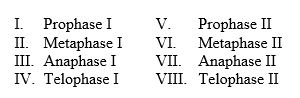
Tetrads of chromosomes are aligned at the equator of the spindle; alignment determines independent assortment.
A)I
B)II
C)IV
D)VI
E)VIII
Tetrads of chromosomes are aligned at the equator of the spindle; alignment determines independent assortment.
A)I
B)II
C)IV
D)VI
E)VIII
Question
For the following questions,match the key event of meiosis with the stages listed below.
Centromeres of sister chromatids disjoin and chromatids separate.
A)II
B)III
C)IV
D)V
E)VII
Centromeres of sister chromatids disjoin and chromatids separate.
A)II
B)III
C)IV
D)V
E)VII
Question
Question
Question
Question
Question
Question
Question
Question
Question
Question
For the following questions,match the key event of meiosis with the stages listed below.
Synaptonemal complexes form or are still present.
A)I only
B)I and IV only
C)I and VIII only
D)II and VI only
E)I, II, III, and IV only
Synaptonemal complexes form or are still present.
A)I only
B)I and IV only
C)I and VIII only
D)II and VI only
E)I, II, III, and IV only
Question
Question
Question
Question
Question
Question
Question
Question
Question
Question
You have isolated DNA from cells in different stages of meiosis within one species.You have determined the relative DNA content for each type,and plotted the results on the graph shown below.Refer to the graph to answer the following questions.
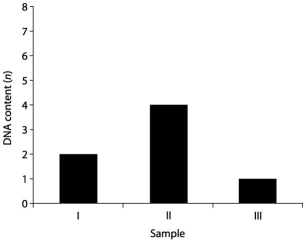
Which sample might represent an animal cell which is at the end of meiosis II?
A)I
B)II
C)III
D)both I and II
E)either II or III
Which sample might represent an animal cell which is at the end of meiosis II?
A)I
B)II
C)III
D)both I and II
E)either II or III
Question
Question
Question
Question
Refer to the life cycles illustrated in the figure below to answer the following questions.
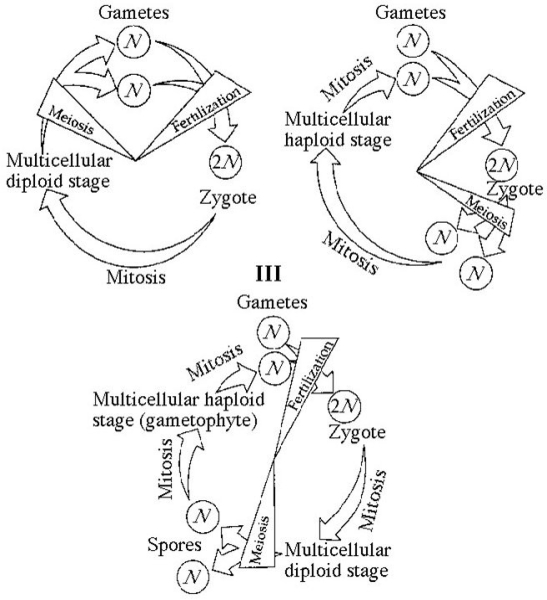
Which of the life cycles is typical for animals?
A)I only
B)II only
C)III only
D)I and II
E)I and III
Which of the life cycles is typical for animals?
A)I only
B)II only
C)III only
D)I and II
E)I and III
Question
Question
Refer to the life cycles illustrated in the figure below to answer the following questions.
Which of the life cycles is typical for most fungi and some protists?
A)I only
B)II only
C)III only
D)I and II
E)I and III
Which of the life cycles is typical for most fungi and some protists?
A)I only
B)II only
C)III only
D)I and II
E)I and III
Question
Question
Refer to the drawings below of a single pair of homologous chromosomes as they might appear during various stages of either mitosis or meiosis,and answer the following questions.
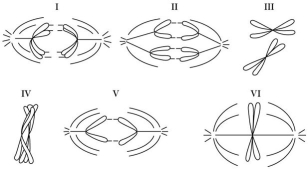
Which diagram(s)represent anaphase II of meiosis?
A)II only
B)III only
C)IV only
D)V only
E)either II or V
Which diagram(s)represent anaphase II of meiosis?
A)II only
B)III only
C)IV only
D)V only
E)either II or V
Question
Question
Question
Question
You have isolated DNA from cells in different stages of meiosis within one species.You have determined the relative DNA content for each type,and plotted the results on the graph shown below.Refer to the graph to answer the following questions.
Which sample of DNA might be from a cell at the end of meiosis I?
A)I
B)II
C)III
D)either I or II
E)either I or III
Which sample of DNA might be from a cell at the end of meiosis I?
A)I
B)II
C)III
D)either I or II
E)either I or III
Question
Question
Question
Refer to the life cycles illustrated in the figure below to answer the following questions.
Which of the life cycles is typical for plants and some algae?
A)I only
B)II only
C)III only
D)I and II
E)I and III
Which of the life cycles is typical for plants and some algae?
A)I only
B)II only
C)III only
D)I and II
E)I and III
Question
Question
Refer to the drawings below of a single pair of homologous chromosomes as they might appear during various stages of either mitosis or meiosis,and answer the following questions.
Which diagram represents anaphase I of meiosis?
A)I
B)II
C)IV
D)V
E)VI
Which diagram represents anaphase I of meiosis?
A)I
B)II
C)IV
D)V
E)VI
Question
Question
Question
Question
Question
Refer to the information and figure below to answer the following question(s).
A certain (hypothetical)organism is diploid,has either blue or orange wings as the consequence of one of its genes on chromosome 12,and has either long or short antennae as the result of a second gene on chromosome 19,as shown in the figure.

A certain female's number 12 chromosomes both have the blue gene,and number 19 chromosomes both have the long gene.As cells in her ovaries undergo meiosis,her resulting eggs (ova)may have which of the following?
A)either two number 12 chromosomes with blue genes, or two with orange genes
B)either two number 19 chromosomes with long genes, or two with short genes
C)either one blue or one orange gene, in addition to either one long or one short gene
D)one chromosome 12 with one blue gene and one chromosome 19 with one long gene
E)two chromosomes of 12 each with one blue gene and two chromosomes of 19 each with one long gene
A certain (hypothetical)organism is diploid,has either blue or orange wings as the consequence of one of its genes on chromosome 12,and has either long or short antennae as the result of a second gene on chromosome 19,as shown in the figure.
A certain female's number 12 chromosomes both have the blue gene,and number 19 chromosomes both have the long gene.As cells in her ovaries undergo meiosis,her resulting eggs (ova)may have which of the following?
A)either two number 12 chromosomes with blue genes, or two with orange genes
B)either two number 19 chromosomes with long genes, or two with short genes
C)either one blue or one orange gene, in addition to either one long or one short gene
D)one chromosome 12 with one blue gene and one chromosome 19 with one long gene
E)two chromosomes of 12 each with one blue gene and two chromosomes of 19 each with one long gene
Question
Question
Question
Question
Refer to the information and figure below to answer the following question(s).
A certain (hypothetical)organism is diploid,has either blue or orange wings as the consequence of one of its genes on chromosome 12,and has either long or short antennae as the result of a second gene on chromosome 19,as shown in the figure.
If a female of this species has one chromosome 12 with a blue gene and another chromosome 12 with an orange gene,and has both number 19 chromosomes with short genes,she will produce which of the following egg types?
A)only blue short gene eggs
B)only orange short gene eggs
C)one-half blue short and one-half orange short gene eggs
D)three-fourths blue short and one-fourth orange short gene eggs
E)three-fourths orange short and one-fourth blue short gene eggs
A certain (hypothetical)organism is diploid,has either blue or orange wings as the consequence of one of its genes on chromosome 12,and has either long or short antennae as the result of a second gene on chromosome 19,as shown in the figure.
If a female of this species has one chromosome 12 with a blue gene and another chromosome 12 with an orange gene,and has both number 19 chromosomes with short genes,she will produce which of the following egg types?
A)only blue short gene eggs
B)only orange short gene eggs
C)one-half blue short and one-half orange short gene eggs
D)three-fourths blue short and one-fourth orange short gene eggs
E)three-fourths orange short and one-fourth blue short gene eggs
Question
You have isolated DNA from cells in different stages of meiosis within one species.You have determined the relative DNA content for each type,and plotted the results on the graph shown below.Refer to the graph to answer the following questions.
Imagine that there are twenty-five different species of protists living in a tide pool.Some of these species reproduce both sexually and asexually,and some of them can reproduce only asexually.The pool gradually becomes infested with disease-causing viruses and bacteria.Which species are more likely to thrive in the changing environment?
A)the sexually reproducing species
B)the asexually reproducing species
C)Sexually and asexually reproducing species are equally likely to thrive.
D)the species with the higher mutation rate
E)the species that can form multinucleated cells
Imagine that there are twenty-five different species of protists living in a tide pool.Some of these species reproduce both sexually and asexually,and some of them can reproduce only asexually.The pool gradually becomes infested with disease-causing viruses and bacteria.Which species are more likely to thrive in the changing environment?
A)the sexually reproducing species
B)the asexually reproducing species
C)Sexually and asexually reproducing species are equally likely to thrive.
D)the species with the higher mutation rate
E)the species that can form multinucleated cells
Question
Question
Question
Question
Question
You have isolated DNA from cells in different stages of meiosis within one species.You have determined the relative DNA content for each type,and plotted the results on the graph shown below.Refer to the graph to answer the following questions.
Which statement best represents the connection between reproduction and evolution?
A)Plants that use sexual reproduction are rare since this type of reproduction in plants does not contribute to genetic diversity.
B)In order to increase genetic diversity for evolution in sexually reproducing organisms, mutations must occur in the zygote after fertilization.
C)Since prokaryotic organisms reproduce asexually, there is no mechanism for them to add genetic diversity for evolution.
D)Sexual reproduction increases genetic variation because random mutations can be shuffled between organisms.
E)The type of reproduction does not impact evolution.
Which statement best represents the connection between reproduction and evolution?
A)Plants that use sexual reproduction are rare since this type of reproduction in plants does not contribute to genetic diversity.
B)In order to increase genetic diversity for evolution in sexually reproducing organisms, mutations must occur in the zygote after fertilization.
C)Since prokaryotic organisms reproduce asexually, there is no mechanism for them to add genetic diversity for evolution.
D)Sexual reproduction increases genetic variation because random mutations can be shuffled between organisms.
E)The type of reproduction does not impact evolution.
Question
Question
You have isolated DNA from cells in different stages of meiosis within one species.You have determined the relative DNA content for each type,and plotted the results on the graph shown below.Refer to the graph to answer the following questions.
If the species were known to be haploid,which sample might represent a zygote?
A)I
B)II
C)III
D)either I or II
E)either II or III
If the species were known to be haploid,which sample might represent a zygote?
A)I
B)II
C)III
D)either I or II
E)either II or III
Question
Question
Question

Unlock Deck
Sign up to unlock the cards in this deck!
Unlock Deck
Unlock Deck
1/90

Play

Full screen (f)
Deck 13: Meiosis and Sexual Life Cycles
1
If a horticulturist breeding gardenias succeeds in having a single plant with a particularly desirable set of traits,which of the following would be her most probable and efficient route to establishing a line of such plants?
A)Backtrack through her previous experiments to obtain another plant with the same traits.
B)Breed this plant with another plant with much weaker traits.
C)Clone the plant asexually to produce an identical one.
D)Force the plant to self-pollinate to obtain an identical one.
E)Add nitrogen to the soil of the offspring of this plant so the desired traits continue.
A)Backtrack through her previous experiments to obtain another plant with the same traits.
B)Breed this plant with another plant with much weaker traits.
C)Clone the plant asexually to produce an identical one.
D)Force the plant to self-pollinate to obtain an identical one.
E)Add nitrogen to the soil of the offspring of this plant so the desired traits continue.
C
2
At which stage of mitosis are chromosomes usually photographed in the preparation of a karyotype?
A)prophase
B)metaphase
C)anaphase
D)telophase
E)interphase
A)prophase
B)metaphase
C)anaphase
D)telophase
E)interphase
B
3
Eukaryotic sexual life cycles show tremendous variation.Of the following elements,which do all sexual life cycles have in common?
I)Alternation of generations
II)Meiosis
III)Fertilization
IV)Gametes
V)Spores
A)I, IV, and V
B)I, II, and IV
C)II, III, and IV
D)II, IV, and V
E)I, II, III, IV, and V
I)Alternation of generations
II)Meiosis
III)Fertilization
IV)Gametes
V)Spores
A)I, IV, and V
B)I, II, and IV
C)II, III, and IV
D)II, IV, and V
E)I, II, III, IV, and V
C
4
Which of these statements is false?
A)In humans, each of the 22 maternal autosomes has a homologous paternal chromosome.
B)In humans, the 23rd pair, the sex chromosomes, determines whether the person is female (XX)or male (XY).
C)Single, haploid (n)sets of chromosomes in ovum and sperm unite during fertilization, forming a diploid (2n), single-celled zygote.
D)At sexual maturity, ovaries and testes produce diploid gametes by meiosis.
E)Sexual life cycles differ with respect to the relative timing of meiosis and fertilization.
A)In humans, each of the 22 maternal autosomes has a homologous paternal chromosome.
B)In humans, the 23rd pair, the sex chromosomes, determines whether the person is female (XX)or male (XY).
C)Single, haploid (n)sets of chromosomes in ovum and sperm unite during fertilization, forming a diploid (2n), single-celled zygote.
D)At sexual maturity, ovaries and testes produce diploid gametes by meiosis.
E)Sexual life cycles differ with respect to the relative timing of meiosis and fertilization.
Unlock Deck
Unlock for access to all 90 flashcards in this deck.
Unlock Deck
k this deck
5
The human X and Y chromosomes
A)are both present in every somatic cell of males and females alike.
B)are of approximately equal size and number of genes.
C)are almost entirely homologous, despite their different names.
D)include genes that determine an individual's sex.
E)include only genes that govern sex determination.
A)are both present in every somatic cell of males and females alike.
B)are of approximately equal size and number of genes.
C)are almost entirely homologous, despite their different names.
D)include genes that determine an individual's sex.
E)include only genes that govern sex determination.
Unlock Deck
Unlock for access to all 90 flashcards in this deck.
Unlock Deck
k this deck
6
Which of the following defines a genome?
A)representation of a complete set of a cell's polypeptides
B)the complete set of an organism's polypeptides
C)the complete set of a species' polypeptides
D)a karyotype
E)the complete set of an organism's genes
A)representation of a complete set of a cell's polypeptides
B)the complete set of an organism's polypeptides
C)the complete set of a species' polypeptides
D)a karyotype
E)the complete set of an organism's genes
Unlock Deck
Unlock for access to all 90 flashcards in this deck.
Unlock Deck
k this deck
7
Which of the following might result in a human zygote with 45 chromosomes?
A)an error in either egg or sperm meiotic anaphase
B)failure of the egg nucleus to be fertilized by the sperm
C)fertilization of a 23-chromosome human egg by a 22-chromosome sperm of a closely related species
D)an error in the alignment of chromosomes on the metaphase plate
E)lack of chiasmata in prophase I
A)an error in either egg or sperm meiotic anaphase
B)failure of the egg nucleus to be fertilized by the sperm
C)fertilization of a 23-chromosome human egg by a 22-chromosome sperm of a closely related species
D)an error in the alignment of chromosomes on the metaphase plate
E)lack of chiasmata in prophase I
Unlock Deck
Unlock for access to all 90 flashcards in this deck.
Unlock Deck
k this deck
8
A karyotype results from which of the following?
A)a natural cellular arrangement of chromosomes in the nucleus
B)an inherited ability of chromosomes to arrange themselves
C)the ordering of human chromosome images
D)the cutting and pasting of parts of chromosomes to form the standard array
E)the separation of homologous chromosomes at metaphase I of meiosis
A)a natural cellular arrangement of chromosomes in the nucleus
B)an inherited ability of chromosomes to arrange themselves
C)the ordering of human chromosome images
D)the cutting and pasting of parts of chromosomes to form the standard array
E)the separation of homologous chromosomes at metaphase I of meiosis
Unlock Deck
Unlock for access to all 90 flashcards in this deck.
Unlock Deck
k this deck
9
The karyotype of one species of primate has 48 chromosomes.In a particular female,cell division goes awry and she produces one of her eggs with an extra chromosome (25).The most probable source of this error would be a mistake in which of the following?
A)mitosis in her ovary
B)metaphase I of one meiotic event
C)telophase II of one meiotic event
D)telophase I of one meiotic event
E)either anaphase I or II
A)mitosis in her ovary
B)metaphase I of one meiotic event
C)telophase II of one meiotic event
D)telophase I of one meiotic event
E)either anaphase I or II
Unlock Deck
Unlock for access to all 90 flashcards in this deck.
Unlock Deck
k this deck
10
Which of these is a karyotype?
A)a display of all of the cell types in an organism
B)organized images of a cell's chromosomes
C)the appearance of an organism
D)a display of a cell's mitotic stages
E)a list of all of the organism's genes
A)a display of all of the cell types in an organism
B)organized images of a cell's chromosomes
C)the appearance of an organism
D)a display of a cell's mitotic stages
E)a list of all of the organism's genes
Unlock Deck
Unlock for access to all 90 flashcards in this deck.
Unlock Deck
k this deck
11
Which of the following best describes a karyotype?
A)a pictorial representation of all the genes for a species
B)a display of each of the chromosomes of a single cell
C)the combination of all the maternal and paternal chromosomes of a species
D)the collection of all the chromosomes in an individual organism
E)a photograph of all the cells with missing or extra chromosomes
A)a pictorial representation of all the genes for a species
B)a display of each of the chromosomes of a single cell
C)the combination of all the maternal and paternal chromosomes of a species
D)the collection of all the chromosomes in an individual organism
E)a photograph of all the cells with missing or extra chromosomes
Unlock Deck
Unlock for access to all 90 flashcards in this deck.
Unlock Deck
k this deck
12
The somatic cells of a particular shrub (the privet shrub)each contain 46 chromosomes.They are obviously very different than human cells,yet have the same number of chromosomes.Which of the following is true?
A)This shrub's cells cannot reproduce sexually.
B)The shrub's sex cells have chromosomes that can synapse with human chromosomes in the laboratory.
C)Genes of privet chromosomes are significantly different than those in humans.
D)Privet shrubs must be metabolically more like animals than like other shrubs.
E)Genes on a particular privet chromosome, such as the X, must be on a different human chromosome, such as number 18.
A)This shrub's cells cannot reproduce sexually.
B)The shrub's sex cells have chromosomes that can synapse with human chromosomes in the laboratory.
C)Genes of privet chromosomes are significantly different than those in humans.
D)Privet shrubs must be metabolically more like animals than like other shrubs.
E)Genes on a particular privet chromosome, such as the X, must be on a different human chromosome, such as number 18.
Unlock Deck
Unlock for access to all 90 flashcards in this deck.
Unlock Deck
k this deck
13
Which of the following can utilize both mitosis and meiosis in the correct circumstances?
A)a haploid animal cell
B)a diploid cell from a plant stem
C)any diploid animal cell
D)a plant-like protist
E)an archaea
A)a haploid animal cell
B)a diploid cell from a plant stem
C)any diploid animal cell
D)a plant-like protist
E)an archaea
Unlock Deck
Unlock for access to all 90 flashcards in this deck.
Unlock Deck
k this deck
14
Which of the following is true of a species that has a chromosome number of 2n = 16?
A)The species is diploid with 32 chromosomes per cell.
B)The species has 16 sets of chromosomes per cell.
C)Each cell has eight homologous pairs.
D)During the S phase of the cell cycle there will be 32 separate chromosomes.
E)A gamete from this species has four chromosomes.
A)The species is diploid with 32 chromosomes per cell.
B)The species has 16 sets of chromosomes per cell.
C)Each cell has eight homologous pairs.
D)During the S phase of the cell cycle there will be 32 separate chromosomes.
E)A gamete from this species has four chromosomes.
Unlock Deck
Unlock for access to all 90 flashcards in this deck.
Unlock Deck
k this deck
15
Referring to a plant's sexual life cycle,which of the following terms describes the process that leads directly to the formation of gametes?
A)sporophyte meiosis
B)gametophyte mitosis
C)gametophyte meiosis
D)sporophyte mitosis
E)alternation of generations
A)sporophyte meiosis
B)gametophyte mitosis
C)gametophyte meiosis
D)sporophyte mitosis
E)alternation of generations
Unlock Deck
Unlock for access to all 90 flashcards in this deck.
Unlock Deck
k this deck
16
The human genome is minimally contained in which of the following?
A)every human cell
B)each human chromosome
C)the entire DNA of a single human
D)the entire human population
E)each human gene
A)every human cell
B)each human chromosome
C)the entire DNA of a single human
D)the entire human population
E)each human gene
Unlock Deck
Unlock for access to all 90 flashcards in this deck.
Unlock Deck
k this deck
17
Which of the following is an example of alternation of generations?
A)A grandparent and grandchild each have dark hair, but the parent has blond hair.
B)A diploid plant (sporophyte)produces, by meiosis, a spore that gives rise to a multicellular, haploid pollen grain (gametophyte).
C)A diploid animal produces gametes by meiosis, and the gametes undergo fertilization to produce a diploid zygote.
D)A haploid mushroom produces gametes by mitosis, and the gametes undergo fertilization, which is immediately followed by meiosis.
E)A diploid cell divides by mitosis to produce two diploid daughter cells, which then fuse to produce a tetraploid cell.
A)A grandparent and grandchild each have dark hair, but the parent has blond hair.
B)A diploid plant (sporophyte)produces, by meiosis, a spore that gives rise to a multicellular, haploid pollen grain (gametophyte).
C)A diploid animal produces gametes by meiosis, and the gametes undergo fertilization to produce a diploid zygote.
D)A haploid mushroom produces gametes by mitosis, and the gametes undergo fertilization, which is immediately followed by meiosis.
E)A diploid cell divides by mitosis to produce two diploid daughter cells, which then fuse to produce a tetraploid cell.
Unlock Deck
Unlock for access to all 90 flashcards in this deck.
Unlock Deck
k this deck
18
If a cell has completed the first meiotic division and is just beginning meiosis II,which of the following is an appropriate description of its contents?
A)It has half the amount of DNA as the cell that began meiosis.
B)It has the same number of chromosomes but each of them has different alleles than another cell from the same meiosis.
C)It has half the chromosomes but twice the DNA of the originating cell.
D)It has one-fourth the DNA and one-half the chromosomes as the originating cell.
E)It is identical in content to another cell from the same meiosis.
A)It has half the amount of DNA as the cell that began meiosis.
B)It has the same number of chromosomes but each of them has different alleles than another cell from the same meiosis.
C)It has half the chromosomes but twice the DNA of the originating cell.
D)It has one-fourth the DNA and one-half the chromosomes as the originating cell.
E)It is identical in content to another cell from the same meiosis.
Unlock Deck
Unlock for access to all 90 flashcards in this deck.
Unlock Deck
k this deck
19
A given organism has 46 chromosomes in its karyotype.We can therefore conclude which of the following?
A)It must be human.
B)It must be a primate.
C)It must be an animal.
D)It must be sexually reproducing.
E)Its gametes must have 23 chromosomes.
A)It must be human.
B)It must be a primate.
C)It must be an animal.
D)It must be sexually reproducing.
E)Its gametes must have 23 chromosomes.
Unlock Deck
Unlock for access to all 90 flashcards in this deck.
Unlock Deck
k this deck
20
Which of the following is a true statement about sexual vs.asexual reproduction?
A)Asexual reproduction, but not sexual reproduction, is characteristic of plants and fungi.
B)In sexual reproduction, individuals transmit 50% of their genes to each of their offspring.
C)In asexual reproduction, offspring are produced by fertilization without meiosis.
D)Sexual reproduction requires that parents be diploid.
E)Asexual reproduction produces only haploid offspring.
A)Asexual reproduction, but not sexual reproduction, is characteristic of plants and fungi.
B)In sexual reproduction, individuals transmit 50% of their genes to each of their offspring.
C)In asexual reproduction, offspring are produced by fertilization without meiosis.
D)Sexual reproduction requires that parents be diploid.
E)Asexual reproduction produces only haploid offspring.
Unlock Deck
Unlock for access to all 90 flashcards in this deck.
Unlock Deck
k this deck
21
Independent assortment of chromosomes occurs.
A)The statement is true for mitosis only.
B)The statement is true for meiosis I only.
C)The statement is true for meiosis II only.
D)The statement is true for mitosis and meiosis I.
E)The statement is true for mitosis and meiosis II.
A)The statement is true for mitosis only.
B)The statement is true for meiosis I only.
C)The statement is true for meiosis II only.
D)The statement is true for mitosis and meiosis I.
E)The statement is true for mitosis and meiosis II.
Unlock Deck
Unlock for access to all 90 flashcards in this deck.
Unlock Deck
k this deck
22
For the following questions,match the key event of meiosis with the stages listed below.
Tetrads of chromosomes are aligned at the equator of the spindle; alignment determines independent assortment.
A)I
B)II
C)IV
D)VI
E)VIII
Tetrads of chromosomes are aligned at the equator of the spindle; alignment determines independent assortment.
A)I
B)II
C)IV
D)VI
E)VIII
Unlock Deck
Unlock for access to all 90 flashcards in this deck.
Unlock Deck
k this deck
23
For the following questions,match the key event of meiosis with the stages listed below.
Centromeres of sister chromatids disjoin and chromatids separate.
A)II
B)III
C)IV
D)V
E)VII
Centromeres of sister chromatids disjoin and chromatids separate.
A)II
B)III
C)IV
D)V
E)VII
Unlock Deck
Unlock for access to all 90 flashcards in this deck.
Unlock Deck
k this deck
24
A tetrad includes which of the following sets of DNA strands?
A)two single-stranded chromosomes that have synapsed
B)two sets of sister chromatids that have synapsed
C)four sets of sister chromatids
D)four sets of unique chromosomes
E)eight sets of sister chromatids
A)two single-stranded chromosomes that have synapsed
B)two sets of sister chromatids that have synapsed
C)four sets of sister chromatids
D)four sets of unique chromosomes
E)eight sets of sister chromatids
Unlock Deck
Unlock for access to all 90 flashcards in this deck.
Unlock Deck
k this deck
25
To visualize and identify meiotic cells at metaphase with a microscope,what would you look for?
A)sister chromatids grouped at the poles
B)individual chromosomes all at the cell's centre
C)an uninterrupted spindle array
D)the synaptonemal complex
E)tetrads all aligned at the cell's centre
A)sister chromatids grouped at the poles
B)individual chromosomes all at the cell's centre
C)an uninterrupted spindle array
D)the synaptonemal complex
E)tetrads all aligned at the cell's centre
Unlock Deck
Unlock for access to all 90 flashcards in this deck.
Unlock Deck
k this deck
26
To view and analyze human chromosomes in a dividing cell,which of the following is/are required?
A)electron microscope
B)radioactive staining
C)fluorescent staining
D)DNA stain and a light microscope
E)a stain particular to human cells
A)electron microscope
B)radioactive staining
C)fluorescent staining
D)DNA stain and a light microscope
E)a stain particular to human cells
Unlock Deck
Unlock for access to all 90 flashcards in this deck.
Unlock Deck
k this deck
27
In a human karyotype,chromosomes are arranged in 23 pairs.If we choose one of these pairs,such as pair 14,which of the following do the two chromosomes of the pair have in common?
A)length and position of the centromere only
B)length, centromere position, and staining pattern only
C)length, centromere position, staining pattern, and traits coded for by their genes
D)length, centromere position, staining pattern, and DNA sequences
E)They have nothing in common except they are X-shaped.
A)length and position of the centromere only
B)length, centromere position, and staining pattern only
C)length, centromere position, staining pattern, and traits coded for by their genes
D)length, centromere position, staining pattern, and DNA sequences
E)They have nothing in common except they are X-shaped.
Unlock Deck
Unlock for access to all 90 flashcards in this deck.
Unlock Deck
k this deck
28
Experiments with cohesins have found that
A)cohesins are protected from destruction throughout meiosis I and II.
B)cohesins are cleaved from chromosomes at the centromere before anaphase I.
C)cohesins are protected from cleavage at the centromere during meiosis I.
D)a protein cleaves cohesins before metaphase I.
E)a protein that cleaves cohesins would cause cellular death.
A)cohesins are protected from destruction throughout meiosis I and II.
B)cohesins are cleaved from chromosomes at the centromere before anaphase I.
C)cohesins are protected from cleavage at the centromere during meiosis I.
D)a protein cleaves cohesins before metaphase I.
E)a protein that cleaves cohesins would cause cellular death.
Unlock Deck
Unlock for access to all 90 flashcards in this deck.
Unlock Deck
k this deck
29
Which of the following occurs in meiosis but not in mitosis?
A)chromosome replication
B)synapsis of chromosomes
C)production of daughter cells
D)alignment of chromosomes at the equator
E)condensation of chromatin
A)chromosome replication
B)synapsis of chromosomes
C)production of daughter cells
D)alignment of chromosomes at the equator
E)condensation of chromatin
Unlock Deck
Unlock for access to all 90 flashcards in this deck.
Unlock Deck
k this deck
30
Whether during mitosis or meiosis,sister chromatids are held together by proteins referred to as cohesins.Such molecules must have which of the following properties?
A)They must persist throughout the cell cycle.
B)They must be removed before meiosis can begin.
C)They must be removed before anaphase can occur.
D)They must reattach to chromosomes during G₁.
E)They must be intact for nuclear envelope reformation.
A)They must persist throughout the cell cycle.
B)They must be removed before meiosis can begin.
C)They must be removed before anaphase can occur.
D)They must reattach to chromosomes during G₁.
E)They must be intact for nuclear envelope reformation.
Unlock Deck
Unlock for access to all 90 flashcards in this deck.
Unlock Deck
k this deck
31
Which of the following happens at the conclusion of meiosis I?
A)Homologous chromosomes are separated.
B)The chromosome number per cell is conserved.
C)Sister chromatids are separated.
D)Four daughter cells are formed.
E)The sperm cells elongate to form a head and a tail end.
A)Homologous chromosomes are separated.
B)The chromosome number per cell is conserved.
C)Sister chromatids are separated.
D)Four daughter cells are formed.
E)The sperm cells elongate to form a head and a tail end.
Unlock Deck
Unlock for access to all 90 flashcards in this deck.
Unlock Deck
k this deck
32
A certain gene found in a diploid species is known to have 18 alleles (variants).Any given organism of that species can/must have which of the following?
A)2 alleles for that gene
B)up to 18 chromosomes with that gene
C)up to 18 genes for that trait
D)a haploid number of 9 chromosomes
E)up to, but not more than, 18 different traits
A)2 alleles for that gene
B)up to 18 chromosomes with that gene
C)up to 18 genes for that trait
D)a haploid number of 9 chromosomes
E)up to, but not more than, 18 different traits
Unlock Deck
Unlock for access to all 90 flashcards in this deck.
Unlock Deck
k this deck
33
For the following questions,match the key event of meiosis with the stages listed below.
Synaptonemal complexes form or are still present.
A)I only
B)I and IV only
C)I and VIII only
D)II and VI only
E)I, II, III, and IV only
Synaptonemal complexes form or are still present.
A)I only
B)I and IV only
C)I and VIII only
D)II and VI only
E)I, II, III, and IV only
Unlock Deck
Unlock for access to all 90 flashcards in this deck.
Unlock Deck
k this deck
34
When we see chiasmata under a microscope,that lets us know which of the following has occurred?
A)asexual reproduction
B)meiosis II
C)anaphase II
D)prophase I
E)separation of homologues
A)asexual reproduction
B)meiosis II
C)anaphase II
D)prophase I
E)separation of homologues
Unlock Deck
Unlock for access to all 90 flashcards in this deck.
Unlock Deck
k this deck
35
The following question refers to the essential steps in meiosis described below.
1.Formation of four new nuclei,each with half the chromosomes present in the parental nucleus
2.Alignment of tetrads at the metaphase plate
3.Separation of sister chromatids
4.Separation of the homologues; no uncoupling of the centromere
5.Synapsis; chromosomes moving to the middle of the cell in pairs
Which of the steps takes place in both mitosis and meiosis?
A)2
B)3
C)5
D)2 and 3 only
E)2, 3, and 5
1.Formation of four new nuclei,each with half the chromosomes present in the parental nucleus
2.Alignment of tetrads at the metaphase plate
3.Separation of sister chromatids
4.Separation of the homologues; no uncoupling of the centromere
5.Synapsis; chromosomes moving to the middle of the cell in pairs
Which of the steps takes place in both mitosis and meiosis?
A)2
B)3
C)5
D)2 and 3 only
E)2, 3, and 5
Unlock Deck
Unlock for access to all 90 flashcards in this deck.
Unlock Deck
k this deck
36
After telophase I of meiosis,the chromosomal makeup of each daughter cell is
A)diploid, and the chromosomes are each composed of a single chromatid.
B)diploid, and the chromosomes are each composed of two chromatids.
C)haploid, and the chromosomes are each composed of a single chromatid.
D)haploid, and the chromosomes are each composed of two chromatids.
E)tetraploid, and the chromosomes are each composed of two chromatids.
A)diploid, and the chromosomes are each composed of a single chromatid.
B)diploid, and the chromosomes are each composed of two chromatids.
C)haploid, and the chromosomes are each composed of a single chromatid.
D)haploid, and the chromosomes are each composed of two chromatids.
E)tetraploid, and the chromosomes are each composed of two chromatids.
Unlock Deck
Unlock for access to all 90 flashcards in this deck.
Unlock Deck
k this deck
37
When does the synaptonemal complex disappear?
A)late prophase of meiosis I
B)during fertilization or fusion of gametes
C)early anaphase of meiosis I
D)mid-prophase of meiosis II
E)late metaphase of meiosis II
A)late prophase of meiosis I
B)during fertilization or fusion of gametes
C)early anaphase of meiosis I
D)mid-prophase of meiosis II
E)late metaphase of meiosis II
Unlock Deck
Unlock for access to all 90 flashcards in this deck.
Unlock Deck
k this deck
38
A cell divides to produce two daughter cells that are genetically different.
A)The statement is true for mitosis only.
B)The statement is true for meiosis I only.
C)The statement is true for meiosis II only.
D)The statement is true for mitosis and meiosis I.
E)The statement is true for mitosis and meiosis II.
A)The statement is true for mitosis only.
B)The statement is true for meiosis I only.
C)The statement is true for meiosis II only.
D)The statement is true for mitosis and meiosis I.
E)The statement is true for mitosis and meiosis II.
Unlock Deck
Unlock for access to all 90 flashcards in this deck.
Unlock Deck
k this deck
39
How do cells at the completion of meiosis compare with cells that have replicated their DNA and are just about to begin meiosis?
A)They have twice the amount of cytoplasm and half the amount of DNA.
B)They have half the number of chromosomes and half the amount of DNA.
C)They have the same number of chromosomes and half the amount of DNA.
D)They have half the number of chromosomes and one-fourth the amount of DNA.
E)They have half the amount of cytoplasm and twice the amount of DNA.
A)They have twice the amount of cytoplasm and half the amount of DNA.
B)They have half the number of chromosomes and half the amount of DNA.
C)They have the same number of chromosomes and half the amount of DNA.
D)They have half the number of chromosomes and one-fourth the amount of DNA.
E)They have half the amount of cytoplasm and twice the amount of DNA.
Unlock Deck
Unlock for access to all 90 flashcards in this deck.
Unlock Deck
k this deck
40
Chromatids are separated from each other.
A)The statement is true for mitosis only.
B)The statement is true for meiosis I only.
C)The statement is true for meiosis II only.
D)The statement is true for mitosis and meiosis I.
E)The statement is true for mitosis and meiosis II.
A)The statement is true for mitosis only.
B)The statement is true for meiosis I only.
C)The statement is true for meiosis II only.
D)The statement is true for mitosis and meiosis I.
E)The statement is true for mitosis and meiosis II.
Unlock Deck
Unlock for access to all 90 flashcards in this deck.
Unlock Deck
k this deck
41
Which of the following best describes the frequency of crossing over in mammals?
A)~50 per chromosome pair
B)~2 per meiotic cell
C)at least 1-2 per chromosome pair
D)~1 per pair of sister chromatids
E)a very rare event among hundreds of cells
A)~50 per chromosome pair
B)~2 per meiotic cell
C)at least 1-2 per chromosome pair
D)~1 per pair of sister chromatids
E)a very rare event among hundreds of cells
Unlock Deck
Unlock for access to all 90 flashcards in this deck.
Unlock Deck
k this deck
42
Independent assortment of chromosomes is a result of
A)the random and independent way in which each pair of homologous chromosomes lines up at the metaphase plate during meiosis I.
B)the random nature of the fertilization of ova by sperm.
C)the random distribution of the sister chromatids to the two daughter cells during anaphase II.
D)the relatively small degree of homology shared by the X and Y chromosomes.
E)the random and independent way in which each pair of homologous chromosomes lines up at the metaphase plate during meiosis I, the random nature of the fertilization of ova by sperm, the random distribution of the sister chromatids to the two daughter cells during anaphase II, and the relatively small degree of homology shared by the X and Y chromosomes.
A)the random and independent way in which each pair of homologous chromosomes lines up at the metaphase plate during meiosis I.
B)the random nature of the fertilization of ova by sperm.
C)the random distribution of the sister chromatids to the two daughter cells during anaphase II.
D)the relatively small degree of homology shared by the X and Y chromosomes.
E)the random and independent way in which each pair of homologous chromosomes lines up at the metaphase plate during meiosis I, the random nature of the fertilization of ova by sperm, the random distribution of the sister chromatids to the two daughter cells during anaphase II, and the relatively small degree of homology shared by the X and Y chromosomes.
Unlock Deck
Unlock for access to all 90 flashcards in this deck.
Unlock Deck
k this deck
43
You have isolated DNA from cells in different stages of meiosis within one species.You have determined the relative DNA content for each type,and plotted the results on the graph shown below.Refer to the graph to answer the following questions.
Which sample might represent an animal cell which is at the end of meiosis II?
A)I
B)II
C)III
D)both I and II
E)either II or III
Which sample might represent an animal cell which is at the end of meiosis II?
A)I
B)II
C)III
D)both I and II
E)either II or III
Unlock Deck
Unlock for access to all 90 flashcards in this deck.
Unlock Deck
k this deck
44
In part III of the above figure,the progression of events corresponds to which of the following series?
A)zygote, mitosis, gametophyte, mitosis, fertilization, zygote, mitosis
B)sporophyte, meiosis, spore, mitosis, gametophyte, mitosis, gametes, fertilization
C)fertilization, mitosis, multicellular haploid, mitosis, spores, sporophyte
D)gametophyte, meiosis, zygote, spores, sporophyte, zygote
E)meiosis, fertilization, zygote, mitosis, adult, meiosis
A)zygote, mitosis, gametophyte, mitosis, fertilization, zygote, mitosis
B)sporophyte, meiosis, spore, mitosis, gametophyte, mitosis, gametes, fertilization
C)fertilization, mitosis, multicellular haploid, mitosis, spores, sporophyte
D)gametophyte, meiosis, zygote, spores, sporophyte, zygote
E)meiosis, fertilization, zygote, mitosis, adult, meiosis
Unlock Deck
Unlock for access to all 90 flashcards in this deck.
Unlock Deck
k this deck
45
The multicellular,diploid phase in a plant life cycle is known as the
A)gametophyte.
B)sporophyte.
C)zygote.
D)dispersal stage.
E)F1 generation.
A)gametophyte.
B)sporophyte.
C)zygote.
D)dispersal stage.
E)F1 generation.
Unlock Deck
Unlock for access to all 90 flashcards in this deck.
Unlock Deck
k this deck
46
In sexual reproduction,the reduction division stage is known as
A)fertilization.
B)anaphase.
C)meiosis II.
D)meiosis I.
E)G₁.
A)fertilization.
B)anaphase.
C)meiosis II.
D)meiosis I.
E)G₁.
Unlock Deck
Unlock for access to all 90 flashcards in this deck.
Unlock Deck
k this deck
47
Refer to the life cycles illustrated in the figure below to answer the following questions.
Which of the life cycles is typical for animals?
A)I only
B)II only
C)III only
D)I and II
E)I and III
Which of the life cycles is typical for animals?
A)I only
B)II only
C)III only
D)I and II
E)I and III
Unlock Deck
Unlock for access to all 90 flashcards in this deck.
Unlock Deck
k this deck
48
When an individual chromosome carries DNA from two different parents,it is said to be
A)fertilized.
B)a mutation.
C)a karyotype.
D)synapsed.
E)recombinant.
A)fertilized.
B)a mutation.
C)a karyotype.
D)synapsed.
E)recombinant.
Unlock Deck
Unlock for access to all 90 flashcards in this deck.
Unlock Deck
k this deck
49
Refer to the life cycles illustrated in the figure below to answer the following questions.
Which of the life cycles is typical for most fungi and some protists?
A)I only
B)II only
C)III only
D)I and II
E)I and III
Which of the life cycles is typical for most fungi and some protists?
A)I only
B)II only
C)III only
D)I and II
E)I and III
Unlock Deck
Unlock for access to all 90 flashcards in this deck.
Unlock Deck
k this deck
50
The following question refers to the essential steps in meiosis described below.
1.Formation of four new nuclei,each with half the chromosomes present in the parental nucleus
2.Alignment of tetrads at the metaphase plate
3.Separation of sister chromatids
4.Separation of the homologues; no uncoupling of the centromere
5.Synapsis; chromosomes moving to the middle of the cell in pairs
For a species with a haploid number of 23 chromosomes,how many different combinations of maternal and paternal chromosomes are possible for the gametes?
A)23
B)46
C)460
D)920
E)about 8 million
1.Formation of four new nuclei,each with half the chromosomes present in the parental nucleus
2.Alignment of tetrads at the metaphase plate
3.Separation of sister chromatids
4.Separation of the homologues; no uncoupling of the centromere
5.Synapsis; chromosomes moving to the middle of the cell in pairs
For a species with a haploid number of 23 chromosomes,how many different combinations of maternal and paternal chromosomes are possible for the gametes?
A)23
B)46
C)460
D)920
E)about 8 million
Unlock Deck
Unlock for access to all 90 flashcards in this deck.
Unlock Deck
k this deck
51
Refer to the drawings below of a single pair of homologous chromosomes as they might appear during various stages of either mitosis or meiosis,and answer the following questions.
Which diagram(s)represent anaphase II of meiosis?
A)II only
B)III only
C)IV only
D)V only
E)either II or V
Which diagram(s)represent anaphase II of meiosis?
A)II only
B)III only
C)IV only
D)V only
E)either II or V
Unlock Deck
Unlock for access to all 90 flashcards in this deck.
Unlock Deck
k this deck
52
The following question refers to the essential steps in meiosis described below.
1.Formation of four new nuclei,each with half the chromosomes present in the parental nucleus
2.Alignment of tetrads at the metaphase plate
3.Separation of sister chromatids
4.Separation of the homologues; no uncoupling of the centromere
5.Synapsis; chromosomes moving to the middle of the cell in pairs
How does the sexual life cycle increase the genetic variation in a species?
A)by allowing crossing over
B)by allowing fertilization
C)by increasing gene stability
D)by conserving chromosomal gene order
E)by decreasing mutation frequency
1.Formation of four new nuclei,each with half the chromosomes present in the parental nucleus
2.Alignment of tetrads at the metaphase plate
3.Separation of sister chromatids
4.Separation of the homologues; no uncoupling of the centromere
5.Synapsis; chromosomes moving to the middle of the cell in pairs
How does the sexual life cycle increase the genetic variation in a species?
A)by allowing crossing over
B)by allowing fertilization
C)by increasing gene stability
D)by conserving chromosomal gene order
E)by decreasing mutation frequency
Unlock Deck
Unlock for access to all 90 flashcards in this deck.
Unlock Deck
k this deck
53
The transmission of traits from one generation to the next is called
A)inheritance.
B)dominance.
C)natural selection.
D)Mendelian genetics.
E)evolution.
A)inheritance.
B)dominance.
C)natural selection.
D)Mendelian genetics.
E)evolution.
Unlock Deck
Unlock for access to all 90 flashcards in this deck.
Unlock Deck
k this deck
54
Autosomes are chromosomes,which are
A)involved in sexual identity.
B)capable of reproducing themselves.
C)involved in the autoimmune responses.
D)all chromosomes, except sex chromosomes.
E)the only chromosomes that are inherited.
A)involved in sexual identity.
B)capable of reproducing themselves.
C)involved in the autoimmune responses.
D)all chromosomes, except sex chromosomes.
E)the only chromosomes that are inherited.
Unlock Deck
Unlock for access to all 90 flashcards in this deck.
Unlock Deck
k this deck
55
You have isolated DNA from cells in different stages of meiosis within one species.You have determined the relative DNA content for each type,and plotted the results on the graph shown below.Refer to the graph to answer the following questions.
Which sample of DNA might be from a cell at the end of meiosis I?
A)I
B)II
C)III
D)either I or II
E)either I or III
Which sample of DNA might be from a cell at the end of meiosis I?
A)I
B)II
C)III
D)either I or II
E)either I or III
Unlock Deck
Unlock for access to all 90 flashcards in this deck.
Unlock Deck
k this deck
56
The generation-to-generation sequence of stages in an organism's life history is called (its)
A)alternation of generations.
B)pedigree.
C)F2 generation.
D)cell cycle.
E)life cycle.
A)alternation of generations.
B)pedigree.
C)F2 generation.
D)cell cycle.
E)life cycle.
Unlock Deck
Unlock for access to all 90 flashcards in this deck.
Unlock Deck
k this deck
57
When homologous chromosomes cross over,what occurs?
A)Two chromatids get tangled, resulting in one re-sequencing its DNA.
B)Two sister chromatids exchange identical pieces of DNA.
C)Specific proteins break the two strands and re-join them with their homologues.
D)Each of the four DNA strands of a tetrad is broken and the pieces are mixed.
E)Maternal alleles are "corrected" to be like paternal alleles and vice versa.
A)Two chromatids get tangled, resulting in one re-sequencing its DNA.
B)Two sister chromatids exchange identical pieces of DNA.
C)Specific proteins break the two strands and re-join them with their homologues.
D)Each of the four DNA strands of a tetrad is broken and the pieces are mixed.
E)Maternal alleles are "corrected" to be like paternal alleles and vice versa.
Unlock Deck
Unlock for access to all 90 flashcards in this deck.
Unlock Deck
k this deck
58
Refer to the life cycles illustrated in the figure below to answer the following questions.
Which of the life cycles is typical for plants and some algae?
A)I only
B)II only
C)III only
D)I and II
E)I and III
Which of the life cycles is typical for plants and some algae?
A)I only
B)II only
C)III only
D)I and II
E)I and III
Unlock Deck
Unlock for access to all 90 flashcards in this deck.
Unlock Deck
k this deck
59
In a life cycle such as that shown in part III of the above figure,if the zygote's chromosome number is 10,which of the following will be true?
A)The sporophyte's chromosome number per cell is 10 and the gametophyte's is 5.
B)The sporophyte's chromosome number per cell is 5 and the gametophyte's is 10.
C)The sporophyte and gametophyte each have 10 chromosomes per cell.
D)The sporophyte and gametophyte each have 5 chromosomes per cell.
E)The sporophyte and gametophyte each have 20 chromosomes per cell.
A)The sporophyte's chromosome number per cell is 10 and the gametophyte's is 5.
B)The sporophyte's chromosome number per cell is 5 and the gametophyte's is 10.
C)The sporophyte and gametophyte each have 10 chromosomes per cell.
D)The sporophyte and gametophyte each have 5 chromosomes per cell.
E)The sporophyte and gametophyte each have 20 chromosomes per cell.
Unlock Deck
Unlock for access to all 90 flashcards in this deck.
Unlock Deck
k this deck
60
Refer to the drawings below of a single pair of homologous chromosomes as they might appear during various stages of either mitosis or meiosis,and answer the following questions.
Which diagram represents anaphase I of meiosis?
A)I
B)II
C)IV
D)V
E)VI
Which diagram represents anaphase I of meiosis?
A)I
B)II
C)IV
D)V
E)VI
Unlock Deck
Unlock for access to all 90 flashcards in this deck.
Unlock Deck
k this deck
61
If the DNA content of a diploid cell in the G₁ phase of the cell cycle is x,then the DNA content of a single cell at metaphase of meiosis II would be
A)0)25x.
B)0)5x.
C)x)
D)2x.
E)4x.
A)0)25x.
B)0)5x.
C)x)
D)2x.
E)4x.
Unlock Deck
Unlock for access to all 90 flashcards in this deck.
Unlock Deck
k this deck
62
Which life cycle stage is found in plants but not animals?
A)gamete
B)zygote
C)multicellular diploid
D)multicellular haploid
E)unicellular diploid
A)gamete
B)zygote
C)multicellular diploid
D)multicellular haploid
E)unicellular diploid
Unlock Deck
Unlock for access to all 90 flashcards in this deck.
Unlock Deck
k this deck
63
Use the following information to answer the questions below.
A species of lizard has been discovered that reproduces asexually.
Upon further investigation,there appears to be a few males in the population.This suggests that
A)the environment is very stable.
B)sexual reproduction may occur occasionally.
C)this is a diploid population.
D)there are no sex linked chromosomes in the species.
E)the males must breed with a neighbouring species.
A species of lizard has been discovered that reproduces asexually.
Upon further investigation,there appears to be a few males in the population.This suggests that
A)the environment is very stable.
B)sexual reproduction may occur occasionally.
C)this is a diploid population.
D)there are no sex linked chromosomes in the species.
E)the males must breed with a neighbouring species.
Unlock Deck
Unlock for access to all 90 flashcards in this deck.
Unlock Deck
k this deck
64
Use the following information to answer the questions below.
A species of lizard has been discovered that reproduces asexually.
A human cell containing 22 autosomes and a Y chromosome is
A)a sperm.
B)an egg.
C)a zygote.
D)a somatic cell of a male.
E)a somatic cell of a female.
A species of lizard has been discovered that reproduces asexually.
A human cell containing 22 autosomes and a Y chromosome is
A)a sperm.
B)an egg.
C)a zygote.
D)a somatic cell of a male.
E)a somatic cell of a female.
Unlock Deck
Unlock for access to all 90 flashcards in this deck.
Unlock Deck
k this deck
65
Refer to the information and figure below to answer the following question(s).
A certain (hypothetical)organism is diploid,has either blue or orange wings as the consequence of one of its genes on chromosome 12,and has either long or short antennae as the result of a second gene on chromosome 19,as shown in the figure.
A certain female's number 12 chromosomes both have the blue gene,and number 19 chromosomes both have the long gene.As cells in her ovaries undergo meiosis,her resulting eggs (ova)may have which of the following?
A)either two number 12 chromosomes with blue genes, or two with orange genes
B)either two number 19 chromosomes with long genes, or two with short genes
C)either one blue or one orange gene, in addition to either one long or one short gene
D)one chromosome 12 with one blue gene and one chromosome 19 with one long gene
E)two chromosomes of 12 each with one blue gene and two chromosomes of 19 each with one long gene
A certain (hypothetical)organism is diploid,has either blue or orange wings as the consequence of one of its genes on chromosome 12,and has either long or short antennae as the result of a second gene on chromosome 19,as shown in the figure.
A certain female's number 12 chromosomes both have the blue gene,and number 19 chromosomes both have the long gene.As cells in her ovaries undergo meiosis,her resulting eggs (ova)may have which of the following?
A)either two number 12 chromosomes with blue genes, or two with orange genes
B)either two number 19 chromosomes with long genes, or two with short genes
C)either one blue or one orange gene, in addition to either one long or one short gene
D)one chromosome 12 with one blue gene and one chromosome 19 with one long gene
E)two chromosomes of 12 each with one blue gene and two chromosomes of 19 each with one long gene
Unlock Deck
Unlock for access to all 90 flashcards in this deck.
Unlock Deck
k this deck
66
If the DNA content of a diploid cell in the G₁ phase of the cell cycle is x,then the DNA content of the same cell at metaphase of meiosis I would be
A)0)25x.
B)0)5x.
C)x)
D)2x.
E)4x.
A)0)25x.
B)0)5x.
C)x)
D)2x.
E)4x.
Unlock Deck
Unlock for access to all 90 flashcards in this deck.
Unlock Deck
k this deck
67
Which of the following is true regarding homologous chromosomes?
A)They are identical.
B)They each carry copies of the same genes.
C)They carry the same alleles.
D)They align on the metaphase plate in meiosis II.
E)All human chromosomes are homologous in somatic cells.
A)They are identical.
B)They each carry copies of the same genes.
C)They carry the same alleles.
D)They align on the metaphase plate in meiosis II.
E)All human chromosomes are homologous in somatic cells.
Unlock Deck
Unlock for access to all 90 flashcards in this deck.
Unlock Deck
k this deck
68
Meiosis II is similar to mitosis in that
A)sister chromatids separate during anaphase.
B)DNA replicates before the division.
C)the daughter cells are diploid.
D)homologous chromosomes synapse.
E)the chromosome number is reduced.
A)sister chromatids separate during anaphase.
B)DNA replicates before the division.
C)the daughter cells are diploid.
D)homologous chromosomes synapse.
E)the chromosome number is reduced.
Unlock Deck
Unlock for access to all 90 flashcards in this deck.
Unlock Deck
k this deck
69
Refer to the information and figure below to answer the following question(s).
A certain (hypothetical)organism is diploid,has either blue or orange wings as the consequence of one of its genes on chromosome 12,and has either long or short antennae as the result of a second gene on chromosome 19,as shown in the figure.
If a female of this species has one chromosome 12 with a blue gene and another chromosome 12 with an orange gene,and has both number 19 chromosomes with short genes,she will produce which of the following egg types?
A)only blue short gene eggs
B)only orange short gene eggs
C)one-half blue short and one-half orange short gene eggs
D)three-fourths blue short and one-fourth orange short gene eggs
E)three-fourths orange short and one-fourth blue short gene eggs
A certain (hypothetical)organism is diploid,has either blue or orange wings as the consequence of one of its genes on chromosome 12,and has either long or short antennae as the result of a second gene on chromosome 19,as shown in the figure.
If a female of this species has one chromosome 12 with a blue gene and another chromosome 12 with an orange gene,and has both number 19 chromosomes with short genes,she will produce which of the following egg types?
A)only blue short gene eggs
B)only orange short gene eggs
C)one-half blue short and one-half orange short gene eggs
D)three-fourths blue short and one-fourth orange short gene eggs
E)three-fourths orange short and one-fourth blue short gene eggs
Unlock Deck
Unlock for access to all 90 flashcards in this deck.
Unlock Deck
k this deck
70
You have isolated DNA from cells in different stages of meiosis within one species.You have determined the relative DNA content for each type,and plotted the results on the graph shown below.Refer to the graph to answer the following questions.
Imagine that there are twenty-five different species of protists living in a tide pool.Some of these species reproduce both sexually and asexually,and some of them can reproduce only asexually.The pool gradually becomes infested with disease-causing viruses and bacteria.Which species are more likely to thrive in the changing environment?
A)the sexually reproducing species
B)the asexually reproducing species
C)Sexually and asexually reproducing species are equally likely to thrive.
D)the species with the higher mutation rate
E)the species that can form multinucleated cells
Imagine that there are twenty-five different species of protists living in a tide pool.Some of these species reproduce both sexually and asexually,and some of them can reproduce only asexually.The pool gradually becomes infested with disease-causing viruses and bacteria.Which species are more likely to thrive in the changing environment?
A)the sexually reproducing species
B)the asexually reproducing species
C)Sexually and asexually reproducing species are equally likely to thrive.
D)the species with the higher mutation rate
E)the species that can form multinucleated cells
Unlock Deck
Unlock for access to all 90 flashcards in this deck.
Unlock Deck
k this deck
71
Columnar aspen,found commonly throughout Canada,although not in the Northwest Territories,can send out underground stems for asexual reproduction.Sexual reproduction is not as common,but when it does happen,the haploid gametes have 19 chromosomes.How many chromosomes are in the cells of the underground stems?
A)9
B)10
C)19
D)38
E)It is not possible to say from this information.
A)9
B)10
C)19
D)38
E)It is not possible to say from this information.
Unlock Deck
Unlock for access to all 90 flashcards in this deck.
Unlock Deck
k this deck
72
Use the following information to answer the questions below.
A species of lizard has been discovered that reproduces asexually.
What type of habitat would you expect to find it in?
A)aquatic
B)one with seasonal variation
C)desert
D)stable
E)unstable
A species of lizard has been discovered that reproduces asexually.
What type of habitat would you expect to find it in?
A)aquatic
B)one with seasonal variation
C)desert
D)stable
E)unstable
Unlock Deck
Unlock for access to all 90 flashcards in this deck.
Unlock Deck
k this deck
73
Use the following information to answer the next questions.
There is a group of invertebrate animals called rotifers,among which a particular group of species reproduces,as far as is known,only asexually.These rotifers,however,have survived a long evolutionary history without evidence of having been overcome by excessive mutations.
How is natural selection related to sexual reproduction as opposed to asexual reproduction?
A)Sexual reproduction results in many new gene combinations, some of which will lead to differential reproduction.
B)Sexual reproduction results in the most appropriate and healthiest balance of two sexes in the population.
C)Sexual reproduction results in the greatest number of new mutations.
D)Sexual reproduction allows the greatest number of offspring to be produced.
E)Sexual reproduction utilizes far less energy than asexual reproduction.
There is a group of invertebrate animals called rotifers,among which a particular group of species reproduces,as far as is known,only asexually.These rotifers,however,have survived a long evolutionary history without evidence of having been overcome by excessive mutations.
How is natural selection related to sexual reproduction as opposed to asexual reproduction?
A)Sexual reproduction results in many new gene combinations, some of which will lead to differential reproduction.
B)Sexual reproduction results in the most appropriate and healthiest balance of two sexes in the population.
C)Sexual reproduction results in the greatest number of new mutations.
D)Sexual reproduction allows the greatest number of offspring to be produced.
E)Sexual reproduction utilizes far less energy than asexual reproduction.
Unlock Deck
Unlock for access to all 90 flashcards in this deck.
Unlock Deck
k this deck
74
If meiosis produces haploid cells,how is the diploid number restored for those organisms that spend most of their life cycle in the diploid state?
A)DNA replication
B)reverse transcription
C)synapsis
D)fertilization
E)spore production
A)DNA replication
B)reverse transcription
C)synapsis
D)fertilization
E)spore production
Unlock Deck
Unlock for access to all 90 flashcards in this deck.
Unlock Deck
k this deck
75
You have isolated DNA from cells in different stages of meiosis within one species.You have determined the relative DNA content for each type,and plotted the results on the graph shown below.Refer to the graph to answer the following questions.
Which statement best represents the connection between reproduction and evolution?
A)Plants that use sexual reproduction are rare since this type of reproduction in plants does not contribute to genetic diversity.
B)In order to increase genetic diversity for evolution in sexually reproducing organisms, mutations must occur in the zygote after fertilization.
C)Since prokaryotic organisms reproduce asexually, there is no mechanism for them to add genetic diversity for evolution.
D)Sexual reproduction increases genetic variation because random mutations can be shuffled between organisms.
E)The type of reproduction does not impact evolution.
Which statement best represents the connection between reproduction and evolution?
A)Plants that use sexual reproduction are rare since this type of reproduction in plants does not contribute to genetic diversity.
B)In order to increase genetic diversity for evolution in sexually reproducing organisms, mutations must occur in the zygote after fertilization.
C)Since prokaryotic organisms reproduce asexually, there is no mechanism for them to add genetic diversity for evolution.
D)Sexual reproduction increases genetic variation because random mutations can be shuffled between organisms.
E)The type of reproduction does not impact evolution.
Unlock Deck
Unlock for access to all 90 flashcards in this deck.
Unlock Deck
k this deck
76
Homologous chromosomes move toward opposite poles of a dividing cell during
A)mitosis.
B)meiosis I.
C)meiosis II.
D)fertilization.
E)binary fission.
A)mitosis.
B)meiosis I.
C)meiosis II.
D)fertilization.
E)binary fission.
Unlock Deck
Unlock for access to all 90 flashcards in this deck.
Unlock Deck
k this deck
77
You have isolated DNA from cells in different stages of meiosis within one species.You have determined the relative DNA content for each type,and plotted the results on the graph shown below.Refer to the graph to answer the following questions.
If the species were known to be haploid,which sample might represent a zygote?
A)I
B)II
C)III
D)either I or II
E)either II or III
If the species were known to be haploid,which sample might represent a zygote?
A)I
B)II
C)III
D)either I or II
E)either II or III
Unlock Deck
Unlock for access to all 90 flashcards in this deck.
Unlock Deck
k this deck
78
Use the following information to answer the next questions.
There is a group of invertebrate animals called rotifers,among which a particular group of species reproduces,as far as is known,only asexually.These rotifers,however,have survived a long evolutionary history without evidence of having been overcome by excessive mutations.
In these asexual rotifers,how does variation occur without meiosis and fertilization?
A)The rotifers have evolved a different mechanism to exchange DNA.
B)Rotifers must produce haploid spores.
C)Variation is caused by mutation and maintained by selection.
D)Some rotifers must selectively lose chromosomes.
E)Rotifers must live only in specialized environments.
There is a group of invertebrate animals called rotifers,among which a particular group of species reproduces,as far as is known,only asexually.These rotifers,however,have survived a long evolutionary history without evidence of having been overcome by excessive mutations.
In these asexual rotifers,how does variation occur without meiosis and fertilization?
A)The rotifers have evolved a different mechanism to exchange DNA.
B)Rotifers must produce haploid spores.
C)Variation is caused by mutation and maintained by selection.
D)Some rotifers must selectively lose chromosomes.
E)Rotifers must live only in specialized environments.
Unlock Deck
Unlock for access to all 90 flashcards in this deck.
Unlock Deck
k this deck
79
Asexual reproduction occurs during which of the following
A)meiosis
B)mitosis
C)fertilization
D)chromosome exchange between organisms of different species
E)cytokinesis
A)meiosis
B)mitosis
C)fertilization
D)chromosome exchange between organisms of different species
E)cytokinesis
Unlock Deck
Unlock for access to all 90 flashcards in this deck.
Unlock Deck
k this deck
80
How many different combinations of maternal and paternal chromosomes can be packaged in gametes made by an organism with a diploid number of 8 (2n = 8)?
A)2
B)4
C)8
D)16
E)32
A)2
B)4
C)8
D)16
E)32
Unlock Deck
Unlock for access to all 90 flashcards in this deck.
Unlock Deck
k this deck
Unlock Deck
Unlock for access to all 90 flashcards in this deck.







