


Deck 12: Managerial Decisions for Firms With Market Power

Full screen (f)
exit full mode
Question
refer to the following figure showing demand and marginal revenue for a monopoly.
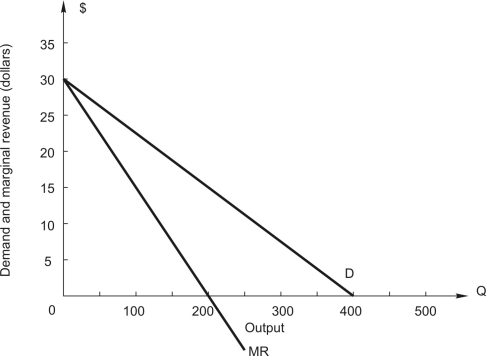
<strong>refer to the following figure showing demand and marginal revenue for a monopoly.    -If production costs are constant and equal to $10 (i.e., LAC = LMC = $10), what price will the monopoly charge?</strong> A) $5 B) $10 C) $15 D) $20 E) $25 <div style=padding-top: 35px>

-If production costs are constant and equal to $10 (i.e., LAC = LMC = $10), what price will the monopoly charge?

A) $5
B) $10
C) $15
D) $20
E) $25
Use Space or
up arrow
down arrow
to flip the card.
Question
refer to the following figure:
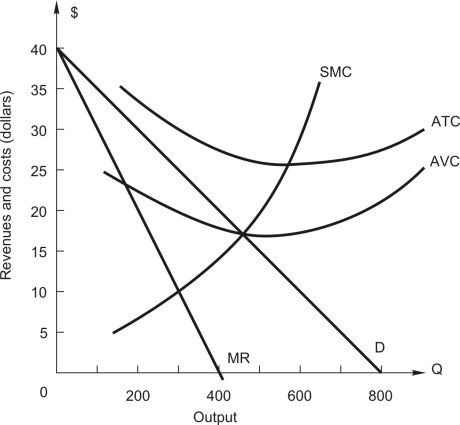
<strong>refer to the following figure:   The figure above shows the demand and cost curves facing a price-setting firm.  -The maximum profit the firm can earn is $________.</strong> A) -$4,500 B) -$1,500 C) $7,500 D) $7,650 E) $8,000 <div style=padding-top: 35px> The figure above shows the demand and cost curves facing a price-setting firm.

-The maximum profit the firm can earn is $________.

A) -$4,500
B) -$1,500
C) $7,500
D) $7,650
E) $8,000
Question
refer to the following:
A manger of a firm with market power faces the marginal revenue product and average revenue product curves shown below. The firm incurs weekly fixed costs of $1,800. The firm employs a single variable input, labor, which costs $600 per worker each week.
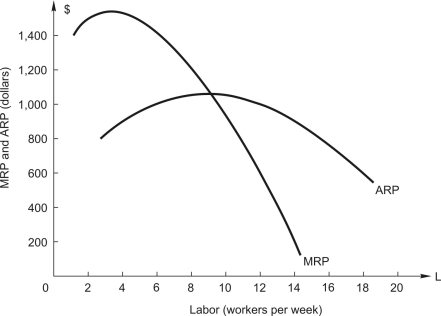
<strong>refer to the following: A manger of a firm with market power faces the marginal revenue product and average revenue product curves shown below. The firm incurs weekly fixed costs of $1,800. The firm employs a single variable input, labor, which costs $600 per worker each week.    -The maximum profit the firm can earn is _____________.</strong> A) $4,800 per week. B) $3,000 per week. C) $2,400 per week. D) $1,800 per week. E) -$1,800 per week. <div style=padding-top: 35px>

-The maximum profit the firm can earn is _____________.

A) $4,800 per week.
B) $3,000 per week.
C) $2,400 per week.
D) $1,800 per week.
E) -$1,800 per week.
Question
refer to the following:
A firm with market power faces the following estimated demand and average variable cost functions: <strong>refer to the following: A firm with market power faces the following estimated demand and average variable cost functions:     where   is quantity demanded, P is price, M is income, and   is the price of a related good. The firm expects income to be $40,000 and   to be $2. Total fixed cost is $100,000.  -What is the estimated demand function for the firm?</strong> A)   = 71,000 - 500P B)   = 39,000 - 200P C)   = 39,000 - 500P D)   = 40,000 - 200P <div style=padding-top: 35px> <strong>refer to the following: A firm with market power faces the following estimated demand and average variable cost functions:     where   is quantity demanded, P is price, M is income, and   is the price of a related good. The firm expects income to be $40,000 and   to be $2. Total fixed cost is $100,000.  -What is the estimated demand function for the firm?</strong> A)   = 71,000 - 500P B)   = 39,000 - 200P C)   = 39,000 - 500P D)   = 40,000 - 200P <div style=padding-top: 35px> where <strong>refer to the following: A firm with market power faces the following estimated demand and average variable cost functions:     where   is quantity demanded, P is price, M is income, and   is the price of a related good. The firm expects income to be $40,000 and   to be $2. Total fixed cost is $100,000.  -What is the estimated demand function for the firm?</strong> A)   = 71,000 - 500P B)   = 39,000 - 200P C)   = 39,000 - 500P D)   = 40,000 - 200P <div style=padding-top: 35px> is quantity demanded, P is price, M is income, and <strong>refer to the following: A firm with market power faces the following estimated demand and average variable cost functions:     where   is quantity demanded, P is price, M is income, and   is the price of a related good. The firm expects income to be $40,000 and   to be $2. Total fixed cost is $100,000.  -What is the estimated demand function for the firm?</strong> A)   = 71,000 - 500P B)   = 39,000 - 200P C)   = 39,000 - 500P D)   = 40,000 - 200P <div style=padding-top: 35px> is the price of a related good. The firm expects income to be $40,000 and <strong>refer to the following: A firm with market power faces the following estimated demand and average variable cost functions:     where   is quantity demanded, P is price, M is income, and   is the price of a related good. The firm expects income to be $40,000 and   to be $2. Total fixed cost is $100,000.  -What is the estimated demand function for the firm?</strong> A)   = 71,000 - 500P B)   = 39,000 - 200P C)   = 39,000 - 500P D)   = 40,000 - 200P <div style=padding-top: 35px> to be $2. Total fixed cost is $100,000.

-What is the estimated demand function for the firm?

A)
<strong>refer to the following: A firm with market power faces the following estimated demand and average variable cost functions:     where   is quantity demanded, P is price, M is income, and   is the price of a related good. The firm expects income to be $40,000 and   to be $2. Total fixed cost is $100,000.  -What is the estimated demand function for the firm?</strong> A)   = 71,000 - 500P B)   = 39,000 - 200P C)   = 39,000 - 500P D)   = 40,000 - 200P <div style=padding-top: 35px>
= 71,000 - 500P
B)
<strong>refer to the following: A firm with market power faces the following estimated demand and average variable cost functions:     where   is quantity demanded, P is price, M is income, and   is the price of a related good. The firm expects income to be $40,000 and   to be $2. Total fixed cost is $100,000.  -What is the estimated demand function for the firm?</strong> A)   = 71,000 - 500P B)   = 39,000 - 200P C)   = 39,000 - 500P D)   = 40,000 - 200P <div style=padding-top: 35px>
= 39,000 - 200P
C)
<strong>refer to the following: A firm with market power faces the following estimated demand and average variable cost functions:     where   is quantity demanded, P is price, M is income, and   is the price of a related good. The firm expects income to be $40,000 and   to be $2. Total fixed cost is $100,000.  -What is the estimated demand function for the firm?</strong> A)   = 71,000 - 500P B)   = 39,000 - 200P C)   = 39,000 - 500P D)   = 40,000 - 200P <div style=padding-top: 35px>
= 39,000 - 500P
D)
<strong>refer to the following: A firm with market power faces the following estimated demand and average variable cost functions:     where   is quantity demanded, P is price, M is income, and   is the price of a related good. The firm expects income to be $40,000 and   to be $2. Total fixed cost is $100,000.  -What is the estimated demand function for the firm?</strong> A)   = 71,000 - 500P B)   = 39,000 - 200P C)   = 39,000 - 500P D)   = 40,000 - 200P <div style=padding-top: 35px>
= 40,000 - 200P
Question
refer to the following:
A firm with market power faces the following estimated demand and average variable cost functions: <strong>refer to the following: A firm with market power faces the following estimated demand and average variable cost functions:     where   is quantity demanded, P is price, M is income, and   is the price of a related good. The firm expects income to be $40,000 and   to be $2. Total fixed cost is $100,000.  -What is the profit-maximizing choice of output?</strong> A) 8,000 units B) 10,000 units C) 12,000 units D) 16,000 units E) 0 units, the firm shuts down <div style=padding-top: 35px> <strong>refer to the following: A firm with market power faces the following estimated demand and average variable cost functions:     where   is quantity demanded, P is price, M is income, and   is the price of a related good. The firm expects income to be $40,000 and   to be $2. Total fixed cost is $100,000.  -What is the profit-maximizing choice of output?</strong> A) 8,000 units B) 10,000 units C) 12,000 units D) 16,000 units E) 0 units, the firm shuts down <div style=padding-top: 35px> where <strong>refer to the following: A firm with market power faces the following estimated demand and average variable cost functions:     where   is quantity demanded, P is price, M is income, and   is the price of a related good. The firm expects income to be $40,000 and   to be $2. Total fixed cost is $100,000.  -What is the profit-maximizing choice of output?</strong> A) 8,000 units B) 10,000 units C) 12,000 units D) 16,000 units E) 0 units, the firm shuts down <div style=padding-top: 35px> is quantity demanded, P is price, M is income, and <strong>refer to the following: A firm with market power faces the following estimated demand and average variable cost functions:     where   is quantity demanded, P is price, M is income, and   is the price of a related good. The firm expects income to be $40,000 and   to be $2. Total fixed cost is $100,000.  -What is the profit-maximizing choice of output?</strong> A) 8,000 units B) 10,000 units C) 12,000 units D) 16,000 units E) 0 units, the firm shuts down <div style=padding-top: 35px> is the price of a related good. The firm expects income to be $40,000 and <strong>refer to the following: A firm with market power faces the following estimated demand and average variable cost functions:     where   is quantity demanded, P is price, M is income, and   is the price of a related good. The firm expects income to be $40,000 and   to be $2. Total fixed cost is $100,000.  -What is the profit-maximizing choice of output?</strong> A) 8,000 units B) 10,000 units C) 12,000 units D) 16,000 units E) 0 units, the firm shuts down <div style=padding-top: 35px> to be $2. Total fixed cost is $100,000.

-What is the profit-maximizing choice of output?

A) 8,000 units
B) 10,000 units
C) 12,000 units
D) 16,000 units
E) 0 units, the firm shuts down
Question
refer to the following:
A firm with market power faces the following estimated demand and average variable cost functions: <strong>refer to the following: A firm with market power faces the following estimated demand and average variable cost functions:     where   is quantity demanded, P is price, M is income, and   is the price of a related good. The firm expects income to be $40,000 and   to be $2. Total fixed cost is $100,000.  -What is the firm's profit?</strong> A) $147,000 B) $120,000 C) $220,000 D) $335,000 <div style=padding-top: 35px> <strong>refer to the following: A firm with market power faces the following estimated demand and average variable cost functions:     where   is quantity demanded, P is price, M is income, and   is the price of a related good. The firm expects income to be $40,000 and   to be $2. Total fixed cost is $100,000.  -What is the firm's profit?</strong> A) $147,000 B) $120,000 C) $220,000 D) $335,000 <div style=padding-top: 35px> where <strong>refer to the following: A firm with market power faces the following estimated demand and average variable cost functions:     where   is quantity demanded, P is price, M is income, and   is the price of a related good. The firm expects income to be $40,000 and   to be $2. Total fixed cost is $100,000.  -What is the firm's profit?</strong> A) $147,000 B) $120,000 C) $220,000 D) $335,000 <div style=padding-top: 35px> is quantity demanded, P is price, M is income, and <strong>refer to the following: A firm with market power faces the following estimated demand and average variable cost functions:     where   is quantity demanded, P is price, M is income, and   is the price of a related good. The firm expects income to be $40,000 and   to be $2. Total fixed cost is $100,000.  -What is the firm's profit?</strong> A) $147,000 B) $120,000 C) $220,000 D) $335,000 <div style=padding-top: 35px> is the price of a related good. The firm expects income to be $40,000 and <strong>refer to the following: A firm with market power faces the following estimated demand and average variable cost functions:     where   is quantity demanded, P is price, M is income, and   is the price of a related good. The firm expects income to be $40,000 and   to be $2. Total fixed cost is $100,000.  -What is the firm's profit?</strong> A) $147,000 B) $120,000 C) $220,000 D) $335,000 <div style=padding-top: 35px> to be $2. Total fixed cost is $100,000.

-What is the firm's profit?

A) $147,000
B) $120,000
C) $220,000
D) $335,000
Question
refer to the following:
The market demand for a monopoly firm is estimated to be: <strong>refer to the following: The market demand for a monopoly firm is estimated to be:   where   is quantity demanded, P is price, M is income, and   is the price of a related good. The manager has forecasted the values of M and   will be $50,000 and $20, respectively, in 2009.  -For 2009, the forecasted demand function is</strong> A)   = 300,000 - 500P B)   = 100,000 - 100P C)   = 600,000 - 100P D)   = 200,000 - 500P E) none of the above <div style=padding-top: 35px> where <strong>refer to the following: The market demand for a monopoly firm is estimated to be:   where   is quantity demanded, P is price, M is income, and   is the price of a related good. The manager has forecasted the values of M and   will be $50,000 and $20, respectively, in 2009.  -For 2009, the forecasted demand function is</strong> A)   = 300,000 - 500P B)   = 100,000 - 100P C)   = 600,000 - 100P D)   = 200,000 - 500P E) none of the above <div style=padding-top: 35px> is quantity demanded, P is price, M is income, and <strong>refer to the following: The market demand for a monopoly firm is estimated to be:   where   is quantity demanded, P is price, M is income, and   is the price of a related good. The manager has forecasted the values of M and   will be $50,000 and $20, respectively, in 2009.  -For 2009, the forecasted demand function is</strong> A)   = 300,000 - 500P B)   = 100,000 - 100P C)   = 600,000 - 100P D)   = 200,000 - 500P E) none of the above <div style=padding-top: 35px> is the price of a related good. The manager has forecasted the values of M and <strong>refer to the following: The market demand for a monopoly firm is estimated to be:   where   is quantity demanded, P is price, M is income, and   is the price of a related good. The manager has forecasted the values of M and   will be $50,000 and $20, respectively, in 2009.  -For 2009, the forecasted demand function is</strong> A)   = 300,000 - 500P B)   = 100,000 - 100P C)   = 600,000 - 100P D)   = 200,000 - 500P E) none of the above <div style=padding-top: 35px> will be $50,000 and $20, respectively, in 2009.

-For 2009, the forecasted demand function is

A)
<strong>refer to the following: The market demand for a monopoly firm is estimated to be:   where   is quantity demanded, P is price, M is income, and   is the price of a related good. The manager has forecasted the values of M and   will be $50,000 and $20, respectively, in 2009.  -For 2009, the forecasted demand function is</strong> A)   = 300,000 - 500P B)   = 100,000 - 100P C)   = 600,000 - 100P D)   = 200,000 - 500P E) none of the above <div style=padding-top: 35px>
= 300,000 - 500P
B)
<strong>refer to the following: The market demand for a monopoly firm is estimated to be:   where   is quantity demanded, P is price, M is income, and   is the price of a related good. The manager has forecasted the values of M and   will be $50,000 and $20, respectively, in 2009.  -For 2009, the forecasted demand function is</strong> A)   = 300,000 - 500P B)   = 100,000 - 100P C)   = 600,000 - 100P D)   = 200,000 - 500P E) none of the above <div style=padding-top: 35px>
= 100,000 - 100P
C)
<strong>refer to the following: The market demand for a monopoly firm is estimated to be:   where   is quantity demanded, P is price, M is income, and   is the price of a related good. The manager has forecasted the values of M and   will be $50,000 and $20, respectively, in 2009.  -For 2009, the forecasted demand function is</strong> A)   = 300,000 - 500P B)   = 100,000 - 100P C)   = 600,000 - 100P D)   = 200,000 - 500P E) none of the above <div style=padding-top: 35px>
= 600,000 - 100P
D)
<strong>refer to the following: The market demand for a monopoly firm is estimated to be:   where   is quantity demanded, P is price, M is income, and   is the price of a related good. The manager has forecasted the values of M and   will be $50,000 and $20, respectively, in 2009.  -For 2009, the forecasted demand function is</strong> A)   = 300,000 - 500P B)   = 100,000 - 100P C)   = 600,000 - 100P D)   = 200,000 - 500P E) none of the above <div style=padding-top: 35px>
= 200,000 - 500P
E) none of the above
Question
refer to the following:
The market demand for a monopoly firm is estimated to be: <strong>refer to the following: The market demand for a monopoly firm is estimated to be:   where   is quantity demanded, P is price, M is income, and   is the price of a related good. The manager has forecasted the values of M and   will be $50,000 and $20, respectively, in 2009.  -For 2009, the inverse demand function is</strong> A) Q = 300 - 0.005P. B) P = 600 - 0.001Q. C) P = 300 - 0.002Q. D) P = 600 - 0.004Q. E) none of the above <div style=padding-top: 35px> where <strong>refer to the following: The market demand for a monopoly firm is estimated to be:   where   is quantity demanded, P is price, M is income, and   is the price of a related good. The manager has forecasted the values of M and   will be $50,000 and $20, respectively, in 2009.  -For 2009, the inverse demand function is</strong> A) Q = 300 - 0.005P. B) P = 600 - 0.001Q. C) P = 300 - 0.002Q. D) P = 600 - 0.004Q. E) none of the above <div style=padding-top: 35px> is quantity demanded, P is price, M is income, and <strong>refer to the following: The market demand for a monopoly firm is estimated to be:   where   is quantity demanded, P is price, M is income, and   is the price of a related good. The manager has forecasted the values of M and   will be $50,000 and $20, respectively, in 2009.  -For 2009, the inverse demand function is</strong> A) Q = 300 - 0.005P. B) P = 600 - 0.001Q. C) P = 300 - 0.002Q. D) P = 600 - 0.004Q. E) none of the above <div style=padding-top: 35px> is the price of a related good. The manager has forecasted the values of M and <strong>refer to the following: The market demand for a monopoly firm is estimated to be:   where   is quantity demanded, P is price, M is income, and   is the price of a related good. The manager has forecasted the values of M and   will be $50,000 and $20, respectively, in 2009.  -For 2009, the inverse demand function is</strong> A) Q = 300 - 0.005P. B) P = 600 - 0.001Q. C) P = 300 - 0.002Q. D) P = 600 - 0.004Q. E) none of the above <div style=padding-top: 35px> will be $50,000 and $20, respectively, in 2009.

-For 2009, the inverse demand function is

A) Q = 300 - 0.005P.
B) P = 600 - 0.001Q.
C) P = 300 - 0.002Q.
D) P = 600 - 0.004Q.
E) none of the above
Question
refer to the following:
The market demand for a monopoly firm is estimated to be: <strong>refer to the following: The market demand for a monopoly firm is estimated to be:   where   is quantity demanded, P is price, M is income, and   is the price of a related good. The manager has forecasted the values of M and   will be $50,000 and $20, respectively, in 2009.  -For 2009, the marginal revenue function is</strong> A) MR = 290 - 0.5P. B) MR = 580 - 0.001Q. C) MR = 290 - 0.002Q. D) MR = 600 - 0.004Q. E) none of the above <div style=padding-top: 35px> where <strong>refer to the following: The market demand for a monopoly firm is estimated to be:   where   is quantity demanded, P is price, M is income, and   is the price of a related good. The manager has forecasted the values of M and   will be $50,000 and $20, respectively, in 2009.  -For 2009, the marginal revenue function is</strong> A) MR = 290 - 0.5P. B) MR = 580 - 0.001Q. C) MR = 290 - 0.002Q. D) MR = 600 - 0.004Q. E) none of the above <div style=padding-top: 35px> is quantity demanded, P is price, M is income, and <strong>refer to the following: The market demand for a monopoly firm is estimated to be:   where   is quantity demanded, P is price, M is income, and   is the price of a related good. The manager has forecasted the values of M and   will be $50,000 and $20, respectively, in 2009.  -For 2009, the marginal revenue function is</strong> A) MR = 290 - 0.5P. B) MR = 580 - 0.001Q. C) MR = 290 - 0.002Q. D) MR = 600 - 0.004Q. E) none of the above <div style=padding-top: 35px> is the price of a related good. The manager has forecasted the values of M and <strong>refer to the following: The market demand for a monopoly firm is estimated to be:   where   is quantity demanded, P is price, M is income, and   is the price of a related good. The manager has forecasted the values of M and   will be $50,000 and $20, respectively, in 2009.  -For 2009, the marginal revenue function is</strong> A) MR = 290 - 0.5P. B) MR = 580 - 0.001Q. C) MR = 290 - 0.002Q. D) MR = 600 - 0.004Q. E) none of the above <div style=padding-top: 35px> will be $50,000 and $20, respectively, in 2009.

-For 2009, the marginal revenue function is

A) MR = 290 - 0.5P.
B) MR = 580 - 0.001Q.
C) MR = 290 - 0.002Q.
D) MR = 600 - 0.004Q.
E) none of the above
Question
refer to the following:
The market demand for a monopoly firm is estimated to be: <strong>refer to the following: The market demand for a monopoly firm is estimated to be:   where   is quantity demanded, P is price, M is income, and   is the price of a related good. The manager has forecasted the values of M and   will be $50,000 and $20, respectively, in 2009.  -The profit-maximizing level of output for 2009 is</strong> A) 1,000 units. B) 4,000 units. C) 5,000 units. D) 10,000 units. E) 20,000 units. <div style=padding-top: 35px> where <strong>refer to the following: The market demand for a monopoly firm is estimated to be:   where   is quantity demanded, P is price, M is income, and   is the price of a related good. The manager has forecasted the values of M and   will be $50,000 and $20, respectively, in 2009.  -The profit-maximizing level of output for 2009 is</strong> A) 1,000 units. B) 4,000 units. C) 5,000 units. D) 10,000 units. E) 20,000 units. <div style=padding-top: 35px> is quantity demanded, P is price, M is income, and <strong>refer to the following: The market demand for a monopoly firm is estimated to be:   where   is quantity demanded, P is price, M is income, and   is the price of a related good. The manager has forecasted the values of M and   will be $50,000 and $20, respectively, in 2009.  -The profit-maximizing level of output for 2009 is</strong> A) 1,000 units. B) 4,000 units. C) 5,000 units. D) 10,000 units. E) 20,000 units. <div style=padding-top: 35px> is the price of a related good. The manager has forecasted the values of M and <strong>refer to the following: The market demand for a monopoly firm is estimated to be:   where   is quantity demanded, P is price, M is income, and   is the price of a related good. The manager has forecasted the values of M and   will be $50,000 and $20, respectively, in 2009.  -The profit-maximizing level of output for 2009 is</strong> A) 1,000 units. B) 4,000 units. C) 5,000 units. D) 10,000 units. E) 20,000 units. <div style=padding-top: 35px> will be $50,000 and $20, respectively, in 2009.

-The profit-maximizing level of output for 2009 is

A) 1,000 units.
B) 4,000 units.
C) 5,000 units.
D) 10,000 units.
E) 20,000 units.
Question
refer to the following:
The market demand for a monopoly firm is estimated to be: <strong>refer to the following: The market demand for a monopoly firm is estimated to be:   where   is quantity demanded, P is price, M is income, and   is the price of a related good. The manager has forecasted the values of M and   will be $50,000 and $20, respectively, in 2009.  -The profit-maximizing price for 2009 is</strong> A) $100. B) $260. C) $80. D) $520. E) $560. <div style=padding-top: 35px> where <strong>refer to the following: The market demand for a monopoly firm is estimated to be:   where   is quantity demanded, P is price, M is income, and   is the price of a related good. The manager has forecasted the values of M and   will be $50,000 and $20, respectively, in 2009.  -The profit-maximizing price for 2009 is</strong> A) $100. B) $260. C) $80. D) $520. E) $560. <div style=padding-top: 35px> is quantity demanded, P is price, M is income, and <strong>refer to the following: The market demand for a monopoly firm is estimated to be:   where   is quantity demanded, P is price, M is income, and   is the price of a related good. The manager has forecasted the values of M and   will be $50,000 and $20, respectively, in 2009.  -The profit-maximizing price for 2009 is</strong> A) $100. B) $260. C) $80. D) $520. E) $560. <div style=padding-top: 35px> is the price of a related good. The manager has forecasted the values of M and <strong>refer to the following: The market demand for a monopoly firm is estimated to be:   where   is quantity demanded, P is price, M is income, and   is the price of a related good. The manager has forecasted the values of M and   will be $50,000 and $20, respectively, in 2009.  -The profit-maximizing price for 2009 is</strong> A) $100. B) $260. C) $80. D) $520. E) $560. <div style=padding-top: 35px> will be $50,000 and $20, respectively, in 2009.

-The profit-maximizing price for 2009 is

A) $100.
B) $260.
C) $80.
D) $520.
E) $560.
Question
refer to the following:
The market demand for a monopoly firm is estimated to be: <strong>refer to the following: The market demand for a monopoly firm is estimated to be:   where   is quantity demanded, P is price, M is income, and   is the price of a related good. The manager has forecasted the values of M and   will be $50,000 and $20, respectively, in 2009.  -The firm's profit is</strong> A) $100,000. B) $200,000. C) $375,000. D) -$182,000. E) $800,000. <div style=padding-top: 35px> where <strong>refer to the following: The market demand for a monopoly firm is estimated to be:   where   is quantity demanded, P is price, M is income, and   is the price of a related good. The manager has forecasted the values of M and   will be $50,000 and $20, respectively, in 2009.  -The firm's profit is</strong> A) $100,000. B) $200,000. C) $375,000. D) -$182,000. E) $800,000. <div style=padding-top: 35px> is quantity demanded, P is price, M is income, and <strong>refer to the following: The market demand for a monopoly firm is estimated to be:   where   is quantity demanded, P is price, M is income, and   is the price of a related good. The manager has forecasted the values of M and   will be $50,000 and $20, respectively, in 2009.  -The firm's profit is</strong> A) $100,000. B) $200,000. C) $375,000. D) -$182,000. E) $800,000. <div style=padding-top: 35px> is the price of a related good. The manager has forecasted the values of M and <strong>refer to the following: The market demand for a monopoly firm is estimated to be:   where   is quantity demanded, P is price, M is income, and   is the price of a related good. The manager has forecasted the values of M and   will be $50,000 and $20, respectively, in 2009.  -The firm's profit is</strong> A) $100,000. B) $200,000. C) $375,000. D) -$182,000. E) $800,000. <div style=padding-top: 35px> will be $50,000 and $20, respectively, in 2009.

-The firm's profit is

A) $100,000.
B) $200,000.
C) $375,000.
D) -$182,000.
E) $800,000.
Question
If demand is estimated to be
<strong>If demand is estimated to be   = 240 -6P, the inverse demand function is</strong> A) P = 40 -0.1667Q. B) P = 240 - Q. C)   = 40 - P. D)   = 240 - 12P. E)   = 240 - 3P. <div style=padding-top: 35px>
= 240 -6P, the inverse demand function is

A) P = 40 -0.1667Q.
B) P = 240 - Q.
C)
<strong>If demand is estimated to be   = 240 -6P, the inverse demand function is</strong> A) P = 40 -0.1667Q. B) P = 240 - Q. C)   = 40 - P. D)   = 240 - 12P. E)   = 240 - 3P. <div style=padding-top: 35px>
= 40 - P.
D)
<strong>If demand is estimated to be   = 240 -6P, the inverse demand function is</strong> A) P = 40 -0.1667Q. B) P = 240 - Q. C)   = 40 - P. D)   = 240 - 12P. E)   = 240 - 3P. <div style=padding-top: 35px>
= 240 - 12P.
E)
<strong>If demand is estimated to be   = 240 -6P, the inverse demand function is</strong> A) P = 40 -0.1667Q. B) P = 240 - Q. C)   = 40 - P. D)   = 240 - 12P. E)   = 240 - 3P. <div style=padding-top: 35px>
= 240 - 3P.
Question
If demand is estimated to be
<strong>If demand is estimated to be   = 240 -6P, the marginal revenue function is</strong> A) MR = 40 - 0.33Q. B) MR = 240 - 2Q. C) MR = 40 - 2P. D) MR = 240 - 12P. E) MR = 240 - 6P. <div style=padding-top: 35px>
= 240 -6P, the marginal revenue function is

A) MR = 40 - 0.33Q.
B) MR = 240 - 2Q.
C) MR = 40 - 2P.
D) MR = 240 - 12P.
E) MR = 240 - 6P.
Question
involve a profit-maximizing monopolist. Using time-series data, the demand function for the monopolist has been estimated as
? <strong>involve a profit-maximizing monopolist. Using time-series data, the demand function for the monopolist has been estimated as ?   where Q<sub>d</sub> is the amount sold, P is price, M is income, and P<sub>R</sub> is the price of a related good. The estimated values for M and P<sub>R</sub> in 2009 are $25,000 and $200, respectively. The short-run marginal cost curve for this firm has been estimated as:    Total fixed cost is forecast to be $500,000 in 2009.  -The forecasted demand function for 2009 is:</strong> A)   = 212,000 - 500P B)   = 200,000 - 2,000P C)   = 80,000 - 500P D)   = 150,000 - 2,000P E)   = 110,000 - 500P <div style=padding-top: 35px>

where Qd is the amount sold, P is price, M is income, and PR is the price of a related good. The estimated values for M and PR in 2009 are $25,000 and $200, respectively. The short-run marginal cost curve for this firm has been estimated as:

<strong>involve a profit-maximizing monopolist. Using time-series data, the demand function for the monopolist has been estimated as ?   where Q<sub>d</sub> is the amount sold, P is price, M is income, and P<sub>R</sub> is the price of a related good. The estimated values for M and P<sub>R</sub> in 2009 are $25,000 and $200, respectively. The short-run marginal cost curve for this firm has been estimated as:    Total fixed cost is forecast to be $500,000 in 2009.  -The forecasted demand function for 2009 is:</strong> A)   = 212,000 - 500P B)   = 200,000 - 2,000P C)   = 80,000 - 500P D)   = 150,000 - 2,000P E)   = 110,000 - 500P <div style=padding-top: 35px>
Total fixed cost is forecast to be $500,000 in 2009.

-The forecasted demand function for 2009 is:

A)
<strong>involve a profit-maximizing monopolist. Using time-series data, the demand function for the monopolist has been estimated as ?   where Q<sub>d</sub> is the amount sold, P is price, M is income, and P<sub>R</sub> is the price of a related good. The estimated values for M and P<sub>R</sub> in 2009 are $25,000 and $200, respectively. The short-run marginal cost curve for this firm has been estimated as:    Total fixed cost is forecast to be $500,000 in 2009.  -The forecasted demand function for 2009 is:</strong> A)   = 212,000 - 500P B)   = 200,000 - 2,000P C)   = 80,000 - 500P D)   = 150,000 - 2,000P E)   = 110,000 - 500P <div style=padding-top: 35px>
= 212,000 - 500P
B)
<strong>involve a profit-maximizing monopolist. Using time-series data, the demand function for the monopolist has been estimated as ?   where Q<sub>d</sub> is the amount sold, P is price, M is income, and P<sub>R</sub> is the price of a related good. The estimated values for M and P<sub>R</sub> in 2009 are $25,000 and $200, respectively. The short-run marginal cost curve for this firm has been estimated as:    Total fixed cost is forecast to be $500,000 in 2009.  -The forecasted demand function for 2009 is:</strong> A)   = 212,000 - 500P B)   = 200,000 - 2,000P C)   = 80,000 - 500P D)   = 150,000 - 2,000P E)   = 110,000 - 500P <div style=padding-top: 35px>
= 200,000 - 2,000P
C)
<strong>involve a profit-maximizing monopolist. Using time-series data, the demand function for the monopolist has been estimated as ?   where Q<sub>d</sub> is the amount sold, P is price, M is income, and P<sub>R</sub> is the price of a related good. The estimated values for M and P<sub>R</sub> in 2009 are $25,000 and $200, respectively. The short-run marginal cost curve for this firm has been estimated as:    Total fixed cost is forecast to be $500,000 in 2009.  -The forecasted demand function for 2009 is:</strong> A)   = 212,000 - 500P B)   = 200,000 - 2,000P C)   = 80,000 - 500P D)   = 150,000 - 2,000P E)   = 110,000 - 500P <div style=padding-top: 35px>
= 80,000 - 500P
D)
<strong>involve a profit-maximizing monopolist. Using time-series data, the demand function for the monopolist has been estimated as ?   where Q<sub>d</sub> is the amount sold, P is price, M is income, and P<sub>R</sub> is the price of a related good. The estimated values for M and P<sub>R</sub> in 2009 are $25,000 and $200, respectively. The short-run marginal cost curve for this firm has been estimated as:    Total fixed cost is forecast to be $500,000 in 2009.  -The forecasted demand function for 2009 is:</strong> A)   = 212,000 - 500P B)   = 200,000 - 2,000P C)   = 80,000 - 500P D)   = 150,000 - 2,000P E)   = 110,000 - 500P <div style=padding-top: 35px>
= 150,000 - 2,000P
E)
<strong>involve a profit-maximizing monopolist. Using time-series data, the demand function for the monopolist has been estimated as ?   where Q<sub>d</sub> is the amount sold, P is price, M is income, and P<sub>R</sub> is the price of a related good. The estimated values for M and P<sub>R</sub> in 2009 are $25,000 and $200, respectively. The short-run marginal cost curve for this firm has been estimated as:    Total fixed cost is forecast to be $500,000 in 2009.  -The forecasted demand function for 2009 is:</strong> A)   = 212,000 - 500P B)   = 200,000 - 2,000P C)   = 80,000 - 500P D)   = 150,000 - 2,000P E)   = 110,000 - 500P <div style=padding-top: 35px>
= 110,000 - 500P
Question
involve a profit-maximizing monopolist. Using time-series data, the demand function for the monopolist has been estimated as
? <strong>involve a profit-maximizing monopolist. Using time-series data, the demand function for the monopolist has been estimated as ?   where Q<sub>d</sub> is the amount sold, P is price, M is income, and P<sub>R</sub> is the price of a related good. The estimated values for M and P<sub>R</sub> in 2009 are $25,000 and $200, respectively. The short-run marginal cost curve for this firm has been estimated as:    Total fixed cost is forecast to be $500,000 in 2009.  -The forecasted marginal revenue function for 2009 is:</strong> A) MR = 200,000 - 0.004Q B) MR = 424 - 0.002Q C) MR = 110 - 0.002Q D) MR = 424 - 0.004Q E) MR = 120 - 0.002Q <div style=padding-top: 35px>
where Qd is the amount sold, P is price, M is income, and PR is the price of a related good. The estimated values for M and PR in 2009 are $25,000 and $200, respectively. The short-run marginal cost curve for this firm has been estimated as:

<strong>involve a profit-maximizing monopolist. Using time-series data, the demand function for the monopolist has been estimated as ?   where Q<sub>d</sub> is the amount sold, P is price, M is income, and P<sub>R</sub> is the price of a related good. The estimated values for M and P<sub>R</sub> in 2009 are $25,000 and $200, respectively. The short-run marginal cost curve for this firm has been estimated as:    Total fixed cost is forecast to be $500,000 in 2009.  -The forecasted marginal revenue function for 2009 is:</strong> A) MR = 200,000 - 0.004Q B) MR = 424 - 0.002Q C) MR = 110 - 0.002Q D) MR = 424 - 0.004Q E) MR = 120 - 0.002Q <div style=padding-top: 35px>
Total fixed cost is forecast to be $500,000 in 2009.

-The forecasted marginal revenue function for 2009 is:

A) MR = 200,000 - 0.004Q
B) MR = 424 - 0.002Q
C) MR = 110 - 0.002Q
D) MR = 424 - 0.004Q
E) MR = 120 - 0.002Q
Question
involve a profit-maximizing monopolist. Using time-series data, the demand function for the monopolist has been estimated as
? <strong>involve a profit-maximizing monopolist. Using time-series data, the demand function for the monopolist has been estimated as ?   where Q<sub>d</sub> is the amount sold, P is price, M is income, and P<sub>R</sub> is the price of a related good. The estimated values for M and P<sub>R</sub> in 2009 are $25,000 and $200, respectively. The short-run marginal cost curve for this firm has been estimated as:    Total fixed cost is forecast to be $500,000 in 2009.  -The firm's forecasted profit (loss) in 2009 is a</strong> A) loss of $100,000. B) loss of $500,000. C) profit of $100,000. D) profit of $500,000. E) profit of $908,000. <div style=padding-top: 35px>
where Qd is the amount sold, P is price, M is income, and PR is the price of a related good. The estimated values for M and PR in 2009 are $25,000 and $200, respectively. The short-run marginal cost curve for this firm has been estimated as:

<strong>involve a profit-maximizing monopolist. Using time-series data, the demand function for the monopolist has been estimated as ?   where Q<sub>d</sub> is the amount sold, P is price, M is income, and P<sub>R</sub> is the price of a related good. The estimated values for M and P<sub>R</sub> in 2009 are $25,000 and $200, respectively. The short-run marginal cost curve for this firm has been estimated as:    Total fixed cost is forecast to be $500,000 in 2009.  -The firm's forecasted profit (loss) in 2009 is a</strong> A) loss of $100,000. B) loss of $500,000. C) profit of $100,000. D) profit of $500,000. E) profit of $908,000. <div style=padding-top: 35px>
Total fixed cost is forecast to be $500,000 in 2009.

-The firm's forecasted profit (loss) in 2009 is a

A) loss of $100,000.
B) loss of $500,000.
C) profit of $100,000.
D) profit of $500,000.
E) profit of $908,000.
Question
refer to the following:
A price-setting firm faces the following estimated demand and average variable cost functions:

<strong>refer to the following: A price-setting firm faces the following estimated demand and average variable cost functions:     where   is the quantity demanded, P is price, M is income, and   is the price of a related good. The firm expects income to be $40,000 and   to be $53. Total fixed cost is $2,600,000.  -What is the estimated demand function for the firm?</strong> A)   = 1,040,000 - 2,000P B)   = 800,000 - 4,000P C)   = 800,000 - 500P D)   = 1,600,000 - 2,000P <div style=padding-top: 35px> <strong>refer to the following: A price-setting firm faces the following estimated demand and average variable cost functions:     where   is the quantity demanded, P is price, M is income, and   is the price of a related good. The firm expects income to be $40,000 and   to be $53. Total fixed cost is $2,600,000.  -What is the estimated demand function for the firm?</strong> A)   = 1,040,000 - 2,000P B)   = 800,000 - 4,000P C)   = 800,000 - 500P D)   = 1,600,000 - 2,000P <div style=padding-top: 35px> where <strong>refer to the following: A price-setting firm faces the following estimated demand and average variable cost functions:     where   is the quantity demanded, P is price, M is income, and   is the price of a related good. The firm expects income to be $40,000 and   to be $53. Total fixed cost is $2,600,000.  -What is the estimated demand function for the firm?</strong> A)   = 1,040,000 - 2,000P B)   = 800,000 - 4,000P C)   = 800,000 - 500P D)   = 1,600,000 - 2,000P <div style=padding-top: 35px> is the quantity demanded, P is price, M is income, and <strong>refer to the following: A price-setting firm faces the following estimated demand and average variable cost functions:     where   is the quantity demanded, P is price, M is income, and   is the price of a related good. The firm expects income to be $40,000 and   to be $53. Total fixed cost is $2,600,000.  -What is the estimated demand function for the firm?</strong> A)   = 1,040,000 - 2,000P B)   = 800,000 - 4,000P C)   = 800,000 - 500P D)   = 1,600,000 - 2,000P <div style=padding-top: 35px> is the price of a related good. The firm expects income to be $40,000 and <strong>refer to the following: A price-setting firm faces the following estimated demand and average variable cost functions:     where   is the quantity demanded, P is price, M is income, and   is the price of a related good. The firm expects income to be $40,000 and   to be $53. Total fixed cost is $2,600,000.  -What is the estimated demand function for the firm?</strong> A)   = 1,040,000 - 2,000P B)   = 800,000 - 4,000P C)   = 800,000 - 500P D)   = 1,600,000 - 2,000P <div style=padding-top: 35px> to be $53. Total fixed cost is $2,600,000.

-What is the estimated demand function for the firm?

A)
<strong>refer to the following: A price-setting firm faces the following estimated demand and average variable cost functions:     where   is the quantity demanded, P is price, M is income, and   is the price of a related good. The firm expects income to be $40,000 and   to be $53. Total fixed cost is $2,600,000.  -What is the estimated demand function for the firm?</strong> A)   = 1,040,000 - 2,000P B)   = 800,000 - 4,000P C)   = 800,000 - 500P D)   = 1,600,000 - 2,000P <div style=padding-top: 35px>
= 1,040,000 - 2,000P
B)
<strong>refer to the following: A price-setting firm faces the following estimated demand and average variable cost functions:     where   is the quantity demanded, P is price, M is income, and   is the price of a related good. The firm expects income to be $40,000 and   to be $53. Total fixed cost is $2,600,000.  -What is the estimated demand function for the firm?</strong> A)   = 1,040,000 - 2,000P B)   = 800,000 - 4,000P C)   = 800,000 - 500P D)   = 1,600,000 - 2,000P <div style=padding-top: 35px>
= 800,000 - 4,000P
C)
<strong>refer to the following: A price-setting firm faces the following estimated demand and average variable cost functions:     where   is the quantity demanded, P is price, M is income, and   is the price of a related good. The firm expects income to be $40,000 and   to be $53. Total fixed cost is $2,600,000.  -What is the estimated demand function for the firm?</strong> A)   = 1,040,000 - 2,000P B)   = 800,000 - 4,000P C)   = 800,000 - 500P D)   = 1,600,000 - 2,000P <div style=padding-top: 35px>
= 800,000 - 500P
D)
<strong>refer to the following: A price-setting firm faces the following estimated demand and average variable cost functions:     where   is the quantity demanded, P is price, M is income, and   is the price of a related good. The firm expects income to be $40,000 and   to be $53. Total fixed cost is $2,600,000.  -What is the estimated demand function for the firm?</strong> A)   = 1,040,000 - 2,000P B)   = 800,000 - 4,000P C)   = 800,000 - 500P D)   = 1,600,000 - 2,000P <div style=padding-top: 35px>
= 1,600,000 - 2,000P
Question
refer to the following:
A price-setting firm faces the following estimated demand and average variable cost functions:
<strong>refer to the following: A price-setting firm faces the following estimated demand and average variable cost functions:     where   is the quantity demanded, P is price, M is income, and   is the price of a related good. The firm expects income to be $40,000 and   to be $53. Total fixed cost is $2,600,000.  -What is the profit-maximizing choice of output?</strong> A) 8,000 units B) 10,000 units C) 12,000 units D) 20,000 units E) 0 units, the firm shuts down <div style=padding-top: 35px> <strong>refer to the following: A price-setting firm faces the following estimated demand and average variable cost functions:     where   is the quantity demanded, P is price, M is income, and   is the price of a related good. The firm expects income to be $40,000 and   to be $53. Total fixed cost is $2,600,000.  -What is the profit-maximizing choice of output?</strong> A) 8,000 units B) 10,000 units C) 12,000 units D) 20,000 units E) 0 units, the firm shuts down <div style=padding-top: 35px> where <strong>refer to the following: A price-setting firm faces the following estimated demand and average variable cost functions:     where   is the quantity demanded, P is price, M is income, and   is the price of a related good. The firm expects income to be $40,000 and   to be $53. Total fixed cost is $2,600,000.  -What is the profit-maximizing choice of output?</strong> A) 8,000 units B) 10,000 units C) 12,000 units D) 20,000 units E) 0 units, the firm shuts down <div style=padding-top: 35px> is the quantity demanded, P is price, M is income, and <strong>refer to the following: A price-setting firm faces the following estimated demand and average variable cost functions:     where   is the quantity demanded, P is price, M is income, and   is the price of a related good. The firm expects income to be $40,000 and   to be $53. Total fixed cost is $2,600,000.  -What is the profit-maximizing choice of output?</strong> A) 8,000 units B) 10,000 units C) 12,000 units D) 20,000 units E) 0 units, the firm shuts down <div style=padding-top: 35px> is the price of a related good. The firm expects income to be $40,000 and <strong>refer to the following: A price-setting firm faces the following estimated demand and average variable cost functions:     where   is the quantity demanded, P is price, M is income, and   is the price of a related good. The firm expects income to be $40,000 and   to be $53. Total fixed cost is $2,600,000.  -What is the profit-maximizing choice of output?</strong> A) 8,000 units B) 10,000 units C) 12,000 units D) 20,000 units E) 0 units, the firm shuts down <div style=padding-top: 35px> to be $53. Total fixed cost is $2,600,000.

-What is the profit-maximizing choice of output?

A) 8,000 units
B) 10,000 units
C) 12,000 units
D) 20,000 units
E) 0 units, the firm shuts down
Question
refer to the following:
A price-setting firm faces the following estimated demand and average variable cost functions:
<strong>refer to the following: A price-setting firm faces the following estimated demand and average variable cost functions:     where   is the quantity demanded, P is price, M is income, and   is the price of a related good. The firm expects income to be $40,000 and   to be $53. Total fixed cost is $2,600,000.  -What is the firm's profit?</strong> A) $1,470,000 B) $1,200,000 C) $1,600,000 D) -$2,600,000 <div style=padding-top: 35px> <strong>refer to the following: A price-setting firm faces the following estimated demand and average variable cost functions:     where   is the quantity demanded, P is price, M is income, and   is the price of a related good. The firm expects income to be $40,000 and   to be $53. Total fixed cost is $2,600,000.  -What is the firm's profit?</strong> A) $1,470,000 B) $1,200,000 C) $1,600,000 D) -$2,600,000 <div style=padding-top: 35px> where <strong>refer to the following: A price-setting firm faces the following estimated demand and average variable cost functions:     where   is the quantity demanded, P is price, M is income, and   is the price of a related good. The firm expects income to be $40,000 and   to be $53. Total fixed cost is $2,600,000.  -What is the firm's profit?</strong> A) $1,470,000 B) $1,200,000 C) $1,600,000 D) -$2,600,000 <div style=padding-top: 35px> is the quantity demanded, P is price, M is income, and <strong>refer to the following: A price-setting firm faces the following estimated demand and average variable cost functions:     where   is the quantity demanded, P is price, M is income, and   is the price of a related good. The firm expects income to be $40,000 and   to be $53. Total fixed cost is $2,600,000.  -What is the firm's profit?</strong> A) $1,470,000 B) $1,200,000 C) $1,600,000 D) -$2,600,000 <div style=padding-top: 35px> is the price of a related good. The firm expects income to be $40,000 and <strong>refer to the following: A price-setting firm faces the following estimated demand and average variable cost functions:     where   is the quantity demanded, P is price, M is income, and   is the price of a related good. The firm expects income to be $40,000 and   to be $53. Total fixed cost is $2,600,000.  -What is the firm's profit?</strong> A) $1,470,000 B) $1,200,000 C) $1,600,000 D) -$2,600,000 <div style=padding-top: 35px> to be $53. Total fixed cost is $2,600,000.

-What is the firm's profit?

A) $1,470,000
B) $1,200,000
C) $1,600,000
D) -$2,600,000
Question
refer to the following.
A firm with two plants, A and B, has the following estimated demand and marginal cost functions:
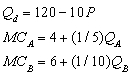
<strong>refer to the following. A firm with two plants, A and B, has the following estimated demand and marginal cost functions:    -What is the profit-maximizing price?</strong> A) $7 B) $8 C) $9 D) $9.50 E) none of the above <div style=padding-top: 35px>

-What is the profit-maximizing price?

A) $7
B) $8
C) $9
D) $9.50
E) none of the above
Question
In order to maximize profit, a firm that produces its output in two plants will allocate total output between the two plants so that

A) marginal cost is equal for the two plants.
B) marginal cost for the firm is equal to the sum of the plants' marginal costs.
C) marginal revenue for the firm is equal to the sum of the plants' marginal costs.
D) all of the above
Question
refer to the following figure:
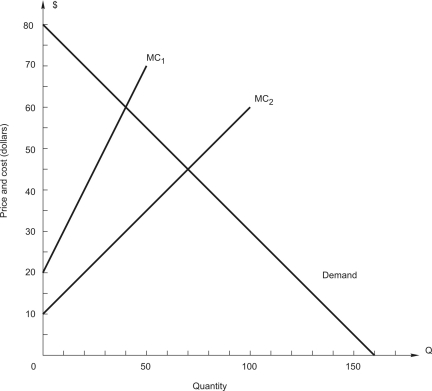
<strong>refer to the following figure:   The demand for dishwashers facing the AllClean Co. is given in the figure above. The firm manufactures dishwashers in two plants. MC<sub>1</sub> and MC<sub>2</sub> are the marginal cost curves for those two plants.  -How should the firm allocate total output between the two plants in order to maximize Profit?</strong> A) 10 to plant 1, 40 to plant 2 B) 20 to plant 1, 30 to plant 2 C) 40 to plant 1, 40 to plant 2 D) 20 to plant 1, 60 to plant 2 E) 20 to plant 1, 50 to plant 2 <div style=padding-top: 35px>
The demand for dishwashers facing the AllClean Co. is given in the figure above. The firm manufactures dishwashers in two plants. MC1 and MC2 are the marginal cost curves for those two plants.

-How should the firm allocate total output between the two plants in order to maximize
Profit?

A) 10 to plant 1, 40 to plant 2
B) 20 to plant 1, 30 to plant 2
C) 40 to plant 1, 40 to plant 2
D) 20 to plant 1, 60 to plant 2
E) 20 to plant 1, 50 to plant 2
Question
This question refers to the following demand schedule for a monopoly firm:Price
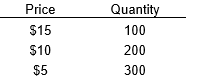
This question refers to the following demand schedule for a monopoly firm:Price   -Between 100 and 200 units of sales, the elasticity of demand is ________ and marginal revenue is $________.<div style=padding-top: 35px>
-Between 100 and 200 units of sales, the elasticity of demand is ________ and marginal revenue is $________.
Question
This question refers to the following demand schedule for a monopoly firm:Price
This question refers to the following demand schedule for a monopoly firm:Price   -Between 200 and 300 units of sales, the elasticity of demand is ________ and marginal revenue is $________.<div style=padding-top: 35px>
-Between 200 and 300 units of sales, the elasticity of demand is ________ and marginal revenue is $________.
Question
Fill in the blanks:
-A monopoly can raise its price without _____________, because it has _____________.
Question
Fill in the blanks:
-Two related ways to measure the extent of a firm's market power are ____________ and _____________.
Question
Fill in the blanks:

-Monopolistically competitive firms will have their economic profit competed away in the long run because of ______________. They will however earn _____________ in the long run.
Question
Fill in the blanks:

-A firm with market power will produce at a loss in the short run only if _____________. If this condition is met and the firm does produce at a loss, the firm will lose ____________(more, less) than its total fixed costs. In the long run, this firm will leave the industry if _______________.
Question
The following graph shows demand and marginal revenue for a monopoly.
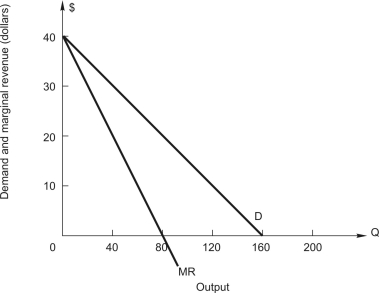
The following graph shows demand and marginal revenue for a monopoly.   -At any price above $_______ and quantity below ________ demand will be elastic. Marginal revenue is ____________ over this range.<div style=padding-top: 35px>
-At any price above $_______ and quantity below ________ demand will be elastic. Marginal revenue is ____________ over this range.
Question
The following graph shows demand and marginal revenue for a monopoly.
The following graph shows demand and marginal revenue for a monopoly.   -At any price below $_______ and quantity above ________ demand will be inelastic. Marginal revenue is _____________ over this range.<div style=padding-top: 35px>
-At any price below $_______ and quantity above ________ demand will be inelastic. Marginal revenue is _____________ over this range.
Question
The following graph shows demand and marginal revenue for a monopoly.
The following graph shows demand and marginal revenue for a monopoly.   -Demand is unitary elastic at a price of $______ and quantity of ________. Marginal revenue is _____________ at this price-quantity combination.<div style=padding-top: 35px>
-Demand is unitary elastic at a price of $______ and quantity of ________. Marginal revenue is _____________ at this price-quantity combination.
Question
Answer the following questions concerning a firm with market power:
-A monopoly will increase its usage of a variable input if _________________________ exceeds ______________________.
Question
Answer the following questions concerning a firm with market power:
-A monopoly will decrease its usage of a variable input if _________________________ exceeds _________________________.
Question
Answer the following questions concerning a firm with market power:
-A monopoly will hire zero amount of a variable input if the wage rate is above _________________________.
Question
The following schedule shows demand and total cost for a firm with market power:
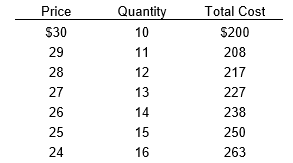
The following schedule shows demand and total cost for a firm with market power:   -To maximize profit firm should produce ______ units of output and charge a price of $_______.<div style=padding-top: 35px>
-To maximize profit firm should produce ______ units of output and charge a price of $_______.
Question
The following schedule shows demand and total cost for a firm with market power:
The following schedule shows demand and total cost for a firm with market power:   -At this level of output the firm earns a profit of $________.<div style=padding-top: 35px>
-At this level of output the firm earns a profit of $________.
Question
The following schedule shows demand and total cost for a firm with market power:
The following schedule shows demand and total cost for a firm with market power:   -The last unit of output produced and sold adds $________ to revenue and $________ to cost.<div style=padding-top: 35px>
-The last unit of output produced and sold adds $________ to revenue and $________ to cost.
Question
The following schedule shows demand and total cost for a firm with market power:
The following schedule shows demand and total cost for a firm with market power:   -One more unit of output beyond the profit-maximizing level of output would add $________ to revenue and $________ to cost, thereby ___________ profit by $________.<div style=padding-top: 35px>
-One more unit of output beyond the profit-maximizing level of output would add $________ to revenue and $________ to cost, thereby ___________ profit by $________.
Question
The following figure shows demand, marginal revenue, and short-run costs for a price-setting firm.
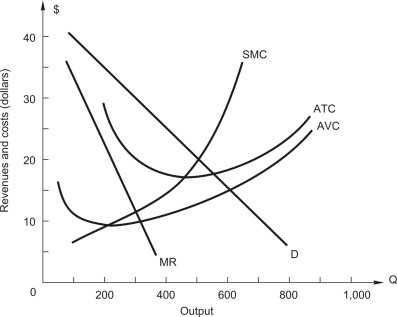
The following figure shows demand, marginal revenue, and short-run costs for a price-setting firm.   -To maximize profit the firm should produce an output of ________ and set a price of $_______.<div style=padding-top: 35px>
-To maximize profit the firm should produce an output of ________ and set a price of $_______.
Question
The following figure shows demand, marginal revenue, and short-run costs for a price-setting firm.
The following figure shows demand, marginal revenue, and short-run costs for a price-setting firm.   -At this level of output total revenue is $________, total cost is $________, and the firm earns a profit of $________.<div style=padding-top: 35px>
-At this level of output total revenue is $________, total cost is $________, and the firm earns a profit of $________.
Question
The following figure shows demand, marginal revenue, and short-run cost for a firm with market power.
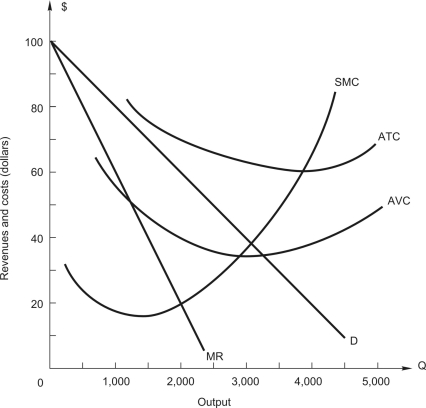
The following figure shows demand, marginal revenue, and short-run cost for a firm with market power.   -This firm should sell ________ units of output and set a price of $________.<div style=padding-top: 35px>
-This firm should sell ________ units of output and set a price of $________.
Question
The following figure shows demand, marginal revenue, and short-run cost for a firm with market power.
The following figure shows demand, marginal revenue, and short-run cost for a firm with market power.   -At this output and price the firm earns a profit of $________.<div style=padding-top: 35px>
-At this output and price the firm earns a profit of $________.
Question
The following figure shows demand, marginal revenue, and short-run cost for a firm with market power.
The following figure shows demand, marginal revenue, and short-run cost for a firm with market power.   -At this output and price the firm's revenue of $________ covers all $________ of its variable cost and the firm has $________ left over to apply to its fixed cost.<div style=padding-top: 35px>
-At this output and price the firm's revenue of $________ covers all $________ of its variable cost and the firm has $________ left over to apply to its fixed cost.
Question
The following figure shows demand, marginal revenue, and short-run cost for a firm with market power.
The following figure shows demand, marginal revenue, and short-run cost for a firm with market power.   -If the firm shut down it would lose ________________.<div style=padding-top: 35px>
-If the firm shut down it would lose ________________.
Question
The following figure shows the average revenue product (ARP) and marginal revenue product curves of monopoly for its only variable input, labor.
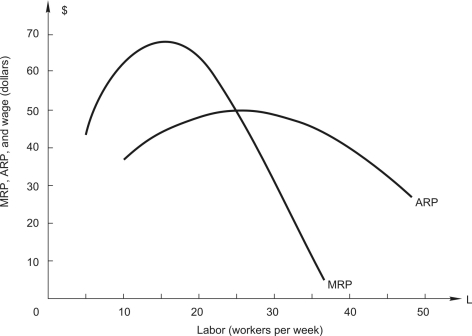
The following figure shows the average revenue product (ARP) and marginal revenue product curves of monopoly for its only variable input, labor.   -If the wage is $30, the firm will hire _________ workers.<div style=padding-top: 35px>
-If the wage is $30, the firm will hire _________ workers.
Question
The following figure shows the average revenue product (ARP) and marginal revenue product curves of monopoly for its only variable input, labor.
The following figure shows the average revenue product (ARP) and marginal revenue product curves of monopoly for its only variable input, labor.   -If the wage is $10, the firm will hire __________ workers. Total revenue is $________ (hint: ARP = P(Q/L), total variable cost is $________. If total fixed cost is $550, the firm earns a profit of $________.<div style=padding-top: 35px>
-If the wage is $10, the firm will hire __________ workers. Total revenue is $________ (hint: ARP = P(Q/L), total variable cost is $________. If total fixed cost is $550, the firm earns a profit of $________.
Question
The following figure shows the average revenue product (ARP) and marginal revenue product curves of monopoly for its only variable input, labor.
The following figure shows the average revenue product (ARP) and marginal revenue product curves of monopoly for its only variable input, labor.   -If the wage is $60, the firm will hire _________ workers.<div style=padding-top: 35px>
-If the wage is $60, the firm will hire _________ workers.
Question
The manager of a monopoly firm obtained the following estimate of the demand for its product.

The manager of a monopoly firm obtained the following estimate of the demand for its product.   where M and   are, respectively, consumer income and the price of a related good. The forecasted values for M and   are M = $30,000 and   = $5. -What is the forecasted demand function?<div style=padding-top: 35px> where M and
The manager of a monopoly firm obtained the following estimate of the demand for its product.   where M and   are, respectively, consumer income and the price of a related good. The forecasted values for M and   are M = $30,000 and   = $5. -What is the forecasted demand function?<div style=padding-top: 35px> are, respectively, consumer income and the price of a related good. The forecasted values for M and
The manager of a monopoly firm obtained the following estimate of the demand for its product.   where M and   are, respectively, consumer income and the price of a related good. The forecasted values for M and   are M = $30,000 and   = $5. -What is the forecasted demand function?<div style=padding-top: 35px> are M = $30,000 and
The manager of a monopoly firm obtained the following estimate of the demand for its product.   where M and   are, respectively, consumer income and the price of a related good. The forecasted values for M and   are M = $30,000 and   = $5. -What is the forecasted demand function?<div style=padding-top: 35px> = $5.
-What is the forecasted demand function?
Question
The manager of a monopoly firm obtained the following estimate of the demand for its product.
The manager of a monopoly firm obtained the following estimate of the demand for its product.   where M and   are, respectively, consumer income and the price of a related good. The forecasted values for M and   are M = $30,000 and   = $5. -What is the inverse demand function?<div style=padding-top: 35px> where M and
The manager of a monopoly firm obtained the following estimate of the demand for its product.   where M and   are, respectively, consumer income and the price of a related good. The forecasted values for M and   are M = $30,000 and   = $5. -What is the inverse demand function?<div style=padding-top: 35px> are, respectively, consumer income and the price of a related good. The forecasted values for M and
The manager of a monopoly firm obtained the following estimate of the demand for its product.   where M and   are, respectively, consumer income and the price of a related good. The forecasted values for M and   are M = $30,000 and   = $5. -What is the inverse demand function?<div style=padding-top: 35px> are M = $30,000 and
The manager of a monopoly firm obtained the following estimate of the demand for its product.   where M and   are, respectively, consumer income and the price of a related good. The forecasted values for M and   are M = $30,000 and   = $5. -What is the inverse demand function?<div style=padding-top: 35px> = $5.
-What is the inverse demand function?
Question
The manager of a monopoly firm obtained the following estimate of the demand for its product.
The manager of a monopoly firm obtained the following estimate of the demand for its product.   where M and   are, respectively, consumer income and the price of a related good. The forecasted values for M and   are M = $30,000 and   = $5. -What is the marginal revenue function? The estimated average variable cost function is<div style=padding-top: 35px> where M and
The manager of a monopoly firm obtained the following estimate of the demand for its product.   where M and   are, respectively, consumer income and the price of a related good. The forecasted values for M and   are M = $30,000 and   = $5. -What is the marginal revenue function? The estimated average variable cost function is<div style=padding-top: 35px> are, respectively, consumer income and the price of a related good. The forecasted values for M and
The manager of a monopoly firm obtained the following estimate of the demand for its product.   where M and   are, respectively, consumer income and the price of a related good. The forecasted values for M and   are M = $30,000 and   = $5. -What is the marginal revenue function? The estimated average variable cost function is<div style=padding-top: 35px> are M = $30,000 and
The manager of a monopoly firm obtained the following estimate of the demand for its product.   where M and   are, respectively, consumer income and the price of a related good. The forecasted values for M and   are M = $30,000 and   = $5. -What is the marginal revenue function? The estimated average variable cost function is<div style=padding-top: 35px> = $5.
-What is the marginal revenue function?
The estimated average variable cost function is
Question
The estimated average variable cost function is
AVC = 40 - 0.8Q + 0.0001Q2
-What is the estimated marginal cost function?
Question
The estimated average variable cost function is
AVC = 40 - 0.8Q + 0.0001Q2
-To maximize profit the firm should produce ______ units of output.
Question
The estimated average variable cost function is
AVC = 40 - 0.8Q + 0.0001Q2
-To maximize profit the firm should set a price of $______.
Question
The estimated average variable cost function is
AVC = 40 - 0.8Q + 0.0001Q2
-Check to see if the firm should produce in the short run rather than shut down.
Question
The estimated average variable cost function is
AVC = 40 - 0.8Q + 0.0001Q2
-Total fixed cost is $5,000. The firm makes a profit (loss) of $______.
Question
A firm produces its output in two plants, A and B.
-To maximize its profit, the firm should produce the output at which ______ equals ______. It sets the price given by ______.
Question
A firm produces its output in two plants, A and B.

-It should allocate this output between the two plants so that ______ equals ______.
Question
A firm produces its output in two plants, A and B.

-If marginal cost in plant A is $20 and the marginal cost in plant B is $15, the firm should reduce output in ______ and increase output in ______. As it continues this reallocation ______ will increase and ______ will decrease.
Question
A firm produces output in two plants, A and B. The marginal cost functions of each are

A firm produces output in two plants, A and B. The marginal cost functions of each are   -Write the inverse marginal cost functions for each plant: Q<sub>A</sub> = _______________________ Q<sub>B</sub> = _______________________<div style=padding-top: 35px>
-Write the inverse marginal cost functions for each plant:
QA = _______________________
QB = _______________________
Question
A firm produces output in two plants, A and B. The marginal cost functions of each are
A firm produces output in two plants, A and B. The marginal cost functions of each are   -Write the inverse total marginal cost function: Q<sub>T</sub> = _______________________<div style=padding-top: 35px>
-Write the inverse total marginal cost function:
QT = _______________________
Question
A firm produces output in two plants, A and B. The marginal cost functions of each are
A firm produces output in two plants, A and B. The marginal cost functions of each are   -Write the total marginal cost function: MC<sub>T</sub> = _______________________<div style=padding-top: 35px>
-Write the total marginal cost function:
MCT = _______________________
Question
A firm produces output in two plants, A and B. The marginal cost functions of each are
A firm produces output in two plants, A and B. The marginal cost functions of each are   -When total output exceeds ___________ units, the firm uses both plants to produce.<div style=padding-top: 35px>
-When total output exceeds ___________ units, the firm uses both plants to produce.
Question
A firm produces output in two plants, A and B. The marginal cost functions of each are
A firm produces output in two plants, A and B. The marginal cost functions of each are   -5 If the firm wishes to produce 1,750 units of output, how will it allocate the output between the two plants? Q<sub>A</sub> =_______ and Q<sub>B</sub> =_______<div style=padding-top: 35px>
-5 If the firm wishes to produce 1,750 units of output, how will it allocate the output between the two plants? QA =_______ and QB =_______
Question
The following figure shows demand and marginal revenue for a firm that produces in two plants, A and B, the marginal cost curves of which are shown, respectively, as MCA and MCB.
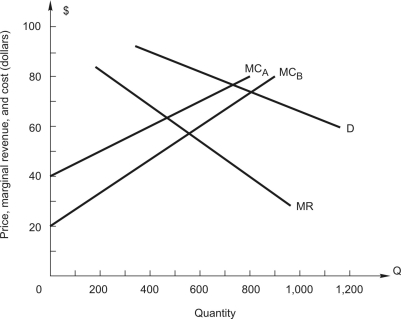
The following figure shows demand and marginal revenue for a firm that produces in two plants, A and B, the marginal cost curves of which are shown, respectively, as MC<sub>A</sub> and MC<sub>B</sub>.   -Any output below ________ would all be produced in plant ______. Draw in the total marginal cost curve and label it MC<sub>T</sub>.<div style=padding-top: 35px>
-Any output below ________ would all be produced in plant ______.
Draw in the total marginal cost curve and label it MCT.
Question
The following figure shows demand and marginal revenue for a firm that produces in two plants, A and B, the marginal cost curves of which are shown, respectively, as MCA and MCB.
The following figure shows demand and marginal revenue for a firm that produces in two plants, A and B, the marginal cost curves of which are shown, respectively, as MC<sub>A</sub> and MC<sub>B</sub>.   -If the firm wants to produce 1,000 units of output it would produce ________ in A and ________ in B.<div style=padding-top: 35px>
-If the firm wants to produce 1,000 units of output it would produce ________ in A and ________ in B.
Question
The following figure shows demand and marginal revenue for a firm that produces in two plants, A and B, the marginal cost curves of which are shown, respectively, as MCA and MCB.
The following figure shows demand and marginal revenue for a firm that produces in two plants, A and B, the marginal cost curves of which are shown, respectively, as MC<sub>A</sub> and MC<sub>B</sub>.   -To maximize profit the firm should produce ________ units of output and set a price of $_______.<div style=padding-top: 35px>
-To maximize profit the firm should produce ________ units of output and set a price of $_______.
Question
The following figure shows demand and marginal revenue for a firm that produces in two plants, A and B, the marginal cost curves of which are shown, respectively, as MCA and MCB.
The following figure shows demand and marginal revenue for a firm that produces in two plants, A and B, the marginal cost curves of which are shown, respectively, as MC<sub>A</sub> and MC<sub>B</sub>.   -This output should be allocated ________ units to plant A and ________ to B.<div style=padding-top: 35px>
-This output should be allocated ________ units to plant A and ________ to B.
Unlock Deck
Sign up to unlock the cards in this deck!
Unlock Deck
Unlock Deck
1/68
auto play flashcards
Play
simple tutorial
Full screen (f)
exit full mode
Deck 12: Managerial Decisions for Firms With Market Power
1
refer to the following figure showing demand and marginal revenue for a monopoly.
<strong>refer to the following figure showing demand and marginal revenue for a monopoly.    -If production costs are constant and equal to $10 (i.e., LAC = LMC = $10), what price will the monopoly charge?</strong> A) $5 B) $10 C) $15 D) $20 E) $25

-If production costs are constant and equal to $10 (i.e., LAC = LMC = $10), what price will the monopoly charge?

A) $5
B) $10
C) $15
D) $20
E) $25
$20
2
refer to the following figure:
<strong>refer to the following figure:   The figure above shows the demand and cost curves facing a price-setting firm.  -The maximum profit the firm can earn is $________.</strong> A) -$4,500 B) -$1,500 C) $7,500 D) $7,650 E) $8,000 The figure above shows the demand and cost curves facing a price-setting firm.

-The maximum profit the firm can earn is $________.

A) -$4,500
B) -$1,500
C) $7,500
D) $7,650
E) $8,000
-$1,500
3
refer to the following:
A manger of a firm with market power faces the marginal revenue product and average revenue product curves shown below. The firm incurs weekly fixed costs of $1,800. The firm employs a single variable input, labor, which costs $600 per worker each week.
<strong>refer to the following: A manger of a firm with market power faces the marginal revenue product and average revenue product curves shown below. The firm incurs weekly fixed costs of $1,800. The firm employs a single variable input, labor, which costs $600 per worker each week.    -The maximum profit the firm can earn is _____________.</strong> A) $4,800 per week. B) $3,000 per week. C) $2,400 per week. D) $1,800 per week. E) -$1,800 per week.

-The maximum profit the firm can earn is _____________.

A) $4,800 per week.
B) $3,000 per week.
C) $2,400 per week.
D) $1,800 per week.
E) -$1,800 per week.
$3,000 per week.
4
refer to the following:
A firm with market power faces the following estimated demand and average variable cost functions: <strong>refer to the following: A firm with market power faces the following estimated demand and average variable cost functions:     where   is quantity demanded, P is price, M is income, and   is the price of a related good. The firm expects income to be $40,000 and   to be $2. Total fixed cost is $100,000.  -What is the estimated demand function for the firm?</strong> A)   = 71,000 - 500P B)   = 39,000 - 200P C)   = 39,000 - 500P D)   = 40,000 - 200P <strong>refer to the following: A firm with market power faces the following estimated demand and average variable cost functions:     where   is quantity demanded, P is price, M is income, and   is the price of a related good. The firm expects income to be $40,000 and   to be $2. Total fixed cost is $100,000.  -What is the estimated demand function for the firm?</strong> A)   = 71,000 - 500P B)   = 39,000 - 200P C)   = 39,000 - 500P D)   = 40,000 - 200P where <strong>refer to the following: A firm with market power faces the following estimated demand and average variable cost functions:     where   is quantity demanded, P is price, M is income, and   is the price of a related good. The firm expects income to be $40,000 and   to be $2. Total fixed cost is $100,000.  -What is the estimated demand function for the firm?</strong> A)   = 71,000 - 500P B)   = 39,000 - 200P C)   = 39,000 - 500P D)   = 40,000 - 200P is quantity demanded, P is price, M is income, and <strong>refer to the following: A firm with market power faces the following estimated demand and average variable cost functions:     where   is quantity demanded, P is price, M is income, and   is the price of a related good. The firm expects income to be $40,000 and   to be $2. Total fixed cost is $100,000.  -What is the estimated demand function for the firm?</strong> A)   = 71,000 - 500P B)   = 39,000 - 200P C)   = 39,000 - 500P D)   = 40,000 - 200P is the price of a related good. The firm expects income to be $40,000 and <strong>refer to the following: A firm with market power faces the following estimated demand and average variable cost functions:     where   is quantity demanded, P is price, M is income, and   is the price of a related good. The firm expects income to be $40,000 and   to be $2. Total fixed cost is $100,000.  -What is the estimated demand function for the firm?</strong> A)   = 71,000 - 500P B)   = 39,000 - 200P C)   = 39,000 - 500P D)   = 40,000 - 200P to be $2. Total fixed cost is $100,000.

-What is the estimated demand function for the firm?

A)
<strong>refer to the following: A firm with market power faces the following estimated demand and average variable cost functions:     where   is quantity demanded, P is price, M is income, and   is the price of a related good. The firm expects income to be $40,000 and   to be $2. Total fixed cost is $100,000.  -What is the estimated demand function for the firm?</strong> A)   = 71,000 - 500P B)   = 39,000 - 200P C)   = 39,000 - 500P D)   = 40,000 - 200P
= 71,000 - 500P
B)
<strong>refer to the following: A firm with market power faces the following estimated demand and average variable cost functions:     where   is quantity demanded, P is price, M is income, and   is the price of a related good. The firm expects income to be $40,000 and   to be $2. Total fixed cost is $100,000.  -What is the estimated demand function for the firm?</strong> A)   = 71,000 - 500P B)   = 39,000 - 200P C)   = 39,000 - 500P D)   = 40,000 - 200P
= 39,000 - 200P
C)
<strong>refer to the following: A firm with market power faces the following estimated demand and average variable cost functions:     where   is quantity demanded, P is price, M is income, and   is the price of a related good. The firm expects income to be $40,000 and   to be $2. Total fixed cost is $100,000.  -What is the estimated demand function for the firm?</strong> A)   = 71,000 - 500P B)   = 39,000 - 200P C)   = 39,000 - 500P D)   = 40,000 - 200P
= 39,000 - 500P
D)
<strong>refer to the following: A firm with market power faces the following estimated demand and average variable cost functions:     where   is quantity demanded, P is price, M is income, and   is the price of a related good. The firm expects income to be $40,000 and   to be $2. Total fixed cost is $100,000.  -What is the estimated demand function for the firm?</strong> A)   = 71,000 - 500P B)   = 39,000 - 200P C)   = 39,000 - 500P D)   = 40,000 - 200P
= 40,000 - 200P
Unlock Deck
Unlock for access to all 68 flashcards in this deck.
Unlock Deck
k this deck
5
refer to the following:
A firm with market power faces the following estimated demand and average variable cost functions: <strong>refer to the following: A firm with market power faces the following estimated demand and average variable cost functions:     where   is quantity demanded, P is price, M is income, and   is the price of a related good. The firm expects income to be $40,000 and   to be $2. Total fixed cost is $100,000.  -What is the profit-maximizing choice of output?</strong> A) 8,000 units B) 10,000 units C) 12,000 units D) 16,000 units E) 0 units, the firm shuts down <strong>refer to the following: A firm with market power faces the following estimated demand and average variable cost functions:     where   is quantity demanded, P is price, M is income, and   is the price of a related good. The firm expects income to be $40,000 and   to be $2. Total fixed cost is $100,000.  -What is the profit-maximizing choice of output?</strong> A) 8,000 units B) 10,000 units C) 12,000 units D) 16,000 units E) 0 units, the firm shuts down where <strong>refer to the following: A firm with market power faces the following estimated demand and average variable cost functions:     where   is quantity demanded, P is price, M is income, and   is the price of a related good. The firm expects income to be $40,000 and   to be $2. Total fixed cost is $100,000.  -What is the profit-maximizing choice of output?</strong> A) 8,000 units B) 10,000 units C) 12,000 units D) 16,000 units E) 0 units, the firm shuts down is quantity demanded, P is price, M is income, and <strong>refer to the following: A firm with market power faces the following estimated demand and average variable cost functions:     where   is quantity demanded, P is price, M is income, and   is the price of a related good. The firm expects income to be $40,000 and   to be $2. Total fixed cost is $100,000.  -What is the profit-maximizing choice of output?</strong> A) 8,000 units B) 10,000 units C) 12,000 units D) 16,000 units E) 0 units, the firm shuts down is the price of a related good. The firm expects income to be $40,000 and <strong>refer to the following: A firm with market power faces the following estimated demand and average variable cost functions:     where   is quantity demanded, P is price, M is income, and   is the price of a related good. The firm expects income to be $40,000 and   to be $2. Total fixed cost is $100,000.  -What is the profit-maximizing choice of output?</strong> A) 8,000 units B) 10,000 units C) 12,000 units D) 16,000 units E) 0 units, the firm shuts down to be $2. Total fixed cost is $100,000.

-What is the profit-maximizing choice of output?

A) 8,000 units
B) 10,000 units
C) 12,000 units
D) 16,000 units
E) 0 units, the firm shuts down
Unlock Deck
Unlock for access to all 68 flashcards in this deck.
Unlock Deck
k this deck
6
refer to the following:
A firm with market power faces the following estimated demand and average variable cost functions: <strong>refer to the following: A firm with market power faces the following estimated demand and average variable cost functions:     where   is quantity demanded, P is price, M is income, and   is the price of a related good. The firm expects income to be $40,000 and   to be $2. Total fixed cost is $100,000.  -What is the firm's profit?</strong> A) $147,000 B) $120,000 C) $220,000 D) $335,000 <strong>refer to the following: A firm with market power faces the following estimated demand and average variable cost functions:     where   is quantity demanded, P is price, M is income, and   is the price of a related good. The firm expects income to be $40,000 and   to be $2. Total fixed cost is $100,000.  -What is the firm's profit?</strong> A) $147,000 B) $120,000 C) $220,000 D) $335,000 where <strong>refer to the following: A firm with market power faces the following estimated demand and average variable cost functions:     where   is quantity demanded, P is price, M is income, and   is the price of a related good. The firm expects income to be $40,000 and   to be $2. Total fixed cost is $100,000.  -What is the firm's profit?</strong> A) $147,000 B) $120,000 C) $220,000 D) $335,000 is quantity demanded, P is price, M is income, and <strong>refer to the following: A firm with market power faces the following estimated demand and average variable cost functions:     where   is quantity demanded, P is price, M is income, and   is the price of a related good. The firm expects income to be $40,000 and   to be $2. Total fixed cost is $100,000.  -What is the firm's profit?</strong> A) $147,000 B) $120,000 C) $220,000 D) $335,000 is the price of a related good. The firm expects income to be $40,000 and <strong>refer to the following: A firm with market power faces the following estimated demand and average variable cost functions:     where   is quantity demanded, P is price, M is income, and   is the price of a related good. The firm expects income to be $40,000 and   to be $2. Total fixed cost is $100,000.  -What is the firm's profit?</strong> A) $147,000 B) $120,000 C) $220,000 D) $335,000 to be $2. Total fixed cost is $100,000.

-What is the firm's profit?

A) $147,000
B) $120,000
C) $220,000
D) $335,000
Unlock Deck
Unlock for access to all 68 flashcards in this deck.
Unlock Deck
k this deck
7
refer to the following:
The market demand for a monopoly firm is estimated to be: <strong>refer to the following: The market demand for a monopoly firm is estimated to be:   where   is quantity demanded, P is price, M is income, and   is the price of a related good. The manager has forecasted the values of M and   will be $50,000 and $20, respectively, in 2009.  -For 2009, the forecasted demand function is</strong> A)   = 300,000 - 500P B)   = 100,000 - 100P C)   = 600,000 - 100P D)   = 200,000 - 500P E) none of the above where <strong>refer to the following: The market demand for a monopoly firm is estimated to be:   where   is quantity demanded, P is price, M is income, and   is the price of a related good. The manager has forecasted the values of M and   will be $50,000 and $20, respectively, in 2009.  -For 2009, the forecasted demand function is</strong> A)   = 300,000 - 500P B)   = 100,000 - 100P C)   = 600,000 - 100P D)   = 200,000 - 500P E) none of the above is quantity demanded, P is price, M is income, and <strong>refer to the following: The market demand for a monopoly firm is estimated to be:   where   is quantity demanded, P is price, M is income, and   is the price of a related good. The manager has forecasted the values of M and   will be $50,000 and $20, respectively, in 2009.  -For 2009, the forecasted demand function is</strong> A)   = 300,000 - 500P B)   = 100,000 - 100P C)   = 600,000 - 100P D)   = 200,000 - 500P E) none of the above is the price of a related good. The manager has forecasted the values of M and <strong>refer to the following: The market demand for a monopoly firm is estimated to be:   where   is quantity demanded, P is price, M is income, and   is the price of a related good. The manager has forecasted the values of M and   will be $50,000 and $20, respectively, in 2009.  -For 2009, the forecasted demand function is</strong> A)   = 300,000 - 500P B)   = 100,000 - 100P C)   = 600,000 - 100P D)   = 200,000 - 500P E) none of the above will be $50,000 and $20, respectively, in 2009.

-For 2009, the forecasted demand function is

A)
<strong>refer to the following: The market demand for a monopoly firm is estimated to be:   where   is quantity demanded, P is price, M is income, and   is the price of a related good. The manager has forecasted the values of M and   will be $50,000 and $20, respectively, in 2009.  -For 2009, the forecasted demand function is</strong> A)   = 300,000 - 500P B)   = 100,000 - 100P C)   = 600,000 - 100P D)   = 200,000 - 500P E) none of the above
= 300,000 - 500P
B)
<strong>refer to the following: The market demand for a monopoly firm is estimated to be:   where   is quantity demanded, P is price, M is income, and   is the price of a related good. The manager has forecasted the values of M and   will be $50,000 and $20, respectively, in 2009.  -For 2009, the forecasted demand function is</strong> A)   = 300,000 - 500P B)   = 100,000 - 100P C)   = 600,000 - 100P D)   = 200,000 - 500P E) none of the above
= 100,000 - 100P
C)
<strong>refer to the following: The market demand for a monopoly firm is estimated to be:   where   is quantity demanded, P is price, M is income, and   is the price of a related good. The manager has forecasted the values of M and   will be $50,000 and $20, respectively, in 2009.  -For 2009, the forecasted demand function is</strong> A)   = 300,000 - 500P B)   = 100,000 - 100P C)   = 600,000 - 100P D)   = 200,000 - 500P E) none of the above
= 600,000 - 100P
D)
<strong>refer to the following: The market demand for a monopoly firm is estimated to be:   where   is quantity demanded, P is price, M is income, and   is the price of a related good. The manager has forecasted the values of M and   will be $50,000 and $20, respectively, in 2009.  -For 2009, the forecasted demand function is</strong> A)   = 300,000 - 500P B)   = 100,000 - 100P C)   = 600,000 - 100P D)   = 200,000 - 500P E) none of the above
= 200,000 - 500P
E) none of the above
Unlock Deck
Unlock for access to all 68 flashcards in this deck.
Unlock Deck
k this deck
8
refer to the following:
The market demand for a monopoly firm is estimated to be: <strong>refer to the following: The market demand for a monopoly firm is estimated to be:   where   is quantity demanded, P is price, M is income, and   is the price of a related good. The manager has forecasted the values of M and   will be $50,000 and $20, respectively, in 2009.  -For 2009, the inverse demand function is</strong> A) Q = 300 - 0.005P. B) P = 600 - 0.001Q. C) P = 300 - 0.002Q. D) P = 600 - 0.004Q. E) none of the above where <strong>refer to the following: The market demand for a monopoly firm is estimated to be:   where   is quantity demanded, P is price, M is income, and   is the price of a related good. The manager has forecasted the values of M and   will be $50,000 and $20, respectively, in 2009.  -For 2009, the inverse demand function is</strong> A) Q = 300 - 0.005P. B) P = 600 - 0.001Q. C) P = 300 - 0.002Q. D) P = 600 - 0.004Q. E) none of the above is quantity demanded, P is price, M is income, and <strong>refer to the following: The market demand for a monopoly firm is estimated to be:   where   is quantity demanded, P is price, M is income, and   is the price of a related good. The manager has forecasted the values of M and   will be $50,000 and $20, respectively, in 2009.  -For 2009, the inverse demand function is</strong> A) Q = 300 - 0.005P. B) P = 600 - 0.001Q. C) P = 300 - 0.002Q. D) P = 600 - 0.004Q. E) none of the above is the price of a related good. The manager has forecasted the values of M and <strong>refer to the following: The market demand for a monopoly firm is estimated to be:   where   is quantity demanded, P is price, M is income, and   is the price of a related good. The manager has forecasted the values of M and   will be $50,000 and $20, respectively, in 2009.  -For 2009, the inverse demand function is</strong> A) Q = 300 - 0.005P. B) P = 600 - 0.001Q. C) P = 300 - 0.002Q. D) P = 600 - 0.004Q. E) none of the above will be $50,000 and $20, respectively, in 2009.

-For 2009, the inverse demand function is

A) Q = 300 - 0.005P.
B) P = 600 - 0.001Q.
C) P = 300 - 0.002Q.
D) P = 600 - 0.004Q.
E) none of the above
Unlock Deck
Unlock for access to all 68 flashcards in this deck.
Unlock Deck
k this deck
9
refer to the following:
The market demand for a monopoly firm is estimated to be: <strong>refer to the following: The market demand for a monopoly firm is estimated to be:   where   is quantity demanded, P is price, M is income, and   is the price of a related good. The manager has forecasted the values of M and   will be $50,000 and $20, respectively, in 2009.  -For 2009, the marginal revenue function is</strong> A) MR = 290 - 0.5P. B) MR = 580 - 0.001Q. C) MR = 290 - 0.002Q. D) MR = 600 - 0.004Q. E) none of the above where <strong>refer to the following: The market demand for a monopoly firm is estimated to be:   where   is quantity demanded, P is price, M is income, and   is the price of a related good. The manager has forecasted the values of M and   will be $50,000 and $20, respectively, in 2009.  -For 2009, the marginal revenue function is</strong> A) MR = 290 - 0.5P. B) MR = 580 - 0.001Q. C) MR = 290 - 0.002Q. D) MR = 600 - 0.004Q. E) none of the above is quantity demanded, P is price, M is income, and <strong>refer to the following: The market demand for a monopoly firm is estimated to be:   where   is quantity demanded, P is price, M is income, and   is the price of a related good. The manager has forecasted the values of M and   will be $50,000 and $20, respectively, in 2009.  -For 2009, the marginal revenue function is</strong> A) MR = 290 - 0.5P. B) MR = 580 - 0.001Q. C) MR = 290 - 0.002Q. D) MR = 600 - 0.004Q. E) none of the above is the price of a related good. The manager has forecasted the values of M and <strong>refer to the following: The market demand for a monopoly firm is estimated to be:   where   is quantity demanded, P is price, M is income, and   is the price of a related good. The manager has forecasted the values of M and   will be $50,000 and $20, respectively, in 2009.  -For 2009, the marginal revenue function is</strong> A) MR = 290 - 0.5P. B) MR = 580 - 0.001Q. C) MR = 290 - 0.002Q. D) MR = 600 - 0.004Q. E) none of the above will be $50,000 and $20, respectively, in 2009.

-For 2009, the marginal revenue function is

A) MR = 290 - 0.5P.
B) MR = 580 - 0.001Q.
C) MR = 290 - 0.002Q.
D) MR = 600 - 0.004Q.
E) none of the above
Unlock Deck
Unlock for access to all 68 flashcards in this deck.
Unlock Deck
k this deck
10
refer to the following:
The market demand for a monopoly firm is estimated to be: <strong>refer to the following: The market demand for a monopoly firm is estimated to be:   where   is quantity demanded, P is price, M is income, and   is the price of a related good. The manager has forecasted the values of M and   will be $50,000 and $20, respectively, in 2009.  -The profit-maximizing level of output for 2009 is</strong> A) 1,000 units. B) 4,000 units. C) 5,000 units. D) 10,000 units. E) 20,000 units. where <strong>refer to the following: The market demand for a monopoly firm is estimated to be:   where   is quantity demanded, P is price, M is income, and   is the price of a related good. The manager has forecasted the values of M and   will be $50,000 and $20, respectively, in 2009.  -The profit-maximizing level of output for 2009 is</strong> A) 1,000 units. B) 4,000 units. C) 5,000 units. D) 10,000 units. E) 20,000 units. is quantity demanded, P is price, M is income, and <strong>refer to the following: The market demand for a monopoly firm is estimated to be:   where   is quantity demanded, P is price, M is income, and   is the price of a related good. The manager has forecasted the values of M and   will be $50,000 and $20, respectively, in 2009.  -The profit-maximizing level of output for 2009 is</strong> A) 1,000 units. B) 4,000 units. C) 5,000 units. D) 10,000 units. E) 20,000 units. is the price of a related good. The manager has forecasted the values of M and <strong>refer to the following: The market demand for a monopoly firm is estimated to be:   where   is quantity demanded, P is price, M is income, and   is the price of a related good. The manager has forecasted the values of M and   will be $50,000 and $20, respectively, in 2009.  -The profit-maximizing level of output for 2009 is</strong> A) 1,000 units. B) 4,000 units. C) 5,000 units. D) 10,000 units. E) 20,000 units. will be $50,000 and $20, respectively, in 2009.

-The profit-maximizing level of output for 2009 is

A) 1,000 units.
B) 4,000 units.
C) 5,000 units.
D) 10,000 units.
E) 20,000 units.
Unlock Deck
Unlock for access to all 68 flashcards in this deck.
Unlock Deck
k this deck
11
refer to the following:
The market demand for a monopoly firm is estimated to be: <strong>refer to the following: The market demand for a monopoly firm is estimated to be:   where   is quantity demanded, P is price, M is income, and   is the price of a related good. The manager has forecasted the values of M and   will be $50,000 and $20, respectively, in 2009.  -The profit-maximizing price for 2009 is</strong> A) $100. B) $260. C) $80. D) $520. E) $560. where <strong>refer to the following: The market demand for a monopoly firm is estimated to be:   where   is quantity demanded, P is price, M is income, and   is the price of a related good. The manager has forecasted the values of M and   will be $50,000 and $20, respectively, in 2009.  -The profit-maximizing price for 2009 is</strong> A) $100. B) $260. C) $80. D) $520. E) $560. is quantity demanded, P is price, M is income, and <strong>refer to the following: The market demand for a monopoly firm is estimated to be:   where   is quantity demanded, P is price, M is income, and   is the price of a related good. The manager has forecasted the values of M and   will be $50,000 and $20, respectively, in 2009.  -The profit-maximizing price for 2009 is</strong> A) $100. B) $260. C) $80. D) $520. E) $560. is the price of a related good. The manager has forecasted the values of M and <strong>refer to the following: The market demand for a monopoly firm is estimated to be:   where   is quantity demanded, P is price, M is income, and   is the price of a related good. The manager has forecasted the values of M and   will be $50,000 and $20, respectively, in 2009.  -The profit-maximizing price for 2009 is</strong> A) $100. B) $260. C) $80. D) $520. E) $560. will be $50,000 and $20, respectively, in 2009.

-The profit-maximizing price for 2009 is

A) $100.
B) $260.
C) $80.
D) $520.
E) $560.
Unlock Deck
Unlock for access to all 68 flashcards in this deck.
Unlock Deck
k this deck
12
refer to the following:
The market demand for a monopoly firm is estimated to be: <strong>refer to the following: The market demand for a monopoly firm is estimated to be:   where   is quantity demanded, P is price, M is income, and   is the price of a related good. The manager has forecasted the values of M and   will be $50,000 and $20, respectively, in 2009.  -The firm's profit is</strong> A) $100,000. B) $200,000. C) $375,000. D) -$182,000. E) $800,000. where <strong>refer to the following: The market demand for a monopoly firm is estimated to be:   where   is quantity demanded, P is price, M is income, and   is the price of a related good. The manager has forecasted the values of M and   will be $50,000 and $20, respectively, in 2009.  -The firm's profit is</strong> A) $100,000. B) $200,000. C) $375,000. D) -$182,000. E) $800,000. is quantity demanded, P is price, M is income, and <strong>refer to the following: The market demand for a monopoly firm is estimated to be:   where   is quantity demanded, P is price, M is income, and   is the price of a related good. The manager has forecasted the values of M and   will be $50,000 and $20, respectively, in 2009.  -The firm's profit is</strong> A) $100,000. B) $200,000. C) $375,000. D) -$182,000. E) $800,000. is the price of a related good. The manager has forecasted the values of M and <strong>refer to the following: The market demand for a monopoly firm is estimated to be:   where   is quantity demanded, P is price, M is income, and   is the price of a related good. The manager has forecasted the values of M and   will be $50,000 and $20, respectively, in 2009.  -The firm's profit is</strong> A) $100,000. B) $200,000. C) $375,000. D) -$182,000. E) $800,000. will be $50,000 and $20, respectively, in 2009.

-The firm's profit is

A) $100,000.
B) $200,000.
C) $375,000.
D) -$182,000.
E) $800,000.
Unlock Deck
Unlock for access to all 68 flashcards in this deck.
Unlock Deck
k this deck
13
If demand is estimated to be
<strong>If demand is estimated to be   = 240 -6P, the inverse demand function is</strong> A) P = 40 -0.1667Q. B) P = 240 - Q. C)   = 40 - P. D)   = 240 - 12P. E)   = 240 - 3P.
= 240 -6P, the inverse demand function is

A) P = 40 -0.1667Q.
B) P = 240 - Q.
C)
<strong>If demand is estimated to be   = 240 -6P, the inverse demand function is</strong> A) P = 40 -0.1667Q. B) P = 240 - Q. C)   = 40 - P. D)   = 240 - 12P. E)   = 240 - 3P.
= 40 - P.
D)
<strong>If demand is estimated to be   = 240 -6P, the inverse demand function is</strong> A) P = 40 -0.1667Q. B) P = 240 - Q. C)   = 40 - P. D)   = 240 - 12P. E)   = 240 - 3P.
= 240 - 12P.
E)
<strong>If demand is estimated to be   = 240 -6P, the inverse demand function is</strong> A) P = 40 -0.1667Q. B) P = 240 - Q. C)   = 40 - P. D)   = 240 - 12P. E)   = 240 - 3P.
= 240 - 3P.
Unlock Deck
Unlock for access to all 68 flashcards in this deck.
Unlock Deck
k this deck
14
If demand is estimated to be
<strong>If demand is estimated to be   = 240 -6P, the marginal revenue function is</strong> A) MR = 40 - 0.33Q. B) MR = 240 - 2Q. C) MR = 40 - 2P. D) MR = 240 - 12P. E) MR = 240 - 6P.
= 240 -6P, the marginal revenue function is

A) MR = 40 - 0.33Q.
B) MR = 240 - 2Q.
C) MR = 40 - 2P.
D) MR = 240 - 12P.
E) MR = 240 - 6P.
Unlock Deck
Unlock for access to all 68 flashcards in this deck.
Unlock Deck
k this deck
15
involve a profit-maximizing monopolist. Using time-series data, the demand function for the monopolist has been estimated as
? <strong>involve a profit-maximizing monopolist. Using time-series data, the demand function for the monopolist has been estimated as ?   where Q<sub>d</sub> is the amount sold, P is price, M is income, and P<sub>R</sub> is the price of a related good. The estimated values for M and P<sub>R</sub> in 2009 are $25,000 and $200, respectively. The short-run marginal cost curve for this firm has been estimated as:    Total fixed cost is forecast to be $500,000 in 2009.  -The forecasted demand function for 2009 is:</strong> A)   = 212,000 - 500P B)   = 200,000 - 2,000P C)   = 80,000 - 500P D)   = 150,000 - 2,000P E)   = 110,000 - 500P
where Qd is the amount sold, P is price, M is income, and PR is the price of a related good. The estimated values for M and PR in 2009 are $25,000 and $200, respectively. The short-run marginal cost curve for this firm has been estimated as:

<strong>involve a profit-maximizing monopolist. Using time-series data, the demand function for the monopolist has been estimated as ?   where Q<sub>d</sub> is the amount sold, P is price, M is income, and P<sub>R</sub> is the price of a related good. The estimated values for M and P<sub>R</sub> in 2009 are $25,000 and $200, respectively. The short-run marginal cost curve for this firm has been estimated as:    Total fixed cost is forecast to be $500,000 in 2009.  -The forecasted demand function for 2009 is:</strong> A)   = 212,000 - 500P B)   = 200,000 - 2,000P C)   = 80,000 - 500P D)   = 150,000 - 2,000P E)   = 110,000 - 500P
Total fixed cost is forecast to be $500,000 in 2009.

-The forecasted demand function for 2009 is:

A)
<strong>involve a profit-maximizing monopolist. Using time-series data, the demand function for the monopolist has been estimated as ?   where Q<sub>d</sub> is the amount sold, P is price, M is income, and P<sub>R</sub> is the price of a related good. The estimated values for M and P<sub>R</sub> in 2009 are $25,000 and $200, respectively. The short-run marginal cost curve for this firm has been estimated as:    Total fixed cost is forecast to be $500,000 in 2009.  -The forecasted demand function for 2009 is:</strong> A)   = 212,000 - 500P B)   = 200,000 - 2,000P C)   = 80,000 - 500P D)   = 150,000 - 2,000P E)   = 110,000 - 500P
= 212,000 - 500P
B)
<strong>involve a profit-maximizing monopolist. Using time-series data, the demand function for the monopolist has been estimated as ?   where Q<sub>d</sub> is the amount sold, P is price, M is income, and P<sub>R</sub> is the price of a related good. The estimated values for M and P<sub>R</sub> in 2009 are $25,000 and $200, respectively. The short-run marginal cost curve for this firm has been estimated as:    Total fixed cost is forecast to be $500,000 in 2009.  -The forecasted demand function for 2009 is:</strong> A)   = 212,000 - 500P B)   = 200,000 - 2,000P C)   = 80,000 - 500P D)   = 150,000 - 2,000P E)   = 110,000 - 500P
= 200,000 - 2,000P
C)
<strong>involve a profit-maximizing monopolist. Using time-series data, the demand function for the monopolist has been estimated as ?   where Q<sub>d</sub> is the amount sold, P is price, M is income, and P<sub>R</sub> is the price of a related good. The estimated values for M and P<sub>R</sub> in 2009 are $25,000 and $200, respectively. The short-run marginal cost curve for this firm has been estimated as:    Total fixed cost is forecast to be $500,000 in 2009.  -The forecasted demand function for 2009 is:</strong> A)   = 212,000 - 500P B)   = 200,000 - 2,000P C)   = 80,000 - 500P D)   = 150,000 - 2,000P E)   = 110,000 - 500P
= 80,000 - 500P
D)
<strong>involve a profit-maximizing monopolist. Using time-series data, the demand function for the monopolist has been estimated as ?   where Q<sub>d</sub> is the amount sold, P is price, M is income, and P<sub>R</sub> is the price of a related good. The estimated values for M and P<sub>R</sub> in 2009 are $25,000 and $200, respectively. The short-run marginal cost curve for this firm has been estimated as:    Total fixed cost is forecast to be $500,000 in 2009.  -The forecasted demand function for 2009 is:</strong> A)   = 212,000 - 500P B)   = 200,000 - 2,000P C)   = 80,000 - 500P D)   = 150,000 - 2,000P E)   = 110,000 - 500P
= 150,000 - 2,000P
E)
<strong>involve a profit-maximizing monopolist. Using time-series data, the demand function for the monopolist has been estimated as ?   where Q<sub>d</sub> is the amount sold, P is price, M is income, and P<sub>R</sub> is the price of a related good. The estimated values for M and P<sub>R</sub> in 2009 are $25,000 and $200, respectively. The short-run marginal cost curve for this firm has been estimated as:    Total fixed cost is forecast to be $500,000 in 2009.  -The forecasted demand function for 2009 is:</strong> A)   = 212,000 - 500P B)   = 200,000 - 2,000P C)   = 80,000 - 500P D)   = 150,000 - 2,000P E)   = 110,000 - 500P
= 110,000 - 500P
Unlock Deck
Unlock for access to all 68 flashcards in this deck.
Unlock Deck
k this deck
16
involve a profit-maximizing monopolist. Using time-series data, the demand function for the monopolist has been estimated as
? <strong>involve a profit-maximizing monopolist. Using time-series data, the demand function for the monopolist has been estimated as ?   where Q<sub>d</sub> is the amount sold, P is price, M is income, and P<sub>R</sub> is the price of a related good. The estimated values for M and P<sub>R</sub> in 2009 are $25,000 and $200, respectively. The short-run marginal cost curve for this firm has been estimated as:    Total fixed cost is forecast to be $500,000 in 2009.  -The forecasted marginal revenue function for 2009 is:</strong> A) MR = 200,000 - 0.004Q B) MR = 424 - 0.002Q C) MR = 110 - 0.002Q D) MR = 424 - 0.004Q E) MR = 120 - 0.002Q
where Qd is the amount sold, P is price, M is income, and PR is the price of a related good. The estimated values for M and PR in 2009 are $25,000 and $200, respectively. The short-run marginal cost curve for this firm has been estimated as:

<strong>involve a profit-maximizing monopolist. Using time-series data, the demand function for the monopolist has been estimated as ?   where Q<sub>d</sub> is the amount sold, P is price, M is income, and P<sub>R</sub> is the price of a related good. The estimated values for M and P<sub>R</sub> in 2009 are $25,000 and $200, respectively. The short-run marginal cost curve for this firm has been estimated as:    Total fixed cost is forecast to be $500,000 in 2009.  -The forecasted marginal revenue function for 2009 is:</strong> A) MR = 200,000 - 0.004Q B) MR = 424 - 0.002Q C) MR = 110 - 0.002Q D) MR = 424 - 0.004Q E) MR = 120 - 0.002Q
Total fixed cost is forecast to be $500,000 in 2009.

-The forecasted marginal revenue function for 2009 is:

A) MR = 200,000 - 0.004Q
B) MR = 424 - 0.002Q
C) MR = 110 - 0.002Q
D) MR = 424 - 0.004Q
E) MR = 120 - 0.002Q
Unlock Deck
Unlock for access to all 68 flashcards in this deck.
Unlock Deck
k this deck
17
involve a profit-maximizing monopolist. Using time-series data, the demand function for the monopolist has been estimated as
? <strong>involve a profit-maximizing monopolist. Using time-series data, the demand function for the monopolist has been estimated as ?   where Q<sub>d</sub> is the amount sold, P is price, M is income, and P<sub>R</sub> is the price of a related good. The estimated values for M and P<sub>R</sub> in 2009 are $25,000 and $200, respectively. The short-run marginal cost curve for this firm has been estimated as:    Total fixed cost is forecast to be $500,000 in 2009.  -The firm's forecasted profit (loss) in 2009 is a</strong> A) loss of $100,000. B) loss of $500,000. C) profit of $100,000. D) profit of $500,000. E) profit of $908,000.
where Qd is the amount sold, P is price, M is income, and PR is the price of a related good. The estimated values for M and PR in 2009 are $25,000 and $200, respectively. The short-run marginal cost curve for this firm has been estimated as:

<strong>involve a profit-maximizing monopolist. Using time-series data, the demand function for the monopolist has been estimated as ?   where Q<sub>d</sub> is the amount sold, P is price, M is income, and P<sub>R</sub> is the price of a related good. The estimated values for M and P<sub>R</sub> in 2009 are $25,000 and $200, respectively. The short-run marginal cost curve for this firm has been estimated as:    Total fixed cost is forecast to be $500,000 in 2009.  -The firm's forecasted profit (loss) in 2009 is a</strong> A) loss of $100,000. B) loss of $500,000. C) profit of $100,000. D) profit of $500,000. E) profit of $908,000.
Total fixed cost is forecast to be $500,000 in 2009.

-The firm's forecasted profit (loss) in 2009 is a

A) loss of $100,000.
B) loss of $500,000.
C) profit of $100,000.
D) profit of $500,000.
E) profit of $908,000.
Unlock Deck
Unlock for access to all 68 flashcards in this deck.
Unlock Deck
k this deck
18
refer to the following:
A price-setting firm faces the following estimated demand and average variable cost functions:
<strong>refer to the following: A price-setting firm faces the following estimated demand and average variable cost functions:     where   is the quantity demanded, P is price, M is income, and   is the price of a related good. The firm expects income to be $40,000 and   to be $53. Total fixed cost is $2,600,000.  -What is the estimated demand function for the firm?</strong> A)   = 1,040,000 - 2,000P B)   = 800,000 - 4,000P C)   = 800,000 - 500P D)   = 1,600,000 - 2,000P <strong>refer to the following: A price-setting firm faces the following estimated demand and average variable cost functions:     where   is the quantity demanded, P is price, M is income, and   is the price of a related good. The firm expects income to be $40,000 and   to be $53. Total fixed cost is $2,600,000.  -What is the estimated demand function for the firm?</strong> A)   = 1,040,000 - 2,000P B)   = 800,000 - 4,000P C)   = 800,000 - 500P D)   = 1,600,000 - 2,000P where <strong>refer to the following: A price-setting firm faces the following estimated demand and average variable cost functions:     where   is the quantity demanded, P is price, M is income, and   is the price of a related good. The firm expects income to be $40,000 and   to be $53. Total fixed cost is $2,600,000.  -What is the estimated demand function for the firm?</strong> A)   = 1,040,000 - 2,000P B)   = 800,000 - 4,000P C)   = 800,000 - 500P D)   = 1,600,000 - 2,000P is the quantity demanded, P is price, M is income, and <strong>refer to the following: A price-setting firm faces the following estimated demand and average variable cost functions:     where   is the quantity demanded, P is price, M is income, and   is the price of a related good. The firm expects income to be $40,000 and   to be $53. Total fixed cost is $2,600,000.  -What is the estimated demand function for the firm?</strong> A)   = 1,040,000 - 2,000P B)   = 800,000 - 4,000P C)   = 800,000 - 500P D)   = 1,600,000 - 2,000P is the price of a related good. The firm expects income to be $40,000 and <strong>refer to the following: A price-setting firm faces the following estimated demand and average variable cost functions:     where   is the quantity demanded, P is price, M is income, and   is the price of a related good. The firm expects income to be $40,000 and   to be $53. Total fixed cost is $2,600,000.  -What is the estimated demand function for the firm?</strong> A)   = 1,040,000 - 2,000P B)   = 800,000 - 4,000P C)   = 800,000 - 500P D)   = 1,600,000 - 2,000P to be $53. Total fixed cost is $2,600,000.

-What is the estimated demand function for the firm?

A)
<strong>refer to the following: A price-setting firm faces the following estimated demand and average variable cost functions:     where   is the quantity demanded, P is price, M is income, and   is the price of a related good. The firm expects income to be $40,000 and   to be $53. Total fixed cost is $2,600,000.  -What is the estimated demand function for the firm?</strong> A)   = 1,040,000 - 2,000P B)   = 800,000 - 4,000P C)   = 800,000 - 500P D)   = 1,600,000 - 2,000P
= 1,040,000 - 2,000P
B)
<strong>refer to the following: A price-setting firm faces the following estimated demand and average variable cost functions:     where   is the quantity demanded, P is price, M is income, and   is the price of a related good. The firm expects income to be $40,000 and   to be $53. Total fixed cost is $2,600,000.  -What is the estimated demand function for the firm?</strong> A)   = 1,040,000 - 2,000P B)   = 800,000 - 4,000P C)   = 800,000 - 500P D)   = 1,600,000 - 2,000P
= 800,000 - 4,000P
C)
<strong>refer to the following: A price-setting firm faces the following estimated demand and average variable cost functions:     where   is the quantity demanded, P is price, M is income, and   is the price of a related good. The firm expects income to be $40,000 and   to be $53. Total fixed cost is $2,600,000.  -What is the estimated demand function for the firm?</strong> A)   = 1,040,000 - 2,000P B)   = 800,000 - 4,000P C)   = 800,000 - 500P D)   = 1,600,000 - 2,000P
= 800,000 - 500P
D)
<strong>refer to the following: A price-setting firm faces the following estimated demand and average variable cost functions:     where   is the quantity demanded, P is price, M is income, and   is the price of a related good. The firm expects income to be $40,000 and   to be $53. Total fixed cost is $2,600,000.  -What is the estimated demand function for the firm?</strong> A)   = 1,040,000 - 2,000P B)   = 800,000 - 4,000P C)   = 800,000 - 500P D)   = 1,600,000 - 2,000P
= 1,600,000 - 2,000P
Unlock Deck
Unlock for access to all 68 flashcards in this deck.
Unlock Deck
k this deck
19
refer to the following:
A price-setting firm faces the following estimated demand and average variable cost functions:
<strong>refer to the following: A price-setting firm faces the following estimated demand and average variable cost functions:     where   is the quantity demanded, P is price, M is income, and   is the price of a related good. The firm expects income to be $40,000 and   to be $53. Total fixed cost is $2,600,000.  -What is the profit-maximizing choice of output?</strong> A) 8,000 units B) 10,000 units C) 12,000 units D) 20,000 units E) 0 units, the firm shuts down <strong>refer to the following: A price-setting firm faces the following estimated demand and average variable cost functions:     where   is the quantity demanded, P is price, M is income, and   is the price of a related good. The firm expects income to be $40,000 and   to be $53. Total fixed cost is $2,600,000.  -What is the profit-maximizing choice of output?</strong> A) 8,000 units B) 10,000 units C) 12,000 units D) 20,000 units E) 0 units, the firm shuts down where <strong>refer to the following: A price-setting firm faces the following estimated demand and average variable cost functions:     where   is the quantity demanded, P is price, M is income, and   is the price of a related good. The firm expects income to be $40,000 and   to be $53. Total fixed cost is $2,600,000.  -What is the profit-maximizing choice of output?</strong> A) 8,000 units B) 10,000 units C) 12,000 units D) 20,000 units E) 0 units, the firm shuts down is the quantity demanded, P is price, M is income, and <strong>refer to the following: A price-setting firm faces the following estimated demand and average variable cost functions:     where   is the quantity demanded, P is price, M is income, and   is the price of a related good. The firm expects income to be $40,000 and   to be $53. Total fixed cost is $2,600,000.  -What is the profit-maximizing choice of output?</strong> A) 8,000 units B) 10,000 units C) 12,000 units D) 20,000 units E) 0 units, the firm shuts down is the price of a related good. The firm expects income to be $40,000 and <strong>refer to the following: A price-setting firm faces the following estimated demand and average variable cost functions:     where   is the quantity demanded, P is price, M is income, and   is the price of a related good. The firm expects income to be $40,000 and   to be $53. Total fixed cost is $2,600,000.  -What is the profit-maximizing choice of output?</strong> A) 8,000 units B) 10,000 units C) 12,000 units D) 20,000 units E) 0 units, the firm shuts down to be $53. Total fixed cost is $2,600,000.

-What is the profit-maximizing choice of output?

A) 8,000 units
B) 10,000 units
C) 12,000 units
D) 20,000 units
E) 0 units, the firm shuts down
Unlock Deck
Unlock for access to all 68 flashcards in this deck.
Unlock Deck
k this deck
20
refer to the following:
A price-setting firm faces the following estimated demand and average variable cost functions:
<strong>refer to the following: A price-setting firm faces the following estimated demand and average variable cost functions:     where   is the quantity demanded, P is price, M is income, and   is the price of a related good. The firm expects income to be $40,000 and   to be $53. Total fixed cost is $2,600,000.  -What is the firm's profit?</strong> A) $1,470,000 B) $1,200,000 C) $1,600,000 D) -$2,600,000 <strong>refer to the following: A price-setting firm faces the following estimated demand and average variable cost functions:     where   is the quantity demanded, P is price, M is income, and   is the price of a related good. The firm expects income to be $40,000 and   to be $53. Total fixed cost is $2,600,000.  -What is the firm's profit?</strong> A) $1,470,000 B) $1,200,000 C) $1,600,000 D) -$2,600,000 where <strong>refer to the following: A price-setting firm faces the following estimated demand and average variable cost functions:     where   is the quantity demanded, P is price, M is income, and   is the price of a related good. The firm expects income to be $40,000 and   to be $53. Total fixed cost is $2,600,000.  -What is the firm's profit?</strong> A) $1,470,000 B) $1,200,000 C) $1,600,000 D) -$2,600,000 is the quantity demanded, P is price, M is income, and <strong>refer to the following: A price-setting firm faces the following estimated demand and average variable cost functions:     where   is the quantity demanded, P is price, M is income, and   is the price of a related good. The firm expects income to be $40,000 and   to be $53. Total fixed cost is $2,600,000.  -What is the firm's profit?</strong> A) $1,470,000 B) $1,200,000 C) $1,600,000 D) -$2,600,000 is the price of a related good. The firm expects income to be $40,000 and <strong>refer to the following: A price-setting firm faces the following estimated demand and average variable cost functions:     where   is the quantity demanded, P is price, M is income, and   is the price of a related good. The firm expects income to be $40,000 and   to be $53. Total fixed cost is $2,600,000.  -What is the firm's profit?</strong> A) $1,470,000 B) $1,200,000 C) $1,600,000 D) -$2,600,000 to be $53. Total fixed cost is $2,600,000.

-What is the firm's profit?

A) $1,470,000
B) $1,200,000
C) $1,600,000
D) -$2,600,000
Unlock Deck
Unlock for access to all 68 flashcards in this deck.
Unlock Deck
k this deck
21
refer to the following.
A firm with two plants, A and B, has the following estimated demand and marginal cost functions:
<strong>refer to the following. A firm with two plants, A and B, has the following estimated demand and marginal cost functions:    -What is the profit-maximizing price?</strong> A) $7 B) $8 C) $9 D) $9.50 E) none of the above

-What is the profit-maximizing price?

A) $7
B) $8
C) $9
D) $9.50
E) none of the above
Unlock Deck
Unlock for access to all 68 flashcards in this deck.
Unlock Deck
k this deck
22
In order to maximize profit, a firm that produces its output in two plants will allocate total output between the two plants so that

A) marginal cost is equal for the two plants.
B) marginal cost for the firm is equal to the sum of the plants' marginal costs.
C) marginal revenue for the firm is equal to the sum of the plants' marginal costs.
D) all of the above
Unlock Deck
Unlock for access to all 68 flashcards in this deck.
Unlock Deck
k this deck
23
refer to the following figure:
<strong>refer to the following figure:   The demand for dishwashers facing the AllClean Co. is given in the figure above. The firm manufactures dishwashers in two plants. MC<sub>1</sub> and MC<sub>2</sub> are the marginal cost curves for those two plants.  -How should the firm allocate total output between the two plants in order to maximize Profit?</strong> A) 10 to plant 1, 40 to plant 2 B) 20 to plant 1, 30 to plant 2 C) 40 to plant 1, 40 to plant 2 D) 20 to plant 1, 60 to plant 2 E) 20 to plant 1, 50 to plant 2
The demand for dishwashers facing the AllClean Co. is given in the figure above. The firm manufactures dishwashers in two plants. MC1 and MC2 are the marginal cost curves for those two plants.

-How should the firm allocate total output between the two plants in order to maximize
Profit?

A) 10 to plant 1, 40 to plant 2
B) 20 to plant 1, 30 to plant 2
C) 40 to plant 1, 40 to plant 2
D) 20 to plant 1, 60 to plant 2
E) 20 to plant 1, 50 to plant 2
Unlock Deck
Unlock for access to all 68 flashcards in this deck.
Unlock Deck
k this deck
24
This question refers to the following demand schedule for a monopoly firm:Price
This question refers to the following demand schedule for a monopoly firm:Price   -Between 100 and 200 units of sales, the elasticity of demand is ________ and marginal revenue is $________.
-Between 100 and 200 units of sales, the elasticity of demand is ________ and marginal revenue is $________.
Unlock Deck
Unlock for access to all 68 flashcards in this deck.
Unlock Deck
k this deck
25
This question refers to the following demand schedule for a monopoly firm:Price
This question refers to the following demand schedule for a monopoly firm:Price   -Between 200 and 300 units of sales, the elasticity of demand is ________ and marginal revenue is $________.
-Between 200 and 300 units of sales, the elasticity of demand is ________ and marginal revenue is $________.
Unlock Deck
Unlock for access to all 68 flashcards in this deck.
Unlock Deck
k this deck
26
Fill in the blanks:
-A monopoly can raise its price without _____________, because it has _____________.
Unlock Deck
Unlock for access to all 68 flashcards in this deck.
Unlock Deck
k this deck
27
Fill in the blanks:
-Two related ways to measure the extent of a firm's market power are ____________ and _____________.
Unlock Deck
Unlock for access to all 68 flashcards in this deck.
Unlock Deck
k this deck
28
Fill in the blanks:

-Monopolistically competitive firms will have their economic profit competed away in the long run because of ______________. They will however earn _____________ in the long run.
Unlock Deck
Unlock for access to all 68 flashcards in this deck.
Unlock Deck
k this deck
29
Fill in the blanks:

-A firm with market power will produce at a loss in the short run only if _____________. If this condition is met and the firm does produce at a loss, the firm will lose ____________(more, less) than its total fixed costs. In the long run, this firm will leave the industry if _______________.
Unlock Deck
Unlock for access to all 68 flashcards in this deck.
Unlock Deck
k this deck
30
The following graph shows demand and marginal revenue for a monopoly.
The following graph shows demand and marginal revenue for a monopoly.   -At any price above $_______ and quantity below ________ demand will be elastic. Marginal revenue is ____________ over this range.
-At any price above $_______ and quantity below ________ demand will be elastic. Marginal revenue is ____________ over this range.
Unlock Deck
Unlock for access to all 68 flashcards in this deck.
Unlock Deck
k this deck
31
The following graph shows demand and marginal revenue for a monopoly.
The following graph shows demand and marginal revenue for a monopoly.   -At any price below $_______ and quantity above ________ demand will be inelastic. Marginal revenue is _____________ over this range.
-At any price below $_______ and quantity above ________ demand will be inelastic. Marginal revenue is _____________ over this range.
Unlock Deck
Unlock for access to all 68 flashcards in this deck.
Unlock Deck
k this deck
32
The following graph shows demand and marginal revenue for a monopoly.
The following graph shows demand and marginal revenue for a monopoly.   -Demand is unitary elastic at a price of $______ and quantity of ________. Marginal revenue is _____________ at this price-quantity combination.
-Demand is unitary elastic at a price of $______ and quantity of ________. Marginal revenue is _____________ at this price-quantity combination.
Unlock Deck
Unlock for access to all 68 flashcards in this deck.
Unlock Deck
k this deck
33
Answer the following questions concerning a firm with market power:
-A monopoly will increase its usage of a variable input if _________________________ exceeds ______________________.
Unlock Deck
Unlock for access to all 68 flashcards in this deck.
Unlock Deck
k this deck
34
Answer the following questions concerning a firm with market power:
-A monopoly will decrease its usage of a variable input if _________________________ exceeds _________________________.
Unlock Deck
Unlock for access to all 68 flashcards in this deck.
Unlock Deck
k this deck
35
Answer the following questions concerning a firm with market power:
-A monopoly will hire zero amount of a variable input if the wage rate is above _________________________.
Unlock Deck
Unlock for access to all 68 flashcards in this deck.
Unlock Deck
k this deck
36
The following schedule shows demand and total cost for a firm with market power:
The following schedule shows demand and total cost for a firm with market power:   -To maximize profit firm should produce ______ units of output and charge a price of $_______.
-To maximize profit firm should produce ______ units of output and charge a price of $_______.
Unlock Deck
Unlock for access to all 68 flashcards in this deck.
Unlock Deck
k this deck
37
The following schedule shows demand and total cost for a firm with market power:
The following schedule shows demand and total cost for a firm with market power:   -At this level of output the firm earns a profit of $________.
-At this level of output the firm earns a profit of $________.
Unlock Deck
Unlock for access to all 68 flashcards in this deck.
Unlock Deck
k this deck
38
The following schedule shows demand and total cost for a firm with market power:
The following schedule shows demand and total cost for a firm with market power:   -The last unit of output produced and sold adds $________ to revenue and $________ to cost.
-The last unit of output produced and sold adds $________ to revenue and $________ to cost.
Unlock Deck
Unlock for access to all 68 flashcards in this deck.
Unlock Deck
k this deck
39
The following schedule shows demand and total cost for a firm with market power:
The following schedule shows demand and total cost for a firm with market power:   -One more unit of output beyond the profit-maximizing level of output would add $________ to revenue and $________ to cost, thereby ___________ profit by $________.
-One more unit of output beyond the profit-maximizing level of output would add $________ to revenue and $________ to cost, thereby ___________ profit by $________.
Unlock Deck
Unlock for access to all 68 flashcards in this deck.
Unlock Deck
k this deck
40
The following figure shows demand, marginal revenue, and short-run costs for a price-setting firm.
The following figure shows demand, marginal revenue, and short-run costs for a price-setting firm.   -To maximize profit the firm should produce an output of ________ and set a price of $_______.
-To maximize profit the firm should produce an output of ________ and set a price of $_______.
Unlock Deck
Unlock for access to all 68 flashcards in this deck.
Unlock Deck
k this deck
41
The following figure shows demand, marginal revenue, and short-run costs for a price-setting firm.
The following figure shows demand, marginal revenue, and short-run costs for a price-setting firm.   -At this level of output total revenue is $________, total cost is $________, and the firm earns a profit of $________.
-At this level of output total revenue is $________, total cost is $________, and the firm earns a profit of $________.
Unlock Deck
Unlock for access to all 68 flashcards in this deck.
Unlock Deck
k this deck
42
The following figure shows demand, marginal revenue, and short-run cost for a firm with market power.
The following figure shows demand, marginal revenue, and short-run cost for a firm with market power.   -This firm should sell ________ units of output and set a price of $________.
-This firm should sell ________ units of output and set a price of $________.
Unlock Deck
Unlock for access to all 68 flashcards in this deck.
Unlock Deck
k this deck
43
The following figure shows demand, marginal revenue, and short-run cost for a firm with market power.
The following figure shows demand, marginal revenue, and short-run cost for a firm with market power.   -At this output and price the firm earns a profit of $________.
-At this output and price the firm earns a profit of $________.
Unlock Deck
Unlock for access to all 68 flashcards in this deck.
Unlock Deck
k this deck
44
The following figure shows demand, marginal revenue, and short-run cost for a firm with market power.
The following figure shows demand, marginal revenue, and short-run cost for a firm with market power.   -At this output and price the firm's revenue of $________ covers all $________ of its variable cost and the firm has $________ left over to apply to its fixed cost.
-At this output and price the firm's revenue of $________ covers all $________ of its variable cost and the firm has $________ left over to apply to its fixed cost.
Unlock Deck
Unlock for access to all 68 flashcards in this deck.
Unlock Deck
k this deck
45
The following figure shows demand, marginal revenue, and short-run cost for a firm with market power.
The following figure shows demand, marginal revenue, and short-run cost for a firm with market power.   -If the firm shut down it would lose ________________.
-If the firm shut down it would lose ________________.
Unlock Deck
Unlock for access to all 68 flashcards in this deck.
Unlock Deck
k this deck
46
The following figure shows the average revenue product (ARP) and marginal revenue product curves of monopoly for its only variable input, labor.
The following figure shows the average revenue product (ARP) and marginal revenue product curves of monopoly for its only variable input, labor.   -If the wage is $30, the firm will hire _________ workers.
-If the wage is $30, the firm will hire _________ workers.
Unlock Deck
Unlock for access to all 68 flashcards in this deck.
Unlock Deck
k this deck
47
The following figure shows the average revenue product (ARP) and marginal revenue product curves of monopoly for its only variable input, labor.
The following figure shows the average revenue product (ARP) and marginal revenue product curves of monopoly for its only variable input, labor.   -If the wage is $10, the firm will hire __________ workers. Total revenue is $________ (hint: ARP = P(Q/L), total variable cost is $________. If total fixed cost is $550, the firm earns a profit of $________.
-If the wage is $10, the firm will hire __________ workers. Total revenue is $________ (hint: ARP = P(Q/L), total variable cost is $________. If total fixed cost is $550, the firm earns a profit of $________.
Unlock Deck
Unlock for access to all 68 flashcards in this deck.
Unlock Deck
k this deck
48
The following figure shows the average revenue product (ARP) and marginal revenue product curves of monopoly for its only variable input, labor.
The following figure shows the average revenue product (ARP) and marginal revenue product curves of monopoly for its only variable input, labor.   -If the wage is $60, the firm will hire _________ workers.
-If the wage is $60, the firm will hire _________ workers.
Unlock Deck
Unlock for access to all 68 flashcards in this deck.
Unlock Deck
k this deck
49
The manager of a monopoly firm obtained the following estimate of the demand for its product.
The manager of a monopoly firm obtained the following estimate of the demand for its product.   where M and   are, respectively, consumer income and the price of a related good. The forecasted values for M and   are M = $30,000 and   = $5. -What is the forecasted demand function? where M and
The manager of a monopoly firm obtained the following estimate of the demand for its product.   where M and   are, respectively, consumer income and the price of a related good. The forecasted values for M and   are M = $30,000 and   = $5. -What is the forecasted demand function? are, respectively, consumer income and the price of a related good. The forecasted values for M and
The manager of a monopoly firm obtained the following estimate of the demand for its product.   where M and   are, respectively, consumer income and the price of a related good. The forecasted values for M and   are M = $30,000 and   = $5. -What is the forecasted demand function? are M = $30,000 and
The manager of a monopoly firm obtained the following estimate of the demand for its product.   where M and   are, respectively, consumer income and the price of a related good. The forecasted values for M and   are M = $30,000 and   = $5. -What is the forecasted demand function? = $5.
-What is the forecasted demand function?
Unlock Deck
Unlock for access to all 68 flashcards in this deck.
Unlock Deck
k this deck
50
The manager of a monopoly firm obtained the following estimate of the demand for its product.
The manager of a monopoly firm obtained the following estimate of the demand for its product.   where M and   are, respectively, consumer income and the price of a related good. The forecasted values for M and   are M = $30,000 and   = $5. -What is the inverse demand function? where M and
The manager of a monopoly firm obtained the following estimate of the demand for its product.   where M and   are, respectively, consumer income and the price of a related good. The forecasted values for M and   are M = $30,000 and   = $5. -What is the inverse demand function? are, respectively, consumer income and the price of a related good. The forecasted values for M and
The manager of a monopoly firm obtained the following estimate of the demand for its product.   where M and   are, respectively, consumer income and the price of a related good. The forecasted values for M and   are M = $30,000 and   = $5. -What is the inverse demand function? are M = $30,000 and
The manager of a monopoly firm obtained the following estimate of the demand for its product.   where M and   are, respectively, consumer income and the price of a related good. The forecasted values for M and   are M = $30,000 and   = $5. -What is the inverse demand function? = $5.
-What is the inverse demand function?
Unlock Deck
Unlock for access to all 68 flashcards in this deck.
Unlock Deck
k this deck
51
The manager of a monopoly firm obtained the following estimate of the demand for its product.
The manager of a monopoly firm obtained the following estimate of the demand for its product.   where M and   are, respectively, consumer income and the price of a related good. The forecasted values for M and   are M = $30,000 and   = $5. -What is the marginal revenue function? The estimated average variable cost function is where M and
The manager of a monopoly firm obtained the following estimate of the demand for its product.   where M and   are, respectively, consumer income and the price of a related good. The forecasted values for M and   are M = $30,000 and   = $5. -What is the marginal revenue function? The estimated average variable cost function is are, respectively, consumer income and the price of a related good. The forecasted values for M and
The manager of a monopoly firm obtained the following estimate of the demand for its product.   where M and   are, respectively, consumer income and the price of a related good. The forecasted values for M and   are M = $30,000 and   = $5. -What is the marginal revenue function? The estimated average variable cost function is are M = $30,000 and
The manager of a monopoly firm obtained the following estimate of the demand for its product.   where M and   are, respectively, consumer income and the price of a related good. The forecasted values for M and   are M = $30,000 and   = $5. -What is the marginal revenue function? The estimated average variable cost function is = $5.
-What is the marginal revenue function?
The estimated average variable cost function is
Unlock Deck
Unlock for access to all 68 flashcards in this deck.
Unlock Deck
k this deck
52
The estimated average variable cost function is
AVC = 40 - 0.8Q + 0.0001Q2
-What is the estimated marginal cost function?
Unlock Deck
Unlock for access to all 68 flashcards in this deck.
Unlock Deck
k this deck
53
The estimated average variable cost function is
AVC = 40 - 0.8Q + 0.0001Q2
-To maximize profit the firm should produce ______ units of output.
Unlock Deck
Unlock for access to all 68 flashcards in this deck.
Unlock Deck
k this deck
54
The estimated average variable cost function is
AVC = 40 - 0.8Q + 0.0001Q2
-To maximize profit the firm should set a price of $______.
Unlock Deck
Unlock for access to all 68 flashcards in this deck.
Unlock Deck
k this deck
55
The estimated average variable cost function is
AVC = 40 - 0.8Q + 0.0001Q2
-Check to see if the firm should produce in the short run rather than shut down.
Unlock Deck
Unlock for access to all 68 flashcards in this deck.
Unlock Deck
k this deck
56
The estimated average variable cost function is
AVC = 40 - 0.8Q + 0.0001Q2
-Total fixed cost is $5,000. The firm makes a profit (loss) of $______.
Unlock Deck
Unlock for access to all 68 flashcards in this deck.
Unlock Deck
k this deck
57
A firm produces its output in two plants, A and B.
-To maximize its profit, the firm should produce the output at which ______ equals ______. It sets the price given by ______.
Unlock Deck
Unlock for access to all 68 flashcards in this deck.
Unlock Deck
k this deck
58
A firm produces its output in two plants, A and B.

-It should allocate this output between the two plants so that ______ equals ______.
Unlock Deck
Unlock for access to all 68 flashcards in this deck.
Unlock Deck
k this deck
59
A firm produces its output in two plants, A and B.

-If marginal cost in plant A is $20 and the marginal cost in plant B is $15, the firm should reduce output in ______ and increase output in ______. As it continues this reallocation ______ will increase and ______ will decrease.
Unlock Deck
Unlock for access to all 68 flashcards in this deck.
Unlock Deck
k this deck
60
A firm produces output in two plants, A and B. The marginal cost functions of each are
A firm produces output in two plants, A and B. The marginal cost functions of each are   -Write the inverse marginal cost functions for each plant: Q<sub>A</sub> = _______________________ Q<sub>B</sub> = _______________________
-Write the inverse marginal cost functions for each plant:
QA = _______________________
QB = _______________________
Unlock Deck
Unlock for access to all 68 flashcards in this deck.
Unlock Deck
k this deck
61
A firm produces output in two plants, A and B. The marginal cost functions of each are
A firm produces output in two plants, A and B. The marginal cost functions of each are   -Write the inverse total marginal cost function: Q<sub>T</sub> = _______________________
-Write the inverse total marginal cost function:
QT = _______________________
Unlock Deck
Unlock for access to all 68 flashcards in this deck.
Unlock Deck
k this deck
62
A firm produces output in two plants, A and B. The marginal cost functions of each are
A firm produces output in two plants, A and B. The marginal cost functions of each are   -Write the total marginal cost function: MC<sub>T</sub> = _______________________
-Write the total marginal cost function:
MCT = _______________________
Unlock Deck
Unlock for access to all 68 flashcards in this deck.
Unlock Deck
k this deck
63
A firm produces output in two plants, A and B. The marginal cost functions of each are
A firm produces output in two plants, A and B. The marginal cost functions of each are   -When total output exceeds ___________ units, the firm uses both plants to produce.
-When total output exceeds ___________ units, the firm uses both plants to produce.
Unlock Deck
Unlock for access to all 68 flashcards in this deck.
Unlock Deck
k this deck
64
A firm produces output in two plants, A and B. The marginal cost functions of each are
A firm produces output in two plants, A and B. The marginal cost functions of each are   -5 If the firm wishes to produce 1,750 units of output, how will it allocate the output between the two plants? Q<sub>A</sub> =_______ and Q<sub>B</sub> =_______
-5 If the firm wishes to produce 1,750 units of output, how will it allocate the output between the two plants? QA =_______ and QB =_______
Unlock Deck
Unlock for access to all 68 flashcards in this deck.
Unlock Deck
k this deck
65
The following figure shows demand and marginal revenue for a firm that produces in two plants, A and B, the marginal cost curves of which are shown, respectively, as MCA and MCB.
The following figure shows demand and marginal revenue for a firm that produces in two plants, A and B, the marginal cost curves of which are shown, respectively, as MC<sub>A</sub> and MC<sub>B</sub>.   -Any output below ________ would all be produced in plant ______. Draw in the total marginal cost curve and label it MC<sub>T</sub>.
-Any output below ________ would all be produced in plant ______.
Draw in the total marginal cost curve and label it MCT.
Unlock Deck
Unlock for access to all 68 flashcards in this deck.
Unlock Deck
k this deck
66
The following figure shows demand and marginal revenue for a firm that produces in two plants, A and B, the marginal cost curves of which are shown, respectively, as MCA and MCB.
The following figure shows demand and marginal revenue for a firm that produces in two plants, A and B, the marginal cost curves of which are shown, respectively, as MC<sub>A</sub> and MC<sub>B</sub>.   -If the firm wants to produce 1,000 units of output it would produce ________ in A and ________ in B.
-If the firm wants to produce 1,000 units of output it would produce ________ in A and ________ in B.
Unlock Deck
Unlock for access to all 68 flashcards in this deck.
Unlock Deck
k this deck
67
The following figure shows demand and marginal revenue for a firm that produces in two plants, A and B, the marginal cost curves of which are shown, respectively, as MCA and MCB.
The following figure shows demand and marginal revenue for a firm that produces in two plants, A and B, the marginal cost curves of which are shown, respectively, as MC<sub>A</sub> and MC<sub>B</sub>.   -To maximize profit the firm should produce ________ units of output and set a price of $_______.
-To maximize profit the firm should produce ________ units of output and set a price of $_______.
Unlock Deck
Unlock for access to all 68 flashcards in this deck.
Unlock Deck
k this deck
68
The following figure shows demand and marginal revenue for a firm that produces in two plants, A and B, the marginal cost curves of which are shown, respectively, as MCA and MCB.
The following figure shows demand and marginal revenue for a firm that produces in two plants, A and B, the marginal cost curves of which are shown, respectively, as MC<sub>A</sub> and MC<sub>B</sub>.   -This output should be allocated ________ units to plant A and ________ to B.
-This output should be allocated ________ units to plant A and ________ to B.
Unlock Deck
Unlock for access to all 68 flashcards in this deck.
Unlock Deck
k this deck
locked card icon
Unlock Deck
Unlock for access to all 68 flashcards in this deck.



