





 Chat with AI

Deck 45: Older Adults
Full screen (f)

Question

Question
Question
Question
Question
Question
Question
Question
Question
Question
Question
Question
Question
Question
Question
Question
Question
When transporting this patient to the ambulance, you should
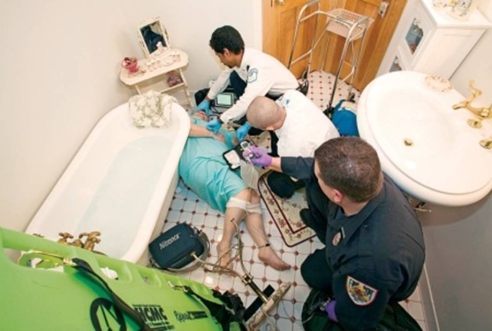
A) place her lying on her left side on a backboard.
B) use a fireman's carry to extricate her from the bathroom.
C) assist her in standing and let her use her walker.
D) use spinal precautions and place her on a backboard.
A) place her lying on her left side on a backboard.
B) use a fireman's carry to extricate her from the bathroom.
C) assist her in standing and let her use her walker.
D) use spinal precautions and place her on a backboard.
Question
In looking at this photo, what is the most important thing that you should note in your patient care report?
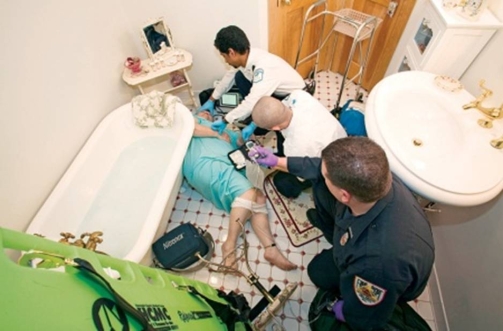
A) What her family should have done to prevent this type of fall.
B) Hazards that exist in the bathroom that could be prevented.
C) Description of the appearance and clothing of the patient.
D) The position and location the patient was in when you arrived.
A) What her family should have done to prevent this type of fall.
B) Hazards that exist in the bathroom that could be prevented.
C) Description of the appearance and clothing of the patient.
D) The position and location the patient was in when you arrived.
Question

Unlock Deck
Sign up to unlock the cards in this deck!
Unlock Deck
Unlock Deck
1/19

Play

Full screen (f)
Deck 45: Older Adults
1
The term elderly refers to persons _____ years of age and older.
A) 70
B) 65
C) 75
D) 60
A) 70
B) 65
C) 75
D) 60
65
2
As many as ______% of older adults who seek emergency care are malnourished.
A) 30
B) 15
C) 25
D) 20
A) 30
B) 15
C) 25
D) 20
20
3
Which of the following is a cardiovascular system change that you would find in an elderly patient?
A) Decreased cardiac output
B) Thinning of the blood vessels
C) Thinning of heart's valves
D) Increased peripheral vascular resistance
A) Decreased cardiac output
B) Thinning of the blood vessels
C) Thinning of heart's valves
D) Increased peripheral vascular resistance
Decreased cardiac output
4
Your patient is complaining of shortness of breath with exertion and has a cough that produces frothy, blood-tinged sputum. You hear crackles and wheezes when he breathes, and his pulse is rapid. He also reports fatigue and recent weight gain, and he appears anxious. You suspect
A) asthma.
B) heart failure.
C) chronic obstructive pulmonary disease.
D) pneumonia.
A) asthma.
B) heart failure.
C) chronic obstructive pulmonary disease.
D) pneumonia.
Unlock Deck
Unlock for access to all 19 flashcards in this deck.
Unlock Deck
k this deck
5
More than _____% of all pneumonia cases occur in individuals 65 years of age and older.
A) 50
B) 30
C) 10
D) 70
A) 50
B) 30
C) 10
D) 70
Unlock Deck
Unlock for access to all 19 flashcards in this deck.
Unlock Deck
k this deck
6
Your 75 year old female patient is complaining of a sudden onset of dyspnea, is very anxious, has shoulder and chest pain, and low blood pressure. You should
A) administer positive-pressure ventilation with oxygen.
B) transport to the hospital for further assessment and care.
C) give oxygen by non-rebreather mask at 20 L/min.
D) allow the patient to assume a position of comfort.
A) administer positive-pressure ventilation with oxygen.
B) transport to the hospital for further assessment and care.
C) give oxygen by non-rebreather mask at 20 L/min.
D) allow the patient to assume a position of comfort.
Unlock Deck
Unlock for access to all 19 flashcards in this deck.
Unlock Deck
k this deck
7
Which of the following is a respiratory system change that you would find in an elderly patient?
A) Less effective coughing
B) Decreased activity of cilia in the lungs
C) Stronger elasticity of the diaphragm
D) Increased number of alveoli involved in gas exchange
A) Less effective coughing
B) Decreased activity of cilia in the lungs
C) Stronger elasticity of the diaphragm
D) Increased number of alveoli involved in gas exchange
Unlock Deck
Unlock for access to all 19 flashcards in this deck.
Unlock Deck
k this deck
8
Depression, pressure sores, urine incontinence, difficulty swallowing, and venous clots in the legs that can lead to pulmonary emboli are common complications that can occur after
A) COPD.
B) a stroke.
C) heart failure.
D) kidney failure.
A) COPD.
B) a stroke.
C) heart failure.
D) kidney failure.
Unlock Deck
Unlock for access to all 19 flashcards in this deck.
Unlock Deck
k this deck
9
Your patient presented with a sudden change in mental status and her speech is rambling and incoherent. She is anxious and irritable. You suspect
A) delirium.
B) dementia.
C) sundowning.
D) stroke.
A) delirium.
B) dementia.
C) sundowning.
D) stroke.
Unlock Deck
Unlock for access to all 19 flashcards in this deck.
Unlock Deck
k this deck
10
Your 75 year old male patient has been diagnosed with Alzheimer's disease. He is unable to recognize his wife and is suspicious and anxious about your presence in his home. He lost control of his bladder during your examination. In which stage of the disease is he?
A) Late
B) End-stage
C) Early
D) Middle
A) Late
B) End-stage
C) Early
D) Middle
Unlock Deck
Unlock for access to all 19 flashcards in this deck.
Unlock Deck
k this deck
11
__________ is a disease associated with a buildup of internal eye pressure that can damage the optic nerve.
A) Macular Degeneration
B) Myopia
C) Retinal Detachment
D) Glaucoma
A) Macular Degeneration
B) Myopia
C) Retinal Detachment
D) Glaucoma
Unlock Deck
Unlock for access to all 19 flashcards in this deck.
Unlock Deck
k this deck
12
Your 68 year old patient is reporting upper abdominal pain, vomiting and a loss of appetite, as well as black, tarry stools. You suspect
A) lower GI bleeding.
B) upper GI bleeding.
C) fecal impaction.
D) an ulcer disease.
A) lower GI bleeding.
B) upper GI bleeding.
C) fecal impaction.
D) an ulcer disease.
Unlock Deck
Unlock for access to all 19 flashcards in this deck.
Unlock Deck
k this deck
13
Which of the following gastrointestinal system changes would you find in a 70 year old patient?
A) Increased hydrochloric acid in the stomach
B) Increased pancreatic secretions
C) Increased risk of periodontal disease
D) Increased metabolism in the liver
A) Increased hydrochloric acid in the stomach
B) Increased pancreatic secretions
C) Increased risk of periodontal disease
D) Increased metabolism in the liver
Unlock Deck
Unlock for access to all 19 flashcards in this deck.
Unlock Deck
k this deck
14
Which of the following is a genitourinary system change that occurs in elderly patients?
A) Reduced blood flow to kidneys
B) Prostate shrinkage in male patients
C) Increased bladder capacity
D) Reduced urination at night
A) Reduced blood flow to kidneys
B) Prostate shrinkage in male patients
C) Increased bladder capacity
D) Reduced urination at night
Unlock Deck
Unlock for access to all 19 flashcards in this deck.
Unlock Deck
k this deck
15
Your elderly patient reported having the flu last week and is now very weak and nauseous. He has warm, flushed skin and an altered mental status. He begins having a seizure. He is likely suffering from
A) heart failure.
B) a hyperosmolar hyperglycemic state.
C) a stroke.
D) Chronic Obstructive Pulmonary Disease.
A) heart failure.
B) a hyperosmolar hyperglycemic state.
C) a stroke.
D) Chronic Obstructive Pulmonary Disease.
Unlock Deck
Unlock for access to all 19 flashcards in this deck.
Unlock Deck
k this deck
16
Your 72 year old patient reports fuzzy vision that has gotten progressively worse over the past year. She also says that she now sees shadowy areas in her central vision and that straight lines appear bent. You suspect
A) glaucoma.
B) retinal detachment.
C) myopia.
D) macular degeneration.
A) glaucoma.
B) retinal detachment.
C) myopia.
D) macular degeneration.
Unlock Deck
Unlock for access to all 19 flashcards in this deck.
Unlock Deck
k this deck
17
When transporting this patient to the ambulance, you should
A) place her lying on her left side on a backboard.
B) use a fireman's carry to extricate her from the bathroom.
C) assist her in standing and let her use her walker.
D) use spinal precautions and place her on a backboard.
A) place her lying on her left side on a backboard.
B) use a fireman's carry to extricate her from the bathroom.
C) assist her in standing and let her use her walker.
D) use spinal precautions and place her on a backboard.
Unlock Deck
Unlock for access to all 19 flashcards in this deck.
Unlock Deck
k this deck
18
In looking at this photo, what is the most important thing that you should note in your patient care report?
A) What her family should have done to prevent this type of fall.
B) Hazards that exist in the bathroom that could be prevented.
C) Description of the appearance and clothing of the patient.
D) The position and location the patient was in when you arrived.
A) What her family should have done to prevent this type of fall.
B) Hazards that exist in the bathroom that could be prevented.
C) Description of the appearance and clothing of the patient.
D) The position and location the patient was in when you arrived.
Unlock Deck
Unlock for access to all 19 flashcards in this deck.
Unlock Deck
k this deck
19
You elderly patient cut her hand while preparing food. The bleeding is controlled; P 64, B/P 110/80, R 14. When you ask questions, she speaks very slowly and often pauses while answering. You should
A) ask simple yes-or-no questions that do not require lengthy explanation.
B) skip the patient interview, apply oxygen, and transport the patient nonemergently.
C) wait for her to answer your questions unless her condition worsens.
D) document your suspicion that the patient has an altered mental status.
A) ask simple yes-or-no questions that do not require lengthy explanation.
B) skip the patient interview, apply oxygen, and transport the patient nonemergently.
C) wait for her to answer your questions unless her condition worsens.
D) document your suspicion that the patient has an altered mental status.
Unlock Deck
Unlock for access to all 19 flashcards in this deck.
Unlock Deck
k this deck
Unlock Deck
Unlock for access to all 19 flashcards in this deck.







