





 Chat with AI

Deck 10: Capital Budgeting Decisions
Full screen (f)

Question

Question
Question
Question
Question
Question
Question
Question
Question
Question
Question
Question
Question
Question
Question
Question
Question
Question
Consider following project:
 The net present value of this project is closest to:
A)-$20.00 million
B)-$6.46 million
C) $6.46 million
D) $20.00 million
The net present value of this project is closest to:A)-$20.00 million
B)-$6.46 million
C) $6.46 million
D) $20.00 million
Question
Question
Question
Question
Consider the following project:
 The net present value of this project is closest to:
A) -$3.00 million
B) $0.79 million
C) $3.00 million
D) $19.21 million
E) $20.00 million
The net present value of this project is closest to:A) -$3.00 million
B) $0.79 million
C) $3.00 million
D) $19.21 million
E) $20.00 million
Question
Consider the following project end of year cash flows:
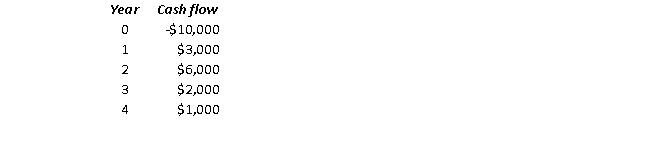 If the project's cost of capital is 8 percent, the net present value of this project is closest to:
A) $226.39
B) $244.51
C) $264.07
D) $2,000.00
If the project's cost of capital is 8 percent, the net present value of this project is closest to:A) $226.39
B) $244.51
C) $264.07
D) $2,000.00
Question
Question
Consider the following project end of year cash flows:
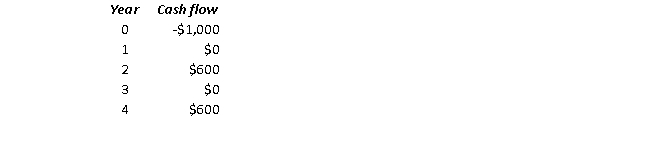 If the project's cost of capital is 8 percent, the net present value of this project is closest to:
A) -$48.15
B) -$44.58
C) -$41.28
D) $200
If the project's cost of capital is 8 percent, the net present value of this project is closest to:A) -$48.15
B) -$44.58
C) -$41.28
D) $200
Question
Consider the following project end of year cash flows:
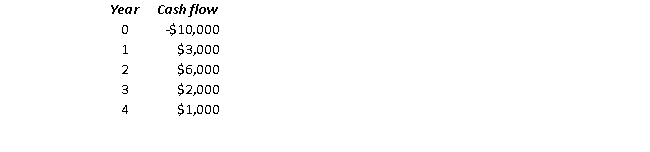 If the project's cost of capital is 8 percent, the internal rate of return on this project is closest to:
A) 5.15%
B) 8.00%
C) 9.30%
D) 20.00%
If the project's cost of capital is 8 percent, the internal rate of return on this project is closest to:A) 5.15%
B) 8.00%
C) 9.30%
D) 20.00%
Question
Consider the following project end of year cash flows:
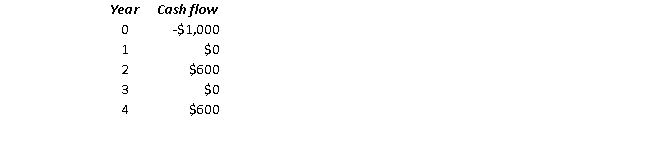 If the project's cost of capital is 8 percent, the internal rate of return on this project is closest to:
A) -22.54%
B) 6.33%
C) 8.00%
D) 20.00%
If the project's cost of capital is 8 percent, the internal rate of return on this project is closest to:A) -22.54%
B) 6.33%
C) 8.00%
D) 20.00%
Question
Consider the following project end of year cash flows:
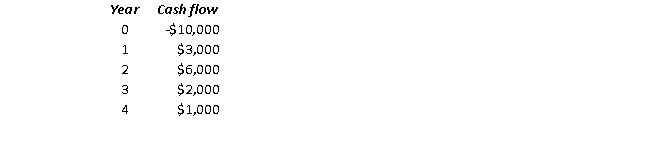 If the project's cost of capital is 8 percent, the profitability index of this project is closest to:
A) 1.000
B) 1.024
C) 1.111
D) 1.200
If the project's cost of capital is 8 percent, the profitability index of this project is closest to:A) 1.000
B) 1.024
C) 1.111
D) 1.200
Question
Consider the following project end of year cash flows:
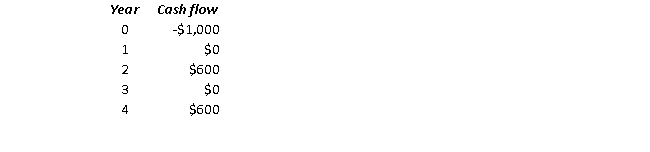 If the project's cost of capital is 8 percent, the profitability index of this project is closest to:
A) 0.882
B) 0.955
C) 1.111
D) 1.200
If the project's cost of capital is 8 percent, the profitability index of this project is closest to:A) 0.882
B) 0.955
C) 1.111
D) 1.200
Question
Question
Consider the following project:
 The net present value of this project is closest to:
A) 3.3%
B) 8.0%
C) 9.2%
D) 20.0%
The net present value of this project is closest to:A) 3.3%
B) 8.0%
C) 9.2%
D) 20.0%
Question
Consider the following project:
 The internal rate of return of this project is closest to:
A) 3.3%
B) 8.0%
C) 18.9%
D) 22.4%
The internal rate of return of this project is closest to:A) 3.3%
B) 8.0%
C) 18.9%
D) 22.4%
Question
Consider the following project:
 If cash flows are reinvested at the project's cost of capital, the modified internal rate of return for this project is closest to:
A) 3.3%
B) 8.0%
C) 8.8%
D) 9.2%
E) 20.0%
If cash flows are reinvested at the project's cost of capital, the modified internal rate of return for this project is closest to:A) 3.3%
B) 8.0%
C) 8.8%
D) 9.2%
E) 20.0%
Question
Consider the following project:
 If cash flows are reinvested at the project's cost of capital, the modified internal rate of return for this project is closest to:
A) 8.0%
B) 18.9%
C) 22.4%
D) 60.0%
If cash flows are reinvested at the project's cost of capital, the modified internal rate of return for this project is closest to:A) 8.0%
B) 18.9%
C) 22.4%
D) 60.0%
Question
Consider the following project:
 If the cash flows are received uniformly throughout the year, the payback period is closest to:
A) 2 years
B) 2 years and 5 months
C) 3 years
D) 3 years and 5 months
If the cash flows are received uniformly throughout the year, the payback period is closest to:A) 2 years
B) 2 years and 5 months
C) 3 years
D) 3 years and 5 months
Question
Consider the following project:
 If the cash flows are received uniformly throughout the year, the payback period is closest to:
A) 2 years
B) 2 years and 4 months
C) 2 years and 8 months
D) 2 years and 10 months
E) 3 years
If the cash flows are received uniformly throughout the year, the payback period is closest to:A) 2 years
B) 2 years and 4 months
C) 2 years and 8 months
D) 2 years and 10 months
E) 3 years
Question
Consider the following project:
 If the cash flows are received uniformly throughout the year, the discounted payback period for this project is closest to:
A) 2 years
B) 2 years and 4 months
C) 2 years and 8 months
D) 2 years and 10 months
E) 3 years
If the cash flows are received uniformly throughout the year, the discounted payback period for this project is closest to:A) 2 years
B) 2 years and 4 months
C) 2 years and 8 months
D) 2 years and 10 months
E) 3 years
Question
Consider the following project:
 If the cash flows are received uniformly throughout the year, the discounted payback period for this project is closest to:
A) 2 years
B) 2 years and 5 months
C) 2 years and 6 months
D) 2 years and 7 months
E) 3 years
If the cash flows are received uniformly throughout the year, the discounted payback period for this project is closest to:A) 2 years
B) 2 years and 5 months
C) 2 years and 6 months
D) 2 years and 7 months
E) 3 years
Question
Question
Question
Consider the following project:
 Which of the following statements is incorrect?
A) The internal rate of return is between 6 percent and 7 percent.
B) The project pays back in terms of the payback period approach.
C) The project has a positive net present value if the project's cost of capital is 6 percent.
D) The profitability index is greater than 1.0 when the project's cost of capital is 5 percent.
Which of the following statements is incorrect?A) The internal rate of return is between 6 percent and 7 percent.
B) The project pays back in terms of the payback period approach.
C) The project has a positive net present value if the project's cost of capital is 6 percent.
D) The profitability index is greater than 1.0 when the project's cost of capital is 5 percent.
Question
Question
Question
Question
Consider two projects, Project J and Project K, with the following end of year cash flows:
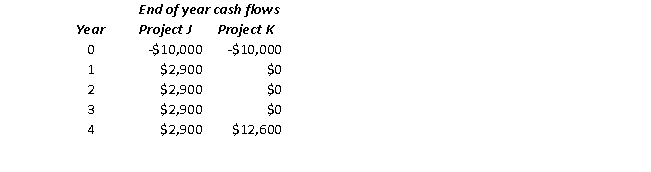 If these projects are mutually exclusive and have a cost of capital of 5 percent, the appropriate decision is to:
A) accept Project J and reject Project K.
B) reject Project J and accept Project K.
C) accept both projects.
D) reject both projects.
If these projects are mutually exclusive and have a cost of capital of 5 percent, the appropriate decision is to:A) accept Project J and reject Project K.
B) reject Project J and accept Project K.
C) accept both projects.
D) reject both projects.
Question
Consider two projects, Project J and Project K, with the following end of year cash flows:
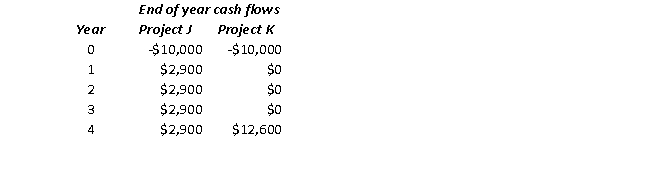 If these projects are mutually exclusive and have a cost of capital of 7 percent, the appropriate decision is to:
A) accept Project J and reject Project K.
B) reject Project J and accept Project K.
C) accept both projects.
D) reject both projects.
If these projects are mutually exclusive and have a cost of capital of 7 percent, the appropriate decision is to:A) accept Project J and reject Project K.
B) reject Project J and accept Project K.
C) accept both projects.
D) reject both projects.
Question
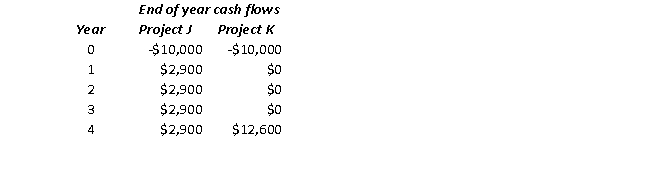
Consider two projects, Project J and Project K, with the following end of year cash flows:
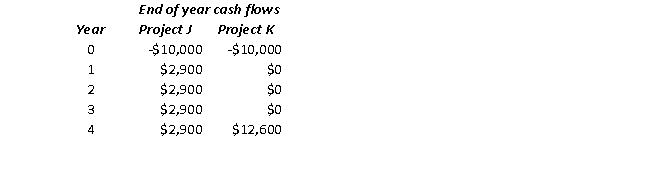 If these projects are independent and have a cost of capital of 5 percent, the appropriate decision is to:
A) accept Project J and reject Project K.
B) reject Project J and accept Project K.
C) accept both projects.
D) reject both projects.
If these projects are independent and have a cost of capital of 5 percent, the appropriate decision is to:A) accept Project J and reject Project K.
B) reject Project J and accept Project K.
C) accept both projects.
D) reject both projects.
Question
Consider two projects, Project P and Project Q, with the following end of year cash flows:
 Which of the following statements is correct?
A) The crossover discount rate is less than the internal rate of return of both projects.
B) If the cost of capital is 5 percent, the profitability index of both projects will be less than 1.0.
C) If these two projects are independent and the cost of capital is 6 percent, we should reject both projects.
D) If these two projects are mutually exclusive and the cost of capital is 5 percent, we should accept only Project P.
Which of the following statements is correct?A) The crossover discount rate is less than the internal rate of return of both projects.
B) If the cost of capital is 5 percent, the profitability index of both projects will be less than 1.0.
C) If these two projects are independent and the cost of capital is 6 percent, we should reject both projects.
D) If these two projects are mutually exclusive and the cost of capital is 5 percent, we should accept only Project P.
Question
Question
Question
Consider these five projects:
 If there is a budget of $50,000, which projects, if any, should be accepted?
A) All projects
B) Project One only
C) Only Projects One, Two, Four and Five
D) Only Projects One, Two, Three and Five
If there is a budget of $50,000, which projects, if any, should be accepted?A) All projects
B) Project One only
C) Only Projects One, Two, Four and Five
D) Only Projects One, Two, Three and Five
Question
Consider these five projects:
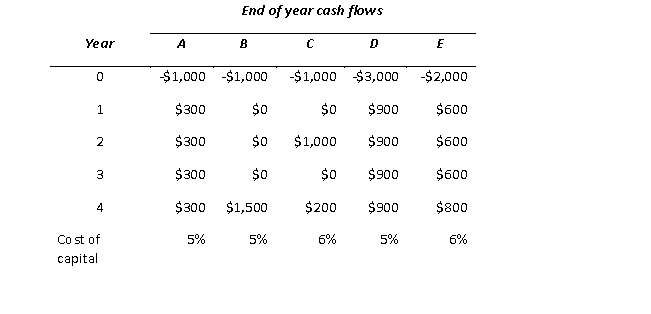 If there is a budget of $5,000, which projects, if any, should be accepted?
A) All projects
B) Project E only
C) Only Projects A, B, C and D
D) Only Projects A, B, C and E
If there is a budget of $5,000, which projects, if any, should be accepted?A) All projects
B) Project E only
C) Only Projects A, B, C and D
D) Only Projects A, B, C and E
Question
Consider these five projects:
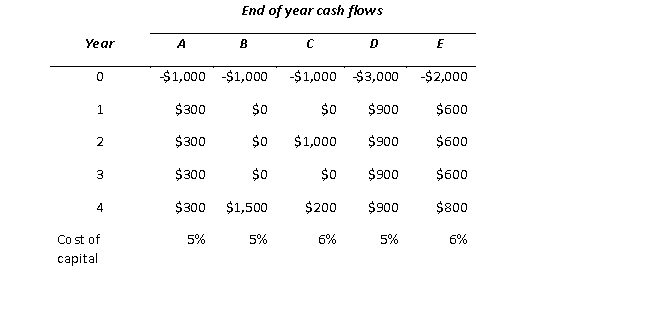 If there is a budget of $4,000, which projects, if any, should be accepted?
A) All projects
B) Project E only
C) Only Projects A, B and D
D) Only Projects A, B and E
If there is a budget of $4,000, which projects, if any, should be accepted?A) All projects
B) Project E only
C) Only Projects A, B and D
D) Only Projects A, B and E
Question
Question
Question
Question
Question
Question
Question
Question
Question
Question
Question
Question
Question
Question
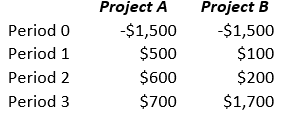
Project B is the better option at a discount rate of 9%.
Question
Question
Question
Question
Question
Question
Question
Question
Question
Question
Question
Question
Question

Unlock Deck
Sign up to unlock the cards in this deck!
Unlock Deck
Unlock Deck
1/97

Play

Full screen (f)
Deck 10: Capital Budgeting Decisions
1
Which of the following is not a step in the capital budgeting process?
A) Evaluating alternatives
B) Identifying investment alternatives
C) Implementing the chosen investment decisions
D) Monitoring and evaluating the implemented decisions
E) All of the above are steps in the Capital budgeting process
A) Evaluating alternatives
B) Identifying investment alternatives
C) Implementing the chosen investment decisions
D) Monitoring and evaluating the implemented decisions
E) All of the above are steps in the Capital budgeting process
All of the above are steps in the Capital budgeting process
2
Which of the following is not an example of a capital expenditure?
A) Plant
B) Equipment
C) Accounts receivable
D) Research and development
A) Plant
B) Equipment
C) Accounts receivable
D) Research and development
Accounts receivable
3
Which of the following is an example of a capital expenditure?
A) Prepaid Insurance
B) Accounts Receivable
C) Investment in Equities
D) Research and Development
A) Prepaid Insurance
B) Accounts Receivable
C) Investment in Equities
D) Research and Development
Research and Development
4
What is the process through which a company makes capital expenditure decisions?
A) Capital budgeting
B) Cash flow budgeting
C) Revenue forecasting
D) Net Income forecasting
A) Capital budgeting
B) Cash flow budgeting
C) Revenue forecasting
D) Net Income forecasting
Unlock Deck
Unlock for access to all 97 flashcards in this deck.
Unlock Deck
k this deck
5
This is referred to as the return on an investment that compensates the investor for explicit and implicit costs, where implicit costs include the opportunity cost of the investor's capital.
A) Capital profit
B) Normal profit
C) Economic profit
D) Competitive advantage
A) Capital profit
B) Normal profit
C) Economic profit
D) Competitive advantage
Unlock Deck
Unlock for access to all 97 flashcards in this deck.
Unlock Deck
k this deck
6
This is referred to as the return on an investment in excess of the normal profit.
A) Capital profit
B) Normal profit
C) Economic profit
D) Competitive advantage
A) Capital profit
B) Normal profit
C) Economic profit
D) Competitive advantage
Unlock Deck
Unlock for access to all 97 flashcards in this deck.
Unlock Deck
k this deck
7
What type of analysis is based on the idea that a company focuses on the strategic decisions about which industries or products the company invest?
A) Top-down analysis
B) Horizontal analysis
C) Bottom-up analysis
A) Top-down analysis
B) Horizontal analysis
C) Bottom-up analysis
Unlock Deck
Unlock for access to all 97 flashcards in this deck.
Unlock Deck
k this deck
8
What type of analysis is based on the idea that a company is simply a set or portfolio of capital investment decisions?
A) Top-down analysis
B) Horizontal analysis
C) Bottom-up analysis
A) Top-down analysis
B) Horizontal analysis
C) Bottom-up analysis
Unlock Deck
Unlock for access to all 97 flashcards in this deck.
Unlock Deck
k this deck
9
An analysis that considers the value of all opportunities that the investment provides including the opportunity to expand, abandon, or wait is best described as:
A) capital budgeting.
B) the payback period.
C) real-option valuation.
D) the discounted cash flow.
A) capital budgeting.
B) the payback period.
C) real-option valuation.
D) the discounted cash flow.
Unlock Deck
Unlock for access to all 97 flashcards in this deck.
Unlock Deck
k this deck
10
Which of the following is not an advantage of payback period?
A) Easy to calculate
B) A useful initial screening technique
C) Considers the time value of money through the hurdle rate.
D) Measures the liquidity of a project (i.e. how fast cash inflows occur)
A) Easy to calculate
B) A useful initial screening technique
C) Considers the time value of money through the hurdle rate.
D) Measures the liquidity of a project (i.e. how fast cash inflows occur)
Unlock Deck
Unlock for access to all 97 flashcards in this deck.
Unlock Deck
k this deck
11
Which of the following companies is least likely to use cost leadership to give it a comparative or competitive advantage?
A) Costco
B) Starbucks
C) Wal-Mart
D) McDonald's
A) Costco
B) Starbucks
C) Wal-Mart
D) McDonald's
Unlock Deck
Unlock for access to all 97 flashcards in this deck.
Unlock Deck
k this deck
12
Which of the following companies is least likely to use product differentiation to give it a comparative or competitive advantage?
A) Exxon
B) Virgin America
C) Harley Davidson
D) Hard Rock Hotel and Casino
A) Exxon
B) Virgin America
C) Harley Davidson
D) Hard Rock Hotel and Casino
Unlock Deck
Unlock for access to all 97 flashcards in this deck.
Unlock Deck
k this deck
13
The estimated value added of a project, which we calculate as the sum of the present value of all future after-tax incremental cash flows generated by an initial cash outlay, less the present value of the investment outlays, is best described as the:
A) capital profit
B) normal profit
C) economic profit
D) net present value
A) capital profit
B) normal profit
C) economic profit
D) net present value
Unlock Deck
Unlock for access to all 97 flashcards in this deck.
Unlock Deck
k this deck
14
The CEO of your company asks your opinion of a prospective project. It has a zero net present value, what is your recommendation?
A) Decline to take on the project.
B) The project should be accepted.
C) Not enough information to decide.
A) Decline to take on the project.
B) The project should be accepted.
C) Not enough information to decide.
Unlock Deck
Unlock for access to all 97 flashcards in this deck.
Unlock Deck
k this deck
15
Which method is consistent with owners' wealth maximization in the case of deciding among mutually exclusive projects?
A) Payback period
B) Net present value
C) Internal rate of return
D) Discounted payback period
A) Payback period
B) Net present value
C) Internal rate of return
D) Discounted payback period
Unlock Deck
Unlock for access to all 97 flashcards in this deck.
Unlock Deck
k this deck
16
Which of the following projects should be declined?
A) Project A, which has a net present value of $45,000
B) Project B, which has a net present value of $0
C) Project C, which has a net present value of -$15,000
D) Both Project B and Project C should be declined
A) Project A, which has a net present value of $45,000
B) Project B, which has a net present value of $0
C) Project C, which has a net present value of -$15,000
D) Both Project B and Project C should be declined
Unlock Deck
Unlock for access to all 97 flashcards in this deck.
Unlock Deck
k this deck
17
Consider the following project:
Initial outlay = $15 million
Year 1 expected cash flow = $5 million
Year 2 expected cash flow = $6 million
Year 3 expected cash flow = $7 million
Project cost of capital = 8%
The net present value of this project is closest to:
A) -$3.00 million
B) $0.33 million
C) $3.00 million
D) $3.30 million
Initial outlay = $15 million
Year 1 expected cash flow = $5 million
Year 2 expected cash flow = $6 million
Year 3 expected cash flow = $7 million
Project cost of capital = 8%
The net present value of this project is closest to:
A) -$3.00 million
B) $0.33 million
C) $3.00 million
D) $3.30 million
Unlock Deck
Unlock for access to all 97 flashcards in this deck.
Unlock Deck
k this deck
18
Consider following project:
The net present value of this project is closest to:
A)-$20.00 million
B)-$6.46 million
C) $6.46 million
D) $20.00 million
The net present value of this project is closest to:A)-$20.00 million
B)-$6.46 million
C) $6.46 million
D) $20.00 million
Unlock Deck
Unlock for access to all 97 flashcards in this deck.
Unlock Deck
k this deck
19
Which of the following does not take the time value of money into account?
A) Payback period
B) Net present value
C) Internal rate of return
D) Modified internal rate of return
A) Payback period
B) Net present value
C) Internal rate of return
D) Modified internal rate of return
Unlock Deck
Unlock for access to all 97 flashcards in this deck.
Unlock Deck
k this deck
20
Which of the following considers all project cash flows?
A) Payback period
B) Internal rate of return
C) Discounted payback period
A) Payback period
B) Internal rate of return
C) Discounted payback period
Unlock Deck
Unlock for access to all 97 flashcards in this deck.
Unlock Deck
k this deck
21
When evaluating two mutually exclusive projects with a crossover rate of 6% and IRR A < IRR B , we prefer Project A when the discount rate is:
A) equal to 6%.
B) less than 6%.
C) greater than 6%.
A) equal to 6%.
B) less than 6%.
C) greater than 6%.
Unlock Deck
Unlock for access to all 97 flashcards in this deck.
Unlock Deck
k this deck
22
Consider the following project:
The net present value of this project is closest to:
A) -$3.00 million
B) $0.79 million
C) $3.00 million
D) $19.21 million
E) $20.00 million
The net present value of this project is closest to:A) -$3.00 million
B) $0.79 million
C) $3.00 million
D) $19.21 million
E) $20.00 million
Unlock Deck
Unlock for access to all 97 flashcards in this deck.
Unlock Deck
k this deck
23
Consider the following project end of year cash flows:
If the project's cost of capital is 8 percent, the net present value of this project is closest to:
A) $226.39
B) $244.51
C) $264.07
D) $2,000.00
If the project's cost of capital is 8 percent, the net present value of this project is closest to:A) $226.39
B) $244.51
C) $264.07
D) $2,000.00
Unlock Deck
Unlock for access to all 97 flashcards in this deck.
Unlock Deck
k this deck
24
We should reject a project if the:
A) net present value less than $0.
B) profitability index greater than 1.
C) internal rate of return is greater than the project's cost of capital.
D) modified internal rate of return is greater than project's cost of capital.
A) net present value less than $0.
B) profitability index greater than 1.
C) internal rate of return is greater than the project's cost of capital.
D) modified internal rate of return is greater than project's cost of capital.
Unlock Deck
Unlock for access to all 97 flashcards in this deck.
Unlock Deck
k this deck
25
Consider the following project end of year cash flows:
If the project's cost of capital is 8 percent, the net present value of this project is closest to:
A) -$48.15
B) -$44.58
C) -$41.28
D) $200
If the project's cost of capital is 8 percent, the net present value of this project is closest to:A) -$48.15
B) -$44.58
C) -$41.28
D) $200
Unlock Deck
Unlock for access to all 97 flashcards in this deck.
Unlock Deck
k this deck
26
Consider the following project end of year cash flows:
If the project's cost of capital is 8 percent, the internal rate of return on this project is closest to:
A) 5.15%
B) 8.00%
C) 9.30%
D) 20.00%
If the project's cost of capital is 8 percent, the internal rate of return on this project is closest to:A) 5.15%
B) 8.00%
C) 9.30%
D) 20.00%
Unlock Deck
Unlock for access to all 97 flashcards in this deck.
Unlock Deck
k this deck
27
Consider the following project end of year cash flows:
If the project's cost of capital is 8 percent, the internal rate of return on this project is closest to:
A) -22.54%
B) 6.33%
C) 8.00%
D) 20.00%
If the project's cost of capital is 8 percent, the internal rate of return on this project is closest to:A) -22.54%
B) 6.33%
C) 8.00%
D) 20.00%
Unlock Deck
Unlock for access to all 97 flashcards in this deck.
Unlock Deck
k this deck
28
Consider the following project end of year cash flows:
If the project's cost of capital is 8 percent, the profitability index of this project is closest to:
A) 1.000
B) 1.024
C) 1.111
D) 1.200
If the project's cost of capital is 8 percent, the profitability index of this project is closest to:A) 1.000
B) 1.024
C) 1.111
D) 1.200
Unlock Deck
Unlock for access to all 97 flashcards in this deck.
Unlock Deck
k this deck
29
Consider the following project end of year cash flows:
If the project's cost of capital is 8 percent, the profitability index of this project is closest to:
A) 0.882
B) 0.955
C) 1.111
D) 1.200
If the project's cost of capital is 8 percent, the profitability index of this project is closest to:A) 0.882
B) 0.955
C) 1.111
D) 1.200
Unlock Deck
Unlock for access to all 97 flashcards in this deck.
Unlock Deck
k this deck
30
Which of the following statements is incorrect?
A) Unlike net present value, internal rate of return does not use discounted cash flows.
B) Internal rate of return is also called the economic rate of return of a given project.
C) Internal rate of return is the discount rate that makes the present value of all project cash flows equal to zero.
D) A company should accept a project whenever the internal rate of return is greater than the appropriate risk-adjusted discount rate.
A) Unlike net present value, internal rate of return does not use discounted cash flows.
B) Internal rate of return is also called the economic rate of return of a given project.
C) Internal rate of return is the discount rate that makes the present value of all project cash flows equal to zero.
D) A company should accept a project whenever the internal rate of return is greater than the appropriate risk-adjusted discount rate.
Unlock Deck
Unlock for access to all 97 flashcards in this deck.
Unlock Deck
k this deck
31
Consider the following project:
The net present value of this project is closest to:
A) 3.3%
B) 8.0%
C) 9.2%
D) 20.0%
The net present value of this project is closest to:A) 3.3%
B) 8.0%
C) 9.2%
D) 20.0%
Unlock Deck
Unlock for access to all 97 flashcards in this deck.
Unlock Deck
k this deck
32
Consider the following project:
The internal rate of return of this project is closest to:
A) 3.3%
B) 8.0%
C) 18.9%
D) 22.4%
The internal rate of return of this project is closest to:A) 3.3%
B) 8.0%
C) 18.9%
D) 22.4%
Unlock Deck
Unlock for access to all 97 flashcards in this deck.
Unlock Deck
k this deck
33
Consider the following project:
If cash flows are reinvested at the project's cost of capital, the modified internal rate of return for this project is closest to:
A) 3.3%
B) 8.0%
C) 8.8%
D) 9.2%
E) 20.0%
If cash flows are reinvested at the project's cost of capital, the modified internal rate of return for this project is closest to:A) 3.3%
B) 8.0%
C) 8.8%
D) 9.2%
E) 20.0%
Unlock Deck
Unlock for access to all 97 flashcards in this deck.
Unlock Deck
k this deck
34
Consider the following project:
If cash flows are reinvested at the project's cost of capital, the modified internal rate of return for this project is closest to:
A) 8.0%
B) 18.9%
C) 22.4%
D) 60.0%
If cash flows are reinvested at the project's cost of capital, the modified internal rate of return for this project is closest to:A) 8.0%
B) 18.9%
C) 22.4%
D) 60.0%
Unlock Deck
Unlock for access to all 97 flashcards in this deck.
Unlock Deck
k this deck
35
Consider the following project:
If the cash flows are received uniformly throughout the year, the payback period is closest to:
A) 2 years
B) 2 years and 5 months
C) 3 years
D) 3 years and 5 months
If the cash flows are received uniformly throughout the year, the payback period is closest to:A) 2 years
B) 2 years and 5 months
C) 3 years
D) 3 years and 5 months
Unlock Deck
Unlock for access to all 97 flashcards in this deck.
Unlock Deck
k this deck
36
Consider the following project:
If the cash flows are received uniformly throughout the year, the payback period is closest to:
A) 2 years
B) 2 years and 4 months
C) 2 years and 8 months
D) 2 years and 10 months
E) 3 years
If the cash flows are received uniformly throughout the year, the payback period is closest to:A) 2 years
B) 2 years and 4 months
C) 2 years and 8 months
D) 2 years and 10 months
E) 3 years
Unlock Deck
Unlock for access to all 97 flashcards in this deck.
Unlock Deck
k this deck
37
Consider the following project:
If the cash flows are received uniformly throughout the year, the discounted payback period for this project is closest to:
A) 2 years
B) 2 years and 4 months
C) 2 years and 8 months
D) 2 years and 10 months
E) 3 years
If the cash flows are received uniformly throughout the year, the discounted payback period for this project is closest to:A) 2 years
B) 2 years and 4 months
C) 2 years and 8 months
D) 2 years and 10 months
E) 3 years
Unlock Deck
Unlock for access to all 97 flashcards in this deck.
Unlock Deck
k this deck
38
Consider the following project:
If the cash flows are received uniformly throughout the year, the discounted payback period for this project is closest to:
A) 2 years
B) 2 years and 5 months
C) 2 years and 6 months
D) 2 years and 7 months
E) 3 years
If the cash flows are received uniformly throughout the year, the discounted payback period for this project is closest to:A) 2 years
B) 2 years and 5 months
C) 2 years and 6 months
D) 2 years and 7 months
E) 3 years
Unlock Deck
Unlock for access to all 97 flashcards in this deck.
Unlock Deck
k this deck
39
Which of the following statements is incorrect?
A) The market is efficient, even in case of capital rationing.
B) If a company faces capital rationing, they may have to turn down positive net present value projects.
C) Under capital rationing, the decision on projects is based on the combination of projects that gives the highest net present value while satisfying the capital budget constraint.
D) Cost of Capital is no longer the appropriate opportunity cost under capital rationing. Cash flows generated by a project can be reinvested at a rate higher than assumed by the cost of capital because the company is leaving some positive net present value projects on the table due to lack of financing.
A) The market is efficient, even in case of capital rationing.
B) If a company faces capital rationing, they may have to turn down positive net present value projects.
C) Under capital rationing, the decision on projects is based on the combination of projects that gives the highest net present value while satisfying the capital budget constraint.
D) Cost of Capital is no longer the appropriate opportunity cost under capital rationing. Cash flows generated by a project can be reinvested at a rate higher than assumed by the cost of capital because the company is leaving some positive net present value projects on the table due to lack of financing.
Unlock Deck
Unlock for access to all 97 flashcards in this deck.
Unlock Deck
k this deck
40
Which of the following is not a disadvantage of using internal rate of return?
A) Considers all the project's cash flows.
B) Should not use when the capital budget is limited.
C) Cannot be used when the signs of cash flows change more than once.
D) Should not be used when deciding among mutually exclusive projects.
A) Considers all the project's cash flows.
B) Should not use when the capital budget is limited.
C) Cannot be used when the signs of cash flows change more than once.
D) Should not be used when deciding among mutually exclusive projects.
Unlock Deck
Unlock for access to all 97 flashcards in this deck.
Unlock Deck
k this deck
41
Consider the following project:
Which of the following statements is incorrect?
A) The internal rate of return is between 6 percent and 7 percent.
B) The project pays back in terms of the payback period approach.
C) The project has a positive net present value if the project's cost of capital is 6 percent.
D) The profitability index is greater than 1.0 when the project's cost of capital is 5 percent.
Which of the following statements is incorrect?A) The internal rate of return is between 6 percent and 7 percent.
B) The project pays back in terms of the payback period approach.
C) The project has a positive net present value if the project's cost of capital is 6 percent.
D) The profitability index is greater than 1.0 when the project's cost of capital is 5 percent.
Unlock Deck
Unlock for access to all 97 flashcards in this deck.
Unlock Deck
k this deck
42
Consider the following project:
Initial outlay = $15 million
Year 1 expected cash flow = $5 million
Year 2 expected cash flow = $5 million
Year 3 expected cash flow = $10 million
Project cost of capital = 10%
The profitability index for this project is closest to:
A) 0.33
B) 1.08
C) 1.19
D) 1.33
Initial outlay = $15 million
Year 1 expected cash flow = $5 million
Year 2 expected cash flow = $5 million
Year 3 expected cash flow = $10 million
Project cost of capital = 10%
The profitability index for this project is closest to:
A) 0.33
B) 1.08
C) 1.19
D) 1.33
Unlock Deck
Unlock for access to all 97 flashcards in this deck.
Unlock Deck
k this deck
43
Consider the following project information:
Initial outlay = $40 million
Year 1 expected cash flow = $8 million
Year 2 expected cash flow = $10 million
Year 3 expected cash flow = $30 million
Project cost of capital = 10%
The profitability index for this project is closest to:
A) 0.55
B) 0.95
C) 1.20
D) 1.33
Initial outlay = $40 million
Year 1 expected cash flow = $8 million
Year 2 expected cash flow = $10 million
Year 3 expected cash flow = $30 million
Project cost of capital = 10%
The profitability index for this project is closest to:
A) 0.55
B) 0.95
C) 1.20
D) 1.33
Unlock Deck
Unlock for access to all 97 flashcards in this deck.
Unlock Deck
k this deck
44
We should accept a project if:
A) profitability index < 1
B) net present value < 0
C) internal rate of return > project's cost of capital
D) modified internal rate of return > project's cost of capital
A) profitability index < 1
B) net present value < 0
C) internal rate of return > project's cost of capital
D) modified internal rate of return > project's cost of capital
Unlock Deck
Unlock for access to all 97 flashcards in this deck.
Unlock Deck
k this deck
45
Consider two projects, Project J and Project K, with the following end of year cash flows:
If these projects are mutually exclusive and have a cost of capital of 5 percent, the appropriate decision is to:
A) accept Project J and reject Project K.
B) reject Project J and accept Project K.
C) accept both projects.
D) reject both projects.
If these projects are mutually exclusive and have a cost of capital of 5 percent, the appropriate decision is to:A) accept Project J and reject Project K.
B) reject Project J and accept Project K.
C) accept both projects.
D) reject both projects.
Unlock Deck
Unlock for access to all 97 flashcards in this deck.
Unlock Deck
k this deck
46
Consider two projects, Project J and Project K, with the following end of year cash flows:
If these projects are mutually exclusive and have a cost of capital of 7 percent, the appropriate decision is to:
A) accept Project J and reject Project K.
B) reject Project J and accept Project K.
C) accept both projects.
D) reject both projects.
If these projects are mutually exclusive and have a cost of capital of 7 percent, the appropriate decision is to:A) accept Project J and reject Project K.
B) reject Project J and accept Project K.
C) accept both projects.
D) reject both projects.
Unlock Deck
Unlock for access to all 97 flashcards in this deck.
Unlock Deck
k this deck
47
Consider two projects, Project J and Project K, with the following end of year cash flows:
If these projects are independent and have a cost of capital of 5 percent, the appropriate decision is to:
A) accept Project J and reject Project K.
B) reject Project J and accept Project K.
C) accept both projects.
D) reject both projects.
If these projects are independent and have a cost of capital of 5 percent, the appropriate decision is to:A) accept Project J and reject Project K.
B) reject Project J and accept Project K.
C) accept both projects.
D) reject both projects.
Unlock Deck
Unlock for access to all 97 flashcards in this deck.
Unlock Deck
k this deck
48
Consider two projects, Project P and Project Q, with the following end of year cash flows:
Which of the following statements is correct?
A) The crossover discount rate is less than the internal rate of return of both projects.
B) If the cost of capital is 5 percent, the profitability index of both projects will be less than 1.0.
C) If these two projects are independent and the cost of capital is 6 percent, we should reject both projects.
D) If these two projects are mutually exclusive and the cost of capital is 5 percent, we should accept only Project P.
Which of the following statements is correct?A) The crossover discount rate is less than the internal rate of return of both projects.
B) If the cost of capital is 5 percent, the profitability index of both projects will be less than 1.0.
C) If these two projects are independent and the cost of capital is 6 percent, we should reject both projects.
D) If these two projects are mutually exclusive and the cost of capital is 5 percent, we should accept only Project P.
Unlock Deck
Unlock for access to all 97 flashcards in this deck.
Unlock Deck
k this deck
49
Allotting investment capital among available investment projects is best described as:
A) allocating.
B) portioning.
C) capital rationing.
D) capital budgeting.
A) allocating.
B) portioning.
C) capital rationing.
D) capital budgeting.
Unlock Deck
Unlock for access to all 97 flashcards in this deck.
Unlock Deck
k this deck
50
When selecting among projects when there is capital rationing, we should select projects based on the:
A) sum of net present values.
B) highest net present values.
C) highest internal rates of return.
D) profitability index values greater than 1.0.
A) sum of net present values.
B) highest net present values.
C) highest internal rates of return.
D) profitability index values greater than 1.0.
Unlock Deck
Unlock for access to all 97 flashcards in this deck.
Unlock Deck
k this deck
51
Consider these five projects:
If there is a budget of $50,000, which projects, if any, should be accepted?
A) All projects
B) Project One only
C) Only Projects One, Two, Four and Five
D) Only Projects One, Two, Three and Five
If there is a budget of $50,000, which projects, if any, should be accepted?A) All projects
B) Project One only
C) Only Projects One, Two, Four and Five
D) Only Projects One, Two, Three and Five
Unlock Deck
Unlock for access to all 97 flashcards in this deck.
Unlock Deck
k this deck
52
Consider these five projects:
If there is a budget of $5,000, which projects, if any, should be accepted?
A) All projects
B) Project E only
C) Only Projects A, B, C and D
D) Only Projects A, B, C and E
If there is a budget of $5,000, which projects, if any, should be accepted?A) All projects
B) Project E only
C) Only Projects A, B, C and D
D) Only Projects A, B, C and E
Unlock Deck
Unlock for access to all 97 flashcards in this deck.
Unlock Deck
k this deck
53
Consider these five projects:
If there is a budget of $4,000, which projects, if any, should be accepted?
A) All projects
B) Project E only
C) Only Projects A, B and D
D) Only Projects A, B and E
If there is a budget of $4,000, which projects, if any, should be accepted?A) All projects
B) Project E only
C) Only Projects A, B and D
D) Only Projects A, B and E
Unlock Deck
Unlock for access to all 97 flashcards in this deck.
Unlock Deck
k this deck
54
The essence of creating value is generating normal profits through capital investments.
Unlock Deck
Unlock for access to all 97 flashcards in this deck.
Unlock Deck
k this deck
55
The purchase of property is a capital budgeting decision.
Unlock Deck
Unlock for access to all 97 flashcards in this deck.
Unlock Deck
k this deck
56
A comparative advantage is any strategy or company action that reduces the competition that the company experiences.
Unlock Deck
Unlock for access to all 97 flashcards in this deck.
Unlock Deck
k this deck
57
Patents, copyrights, and trademarks are examples of competitive advantages.
Unlock Deck
Unlock for access to all 97 flashcards in this deck.
Unlock Deck
k this deck
58
Top-down analysis focuses on the strategic decisions about the industries or products in which the company should invest.
Unlock Deck
Unlock for access to all 97 flashcards in this deck.
Unlock Deck
k this deck
59
Discounted cash flow used to evaluate stocks and bonds cannot be used for capital investment decisions.
Unlock Deck
Unlock for access to all 97 flashcards in this deck.
Unlock Deck
k this deck
60
Discounted cash flow valuation involves estimating future cash flows and comparing their discounted values with investment outlays required today.
Unlock Deck
Unlock for access to all 97 flashcards in this deck.
Unlock Deck
k this deck
61
Projects that produce a net present value of 0 should be accepted.
Unlock Deck
Unlock for access to all 97 flashcards in this deck.
Unlock Deck
k this deck
62
When the internal rate of return is higher than the hurdle rate, a company should invest in the capital project.
Unlock Deck
Unlock for access to all 97 flashcards in this deck.
Unlock Deck
k this deck
63
If the net present value of a project is positive, the profitability index will be greater than 1.0.
Unlock Deck
Unlock for access to all 97 flashcards in this deck.
Unlock Deck
k this deck
64
If the internal rate of return on a project is greater than the project's cost of capital and the cash flows have only one sign change, the net present value of the project will be greater than $0.
Unlock Deck
Unlock for access to all 97 flashcards in this deck.
Unlock Deck
k this deck
65
The difference between internal rate of return and modified internal rate of return is that internal rate of return has a more realistic assumption regarding reinvestment of cash flows from the project.
Unlock Deck
Unlock for access to all 97 flashcards in this deck.
Unlock Deck
k this deck
66
The mortgage broker says that your mortgage refinance has a payback period of one year and 3 months. This means that you will have the mortgage paid off in one year and three months.
Unlock Deck
Unlock for access to all 97 flashcards in this deck.
Unlock Deck
k this deck
67
Project B is the better option at a discount rate of 9%.
Unlock Deck
Unlock for access to all 97 flashcards in this deck.
Unlock Deck
k this deck
68
The profitability index (PI) formula is: PI = PV (cash outflows) / PV (cash inflows).
Unlock Deck
Unlock for access to all 97 flashcards in this deck.
Unlock Deck
k this deck
69
The profitability index for an initial outlay of $15million and subsequent end-of-year cash inflows of $5, $5 and $10 million, respectively, if the discount rate is 15 percent is 1.12.
Unlock Deck
Unlock for access to all 97 flashcards in this deck.
Unlock Deck
k this deck
70
The net present value and internal rate of return have different assumptions regarding cash flows. net present value assumes that all cash flows are reinvested at one consistent discount rate, while the internal rate of return assumes that all cash flows are reinvested at the internal rate of return (similar yielding investments).
Unlock Deck
Unlock for access to all 97 flashcards in this deck.
Unlock Deck
k this deck
71
The discount rate used in calculating a project's net present value is the project's cost of capital.
Unlock Deck
Unlock for access to all 97 flashcards in this deck.
Unlock Deck
k this deck
72
The same accept / reject decision is reached when looking at independent projects using net present value, internal rate of return, and the profitability index methods.
Unlock Deck
Unlock for access to all 97 flashcards in this deck.
Unlock Deck
k this deck
73
The net present value and internal rate of return methods yield the same ranking when evaluating projects.
Unlock Deck
Unlock for access to all 97 flashcards in this deck.
Unlock Deck
k this deck
74
When evaluating two mutually exclusive projects with a crossover rate of 7 percent and IRR A < IRR B we prefer Project A when the discount rate is greater than 7 percent.
Unlock Deck
Unlock for access to all 97 flashcards in this deck.
Unlock Deck
k this deck
75
If a project has a positive net present value using a discount rate of 6%, the project's internal rate of return is greater than 6%.
Unlock Deck
Unlock for access to all 97 flashcards in this deck.
Unlock Deck
k this deck
76
With contingent projects, one must be turned down even if the net present values of both are positive.
Unlock Deck
Unlock for access to all 97 flashcards in this deck.
Unlock Deck
k this deck
77
The pure play approach involves estimating betas and the risk associated with an investment and the optimal financing by estimating the weighted average cost of capital of companies in an industry associated with the project.
Unlock Deck
Unlock for access to all 97 flashcards in this deck.
Unlock Deck
k this deck
78
List 3 of the 5 forces that Michael Porter identifies as critical factors that determine the profitability and attractiveness of investing in an industry.
Unlock Deck
Unlock for access to all 97 flashcards in this deck.
Unlock Deck
k this deck
79
Calculate the net present value of a project with the following:
Initial outlay: $10 million
Year 1 expected cash flow $8 million
Year 2 expected cash flow $5 million
Year 3 expected cash flow $5 million
Project cost of capital = 10%
Initial outlay: $10 million
Year 1 expected cash flow $8 million
Year 2 expected cash flow $5 million
Year 3 expected cash flow $5 million
Project cost of capital = 10%
Unlock Deck
Unlock for access to all 97 flashcards in this deck.
Unlock Deck
k this deck
80
Calculate the net present value of a project with the following:
Initial outlay: $15 million
Year 1 expected cash flow $5 million
Year 2 expected cash flow $5 million
Year 3 expected cash flow $8 million
Project cost of capital = 10%
Initial outlay: $15 million
Year 1 expected cash flow $5 million
Year 2 expected cash flow $5 million
Year 3 expected cash flow $8 million
Project cost of capital = 10%
Unlock Deck
Unlock for access to all 97 flashcards in this deck.
Unlock Deck
k this deck
Unlock Deck
Unlock for access to all 97 flashcards in this deck.







