





 Chat with AI

Deck 10: Female Pelvic Imaging
Full screen (f)

Question
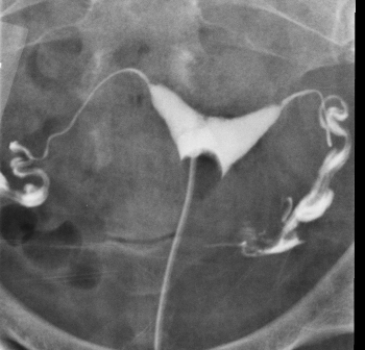 This hysterosalpingogram shows a patient with a:
A) bicornuate uterus that may be related to an increased incidence of spontaneous abortions.
B) severe Müllerian duct anomaly that is incompatible with normal pregnancy and delivery.
C) history of multiple pelvic infections and obstructed fallopian tubes that are preventing successful pregnancy.
D) multiple uterine fibroids that explain the recent onset of pelvic pain.

Question
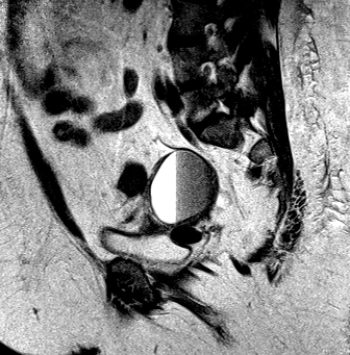 This sagittal MRI shows a patient with:
A) an endometrioma.
B) normal yolk sac.
C) polyhydramnios.
D) uterine tumor.
Question
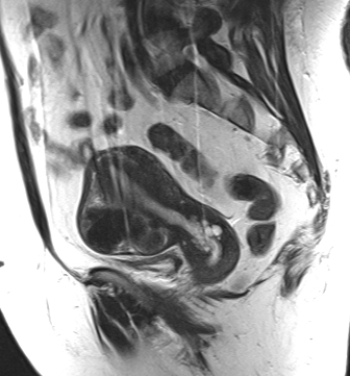 The above sagittal MRI shows a patient with:
A) multiple gestations.
B) uterine fibroids.
C) endometriosis.
D) ectopic pregnancy.
Question
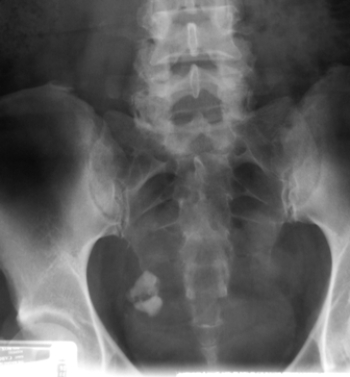 The above radiograph shows that the patient has:
A) an ectopic pregnancy.
B) a pelvic metastatic disease.
C) a phlebolith.
D) an ovarian teratoma.
Question
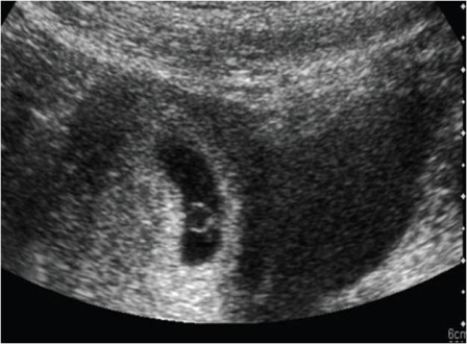 This ultrasound image was done on a woman who is several weeks pregnant and shows:
A) evidence of a blighted ovum.
B) a sign of impending spontaneous abortion.
C) a subchorionic hemorrhage.
D) a normal yolk sac.
Question
Question
Question
Question
Question
Question
Question

Unlock Deck
Sign up to unlock the cards in this deck!
Unlock Deck
Unlock Deck
1/12

Play

Full screen (f)
Deck 10: Female Pelvic Imaging
1
This hysterosalpingogram shows a patient with a:A) bicornuate uterus that may be related to an increased incidence of spontaneous abortions.
B) severe Müllerian duct anomaly that is incompatible with normal pregnancy and delivery.
C) history of multiple pelvic infections and obstructed fallopian tubes that are preventing successful pregnancy.
D) multiple uterine fibroids that explain the recent onset of pelvic pain.
bicornuate uterus that may be related to an increased incidence of spontaneous abortions.
2
This sagittal MRI shows a patient with:A) an endometrioma.
B) normal yolk sac.
C) polyhydramnios.
D) uterine tumor.
an endometrioma.
3
The above sagittal MRI shows a patient with:A) multiple gestations.
B) uterine fibroids.
C) endometriosis.
D) ectopic pregnancy.
uterine fibroids.
4
The above radiograph shows that the patient has:A) an ectopic pregnancy.
B) a pelvic metastatic disease.
C) a phlebolith.
D) an ovarian teratoma.
Unlock Deck
Unlock for access to all 12 flashcards in this deck.
Unlock Deck
k this deck
5
This ultrasound image was done on a woman who is several weeks pregnant and shows:A) evidence of a blighted ovum.
B) a sign of impending spontaneous abortion.
C) a subchorionic hemorrhage.
D) a normal yolk sac.
Unlock Deck
Unlock for access to all 12 flashcards in this deck.
Unlock Deck
k this deck
6
Hysterosalpingography (HSG) is:
A) a radiographic procedure that assesses the endometrial cavity and tubal patency.
B) an ultrasound procedure in which a probe is inserted through the cervix to assess the thickness of the myometrium.
C) an MRI procedure in which gadolinium is injected into the uterus to assess the endometrial cavity and tubal patency.
D) a multiphase CT scan of the uterus done rapidly after the IV injection of contrast material.
A) a radiographic procedure that assesses the endometrial cavity and tubal patency.
B) an ultrasound procedure in which a probe is inserted through the cervix to assess the thickness of the myometrium.
C) an MRI procedure in which gadolinium is injected into the uterus to assess the endometrial cavity and tubal patency.
D) a multiphase CT scan of the uterus done rapidly after the IV injection of contrast material.
Unlock Deck
Unlock for access to all 12 flashcards in this deck.
Unlock Deck
k this deck
7
Round or ovoid filling defect(s) within the contrast-filled endometrial cavity in hysterosalpingography are consistent with:
A) normal pregnancy.
B) endometriosis.
C) endometrial polyp(s).
D) ovarian cyst(s).
A) normal pregnancy.
B) endometriosis.
C) endometrial polyp(s).
D) ovarian cyst(s).
Unlock Deck
Unlock for access to all 12 flashcards in this deck.
Unlock Deck
k this deck
8
Which of the following is INCORRECT regarding transabdominal ultrasonography for the pregnant patient?
A) It is better for visualizing fetal structure in the early stages of pregnancy than transvaginal ultrasonography because of distortion of the ultrasound beam that occurs with this technique.
B) It should be done with a full bladder.
C) Although transvaginal sonography may be needed for very early pregnancies, transabdominal sonography is usually sufficient in all three trimesters of pregnancy.
D) Obstetric ultrasound examinations can reveal abnormal fetal growth and weight gain.
A) It is better for visualizing fetal structure in the early stages of pregnancy than transvaginal ultrasonography because of distortion of the ultrasound beam that occurs with this technique.
B) It should be done with a full bladder.
C) Although transvaginal sonography may be needed for very early pregnancies, transabdominal sonography is usually sufficient in all three trimesters of pregnancy.
D) Obstetric ultrasound examinations can reveal abnormal fetal growth and weight gain.
Unlock Deck
Unlock for access to all 12 flashcards in this deck.
Unlock Deck
k this deck
9
Which of the following statements about fetal development monitoring using ultrasonography is INCORRECT?
A) The earliest sonographic visualization of the embryo is an indistinct thick linear echo, referred to as a fetal pole.
B) Dating of a pregnancy in the first trimester is done by measuring the crown-rump length (CRL) of the fetus.
C) In a first trimester, a pregnant patient with limited vaginal bleeding on ultrasound may show a subchorionic hemorrhage.
D) Ultrasonography cannot be used to diagnose polyhydramnios.
A) The earliest sonographic visualization of the embryo is an indistinct thick linear echo, referred to as a fetal pole.
B) Dating of a pregnancy in the first trimester is done by measuring the crown-rump length (CRL) of the fetus.
C) In a first trimester, a pregnant patient with limited vaginal bleeding on ultrasound may show a subchorionic hemorrhage.
D) Ultrasonography cannot be used to diagnose polyhydramnios.
Unlock Deck
Unlock for access to all 12 flashcards in this deck.
Unlock Deck
k this deck
10
Pelvic inflammatory disease (PID):
A) is conclusively demonstrated with MRI.
B) is suggested by the appearance of shrunken ovaries on ultrasonography.
C) is often associated with excessive free pelvic fluid.
D) is always self-limiting.
A) is conclusively demonstrated with MRI.
B) is suggested by the appearance of shrunken ovaries on ultrasonography.
C) is often associated with excessive free pelvic fluid.
D) is always self-limiting.
Unlock Deck
Unlock for access to all 12 flashcards in this deck.
Unlock Deck
k this deck
11
When an adolescent female with an imperforate hymen presents with a history of amenorrhea and physical examination reveals an enlarged uterus, you should request:
A) a transabdominal pelvic ultrasound.
B) a transvaginal pelvic sonography.
C) an enhanced pelvic CT.
D) an unenhanced pelvic MRI.
A) a transabdominal pelvic ultrasound.
B) a transvaginal pelvic sonography.
C) an enhanced pelvic CT.
D) an unenhanced pelvic MRI.
Unlock Deck
Unlock for access to all 12 flashcards in this deck.
Unlock Deck
k this deck
12
Omental caking is associated with:
A) uterine cancer metastatic to the spine.
B) ovarian cancer with peritoneal metastases.
C) bilateral dermoid ovarian cysts.
D) corpus lutein cysts.
A) uterine cancer metastatic to the spine.
B) ovarian cancer with peritoneal metastases.
C) bilateral dermoid ovarian cysts.
D) corpus lutein cysts.
Unlock Deck
Unlock for access to all 12 flashcards in this deck.
Unlock Deck
k this deck
Unlock Deck
Unlock for access to all 12 flashcards in this deck.







