





 Chat with AI

Deck 6: Nutrition, Feeding, and Digestion
Full screen (f)

Question

Question
Question
Question
Question
Question
Question
Question
Question
Question
Question
Question
Question
Question
Question
Question
Question
Question
Question
Question
Question
Question
Question
Question
Question
Question
Question
Question
Question
Question
Question
Question
Question
Question
Question
Question
Question
Refer to the figure shown.
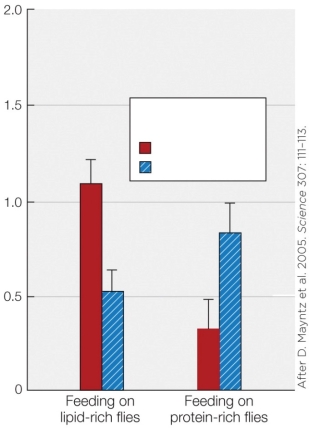 What is the best title for this panel?
A) Death rate is altered by diet
B) Diet affects activity level
C) Balancing protein and lipid intake
D) Food selection affects metabolic rate
What is the best title for this panel?A) Death rate is altered by diet
B) Diet affects activity level
C) Balancing protein and lipid intake
D) Food selection affects metabolic rate
Question
Refer to the figure shown.
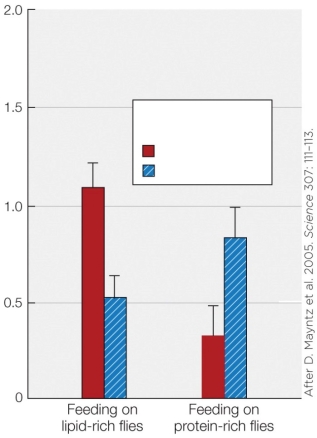 What is the best label for the y axis?
A) Food amount eaten (mg)
B) Metabolic rate (J/mg/h)
C) Activity (Watts/h)
D) Percent protein or lipid
What is the best label for the y axis?A) Food amount eaten (mg)
B) Metabolic rate (J/mg/h)
C) Activity (Watts/h)
D) Percent protein or lipid
Question
Refer to the figure shown.
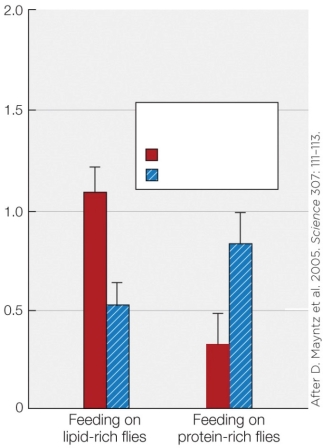 According to the graph, spiders that fed most on protein-rich flies during the 24-hour period before testing
A) were more active compared to those fed lipid-rich flies.
B) preferred lipid-rich flies over the next 72 h.
C) had a body composition higher in protein compared to fat.
D) had the highest metabolic rate.
According to the graph, spiders that fed most on protein-rich flies during the 24-hour period before testingA) were more active compared to those fed lipid-rich flies.
B) preferred lipid-rich flies over the next 72 h.
C) had a body composition higher in protein compared to fat.
D) had the highest metabolic rate.
Question
Question
Question
Question
Question
Question
Question
Question
Question
Question
Question
Question
Question
Question
Question
Question
Question
Question
Question
Refer to the figure shown.
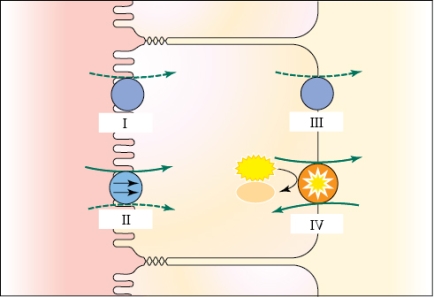 In which area(s) is sodium transport involved?
A) I
B) I and II
C) II and III
D) II and IV
In which area(s) is sodium transport involved?A) I
B) I and II
C) II and III
D) II and IV
Question
Refer to the figure shown.
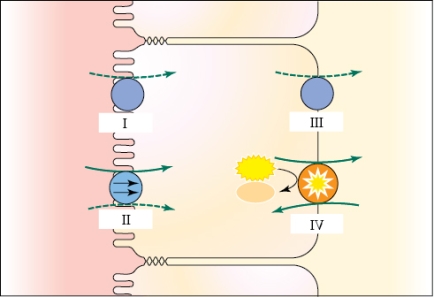 In which area(s) is facilitated diffusion of fructose occurring?
A) I
B) I and II
C) I and III
D) II and III
In which area(s) is facilitated diffusion of fructose occurring?A) I
B) I and II
C) I and III
D) II and III
Question
Refer to the figure shown.
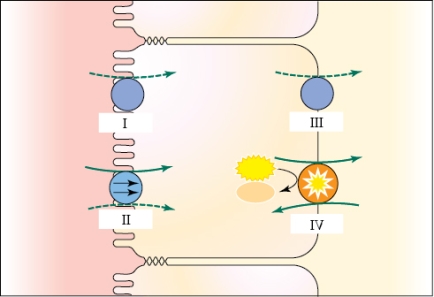 In which area(s) is secondary active transport occurring?
A) I
B) II
C) I and III
D) IV
In which area(s) is secondary active transport occurring?A) I
B) II
C) I and III
D) IV
Question
Refer to the figure shown.
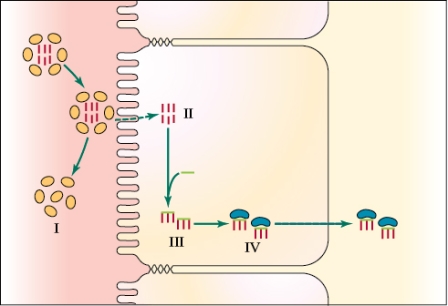 What process is being shown by the figure?
A) Fatty acid absorption
B) Fatty acid metabolism
C) Bile synthesis
D) Glycerol cycling
What process is being shown by the figure?A) Fatty acid absorption
B) Fatty acid metabolism
C) Bile synthesis
D) Glycerol cycling
Question
Refer to the figure shown.
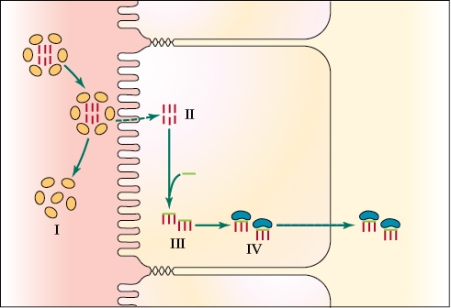 Which label most accurately points to lipoproteins?
A) I
B) II
C) III
D) IV
Which label most accurately points to lipoproteins?A) I
B) II
C) III
D) IV
Question
Question
Question
Question
Question
Question
Question
Question
Question
Question
Question
Question
Question
Question
Question

Unlock Deck
Sign up to unlock the cards in this deck!
Unlock Deck
Unlock Deck
1/77

Play

Full screen (f)
Deck 6: Nutrition, Feeding, and Digestion
1
Among Africans, the Masai are unusual in that
A) adults are strict carnivores.
B) adults and children both produce lactase.
C) only adults produce lactase.
D) adults do not produce lactase but they can drink milk without gut distress.
A) adults are strict carnivores.
B) adults and children both produce lactase.
C) only adults produce lactase.
D) adults do not produce lactase but they can drink milk without gut distress.
B
2
Which factor is not required for a food to have nutritional value.
A) Food must be ingestible.
B) Food must be digestible.
C) Food must have an essential component to it.
D) Food must be absorbable.
A) Food must be ingestible.
B) Food must be digestible.
C) Food must have an essential component to it.
D) Food must be absorbable.
C
3
Why do animals need to eat?
A) Individual molecules deteriorate.
B) Chemical-bond energy used in metabolism can be reused.
C) Animals are physiologically static systems.
D) Cells become damaged and need to be replaced.
A) Individual molecules deteriorate.
B) Chemical-bond energy used in metabolism can be reused.
C) Animals are physiologically static systems.
D) Cells become damaged and need to be replaced.
D
4
Which body component has the greatest mass in a normal, slender adult human?
A) Proteins
B) Lipids
C) Nucleic acid
D) Carbohydrates
A) Proteins
B) Lipids
C) Nucleic acid
D) Carbohydrates
Unlock Deck
Unlock for access to all 77 flashcards in this deck.
Unlock Deck
k this deck
5
Suppose a normal, slender adult gains 10 kg of fat. Which body component would weigh the most?
A) Proteins
B) Lipids
C) Nucleic acid
D) Body water
A) Proteins
B) Lipids
C) Nucleic acid
D) Body water
Unlock Deck
Unlock for access to all 77 flashcards in this deck.
Unlock Deck
k this deck
6
Which substances do not contain nitrogen?
A) Essential and nonessential amino acids
B) Carbohydrates and lipids
C) Lipids and proteins
D) Carbohydrates and polypeptides
A) Essential and nonessential amino acids
B) Carbohydrates and lipids
C) Lipids and proteins
D) Carbohydrates and polypeptides
Unlock Deck
Unlock for access to all 77 flashcards in this deck.
Unlock Deck
k this deck
7
Herbivorous animals obtain their nitrogen primarily from
A) nitrogen gas.
B) nitrates in drinking water.
C) ammonium in drinking water.
D) proteins in plants they eat.
A) nitrogen gas.
B) nitrates in drinking water.
C) ammonium in drinking water.
D) proteins in plants they eat.
Unlock Deck
Unlock for access to all 77 flashcards in this deck.
Unlock Deck
k this deck
8
In terms of essential nutritional requirements for particular molecules, the most exacting requirements are for _______ and the least exacting are for _______.
A) proteins; carbohydrates
B) proteins; lipids
C) carbohydrates; lipids
D) carbohydrates; proteins
A) proteins; carbohydrates
B) proteins; lipids
C) carbohydrates; lipids
D) carbohydrates; proteins
Unlock Deck
Unlock for access to all 77 flashcards in this deck.
Unlock Deck
k this deck
9
A nonessential amino acid is an amino acid that
A) is stored for future use in building proteins.
B) can be synthesized by the animal.
C) is deaminated and used in other biochemical pathways.
D) can be used to synthesize essential amino acids.
A) is stored for future use in building proteins.
B) can be synthesized by the animal.
C) is deaminated and used in other biochemical pathways.
D) can be used to synthesize essential amino acids.
Unlock Deck
Unlock for access to all 77 flashcards in this deck.
Unlock Deck
k this deck
10
In children, there are nine essential amino acids but in adults there are only eight. What accounts for this?
A) Adults can synthesize enough of one amino acid that children cannot.
B) Children store one essential amino acid that they later use as adults.
C) Adults lose the ability to synthesize one amino acid that children can synthesize.
D) Adults have an amino acid transporter that children lack.
A) Adults can synthesize enough of one amino acid that children cannot.
B) Children store one essential amino acid that they later use as adults.
C) Adults lose the ability to synthesize one amino acid that children can synthesize.
D) Adults have an amino acid transporter that children lack.
Unlock Deck
Unlock for access to all 77 flashcards in this deck.
Unlock Deck
k this deck
11
Organic chemists and biochemists often classify molecules based on similarities in their chemical composition. For which compound would developing a generalizable "formula" for chemical composition be most difficult?
A) Proteins
B) Carbohydrates
C) Lipids
D) Vitamins
A) Proteins
B) Carbohydrates
C) Lipids
D) Vitamins
Unlock Deck
Unlock for access to all 77 flashcards in this deck.
Unlock Deck
k this deck
12
Mineral deficiencies are a major problem in some impoverished regions of the world. Ultimately, mineral deficiencies result from
A) soils with insufficient mineral availability.
B) diets low in lipids.
C) lactose intolerance.
D) diets with insufficient protein.
A) soils with insufficient mineral availability.
B) diets low in lipids.
C) lactose intolerance.
D) diets with insufficient protein.
Unlock Deck
Unlock for access to all 77 flashcards in this deck.
Unlock Deck
k this deck
13
One of the minerals that is particularly important for lactating females and their offspring is
A) selenium.
B) calcium.
C) zinc.
D) riboflavin.
A) selenium.
B) calcium.
C) zinc.
D) riboflavin.
Unlock Deck
Unlock for access to all 77 flashcards in this deck.
Unlock Deck
k this deck
14
Which vitamin is most closely integrated with calcium metabolism?
A) Vitamin B12
B) Vitamin D
C) Vitamin E
D) Vitamin K
A) Vitamin B12
B) Vitamin D
C) Vitamin E
D) Vitamin K
Unlock Deck
Unlock for access to all 77 flashcards in this deck.
Unlock Deck
k this deck
15
A newborn is having problems with excessive bleeding following a very minor injury. It is therefore suspected that vitamin _______ was inadequate following birth.
A) B12
B) D
C) E
D) K
A) B12
B) D
C) E
D) K
Unlock Deck
Unlock for access to all 77 flashcards in this deck.
Unlock Deck
k this deck
16
You are browsing at a nutritional supplement store and a representative is trying to sell you their brand of bulk amino acid supplements because this particular brand contains only essential amino acids, which are clearly needed by the body. Would the additional expense of this brand be worth it?
A) No - The body will naturally obtain essential amino acids.
B) No - Although we require the essential amino acids, the excess ingested would be quickly broken down for other purposes and wasted.
C) Yes - You should consume as many essential amino acids in your diet as possible.
D) Yes - We rarely obtain all the essential amino acids we require in our diet.
A) No - The body will naturally obtain essential amino acids.
B) No - Although we require the essential amino acids, the excess ingested would be quickly broken down for other purposes and wasted.
C) Yes - You should consume as many essential amino acids in your diet as possible.
D) Yes - We rarely obtain all the essential amino acids we require in our diet.
Unlock Deck
Unlock for access to all 77 flashcards in this deck.
Unlock Deck
k this deck
17
Lipids are important for all of the following except
A) reducing the permeability of the integument to water.
B) storing water.
C) forming cellular membranes.
D) serving as hormones (for example, steroid lipids).
A) reducing the permeability of the integument to water.
B) storing water.
C) forming cellular membranes.
D) serving as hormones (for example, steroid lipids).
Unlock Deck
Unlock for access to all 77 flashcards in this deck.
Unlock Deck
k this deck
18
The carbohydrates _______ are likely to be more important in insects than in mammals.
A) trehalose and glycogen
B) trehalose and chitin
C) glucose and glycogen
D) trehalose and fructose
A) trehalose and glycogen
B) trehalose and chitin
C) glucose and glycogen
D) trehalose and fructose
Unlock Deck
Unlock for access to all 77 flashcards in this deck.
Unlock Deck
k this deck
19
Suspension feeding is more common in aquatic environments than in terrestrial environments because
A) terrestrial vertebrates are too large to suspension feed.
B) terrestrial animals are too selective in their feeding to be suspension feeders.
C) terrestrial animals typically feed lower on the food chain than aquatic animals do.
D) small suspended food items are abundant in aquatic systems but not in terrestrial systems.
A) terrestrial vertebrates are too large to suspension feed.
B) terrestrial animals are too selective in their feeding to be suspension feeders.
C) terrestrial animals typically feed lower on the food chain than aquatic animals do.
D) small suspended food items are abundant in aquatic systems but not in terrestrial systems.
Unlock Deck
Unlock for access to all 77 flashcards in this deck.
Unlock Deck
k this deck
20
Which animal is not a suspension feeder?
A) Blue whale
B) Whale shark
C) Snail
D) Crabeater seal
A) Blue whale
B) Whale shark
C) Snail
D) Crabeater seal
Unlock Deck
Unlock for access to all 77 flashcards in this deck.
Unlock Deck
k this deck
21
Suppose you discover the fossilized gill arches from a previously unknown species of fish. The gill arches have long, closely packed gill rakers. This fish most likely obtained its energy from
A) eating aquatic plants.
B) eating large molluscs.
C) autotrophy.
D) suspension feeding.
A) eating aquatic plants.
B) eating large molluscs.
C) autotrophy.
D) suspension feeding.
Unlock Deck
Unlock for access to all 77 flashcards in this deck.
Unlock Deck
k this deck
22
You discover a fossil of an organism that came from a deep marine environment. The fossil has no mouth or gastrointestinal tract, and your colleague thinks that it cannot be that of an animal. Is your colleague correct?
A) Yes, because all animals have mouths.
B) Yes, because all animals have gastrointestinal tracts.
C) Yes, because all animals have both mouths and gastrointestinal tracts.
D) No, because some animals lack both mouths and gastrointestinal tracts.
A) Yes, because all animals have mouths.
B) Yes, because all animals have gastrointestinal tracts.
C) Yes, because all animals have both mouths and gastrointestinal tracts.
D) No, because some animals lack both mouths and gastrointestinal tracts.
Unlock Deck
Unlock for access to all 77 flashcards in this deck.
Unlock Deck
k this deck
23
In the study by Mayntz et al., wolf spiders were fed either a protein-rich or lipid-rich diet of fruit flies (Drosophila) and then tested for their preference by being presented with each diet in sequence. Which statement about the results of the study is true?
A) All spiders preferred protein because protein is both uniquely important and uniquely tenuous in animal nutrition (i.e., it is "foremost").
B) All spiders preferred lipid because it has the most energy per gram.
C) Spiders on the protein-rich diet ate flies rich in protein and spiders on the lipid-rich diet ate flies rich in lipid.
D) Spiders on the protein-rich diet ate flies rich in lipid and spiders on the lipid-rich diet ate flies rich in protein.
A) All spiders preferred protein because protein is both uniquely important and uniquely tenuous in animal nutrition (i.e., it is "foremost").
B) All spiders preferred lipid because it has the most energy per gram.
C) Spiders on the protein-rich diet ate flies rich in protein and spiders on the lipid-rich diet ate flies rich in lipid.
D) Spiders on the protein-rich diet ate flies rich in lipid and spiders on the lipid-rich diet ate flies rich in protein.
Unlock Deck
Unlock for access to all 77 flashcards in this deck.
Unlock Deck
k this deck
24
The radular teeth of snails are sometimes hardened by the addition of
A) calcium and iodine.
B) iron and silica.
C) iron and folate.
D) copper and vitamin K.
A) calcium and iodine.
B) iron and silica.
C) iron and folate.
D) copper and vitamin K.
Unlock Deck
Unlock for access to all 77 flashcards in this deck.
Unlock Deck
k this deck
25
Suppose that large nonavian dinosaurs still roamed the earth. If the lowest level of the food chains started with the same amount of energy, dinosaurs at the top of the food chain would receive the most amount of energy from a _______ food chain.
A) three-level
B) four-level
C) five-level
D) six-level
A) three-level
B) four-level
C) five-level
D) six-level
Unlock Deck
Unlock for access to all 77 flashcards in this deck.
Unlock Deck
k this deck
26
The microbes that live in the guts of animals are collectively known as the gut
A) microhome.
B) microbiome.
C) lumen.
D) culture.
A) microhome.
B) microbiome.
C) lumen.
D) culture.
Unlock Deck
Unlock for access to all 77 flashcards in this deck.
Unlock Deck
k this deck
27
The feeding modes that is most associated with a ruminant is
A) attack of individual prey items.
B) suspension feeding.
C) association with symbiotic microbes.
D) coprophagy
A) attack of individual prey items.
B) suspension feeding.
C) association with symbiotic microbes.
D) coprophagy
Unlock Deck
Unlock for access to all 77 flashcards in this deck.
Unlock Deck
k this deck
28
The sulfur-oxidizing bacteria of hydrothermal vent communities are
A) anaerobic and heterotrophic.
B) aerobic and heterotrophic.
C) anaerobic and chemoautotrophic.
D) aerobic and chemoautotrophic.
A) anaerobic and heterotrophic.
B) aerobic and heterotrophic.
C) anaerobic and chemoautotrophic.
D) aerobic and chemoautotrophic.
Unlock Deck
Unlock for access to all 77 flashcards in this deck.
Unlock Deck
k this deck
29
The most abundant component of the gut microbiome in humans is(are)
A) archaea.
B) bacteria.
C) viruses.
D) prions.
A) archaea.
B) bacteria.
C) viruses.
D) prions.
Unlock Deck
Unlock for access to all 77 flashcards in this deck.
Unlock Deck
k this deck
30
Cellulose is one of the most abundant organic molecules in the biosphere, but most animals lack the enzymes needed to break it down. Nevertheless, some animals have and can digest a diet high in cellulose because
A) cellulose provides essential fatty acids.
B) their microbial symbionts break it down, allowing them to obtain energy from cellulose indirectly.
C) cellulose is a required nutrient for microbial symbionts.
D) the only food supply available to them contains large amounts of cellulose.
A) cellulose provides essential fatty acids.
B) their microbial symbionts break it down, allowing them to obtain energy from cellulose indirectly.
C) cellulose is a required nutrient for microbial symbionts.
D) the only food supply available to them contains large amounts of cellulose.
Unlock Deck
Unlock for access to all 77 flashcards in this deck.
Unlock Deck
k this deck
31
Which process is not a useful function of microbes in the rumen?
A) Breakdown of cellulose
B) Synthesis of B vitamins
C) Synthesis of essential amino acids
D) Water balance
A) Breakdown of cellulose
B) Synthesis of B vitamins
C) Synthesis of essential amino acids
D) Water balance
Unlock Deck
Unlock for access to all 77 flashcards in this deck.
Unlock Deck
k this deck
32
Ruminants obtain energy from cellulose by
A) absorbing short-chain fatty acids produced by microbes and digesting microbes that break down the cellulose.
B) absorbing proteins produced by microbes and digesting microbes that break down the cellulose.
C) absorbing both short-chain fatty acids and nonessential amino acids produced by microbes.
D) absorbing both essential and nonessential amino acids produced by microbes.
A) absorbing short-chain fatty acids produced by microbes and digesting microbes that break down the cellulose.
B) absorbing proteins produced by microbes and digesting microbes that break down the cellulose.
C) absorbing both short-chain fatty acids and nonessential amino acids produced by microbes.
D) absorbing both essential and nonessential amino acids produced by microbes.
Unlock Deck
Unlock for access to all 77 flashcards in this deck.
Unlock Deck
k this deck
33
Which animal would be most likely to survive on a diet high in cellulose and low in nitrogen?
A) Sheep
B) Horse
C) Rabbit
D) Koala
A) Sheep
B) Horse
C) Rabbit
D) Koala
Unlock Deck
Unlock for access to all 77 flashcards in this deck.
Unlock Deck
k this deck
34
The reactor model that is most analogous to the rumen of a cow is the _______; the model that is most analogous to the intestine of a cow is the _______.
A) continuous-flow reactor with mixing; continuous-flow reactor without mixing
B) continuous-flow reactor without mixing; continuous-flow reactor with mixing
C) batch reactor; continuous-flow reactor with mixing
D) continuous-flow reactor without mixing; batch reactor
A) continuous-flow reactor with mixing; continuous-flow reactor without mixing
B) continuous-flow reactor without mixing; continuous-flow reactor with mixing
C) batch reactor; continuous-flow reactor with mixing
D) continuous-flow reactor without mixing; batch reactor
Unlock Deck
Unlock for access to all 77 flashcards in this deck.
Unlock Deck
k this deck
35
Nutritionally, the consumption of feces (coprophagy) makes more sense for hindgut fermenters than foregut fermenters. Why?
A) Nutrients produced by microbes in the hindgut are not absorbed; therefore, coprophagy enables hindgut fermenters to absorb nutrients produced by microbes.
B) Microbial symbionts are not activated to produce nutrients unless they have passed through the digestive system at least twice.
C) Microbial symbionts are rarely excreted; therefore, coprophagy enables hindgut fermenters to increase the population of beneficial microbes.
D) The microenvironment in the hindgut is more favorable to microbes compared to the foregut.
A) Nutrients produced by microbes in the hindgut are not absorbed; therefore, coprophagy enables hindgut fermenters to absorb nutrients produced by microbes.
B) Microbial symbionts are not activated to produce nutrients unless they have passed through the digestive system at least twice.
C) Microbial symbionts are rarely excreted; therefore, coprophagy enables hindgut fermenters to increase the population of beneficial microbes.
D) The microenvironment in the hindgut is more favorable to microbes compared to the foregut.
Unlock Deck
Unlock for access to all 77 flashcards in this deck.
Unlock Deck
k this deck
36
In a ruminant animal, the stomach chamber that secretes acid and digestive enzymes is called the
A) rumen.
B) reticulum.
C) abomasum.
D) cecum.
A) rumen.
B) reticulum.
C) abomasum.
D) cecum.
Unlock Deck
Unlock for access to all 77 flashcards in this deck.
Unlock Deck
k this deck
37
Refer to the figure shown.
What is the best title for this panel?
A) Death rate is altered by diet
B) Diet affects activity level
C) Balancing protein and lipid intake
D) Food selection affects metabolic rate
What is the best title for this panel?A) Death rate is altered by diet
B) Diet affects activity level
C) Balancing protein and lipid intake
D) Food selection affects metabolic rate
Unlock Deck
Unlock for access to all 77 flashcards in this deck.
Unlock Deck
k this deck
38
Refer to the figure shown.
What is the best label for the y axis?
A) Food amount eaten (mg)
B) Metabolic rate (J/mg/h)
C) Activity (Watts/h)
D) Percent protein or lipid
What is the best label for the y axis?A) Food amount eaten (mg)
B) Metabolic rate (J/mg/h)
C) Activity (Watts/h)
D) Percent protein or lipid
Unlock Deck
Unlock for access to all 77 flashcards in this deck.
Unlock Deck
k this deck
39
Refer to the figure shown.
According to the graph, spiders that fed most on protein-rich flies during the 24-hour period before testing
A) were more active compared to those fed lipid-rich flies.
B) preferred lipid-rich flies over the next 72 h.
C) had a body composition higher in protein compared to fat.
D) had the highest metabolic rate.
According to the graph, spiders that fed most on protein-rich flies during the 24-hour period before testingA) were more active compared to those fed lipid-rich flies.
B) preferred lipid-rich flies over the next 72 h.
C) had a body composition higher in protein compared to fat.
D) had the highest metabolic rate.
Unlock Deck
Unlock for access to all 77 flashcards in this deck.
Unlock Deck
k this deck
40
Which statement best describes blue whale feeding?
A) A blue whale sucks in water containing krill across the baleen arrays. The krill caught in the baleen is then swallowed.
B) A blue whale takes in a huge volume of water containing krill and forces the water out laterally through baleen arrays. The krill are left behind in the mouth and swallowed.
C) A blue whale takes in a large volume of water containing krill, which is swallowed.
D) A blue whale takes in small amounts of water containing krill and pushes it across the baleen plates. When enough krill collects in the baleen, it is then all swallowed in one gulp.
A) A blue whale sucks in water containing krill across the baleen arrays. The krill caught in the baleen is then swallowed.
B) A blue whale takes in a huge volume of water containing krill and forces the water out laterally through baleen arrays. The krill are left behind in the mouth and swallowed.
C) A blue whale takes in a large volume of water containing krill, which is swallowed.
D) A blue whale takes in small amounts of water containing krill and pushes it across the baleen plates. When enough krill collects in the baleen, it is then all swallowed in one gulp.
Unlock Deck
Unlock for access to all 77 flashcards in this deck.
Unlock Deck
k this deck
41
The posterior "pyloric" stomach chamber of a crustacean often has a lining of bristlelike setae. Collectively, these setae share a functional similarity with the omasum of ruminants, in that both
A) prevent larger food particles from passing down the digestive tract.
B) participate in the mechanical grinding of food.
C) participate in the storing of food.
D) are the primary site of nutrient absorption.
A) prevent larger food particles from passing down the digestive tract.
B) participate in the mechanical grinding of food.
C) participate in the storing of food.
D) are the primary site of nutrient absorption.
Unlock Deck
Unlock for access to all 77 flashcards in this deck.
Unlock Deck
k this deck
42
Many bats and rodents feed on insects, but humans and rabbits generally do not. These dietary habits suggest that
A) humans and rabbits are strict herbivores.
B) many bats and rodents produce cellulase and chitinase enzymes, but humans and rabbits do not.
C) many bats and rodents produce cellulase enzymes, but humans and rabbits do not.
D) many bats and rodents produce chitinase enzymes, but humans and rabbits do not.
A) humans and rabbits are strict herbivores.
B) many bats and rodents produce cellulase and chitinase enzymes, but humans and rabbits do not.
C) many bats and rodents produce cellulase enzymes, but humans and rabbits do not.
D) many bats and rodents produce chitinase enzymes, but humans and rabbits do not.
Unlock Deck
Unlock for access to all 77 flashcards in this deck.
Unlock Deck
k this deck
43
The entry of molecules into the living tissues of an animal from outside the living tissues of an animal is called
A) targeted entry.
B) absorption.
C) intracellular digestion.
D) extracellular digestion.
A) targeted entry.
B) absorption.
C) intracellular digestion.
D) extracellular digestion.
Unlock Deck
Unlock for access to all 77 flashcards in this deck.
Unlock Deck
k this deck
44
In vertebrates, the principal site of digestion of carbohydrates and lipids is the
A) headgut.
B) foregut.
C) midgut.
D) hindgut.
A) headgut.
B) foregut.
C) midgut.
D) hindgut.
Unlock Deck
Unlock for access to all 77 flashcards in this deck.
Unlock Deck
k this deck
45
Which substance(s) is(are) secreted in one part of the digestive tract and then reabsorbed downstream?
A) Bile salts and sodium
B) Proenzymes
C) Exopeptidases
D) Zymogens
A) Bile salts and sodium
B) Proenzymes
C) Exopeptidases
D) Zymogens
Unlock Deck
Unlock for access to all 77 flashcards in this deck.
Unlock Deck
k this deck
46
A major difference between vertebrate and insect digestive systems is that
A) only vertebrates have a foregut.
B) gut motility is a characteristic of vertebrates only.
C) the hindgut affects urine composition in insects but not in vertebrates.
D) insects lack digestive enzymes and rely solely on endosymbionts.
A) only vertebrates have a foregut.
B) gut motility is a characteristic of vertebrates only.
C) the hindgut affects urine composition in insects but not in vertebrates.
D) insects lack digestive enzymes and rely solely on endosymbionts.
Unlock Deck
Unlock for access to all 77 flashcards in this deck.
Unlock Deck
k this deck
47
In crustaceans, the hepatopancreas performs functions very similar to those of the _______ in vertebrates.
A) liver
B) pancreas
C) liver and pancreas
D) stomach
A) liver
B) pancreas
C) liver and pancreas
D) stomach
Unlock Deck
Unlock for access to all 77 flashcards in this deck.
Unlock Deck
k this deck
48
In which animal does intracellular digestion play a major role?
A) Fish
B) Molluscs
C) Insects
D) Crustaceans
A) Fish
B) Molluscs
C) Insects
D) Crustaceans
Unlock Deck
Unlock for access to all 77 flashcards in this deck.
Unlock Deck
k this deck
49
Which substance is associated with extracellular digestion?
A) Intraluminal enzymes
B) Membrane-associated enzymes
C) Intracellular enzymes
D) Intraluminal enzymes and membrane-associated enzymes
A) Intraluminal enzymes
B) Membrane-associated enzymes
C) Intracellular enzymes
D) Intraluminal enzymes and membrane-associated enzymes
Unlock Deck
Unlock for access to all 77 flashcards in this deck.
Unlock Deck
k this deck
50
Which substance is a disaccharidase?
A) Amylase
B) Lactase
C) Sucrose
D) Fructase
A) Amylase
B) Lactase
C) Sucrose
D) Fructase
Unlock Deck
Unlock for access to all 77 flashcards in this deck.
Unlock Deck
k this deck
51
_______ contain the greatest diversity of chemical bonds that must be broken down during digestion.
A) Structural carbohydrates
B) Nonstructural carbohydrates
C) Proteins
D) Lipids
A) Structural carbohydrates
B) Nonstructural carbohydrates
C) Proteins
D) Lipids
Unlock Deck
Unlock for access to all 77 flashcards in this deck.
Unlock Deck
k this deck
52
The inactive forms of digestive enzymes are called
A) endopeptidases.
B) inactivases.
C) zymogens.
D) bile salts.
A) endopeptidases.
B) inactivases.
C) zymogens.
D) bile salts.
Unlock Deck
Unlock for access to all 77 flashcards in this deck.
Unlock Deck
k this deck
53
Bile salts are important for the effective functioning of
A) amylase.
B) endopeptidases.
C) exopeptidases.
D) lipases.
A) amylase.
B) endopeptidases.
C) exopeptidases.
D) lipases.
Unlock Deck
Unlock for access to all 77 flashcards in this deck.
Unlock Deck
k this deck
54
Two transporters are needed for secondary active transport of glucose into a midgut epithelial cell. One transporter is needed to pump _______, and the other is needed to _______.
A) Na+; cotransport glucose
B) glucose; pump water
C) Ca2+; cotransport glucose
D) glucose; pump galactose
A) Na+; cotransport glucose
B) glucose; pump water
C) Ca2+; cotransport glucose
D) glucose; pump galactose
Unlock Deck
Unlock for access to all 77 flashcards in this deck.
Unlock Deck
k this deck
55
In humans and many other vertebrates, the midgut contains minute fingerlike projections called _______ that increase the surface area of the gut epithelium.
A) villi
B) goblet cells
C) crypts
D) enterocytes
A) villi
B) goblet cells
C) crypts
D) enterocytes
Unlock Deck
Unlock for access to all 77 flashcards in this deck.
Unlock Deck
k this deck
56
Three polypeptide hormones secreted in the upper midgut are gastric inhibitory polypeptide,
A) gastrin, and secretin.
B) cholecystokinin, and secretin.
C) gastrin, and cholecystokinin.
D) secretin, and acetylcholine.
A) gastrin, and secretin.
B) cholecystokinin, and secretin.
C) gastrin, and cholecystokinin.
D) secretin, and acetylcholine.
Unlock Deck
Unlock for access to all 77 flashcards in this deck.
Unlock Deck
k this deck
57
Which substance has stimulatory effects on acid-secreting cells, pepsinogen-secreting cells, and muscle motility in the stomach?
A) Secretin
B) Cholecystokinin
C) Gastrin
D) Gastric inhibitory polypeptide
A) Secretin
B) Cholecystokinin
C) Gastrin
D) Gastric inhibitory polypeptide
Unlock Deck
Unlock for access to all 77 flashcards in this deck.
Unlock Deck
k this deck
58
Refer to the figure shown.
In which area(s) is sodium transport involved?
A) I
B) I and II
C) II and III
D) II and IV
In which area(s) is sodium transport involved?A) I
B) I and II
C) II and III
D) II and IV
Unlock Deck
Unlock for access to all 77 flashcards in this deck.
Unlock Deck
k this deck
59
Refer to the figure shown.
In which area(s) is facilitated diffusion of fructose occurring?
A) I
B) I and II
C) I and III
D) II and III
In which area(s) is facilitated diffusion of fructose occurring?A) I
B) I and II
C) I and III
D) II and III
Unlock Deck
Unlock for access to all 77 flashcards in this deck.
Unlock Deck
k this deck
60
Refer to the figure shown.
In which area(s) is secondary active transport occurring?
A) I
B) II
C) I and III
D) IV
In which area(s) is secondary active transport occurring?A) I
B) II
C) I and III
D) IV
Unlock Deck
Unlock for access to all 77 flashcards in this deck.
Unlock Deck
k this deck
61
Refer to the figure shown.
What process is being shown by the figure?
A) Fatty acid absorption
B) Fatty acid metabolism
C) Bile synthesis
D) Glycerol cycling
What process is being shown by the figure?A) Fatty acid absorption
B) Fatty acid metabolism
C) Bile synthesis
D) Glycerol cycling
Unlock Deck
Unlock for access to all 77 flashcards in this deck.
Unlock Deck
k this deck
62
Refer to the figure shown.
Which label most accurately points to lipoproteins?
A) I
B) II
C) III
D) IV
Which label most accurately points to lipoproteins?A) I
B) II
C) III
D) IV
Unlock Deck
Unlock for access to all 77 flashcards in this deck.
Unlock Deck
k this deck
63
Which hormone increases muscle motility of the stomach?
A) Gastrin
B) Secretin
C) Leptin
D) Cholecystokinin
A) Gastrin
B) Secretin
C) Leptin
D) Cholecystokinin
Unlock Deck
Unlock for access to all 77 flashcards in this deck.
Unlock Deck
k this deck
64
One of the weird side effects of a drug you are taking is reduced gut segmentation. How might this manifest itself as a symptom?
A) Food you eat takes longer to go through your intestinal tract.
B) Food has trouble exiting the stomach
C) Food exiting your intestinal tract is less fully broken down.
D) You have trouble swallowing food.
A) Food you eat takes longer to go through your intestinal tract.
B) Food has trouble exiting the stomach
C) Food exiting your intestinal tract is less fully broken down.
D) You have trouble swallowing food.
Unlock Deck
Unlock for access to all 77 flashcards in this deck.
Unlock Deck
k this deck
65
Following a large meal, which hormone(s) is downregulated?
A) Gastrin
B) Ghrelin
C) Secretin
D) Cholecystokinin
A) Gastrin
B) Ghrelin
C) Secretin
D) Cholecystokinin
Unlock Deck
Unlock for access to all 77 flashcards in this deck.
Unlock Deck
k this deck
66
Many "megachiropteran" bats feed on fruit, and many "microchiropteran" bats feed on insects. If you capture a number of bats from each of these groups and feed them all fruit because you are unable to find insects to feed them, what is most likely to occur (provided the other aspects of their captivity are low in stress)?
A) Both groups will do equally well if there are a wide variety of fruits available.
B) The microchirpteran group is likely to lag briefly because of a general lack of gut enzymes and transporters for fruit sugars but will adapt to fruits within days.
C) The microchirpteran group is likely to do very poorly because of a general lack of gut enzymes and transporters for fruit sugars.
D) The megachirpteran group is likely to do very poorly because of a general lack of gut enzymes and transporters for fruit sugars.
A) Both groups will do equally well if there are a wide variety of fruits available.
B) The microchirpteran group is likely to lag briefly because of a general lack of gut enzymes and transporters for fruit sugars but will adapt to fruits within days.
C) The microchirpteran group is likely to do very poorly because of a general lack of gut enzymes and transporters for fruit sugars.
D) The megachirpteran group is likely to do very poorly because of a general lack of gut enzymes and transporters for fruit sugars.
Unlock Deck
Unlock for access to all 77 flashcards in this deck.
Unlock Deck
k this deck
67
Many "megachiropteran" bats feed on fruit, and many "microchiropteran" bats feed on insects. Compared to "megachiropteran" bats, "microchiropteran" bats probably secrete _______ amylase and _______ pancreatic peptidase. They also probably have a _______ density of sugar transporters and a _______ density of amino acid transporters.
A) less; more; lower; lower
B) less; more; lower; higher
C) more; less; lower; higher
D) more; less; higher; lower
A) less; more; lower; lower
B) less; more; lower; higher
C) more; less; lower; higher
D) more; less; higher; lower
Unlock Deck
Unlock for access to all 77 flashcards in this deck.
Unlock Deck
k this deck
68
Why is phenotypic plasticity important in digestion and absorption by vertebrates?
Unlock Deck
Unlock for access to all 77 flashcards in this deck.
Unlock Deck
k this deck
69
Omega-3 and omega-6 fatty acids are essential fatty acids. Can eating saturated fatty acids supply these essential nutritional needs? Explain.
Unlock Deck
Unlock for access to all 77 flashcards in this deck.
Unlock Deck
k this deck
70
Explain how the chemical structure of the retinol (vitamin A) molecule makes it suitable for inclusion in visual pigments of animals?
Unlock Deck
Unlock for access to all 77 flashcards in this deck.
Unlock Deck
k this deck
71
Urea is highly soluble in water and readily diffuses across cells, but uric acid is relatively insoluble in water and does not readily diffuse across cell membranes. If ruminants excreted their nitrogenous wastes as uric acid, how might that affect the benefits that symbiotic microbes provide to them?
Unlock Deck
Unlock for access to all 77 flashcards in this deck.
Unlock Deck
k this deck
72
If the Na+-K+-ATPase in the basolateral membrane were blocked, would you predict a larger effect on glucose transport or fructose transport? Why?
Unlock Deck
Unlock for access to all 77 flashcards in this deck.
Unlock Deck
k this deck
73
Some people have trouble swallowing pills. What might account for this?
Unlock Deck
Unlock for access to all 77 flashcards in this deck.
Unlock Deck
k this deck
74
In some ways, short-chain fatty acids share similarities with monosaccharides and amino acids. In other ways, they resemble long-chain fatty acids. What characteristic of short-chain fatty acids accounts for these resemblances?
Unlock Deck
Unlock for access to all 77 flashcards in this deck.
Unlock Deck
k this deck
75
What response to the ingestion of food is shared by Burmese pythons and molluscs such as oysters, muscles, and clams?
Unlock Deck
Unlock for access to all 77 flashcards in this deck.
Unlock Deck
k this deck
76
Why can the nutritional value of a single food item vary across animals and across time?
Unlock Deck
Unlock for access to all 77 flashcards in this deck.
Unlock Deck
k this deck
77
Running is an energetically costly activity. If mice that normally run 4 km a day are forced to run 10 km a day, what might happen to their digestive tract?
Unlock Deck
Unlock for access to all 77 flashcards in this deck.
Unlock Deck
k this deck
Unlock Deck
Unlock for access to all 77 flashcards in this deck.







