





 Chat with AI

Deck 30: Water, Salts, and Excretion at Work: Mammals of Deserts and Dry Savannas
Full screen (f)

Question

Question
Question
Question
Question
Question
Question
Question
Question
Question
Question
Question
Question
Question
Question
Question
Question
Question
Question
Question
Question
Question
Question
Question
Question
Question
Question
Question
Question
Question
Question
Question
Question
Question
Question
Question
Refer to the figure shown.
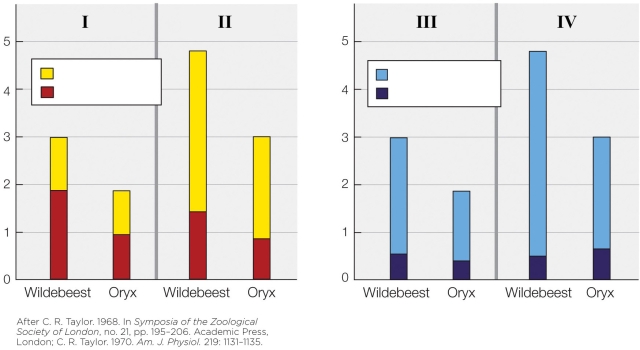 Which would be the most accurate y axis label for both figures?
A) Water loss (L/kg·day)
B) Water gain (L/kg·day)
C) Water flux (L/kg·day)
D) Metabolic water (L/kg·day)
Which would be the most accurate y axis label for both figures?A) Water loss (L/kg·day)
B) Water gain (L/kg·day)
C) Water flux (L/kg·day)
D) Metabolic water (L/kg·day)
Question
Refer to the figure shown.
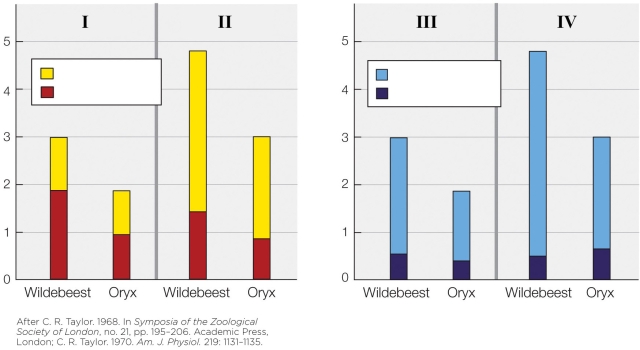 Which panel shows evaporative water loss under near-desert temperatures?
A) I
B) II
C) III
D) IV
Which panel shows evaporative water loss under near-desert temperatures?A) I
B) II
C) III
D) IV
Question
Refer to the figure shown.
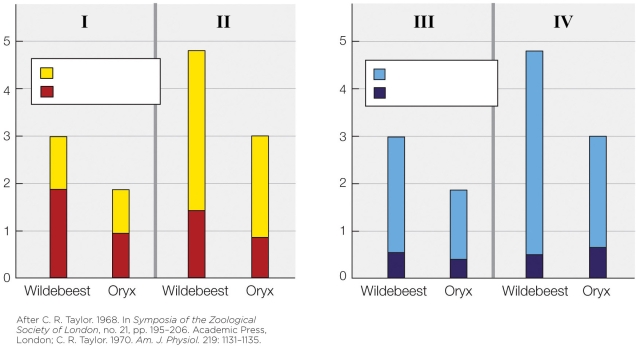 In which panel does the wildebeest appear to be most dependent on preformed water?
A) I
B) II
C) III
D) IV
In which panel does the wildebeest appear to be most dependent on preformed water?A) I
B) II
C) III
D) IV
Question
Refer to the figure shown.
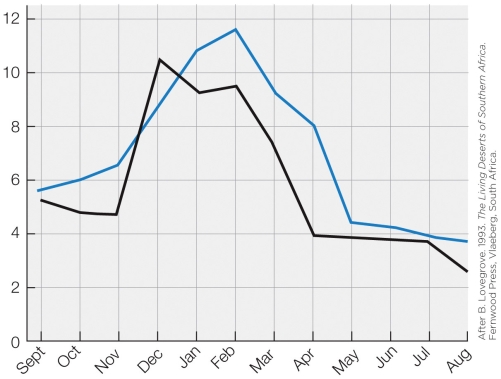 What do the two lines in this figure represent?
A) Species of perennial grasses
B) Species of drinking-water- dependent herbivores
C) Species of drinking-water- independent herbivores
D) Species of desert insects
What do the two lines in this figure represent?A) Species of perennial grasses
B) Species of drinking-water- dependent herbivores
C) Species of drinking-water- independent herbivores
D) Species of desert insects
Question
Question
Question
Question
Question
Question
Question
Question
Question
Question
Question
Question
Question
Question
Refer to the figure shown.
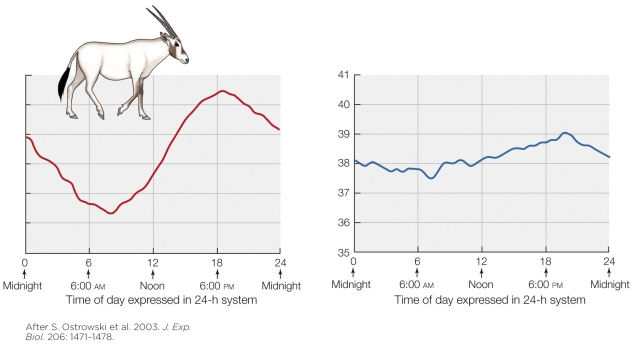 The y axis is most likely measuring
A) urine concentration.
B) body temperature.
C) insulation thickness.
D) metabolic rate.
The y axis is most likely measuringA) urine concentration.
B) body temperature.
C) insulation thickness.
D) metabolic rate.
Question
Refer to the figure shown.
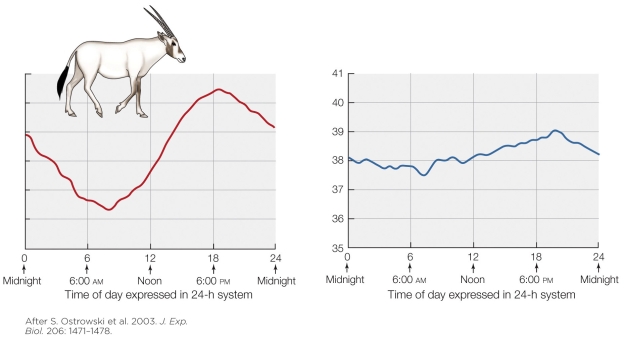 The most accurate description of the results in the figures is
A) gazelles cycle their metabolic rate more in summer than in winter.
B) oryxes have less consistent body water content in winter than in summer.
C) gazelles have more variable urine concentrations in winter than in summer.
D) oryxes have more variable body temperatures in summer than in winter.
The most accurate description of the results in the figures isA) gazelles cycle their metabolic rate more in summer than in winter.
B) oryxes have less consistent body water content in winter than in summer.
C) gazelles have more variable urine concentrations in winter than in summer.
D) oryxes have more variable body temperatures in summer than in winter.
Question
Question
Question
Question
Question
Question
Question
Question
Question
Question

Unlock Deck
Sign up to unlock the cards in this deck!
Unlock Deck
Unlock Deck
1/64

Play

Full screen (f)
Deck 30: Water, Salts, and Excretion at Work: Mammals of Deserts and Dry Savannas
1
Oryxes are
A) small herbivores.
B) small omnivores.
C) large omnivores.
D) large herbivores.
A) small herbivores.
B) small omnivores.
C) large omnivores.
D) large herbivores.
D
2
Chapter 30 focuses on _______ and how they are able to live in such hot and dry environments.
A) mammals
B) small mammals
C) large mammals
D) large animals
A) mammals
B) small mammals
C) large mammals
D) large animals
C
3
Deserts and semi-deserts cover about _______ of the land on Earth.
A) one-sixth
B) a quarter
C) a third
D) half
A) one-sixth
B) a quarter
C) a third
D) half
C
4
Deserts receive less than _______ cm of precipitation per year.
A) 15
B) 20
C) 25
D) 30
A) 15
B) 20
C) 25
D) 30
Unlock Deck
Unlock for access to all 64 flashcards in this deck.
Unlock Deck
k this deck
5
Deserts and savannas affect biological life by
A) presenting challenges for animals, but not plants.
B) presenting challenges for plants, but not animals.
C) presenting challenges for plants and animals.
D) creating an environment that does not support life.
A) presenting challenges for animals, but not plants.
B) presenting challenges for plants, but not animals.
C) presenting challenges for plants and animals.
D) creating an environment that does not support life.
Unlock Deck
Unlock for access to all 64 flashcards in this deck.
Unlock Deck
k this deck
6
The dominant controlling factor of biological processes in dry savannas is
A) the air.
B) water.
C) the sun.
D) the sand.
A) the air.
B) water.
C) the sun.
D) the sand.
Unlock Deck
Unlock for access to all 64 flashcards in this deck.
Unlock Deck
k this deck
7
Which of the following does not occur in the Serengeti plains of East Africa?
A) Lack of rainfall for 4-6 months at a time
B) The drying of streams
C) Prolonged period during which soils are extremely wet
D) Dry, brown grass
A) Lack of rainfall for 4-6 months at a time
B) The drying of streams
C) Prolonged period during which soils are extremely wet
D) Dry, brown grass
Unlock Deck
Unlock for access to all 64 flashcards in this deck.
Unlock Deck
k this deck
8
The principal reason deserts and savannas exist is
A) to balance out wetter areas of Earth.
B) because of the global pattern of air movements.
C) because of evaporation of water, which forms rain.
D) because of rain-shadowing caused by rivers.
A) to balance out wetter areas of Earth.
B) because of the global pattern of air movements.
C) because of evaporation of water, which forms rain.
D) because of rain-shadowing caused by rivers.
Unlock Deck
Unlock for access to all 64 flashcards in this deck.
Unlock Deck
k this deck
9
Near Los Angeles, the coastal mountains force the prevailing winds blowing _______ from the Pacific Ocean to _______, causing mountain rain.
A) west; fall
B) east; rise
C) south; rise
D) north; fall
A) west; fall
B) east; rise
C) south; rise
D) north; fall
Unlock Deck
Unlock for access to all 64 flashcards in this deck.
Unlock Deck
k this deck
10
Scientists predict that the southern regions of Europe are likely to become _______ in the future.
A) less dry
B) drier
C) colder
D) more temperate
A) less dry
B) drier
C) colder
D) more temperate
Unlock Deck
Unlock for access to all 64 flashcards in this deck.
Unlock Deck
k this deck
11
Why does water in deserts and dry savannas often become salty?
A) Salt dissolves from the soil.
B) The rain carries a trace of salt.
C) Salt collects from dead organisms.
D) Salt dissolves from the soil and is collect from rain.
A) Salt dissolves from the soil.
B) The rain carries a trace of salt.
C) Salt collects from dead organisms.
D) Salt dissolves from the soil and is collect from rain.
Unlock Deck
Unlock for access to all 64 flashcards in this deck.
Unlock Deck
k this deck
12
In dry savannas and deserts, animals that weigh _______ have the most behavioral advantages.
A) 500 g
B) 100 kg
C) 200 kg
D) 300 kg
A) 500 g
B) 100 kg
C) 200 kg
D) 300 kg
Unlock Deck
Unlock for access to all 64 flashcards in this deck.
Unlock Deck
k this deck
13
In dry savannas and deserts, animals that weigh _______ have the fewest behavioral advantages.
A) 200 g
B) 400 g
C) 500 g
D) 2 kg
A) 200 g
B) 400 g
C) 500 g
D) 2 kg
Unlock Deck
Unlock for access to all 64 flashcards in this deck.
Unlock Deck
k this deck
14
In dry savannas and deserts, animals that weigh _______ face the heat most directly, thereby generating high heat stress.
A) 200 g
B) 250 g
C) 300 g
D) 40 kg
A) 200 g
B) 250 g
C) 300 g
D) 40 kg
Unlock Deck
Unlock for access to all 64 flashcards in this deck.
Unlock Deck
k this deck
15
In the desert heat, animals that are _______ with relatively _______ surface area for their size have the best chance at survival (assuming no shelter is available).
A) small; high
B) small; low
C) large; high
D) large; low
A) small; high
B) small; low
C) large; high
D) large; low
Unlock Deck
Unlock for access to all 64 flashcards in this deck.
Unlock Deck
k this deck
16
Which animal has the most body-surface area per unit of weight?
A) Squirrel
B) Mouse
C) Dog
D) Horse
A) Squirrel
B) Mouse
C) Dog
D) Horse
Unlock Deck
Unlock for access to all 64 flashcards in this deck.
Unlock Deck
k this deck
17
Environmental heat enters an animal's body when
A) the air temperature is lower than the body temperature.
B) the air temperature is higher than the body temperature.
C) the air temperature is equal to the body temperature.
D) there is enough water available in the environment.
A) the air temperature is lower than the body temperature.
B) the air temperature is higher than the body temperature.
C) the air temperature is equal to the body temperature.
D) there is enough water available in the environment.
Unlock Deck
Unlock for access to all 64 flashcards in this deck.
Unlock Deck
k this deck
18
A large desert mammal regulates its temperature to maintain a constant body temperature. When the air temperature is higher than the body temperature, the animal's evaporation rate will
A) create an unfavorable physiological condition.
B) be lower per unit of weight than for a smaller mammal.
C) decrease.
D) decrease first and then remain constant.
A) create an unfavorable physiological condition.
B) be lower per unit of weight than for a smaller mammal.
C) decrease.
D) decrease first and then remain constant.
Unlock Deck
Unlock for access to all 64 flashcards in this deck.
Unlock Deck
k this deck
19
Which animal has the lowest weight-specific metabolic rate?
A) Horse
B) Mouse
C) Kangaroo rat
D) Dog
A) Horse
B) Mouse
C) Kangaroo rat
D) Dog
Unlock Deck
Unlock for access to all 64 flashcards in this deck.
Unlock Deck
k this deck
20
Which animal's core temperature will be affected most by an exogenous heat load?
A) Small, with relatively high surface area for their size
B) Small, with relatively low surface area for their size
C) Large, with relatively high surface area for their size
D) Large, with relatively low surface area for their size
A) Small, with relatively high surface area for their size
B) Small, with relatively low surface area for their size
C) Large, with relatively high surface area for their size
D) Large, with relatively low surface area for their size
Unlock Deck
Unlock for access to all 64 flashcards in this deck.
Unlock Deck
k this deck
21
Which animal has the highest rate of endogenous heat production per unit of body weight?
A) Horse
B) Human
C) Kangaroo rat
D) Dog
A) Horse
B) Human
C) Kangaroo rat
D) Dog
Unlock Deck
Unlock for access to all 64 flashcards in this deck.
Unlock Deck
k this deck
22
Which animal has the greatest capacity to void both exogenous and endogenous heat from its body through evaporation?
A) Mouse
B) Rat
C) Horse
D) Dog
A) Mouse
B) Rat
C) Horse
D) Dog
Unlock Deck
Unlock for access to all 64 flashcards in this deck.
Unlock Deck
k this deck
23
In small desert mammals, the water cost of being active in the daytime soars due to
A) the fact that they often hide in burrows to escape the heat rather than seek water.
B) the percentage of body weight lost per hour via evaporative thermoregulation.
C) their relatively small body-surface area per unit of weight.
D) their low metabolic rate.
A) the fact that they often hide in burrows to escape the heat rather than seek water.
B) the percentage of body weight lost per hour via evaporative thermoregulation.
C) their relatively small body-surface area per unit of weight.
D) their low metabolic rate.
Unlock Deck
Unlock for access to all 64 flashcards in this deck.
Unlock Deck
k this deck
24
Which animal has the highest mass-specific evaporative water loss?
A) Monkey
B) Squirrel
C) Lion
D) Elephant
A) Monkey
B) Squirrel
C) Lion
D) Elephant
Unlock Deck
Unlock for access to all 64 flashcards in this deck.
Unlock Deck
k this deck
25
Which animal has the highest weight-specific water costs to void endogenously produced heat?
A) Squirrel
B) Monkey
C) Lion
D) Elephant
A) Squirrel
B) Monkey
C) Lion
D) Elephant
Unlock Deck
Unlock for access to all 64 flashcards in this deck.
Unlock Deck
k this deck
26
For most animals, dehydration becomes lethal under hot conditions when _______ or more of total body weight has been lost.
A) 5%
B) 7%
C) 8%
D) 12%
A) 5%
B) 7%
C) 8%
D) 12%
Unlock Deck
Unlock for access to all 64 flashcards in this deck.
Unlock Deck
k this deck
27
If a dog, a human, a kangaroo rat, and a horse set out walking in a hot desert during the hottest part of the day, which animal would die first?
A) Dog
B) Human
C) Kangaroo rat
D) Horse
A) Dog
B) Human
C) Kangaroo rat
D) Horse
Unlock Deck
Unlock for access to all 64 flashcards in this deck.
Unlock Deck
k this deck
28
Which animal would have the least chance of finding food sources in distant locations?
A) Grant's gazelle
B) Zebra
C) Common eland
D) Dwarf antelope
A) Grant's gazelle
B) Zebra
C) Common eland
D) Dwarf antelope
Unlock Deck
Unlock for access to all 64 flashcards in this deck.
Unlock Deck
k this deck
29
The species that can travel furthest from standing water because they are drinking-water-independent is the
A) dwarf antelope.
B) wildebeest.
C) zebra.
D) kangaroo rat.
A) dwarf antelope.
B) wildebeest.
C) zebra.
D) kangaroo rat.
Unlock Deck
Unlock for access to all 64 flashcards in this deck.
Unlock Deck
k this deck
30
An organism meets 30% of its water needs from metabolic water; the rest of its water needs are met
A) from preformed water.
B) by drinking.
C) by eating plants.
D) from preformed water and by drinking.
A) from preformed water.
B) by drinking.
C) by eating plants.
D) from preformed water and by drinking.
Unlock Deck
Unlock for access to all 64 flashcards in this deck.
Unlock Deck
k this deck
31
To maximize water intake, an animal living in dry savannas should eat leaves
A) just before dawn.
B) at noon.
C) in the afternoon.
D) in the evening.
A) just before dawn.
B) at noon.
C) in the afternoon.
D) in the evening.
Unlock Deck
Unlock for access to all 64 flashcards in this deck.
Unlock Deck
k this deck
32
The ambient humidity in deserts is highest
A) at pre-dawn.
B) in the morning.
C) in the afternoon.
D) at night.
A) at pre-dawn.
B) in the morning.
C) in the afternoon.
D) at night.
Unlock Deck
Unlock for access to all 64 flashcards in this deck.
Unlock Deck
k this deck
33
Which species is/are considered drinking-water-dependent herbivore(s)?
A) Wildebeest
B) Eland
C) Zebra
D) Wildebeest and zebra
A) Wildebeest
B) Eland
C) Zebra
D) Wildebeest and zebra
Unlock Deck
Unlock for access to all 64 flashcards in this deck.
Unlock Deck
k this deck
34
Which species does not migrate?
A) Grant's gazelle
B) Wildebeest
C) Thompson's gazelle
D) Zebra
A) Grant's gazelle
B) Wildebeest
C) Thompson's gazelle
D) Zebra
Unlock Deck
Unlock for access to all 64 flashcards in this deck.
Unlock Deck
k this deck
35
Which species is not drinking-water-independent?
A) Oryx
B) Eland
C) Wildebeest
D) Grant's gazelle
A) Oryx
B) Eland
C) Wildebeest
D) Grant's gazelle
Unlock Deck
Unlock for access to all 64 flashcards in this deck.
Unlock Deck
k this deck
36
Refer to the figure shown.
Which would be the most accurate y axis label for both figures?
A) Water loss (L/kg·day)
B) Water gain (L/kg·day)
C) Water flux (L/kg·day)
D) Metabolic water (L/kg·day)
Which would be the most accurate y axis label for both figures?A) Water loss (L/kg·day)
B) Water gain (L/kg·day)
C) Water flux (L/kg·day)
D) Metabolic water (L/kg·day)
Unlock Deck
Unlock for access to all 64 flashcards in this deck.
Unlock Deck
k this deck
37
Refer to the figure shown.
Which panel shows evaporative water loss under near-desert temperatures?
A) I
B) II
C) III
D) IV
Which panel shows evaporative water loss under near-desert temperatures?A) I
B) II
C) III
D) IV
Unlock Deck
Unlock for access to all 64 flashcards in this deck.
Unlock Deck
k this deck
38
Refer to the figure shown.
In which panel does the wildebeest appear to be most dependent on preformed water?
A) I
B) II
C) III
D) IV
In which panel does the wildebeest appear to be most dependent on preformed water?A) I
B) II
C) III
D) IV
Unlock Deck
Unlock for access to all 64 flashcards in this deck.
Unlock Deck
k this deck
39
Refer to the figure shown.
What do the two lines in this figure represent?
A) Species of perennial grasses
B) Species of drinking-water- dependent herbivores
C) Species of drinking-water- independent herbivores
D) Species of desert insects
What do the two lines in this figure represent?A) Species of perennial grasses
B) Species of drinking-water- dependent herbivores
C) Species of drinking-water- independent herbivores
D) Species of desert insects
Unlock Deck
Unlock for access to all 64 flashcards in this deck.
Unlock Deck
k this deck
40
Why do wildebeests migrate from the northwest to the southeast during the beginning of the rainy season?
A) The immediate lack of freshwater
B) Lack of food
C) The increase of predators
D) It is still unknown at this time
A) The immediate lack of freshwater
B) Lack of food
C) The increase of predators
D) It is still unknown at this time
Unlock Deck
Unlock for access to all 64 flashcards in this deck.
Unlock Deck
k this deck
41
Which statement about Arabian oryxes is false?
A) The more they acclimate, the lower their respiratory surface area.
B) The more they acclimate, the more water they conserve.
C) The more they acclimate, the less their total rate of evaporative water loss.
D) They turnover water at a rate one-quarter to that of other free-living mammals their size.
A) The more they acclimate, the lower their respiratory surface area.
B) The more they acclimate, the more water they conserve.
C) The more they acclimate, the less their total rate of evaporative water loss.
D) They turnover water at a rate one-quarter to that of other free-living mammals their size.
Unlock Deck
Unlock for access to all 64 flashcards in this deck.
Unlock Deck
k this deck
42
If an Arabian oryx's urine osmolarity is 240 mOsm and the U/P ratio is 8, its plasma osmolarity would be _______ mOsm.
A) 30
B) 60
C) 240
D) 1920
A) 30
B) 60
C) 240
D) 1920
Unlock Deck
Unlock for access to all 64 flashcards in this deck.
Unlock Deck
k this deck
43
If an Arabian oryx's plasma osmolarity is 200 mOsm, its maximum urine osmolarity would be _______ mOsm.
A) 200
B) 800
C) 1600
D) 3200
A) 200
B) 800
C) 1600
D) 3200
Unlock Deck
Unlock for access to all 64 flashcards in this deck.
Unlock Deck
k this deck
44
The osmotic U/P ratio for a dik-dik is about
A) 5.
B) 8.
C) 10.
D) 12.
A) 5.
B) 8.
C) 10.
D) 12.
Unlock Deck
Unlock for access to all 64 flashcards in this deck.
Unlock Deck
k this deck
45
Among the animals listed, the species with the lowest peak urine osmotic pressure is the
A) African buffalo.
B) Somali donkey.
C) Arabian oryx.
D) dromedary camel.
A) African buffalo.
B) Somali donkey.
C) Arabian oryx.
D) dromedary camel.
Unlock Deck
Unlock for access to all 64 flashcards in this deck.
Unlock Deck
k this deck
46
On a summer day, oryxes exhibit the highest average body temperature at
A) midnight.
B) 6:00 AM.
C) noon.
D) 6:00 PM.
A) midnight.
B) 6:00 AM.
C) noon.
D) 6:00 PM.
Unlock Deck
Unlock for access to all 64 flashcards in this deck.
Unlock Deck
k this deck
47
It has been shown that oryxes can survive without drinking water for
A) days.
B) weeks.
C) months.
D) years.
A) days.
B) weeks.
C) months.
D) years.
Unlock Deck
Unlock for access to all 64 flashcards in this deck.
Unlock Deck
k this deck
48
Oryxes living in deserts or savannas raise their body temperature to
A) release heat.
B) absorb heat.
C) store heat.
D) evaporate excess heat.
A) release heat.
B) absorb heat.
C) store heat.
D) evaporate excess heat.
Unlock Deck
Unlock for access to all 64 flashcards in this deck.
Unlock Deck
k this deck
49
In an oryx living in a dry savanna, the amount of water saved per day as a result of a cycling body temperature as opposed to a constant one is
A) 0.1 L.
B) 0.2 L.
C) 0.3 L.
D) 1.0 L.
A) 0.1 L.
B) 0.2 L.
C) 0.3 L.
D) 1.0 L.
Unlock Deck
Unlock for access to all 64 flashcards in this deck.
Unlock Deck
k this deck
50
The highest recorded rectal temperature in a vertebrate is
A) 38.5°C.
B) 43°C.
C) 46.5°C.
D) 49°C.
A) 38.5°C.
B) 43°C.
C) 46.5°C.
D) 49°C.
Unlock Deck
Unlock for access to all 64 flashcards in this deck.
Unlock Deck
k this deck
51
Based on studies of recently dead animals, oryxes exposed to severe drought in their natural habitat seem to die mostly of
A) predation.
B) dehydration.
C) hyponatremia.
D) severe nutritional deficiency.
A) predation.
B) dehydration.
C) hyponatremia.
D) severe nutritional deficiency.
Unlock Deck
Unlock for access to all 64 flashcards in this deck.
Unlock Deck
k this deck
52
The strategy that conserves the most water in large herbivores is
A) cessation of urination.
B) cycling body core temperature.
C) shedding fur.
D) lowering brain energy consumption.
A) cessation of urination.
B) cycling body core temperature.
C) shedding fur.
D) lowering brain energy consumption.
Unlock Deck
Unlock for access to all 64 flashcards in this deck.
Unlock Deck
k this deck
53
Refer to the figure shown.
The y axis is most likely measuring
A) urine concentration.
B) body temperature.
C) insulation thickness.
D) metabolic rate.
The y axis is most likely measuringA) urine concentration.
B) body temperature.
C) insulation thickness.
D) metabolic rate.
Unlock Deck
Unlock for access to all 64 flashcards in this deck.
Unlock Deck
k this deck
54
Refer to the figure shown.
The most accurate description of the results in the figures is
A) gazelles cycle their metabolic rate more in summer than in winter.
B) oryxes have less consistent body water content in winter than in summer.
C) gazelles have more variable urine concentrations in winter than in summer.
D) oryxes have more variable body temperatures in summer than in winter.
The most accurate description of the results in the figures isA) gazelles cycle their metabolic rate more in summer than in winter.
B) oryxes have less consistent body water content in winter than in summer.
C) gazelles have more variable urine concentrations in winter than in summer.
D) oryxes have more variable body temperatures in summer than in winter.
Unlock Deck
Unlock for access to all 64 flashcards in this deck.
Unlock Deck
k this deck
55
According to most biologists, what is the proper definition of a desert?
Unlock Deck
Unlock for access to all 64 flashcards in this deck.
Unlock Deck
k this deck
56
Deserts and savannas have extreme conditions. Explain why these conditions exist.
Unlock Deck
Unlock for access to all 64 flashcards in this deck.
Unlock Deck
k this deck
57
Describe the advantages and disadvantages that large mammals have living in hot deserts and dry savannas over small mammals in the same environment.
Unlock Deck
Unlock for access to all 64 flashcards in this deck.
Unlock Deck
k this deck
58
Describe the advantages and disadvantages that small mammals living in hot deserts and dry savannas have over large mammals in the same environment.
Unlock Deck
Unlock for access to all 64 flashcards in this deck.
Unlock Deck
k this deck
59
Endothermic animals that live in hot climates regulate their body heat. Where is the heat coming from and how do they regulate it? Does the size of the animal play a role in thermoregulation?
Unlock Deck
Unlock for access to all 64 flashcards in this deck.
Unlock Deck
k this deck
60
D. B. Dill was a pioneer in the study of exercise and heat. Describe his experiments and explain the results.
Unlock Deck
Unlock for access to all 64 flashcards in this deck.
Unlock Deck
k this deck
61
In an experiment to study water budgets, the drinking-water-dependent common wildebeest and the drinking-water-independent beisa oryx were studied under two sets of conditions. Explain the results of this experiment.
Unlock Deck
Unlock for access to all 64 flashcards in this deck.
Unlock Deck
k this deck
62
All species of large herbivores obtain a considerable amount of preformed water, but some require more than others. Explain how different groups of these mammals maintain their water budget.
Unlock Deck
Unlock for access to all 64 flashcards in this deck.
Unlock Deck
k this deck
63
What are the mechanisms by which oryxes achieve exceptional water conservation and low water turnover rates?
Unlock Deck
Unlock for access to all 64 flashcards in this deck.
Unlock Deck
k this deck
64
List the strategies dromedary camels employ to conserve water.
Unlock Deck
Unlock for access to all 64 flashcards in this deck.
Unlock Deck
k this deck
Unlock Deck
Unlock for access to all 64 flashcards in this deck.







