





 Chat with AI

Deck 8: HESI-A2-Anatomy & Physiology
 Free Deck
 Full screen (f)
 Free Deck
 Question

Question
Question
Question
Question
Question
Question
Question
Question
Question
Question
Question
Question
Question
Question
Question
Question
Question
Question
Question
Question
Question
Question
Question
Question
Question
Using the provided image, choose the anatomical structure designated by letter B.
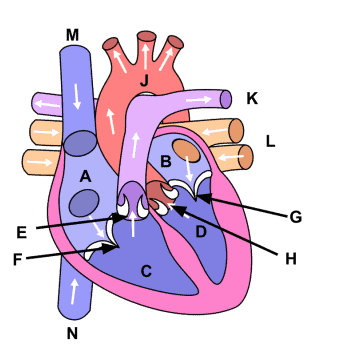
A)Right ventricle
B)Right atrium
C)Left atrium
D)Left ventricle
A)Right ventricle
B)Right atrium
C)Left atrium
D)Left ventricle
Question
Question
Question
Question
Question
Question
Question
Question
Question
Question
Question
Question
Question
Question
Question
Question
Question
Question
Question
Question
Question
Question
Question
Question
Question
Question
Question
Question
Question
Question
Question
Question
Question
Question
Question
Question
Question
Question
Question
Question
Question
Question
Question
Question
Question
Question
Question
Question
Question
Question
Question
Question
Question
Question
Sign Up to check this deck
already have account? log in
1/314

Play


Full screen (f)
Deck 8: HESI-A2-Anatomy & Physiology
1
What does the presence of antidiuretic hormone stimulate?
A)Water reabsorption from the urinary filtrate
B)The release of water into the bladder to be voided as urine
C)The increase of calcium levels in the blood
D)Calcium reabsorption by the nephrons
A)Water reabsorption from the urinary filtrate
B)The release of water into the bladder to be voided as urine
C)The increase of calcium levels in the blood
D)Calcium reabsorption by the nephrons
Water reabsorption from the urinary filtrate.
The most important job of antidiuretic hormone (ADH) is to conserve water in the body by reducing the loss of water in urine. It does this by telling your kidneys how much water it needs to put back into your body instead of voiding it as urine.
Antidiuretic hormone binds to receptors on cells in the collecting ducts of the kidney and promotes reabsorption of water back into the circulation.
Parathyroid hormone is the hormone that increases the levels of calcium in the blood.
Use the following mnemonic device to remember the purpose of ADH:
ADH = Ain't Dumping H2O
The most important job of antidiuretic hormone (ADH) is to conserve water in the body by reducing the loss of water in urine. It does this by telling your kidneys how much water it needs to put back into your body instead of voiding it as urine.
Antidiuretic hormone binds to receptors on cells in the collecting ducts of the kidney and promotes reabsorption of water back into the circulation.
Parathyroid hormone is the hormone that increases the levels of calcium in the blood.
Use the following mnemonic device to remember the purpose of ADH:
ADH = Ain't Dumping H2O
2
A sprain occurs when which of the following structures is stretched or torn?
A)Ligament
B)Tendon
C)Muscle
D)Fibrous joint
A)Ligament
B)Tendon
C)Muscle
D)Fibrous joint
Ligament
A sprain is a stretched or torn ligament.
Ligaments are bands of fibrous tissue that connect bones to bones at your joints.
A strain is also a stretch or tear, but it happens in a muscle or a tendon.
A tendon is a band of fibrous tissue that connect muscles to bones.
A fibrous joint is a joint connected by dense connective tissue consisting mainly of collagen. Fibrous joints are also called fixed or immovable joints because they do not move (unlike synovial joints, which are freely mobile). Fibrous joints have no joint cavity and are connected via fibrous connective tissue. The sutures that connect the bones in your skull are an example of fibrous joints.
See the diagram of the anatomy of the elbow below.
Note the biceps tendon connecting the biceps muscle to the radius (bone).
Also note the anterior band (ligament) connecting the radius (bone) to humerus (bone).
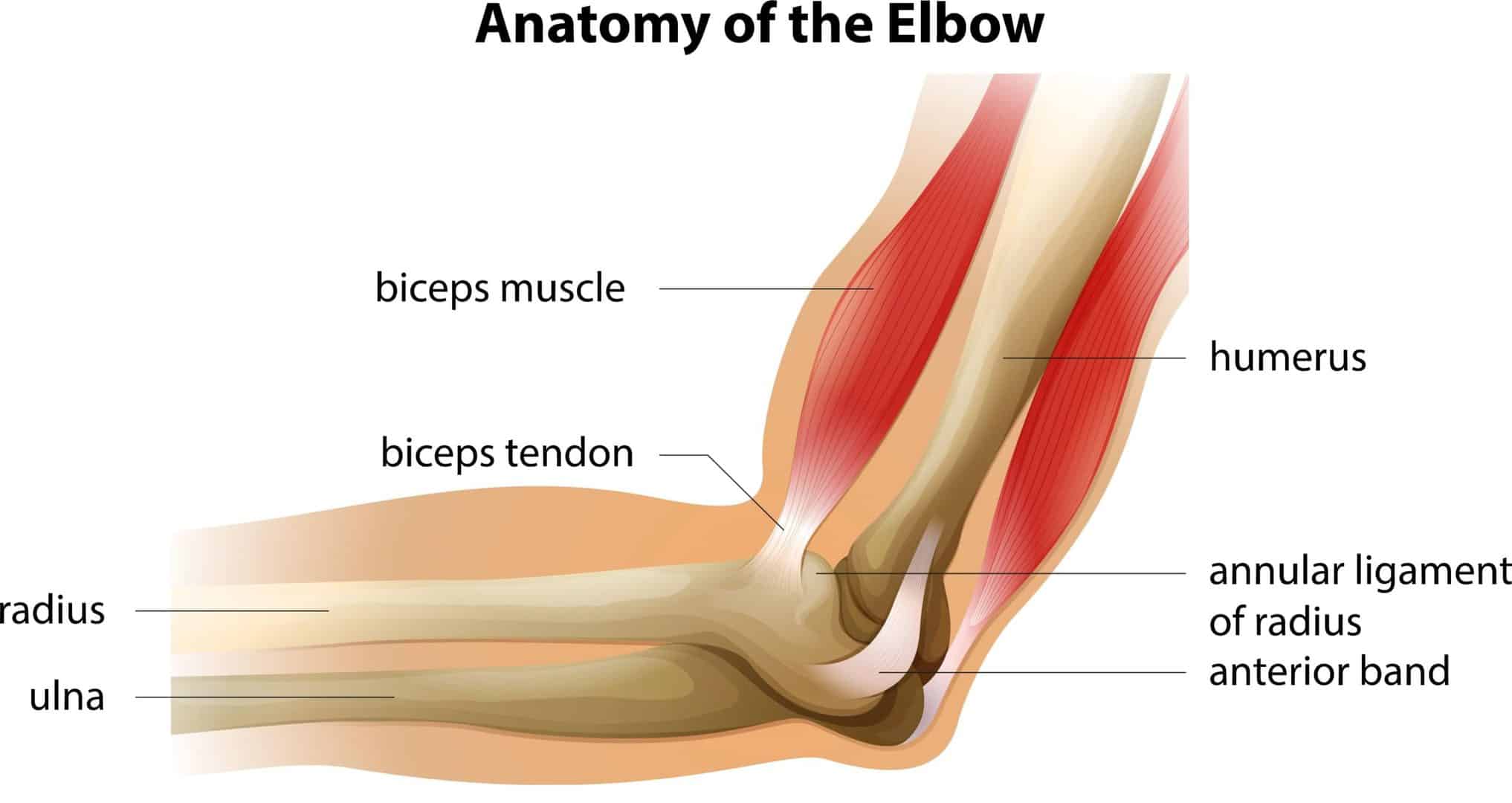
A sprain is a stretched or torn ligament.
Ligaments are bands of fibrous tissue that connect bones to bones at your joints.
A strain is also a stretch or tear, but it happens in a muscle or a tendon.
A tendon is a band of fibrous tissue that connect muscles to bones.
A fibrous joint is a joint connected by dense connective tissue consisting mainly of collagen. Fibrous joints are also called fixed or immovable joints because they do not move (unlike synovial joints, which are freely mobile). Fibrous joints have no joint cavity and are connected via fibrous connective tissue. The sutures that connect the bones in your skull are an example of fibrous joints.
See the diagram of the anatomy of the elbow below.
Note the biceps tendon connecting the biceps muscle to the radius (bone).
Also note the anterior band (ligament) connecting the radius (bone) to humerus (bone).
3
Which of the following lists the correct pathway of blood through the circulatory system?
A)Right ventricle, aorta, systemic circuit, vena cava, left atrium, left ventricle, lungs, right atrium
B)Left ventricle, aorta, systemic circuit, vena cava, right atrium, right ventricle, lungs, left atrium
C)Left ventricle, vena cava, systemic circuit, aorta, right atrium, right ventricle, lungs, left atrium
D)Right ventricle, vena cava, systemic circuit, aorta, left atrium, left ventricle, lungs, right atrium
A)Right ventricle, aorta, systemic circuit, vena cava, left atrium, left ventricle, lungs, right atrium
B)Left ventricle, aorta, systemic circuit, vena cava, right atrium, right ventricle, lungs, left atrium
C)Left ventricle, vena cava, systemic circuit, aorta, right atrium, right ventricle, lungs, left atrium
D)Right ventricle, vena cava, systemic circuit, aorta, left atrium, left ventricle, lungs, right atrium
Left ventricle, aorta, systemic circuit, vena cava, right atrium, right ventricle, lungs, left atrium
The pathway of blood through the circulatory system is comprised of 8 steps. 4 steps happen in the right side of the heart and 4 steps happen in the left.
Right Side of the Heart
The goal of the right side of the heart is to pump un-oxygenated blood (the blood that your body has used) into the lungs so that the blood can be re-supplied with oxygen. It happens in this order:
The un-oxygenated blood is collected by the vena cava, where the superior vena cava (SVC) collects blood from the upper extremities, and the inferior vena cava (IVC) collects blood from the lower extremities.
The vena cava then delivers the un-oxygenated blood directly into the right atrium.
The blood is then squeezed through the tricuspid valve and into the right ventricle.
Then the blood is squeezed through the pulmonic valve and shot up through the pulmonary artery and into the lungs to be re-oxygenated.
Left Side of the Heart
The goal of the left side of the heart is to pump the re-oxygenated blood from the lungs into the rest of the body so oxygen can be delivered to the other organs and tissues.
The re-oxygenated blood leaves the lungs through the pulmonary vein and goes back into the left atrium.
The blood is then squeezed through the bicuspid (mitral) valve into the left ventricle.
From there, the blood is ejected out through the aortic valve and through the aorta, which is the large artery leaving the heart.
Blood is then distributed throughout the body (i.e. systemic circuit).
Note that this is a circuit. Thus, the correct answer does not necessarily have to start at the first step and end at the last.
The diagram below shows the right side of the heart in blue and the left side of the heart in red.
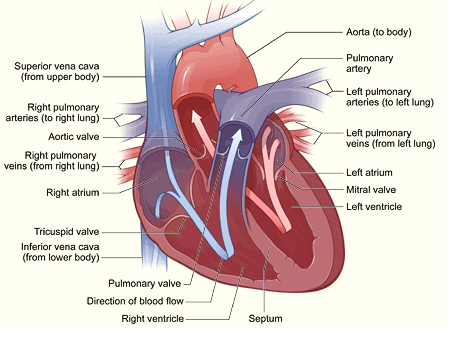
The pathway of blood through the circulatory system is comprised of 8 steps. 4 steps happen in the right side of the heart and 4 steps happen in the left.
Right Side of the Heart
The goal of the right side of the heart is to pump un-oxygenated blood (the blood that your body has used) into the lungs so that the blood can be re-supplied with oxygen. It happens in this order:
The un-oxygenated blood is collected by the vena cava, where the superior vena cava (SVC) collects blood from the upper extremities, and the inferior vena cava (IVC) collects blood from the lower extremities.
The vena cava then delivers the un-oxygenated blood directly into the right atrium.
The blood is then squeezed through the tricuspid valve and into the right ventricle.
Then the blood is squeezed through the pulmonic valve and shot up through the pulmonary artery and into the lungs to be re-oxygenated.
Left Side of the Heart
The goal of the left side of the heart is to pump the re-oxygenated blood from the lungs into the rest of the body so oxygen can be delivered to the other organs and tissues.
The re-oxygenated blood leaves the lungs through the pulmonary vein and goes back into the left atrium.
The blood is then squeezed through the bicuspid (mitral) valve into the left ventricle.
From there, the blood is ejected out through the aortic valve and through the aorta, which is the large artery leaving the heart.
Blood is then distributed throughout the body (i.e. systemic circuit).
Note that this is a circuit. Thus, the correct answer does not necessarily have to start at the first step and end at the last.
The diagram below shows the right side of the heart in blue and the left side of the heart in red.
4
Which of the following best describes the anatomical position?
A)Standing upright, facing the observer, upper extremities at the body's sides, feet flat and directed forward, and the palms facing posteriorly
B)Standing upright, facing away from the observer, upper extremities at the body's sides, feet flat and directed forward, and the palms facing towards anteriorly.
C)Standing upright, facing the observer, upper extremities at the body's sides, feet flat and directed forward, and the palms facing anteriorly
D)Standing upright, facing the observer, upper extremities at the body's sides, feet flat and directed outward, and the palms facing anteriorly.
A)Standing upright, facing the observer, upper extremities at the body's sides, feet flat and directed forward, and the palms facing posteriorly
B)Standing upright, facing away from the observer, upper extremities at the body's sides, feet flat and directed forward, and the palms facing towards anteriorly.
C)Standing upright, facing the observer, upper extremities at the body's sides, feet flat and directed forward, and the palms facing anteriorly
D)Standing upright, facing the observer, upper extremities at the body's sides, feet flat and directed outward, and the palms facing anteriorly.

Unlock Deck
Unlock for access to all 314 flashcards in this deck.
Unlock Deck
k this deck
5
Which of the following male reproductive organs is also a part of the urinary system?
A)Vas deferens
B)Urethra
C)Ureter
D)Epidiymis
A)Vas deferens
B)Urethra
C)Ureter
D)Epidiymis
Unlock Deck
Unlock for access to all 314 flashcards in this deck.
Unlock Deck
k this deck
6
Which of the following is defined as "a group of similar cells and their intercellular matrix that carry out a specific function together?"
A)Neuroglia
B)Organs
C)Tissues
D)Organ systems
A)Neuroglia
B)Organs
C)Tissues
D)Organ systems
Unlock Deck
Unlock for access to all 314 flashcards in this deck.
Unlock Deck
k this deck
7
Which of the following occurs when the sympathetic nervous system is stimulated?
A)Heart rate increases, pupils dilate, digestion slows down
B)Heart rate increases, pupils constrict, digestion slows down
C)Heart rate increases, pupils dilate, digestion increases
D)Heart rate decreases, pupils constrict, digestion increases
A)Heart rate increases, pupils dilate, digestion slows down
B)Heart rate increases, pupils constrict, digestion slows down
C)Heart rate increases, pupils dilate, digestion increases
D)Heart rate decreases, pupils constrict, digestion increases
Unlock Deck
Unlock for access to all 314 flashcards in this deck.
Unlock Deck
k this deck
8
Which of the following is a byproduct of anaerobic respiration that can lead to muscular fatigue, muscle cramps, muscle pain, or a burning sensation in the muscles?
A)Lactic acid
B)Folic acid
C)Hydrochloric acid
D)Citric acid
A)Lactic acid
B)Folic acid
C)Hydrochloric acid
D)Citric acid
Unlock Deck
Unlock for access to all 314 flashcards in this deck.
Unlock Deck
k this deck
9
The internal reproductive organs are located in which of the following anatomical regions?
A)Brachial
B)Thoracic
C)Femoral
D)Pelvic
A)Brachial
B)Thoracic
C)Femoral
D)Pelvic
Unlock Deck
Unlock for access to all 314 flashcards in this deck.
Unlock Deck
k this deck
10
What is erythropoiesis and where does it occur?
A)The formation of bile; Liver
B)The formation of white blood cells; Spleen
C)The formation of red blood cells; Heart
D)The formation of red blood cells; Red bone marrow
A)The formation of bile; Liver
B)The formation of white blood cells; Spleen
C)The formation of red blood cells; Heart
D)The formation of red blood cells; Red bone marrow
Unlock Deck
Unlock for access to all 314 flashcards in this deck.
Unlock Deck
k this deck
11
Which organelle is responsible for regulating the transport of substances in and out of the cell?
A)Rough endoplasmic reticulum
B)Nucleus
C)Cell membrane
D)Smooth endoplasmic reticulum
A)Rough endoplasmic reticulum
B)Nucleus
C)Cell membrane
D)Smooth endoplasmic reticulum
Unlock Deck
Unlock for access to all 314 flashcards in this deck.
Unlock Deck
k this deck
12
The carpals articulate with the distal ends of which two bones?
A)Radius and ulna
B)Tibia and fibula
C)Metacarpals and phalanges
D)Tarsals and metatarsals
A)Radius and ulna
B)Tibia and fibula
C)Metacarpals and phalanges
D)Tarsals and metatarsals
Unlock Deck
Unlock for access to all 314 flashcards in this deck.
Unlock Deck
k this deck
13
Which of the following is not a bone of the lower extremities?
A)Tibia
B)Ulna
C)Fibula
D)Femur
A)Tibia
B)Ulna
C)Fibula
D)Femur
Unlock Deck
Unlock for access to all 314 flashcards in this deck.
Unlock Deck
k this deck
14
The shoulder is an example of which type of synovial joint?
A)Hinge
B)Ball and socket
C)Pivot
D)Saddle
A)Hinge
B)Ball and socket
C)Pivot
D)Saddle
Unlock Deck
Unlock for access to all 314 flashcards in this deck.
Unlock Deck
k this deck
15
Where is the popliteal artery located?
A)Below the jaw line between the trachea and sternomastoid muscle
B)On the underside of the wrist
C)Near the top of the cubital fossa
D)Behind the knee
A)Below the jaw line between the trachea and sternomastoid muscle
B)On the underside of the wrist
C)Near the top of the cubital fossa
D)Behind the knee
Unlock Deck
Unlock for access to all 314 flashcards in this deck.
Unlock Deck
k this deck
16
Which of the following glands secrete earwax?
A)Sebaceous
B)Ceruminous
C)Salivary
D)Eccrine
A)Sebaceous
B)Ceruminous
C)Salivary
D)Eccrine
Unlock Deck
Unlock for access to all 314 flashcards in this deck.
Unlock Deck
k this deck
17
Which of the following types of cancer would present warning signs that are identified using the ABCDE method?
A)Basal cell carcinoma
B)Squamous cell carcinoma
C)Melanoma
D)Leukemia
A)Basal cell carcinoma
B)Squamous cell carcinoma
C)Melanoma
D)Leukemia
Unlock Deck
Unlock for access to all 314 flashcards in this deck.
Unlock Deck
k this deck
18
Which bones form via intramembranous ossification?
A)The ulna, radius, and carpals
B)The flat bones of the skull, the mandible, and clavicles
C)The malleus, incus, and stapes
D)The manubrium and xyphoid process
A)The ulna, radius, and carpals
B)The flat bones of the skull, the mandible, and clavicles
C)The malleus, incus, and stapes
D)The manubrium and xyphoid process
Unlock Deck
Unlock for access to all 314 flashcards in this deck.
Unlock Deck
k this deck
19
A patient who is on a plant-based diet complains that their skin is appearing to take on a yellowish color. Which of the following foods would you expect the patient to have eaten a large amount of?
A)Shellfish
B)Soda
C)Carrots
D)Cabbage
A)Shellfish
B)Soda
C)Carrots
D)Cabbage
Unlock Deck
Unlock for access to all 314 flashcards in this deck.
Unlock Deck
k this deck
20
Where does digestion begin in the alimentary canal?
A)Oral cavity
B)Esophagus
C)Stomach
D)Small intestine
A)Oral cavity
B)Esophagus
C)Stomach
D)Small intestine
Unlock Deck
Unlock for access to all 314 flashcards in this deck.
Unlock Deck
k this deck
21
A patient with a lower than normal amount of thrombocytes could be at risk of ____________.
A)fatigue and shortness of breath
B)extensive bleeding
C)unnecessary blood clotting
D)inability to fight infection
A)fatigue and shortness of breath
B)extensive bleeding
C)unnecessary blood clotting
D)inability to fight infection
Unlock Deck
Unlock for access to all 314 flashcards in this deck.
Unlock Deck
k this deck
22
What is the purpose of gastric mucous?
A)To prevent pathogens from being absorbed by the stomach lining and into the bloodstream.
B)To help break down fibrous foods.
C)To trap waste products to be turned into fecal matter.
D)To protect the stomach lining from acid and digestive enzymes.
A)To prevent pathogens from being absorbed by the stomach lining and into the bloodstream.
B)To help break down fibrous foods.
C)To trap waste products to be turned into fecal matter.
D)To protect the stomach lining from acid and digestive enzymes.
Unlock Deck
Unlock for access to all 314 flashcards in this deck.
Unlock Deck
k this deck
23
Which of the following muscles is located towards the outer side of the leg?
A)Gracilis
B)Vastus medialis
C)Rectus femoris
D)Vastus lateralis
A)Gracilis
B)Vastus medialis
C)Rectus femoris
D)Vastus lateralis
Unlock Deck
Unlock for access to all 314 flashcards in this deck.
Unlock Deck
k this deck
24
What is the function of endocrine glands?
A)They are a group of cells that respond to specific hormones.
B)They secrete hormones directly into the blood.
C)They secrete products directly into a duct that carries the products to where they are needed.
D)They transmit nerve impulses between parts of the body.
A)They are a group of cells that respond to specific hormones.
B)They secrete hormones directly into the blood.
C)They secrete products directly into a duct that carries the products to where they are needed.
D)They transmit nerve impulses between parts of the body.
Unlock Deck
Unlock for access to all 314 flashcards in this deck.
Unlock Deck
k this deck
25
Which of the following organelles would you expect to find an abundance of in leukocytes?
A)Golgi bodies
B)Ribosomes
C)Mitochondria
D)Lysosomes
A)Golgi bodies
B)Ribosomes
C)Mitochondria
D)Lysosomes
Unlock Deck
Unlock for access to all 314 flashcards in this deck.
Unlock Deck
k this deck
26
Using the provided image, choose the anatomical structure designated by letter B.
A)Right ventricle
B)Right atrium
C)Left atrium
D)Left ventricle
A)Right ventricle
B)Right atrium
C)Left atrium
D)Left ventricle
Unlock Deck
Unlock for access to all 314 flashcards in this deck.
Unlock Deck
k this deck
27
Which of the following options correctly lists the layers of the epidermis from the most superficial to the deepest layer?
A)Stratum germinativum, stratum granulosum, stratum lucidum, stratum corneum
B)Stratum lucidum, stratum granulosum, stratum germinativum, stratum corneum
C)Stratum corneum, stratum lucidum, stratum granulosum, stratum germinativum
D)Stratum germinativum, stratum lucidum, stratum corneum, stratum granulosum
A)Stratum germinativum, stratum granulosum, stratum lucidum, stratum corneum
B)Stratum lucidum, stratum granulosum, stratum germinativum, stratum corneum
C)Stratum corneum, stratum lucidum, stratum granulosum, stratum germinativum
D)Stratum germinativum, stratum lucidum, stratum corneum, stratum granulosum
Unlock Deck
Unlock for access to all 314 flashcards in this deck.
Unlock Deck
k this deck
28
Which of the following structures is part of the upper respiratory system?
A)Lungs
B)Pharynx
C)Trachea
D)Bronchi
A)Lungs
B)Pharynx
C)Trachea
D)Bronchi
Unlock Deck
Unlock for access to all 314 flashcards in this deck.
Unlock Deck
k this deck
29
Which of the following is a molecule carrying genetic instructions for the development, functioning, growth, and reproduction for all organisms?
A)RNA
B)Nucleus
C)Ribosomes
D)DNA
A)RNA
B)Nucleus
C)Ribosomes
D)DNA
Unlock Deck
Unlock for access to all 314 flashcards in this deck.
Unlock Deck
k this deck
30
Which important minerals are stored within the skeletal system?
A)Calcium and iron
B)Calcium and sodium
C)Calcium and phosphorous
D)Calcium and carbon
A)Calcium and iron
B)Calcium and sodium
C)Calcium and phosphorous
D)Calcium and carbon
Unlock Deck
Unlock for access to all 314 flashcards in this deck.
Unlock Deck
k this deck
31
The malleus, incus, and stapes are bones found in the _________.
A)Arm
B)Leg
C)Ear
D)Neck
A)Arm
B)Leg
C)Ear
D)Neck
Unlock Deck
Unlock for access to all 314 flashcards in this deck.
Unlock Deck
k this deck
32
Urine travels from the kidney to the urinary bladder through which structure?
A)Collecting ducts
B)Urethra
C)Ureter
D)Nephron
A)Collecting ducts
B)Urethra
C)Ureter
D)Nephron
Unlock Deck
Unlock for access to all 314 flashcards in this deck.
Unlock Deck
k this deck
33
Which of the following best describes the primary function of hemoglobin?
A)Carries oxygen to tissues and organs
B)Regulates balance and thermoregulation
C)Detects increases in carbon dioxide and decreases in oxygen in the blood
D)Engages in the process of phagocytosis
A)Carries oxygen to tissues and organs
B)Regulates balance and thermoregulation
C)Detects increases in carbon dioxide and decreases in oxygen in the blood
D)Engages in the process of phagocytosis
Unlock Deck
Unlock for access to all 314 flashcards in this deck.
Unlock Deck
k this deck
34
A patient complaining of pain in their sternum reveals that they were recently in a mild car accident. Which of the following structures may have been injured in the accident?
A)Fontanelle
B)Vastus lateralis
C)Xiphoid process
D)Vomer
A)Fontanelle
B)Vastus lateralis
C)Xiphoid process
D)Vomer
Unlock Deck
Unlock for access to all 314 flashcards in this deck.
Unlock Deck
k this deck
35
In which of the following reproductive structures does the fertilization of an ovum occur?
A)Endometrium
B)Uterus
C)Fallopian tube
D)Corpus luteum
A)Endometrium
B)Uterus
C)Fallopian tube
D)Corpus luteum
Unlock Deck
Unlock for access to all 314 flashcards in this deck.
Unlock Deck
k this deck
36
The elbow is what type of joint?
A)Ball-and-socket
B)Hinge
C)Pivot
D)Planar
A)Ball-and-socket
B)Hinge
C)Pivot
D)Planar
Unlock Deck
Unlock for access to all 314 flashcards in this deck.
Unlock Deck
k this deck
37
Which of the following is located in the thoracic cavity?
A)The mediastinum
B)The urinary and reproductive organs
C)The small intestine
D)The adrenal glands
A)The mediastinum
B)The urinary and reproductive organs
C)The small intestine
D)The adrenal glands
Unlock Deck
Unlock for access to all 314 flashcards in this deck.
Unlock Deck
k this deck
38
Which type of connection do ligaments create?
A)Muscle to muscle
B)Bone to bone
C)Muscle to bone
D)Muscle to organ
A)Muscle to muscle
B)Bone to bone
C)Muscle to bone
D)Muscle to organ
Unlock Deck
Unlock for access to all 314 flashcards in this deck.
Unlock Deck
k this deck
39
Which of the following muscles pulls a body part away from the midline of the body?
A)Abductors
B)Extensors
C)Adductors
D)Flexors
A)Abductors
B)Extensors
C)Adductors
D)Flexors
Unlock Deck
Unlock for access to all 314 flashcards in this deck.
Unlock Deck
k this deck
40
Which part of the brain is involved in processing auditory information?
A)Frontal lobe
B)Parietal lobe
C)Temporal lobe
D)Occipital lobe
A)Frontal lobe
B)Parietal lobe
C)Temporal lobe
D)Occipital lobe
Unlock Deck
Unlock for access to all 314 flashcards in this deck.
Unlock Deck
k this deck
41
A patient complains of decreased sensation in the distal part of their arm and an inability to adduct and abduct their fingers. Based on these symptoms, which nerve is most likely compromised?
A)Tibial
B)Femoral
C)Ulnar
D)Olfactory
A)Tibial
B)Femoral
C)Ulnar
D)Olfactory
Unlock Deck
Unlock for access to all 314 flashcards in this deck.
Unlock Deck
k this deck
42
Which type of tissue is most widely distributed throughout the body?
A)Muscle tissue
B)Epithelial tissue
C)Nervous tissue
D)Connective tissue
A)Muscle tissue
B)Epithelial tissue
C)Nervous tissue
D)Connective tissue
Unlock Deck
Unlock for access to all 314 flashcards in this deck.
Unlock Deck
k this deck
43
Which of the four chambers of the heart has the thickest muscular wall?
A)Left atrium
B)Left ventricle
C)Right ventricle
D)Right atrium
A)Left atrium
B)Left ventricle
C)Right ventricle
D)Right atrium
Unlock Deck
Unlock for access to all 314 flashcards in this deck.
Unlock Deck
k this deck
44
What is the function of the sebaceous glands?
A)To secrete a watery substance onto the surface of the skin to regulate body temperature.
B)To secrete the aqueous layer of the tear film to lubricate the eye.
C)To secrete earwax to protect the ear from bacteria and viruses.
D)To secrete oil that lubricates the skin and prevents drying.
A)To secrete a watery substance onto the surface of the skin to regulate body temperature.
B)To secrete the aqueous layer of the tear film to lubricate the eye.
C)To secrete earwax to protect the ear from bacteria and viruses.
D)To secrete oil that lubricates the skin and prevents drying.
Unlock Deck
Unlock for access to all 314 flashcards in this deck.
Unlock Deck
k this deck
45
Which of the following best describes the function of the mitral valve?
A)Lets blood flow from the right atrium to the right ventricle
B)Lets blood flow from the left ventricle to the left atrium
C)Lets blood flow from the right ventricle to the right atrium
D)Lets blood flow from the left atrium to the left ventricle
A)Lets blood flow from the right atrium to the right ventricle
B)Lets blood flow from the left ventricle to the left atrium
C)Lets blood flow from the right ventricle to the right atrium
D)Lets blood flow from the left atrium to the left ventricle
Unlock Deck
Unlock for access to all 314 flashcards in this deck.
Unlock Deck
k this deck
46
Which plane divides the body into left and right sides?
A)Sagittal
B)Coronal
C)Transverse
D)Frontal
A)Sagittal
B)Coronal
C)Transverse
D)Frontal
Unlock Deck
Unlock for access to all 314 flashcards in this deck.
Unlock Deck
k this deck
47
Which organ is responsible for most of the nutrient absorption in the body?
A)Gall bladder
B)Small intestine
C)Stomach
D)Large intestine
A)Gall bladder
B)Small intestine
C)Stomach
D)Large intestine
Unlock Deck
Unlock for access to all 314 flashcards in this deck.
Unlock Deck
k this deck
48
How does serotonin affect the body?
A)It helps to regulate motivation, euphoria, and fine motor function.
B)It helps to regulate mood, anxiety, sleep, memory, and appetite.
C)It helps to regulate urine output and maintains osmolarity.
D)It stimulates the uterine muscles to contract during childbirth and promotes lactation.
A)It helps to regulate motivation, euphoria, and fine motor function.
B)It helps to regulate mood, anxiety, sleep, memory, and appetite.
C)It helps to regulate urine output and maintains osmolarity.
D)It stimulates the uterine muscles to contract during childbirth and promotes lactation.
Unlock Deck
Unlock for access to all 314 flashcards in this deck.
Unlock Deck
k this deck
49
Where is the tibialis anterior located?
A)The back of the lower extremities
B)The back of the upper extremities
C)The front of the upper extremities
D)The front of the lower extremities
A)The back of the lower extremities
B)The back of the upper extremities
C)The front of the upper extremities
D)The front of the lower extremities
Unlock Deck
Unlock for access to all 314 flashcards in this deck.
Unlock Deck
k this deck
50
Which of the following statements about the endocrine system is false?
A)The hypothalamus is commonly known as the "master gland."
B)Oxytocin and antidiuretic hormone are stored in and secreted by the posterior pituitary gland.
C)Growth of pubic and axillary hair is induced by testosterone and estrogen.
D)The adrenal glands secrete cortisol and aldosterone.
A)The hypothalamus is commonly known as the "master gland."
B)Oxytocin and antidiuretic hormone are stored in and secreted by the posterior pituitary gland.
C)Growth of pubic and axillary hair is induced by testosterone and estrogen.
D)The adrenal glands secrete cortisol and aldosterone.
Unlock Deck
Unlock for access to all 314 flashcards in this deck.
Unlock Deck
k this deck
51
The pulse point located on the neck is palpated over which artery?
A)Median cubital
B)Carotid
C)Popliteal
D)Femoral
A)Median cubital
B)Carotid
C)Popliteal
D)Femoral
Unlock Deck
Unlock for access to all 314 flashcards in this deck.
Unlock Deck
k this deck
52
T-lymphocytes are developed by which of the following glands?
A)Thymus
B)Lymph nodes
C)Hypothalamus
D)Thyroid
A)Thymus
B)Lymph nodes
C)Hypothalamus
D)Thyroid
Unlock Deck
Unlock for access to all 314 flashcards in this deck.
Unlock Deck
k this deck
53
Which blood vessel returns blood from the lungs back to the heart?
A)Pulmonary artery
B)Superior vena cava
C)Pulmonary vein
D)Inferior vena cava
A)Pulmonary artery
B)Superior vena cava
C)Pulmonary vein
D)Inferior vena cava
Unlock Deck
Unlock for access to all 314 flashcards in this deck.
Unlock Deck
k this deck
54
What is secreted by the adrenal glands?
A)Oxytocin only
B)Oxytocin and antidiuretic hormone
C)Cortisol and aldosterone
D)Progesterone and estrogen
A)Oxytocin only
B)Oxytocin and antidiuretic hormone
C)Cortisol and aldosterone
D)Progesterone and estrogen
Unlock Deck
Unlock for access to all 314 flashcards in this deck.
Unlock Deck
k this deck
55
Cerumen is secreted by apocrine glands located in which of the following structures?
A)The eustachian tube
B)The external auditory canal
C)The cochlea
D)The organ of corti
A)The eustachian tube
B)The external auditory canal
C)The cochlea
D)The organ of corti
Unlock Deck
Unlock for access to all 314 flashcards in this deck.
Unlock Deck
k this deck
56
Eccrine glands secrete a watery substance onto the surface of the skin to maintain temperature homeostasis through which process?
A)Absorption
B)Condensation
C)Evaporation
D)Precipitation
A)Absorption
B)Condensation
C)Evaporation
D)Precipitation
Unlock Deck
Unlock for access to all 314 flashcards in this deck.
Unlock Deck
k this deck
57
In what area of the body would you expect to find especially thick stratum corneum?
A)Heel of the foot
B)On the scalp
C)Back of the hand
D)In the ear canal
A)Heel of the foot
B)On the scalp
C)Back of the hand
D)In the ear canal
Unlock Deck
Unlock for access to all 314 flashcards in this deck.
Unlock Deck
k this deck
58
What, in addition to adenosine triphosphate, must be present for a muscle to contract?
A)Lactate
B)Calcium
C)Oxygen
D)Sodium
A)Lactate
B)Calcium
C)Oxygen
D)Sodium
Unlock Deck
Unlock for access to all 314 flashcards in this deck.
Unlock Deck
k this deck
59
Which of the following could result from a damaged olfactory nerve?
A)Reduced sense of smell
B)Distorted vision
C)Discomfort in the lumbar region
D)Loss of sensation in the arm
A)Reduced sense of smell
B)Distorted vision
C)Discomfort in the lumbar region
D)Loss of sensation in the arm
Unlock Deck
Unlock for access to all 314 flashcards in this deck.
Unlock Deck
k this deck
60
Which part of the eye allows us to see color?
A)Iris
B)Aqueous humor
C)Retina
D)Pupil
A)Iris
B)Aqueous humor
C)Retina
D)Pupil
Unlock Deck
Unlock for access to all 314 flashcards in this deck.
Unlock Deck
k this deck
61
A patient reveals to you that they were recently involved in a car accident that they believe resulted in a deviated septum. Which of the following bones may have been injured in the accident, resulting in the deviated septum?
A)Manubrium
B)Maxilla
C)Vomer
D)Tibia
A)Manubrium
B)Maxilla
C)Vomer
D)Tibia
Unlock Deck
Unlock for access to all 314 flashcards in this deck.
Unlock Deck
k this deck
62
Which of the following describes the distal region of the humerus?
A)The diaphysis of the humerus
B)The epiphysis that articulates with the radius and ulna
C)The epiphysis that articulates with the scapula
D)The proximal articulating cartilage
A)The diaphysis of the humerus
B)The epiphysis that articulates with the radius and ulna
C)The epiphysis that articulates with the scapula
D)The proximal articulating cartilage
Unlock Deck
Unlock for access to all 314 flashcards in this deck.
Unlock Deck
k this deck
63
Which of the following causes bone matrix resorption in response to a decrease of calcium levels in the blood?
A)Osteoblasts
B)Osteoprogenitor
C)Osteoclasts
D)Osteocytes
A)Osteoblasts
B)Osteoprogenitor
C)Osteoclasts
D)Osteocytes
Unlock Deck
Unlock for access to all 314 flashcards in this deck.
Unlock Deck
k this deck
64
Mitosis occurs in which layer of the skin?
A)Stratum corneum
B)Dermis
C)Keratin
D)Stratum germinativum
A)Stratum corneum
B)Dermis
C)Keratin
D)Stratum germinativum
Unlock Deck
Unlock for access to all 314 flashcards in this deck.
Unlock Deck
k this deck
65
Which of the following anatomical terms is correctly matched with its meaning?
A)inguinal/neck
B)cervical/wrist
C)carpal/foot
D)cranial/skull
A)inguinal/neck
B)cervical/wrist
C)carpal/foot
D)cranial/skull
Unlock Deck
Unlock for access to all 314 flashcards in this deck.
Unlock Deck
k this deck
66
Which organelle is responsible for storing DNA?
A)Rough Endoplasmic Reticulum
B)Golgi Apparatus
C)Lysosomes
D)Nucleus
A)Rough Endoplasmic Reticulum
B)Golgi Apparatus
C)Lysosomes
D)Nucleus
Unlock Deck
Unlock for access to all 314 flashcards in this deck.
Unlock Deck
k this deck
67
Which of the following organelles is responsible for digesting damaged cellular structures, as well as macromolecules and bacteria ingested by the cell?
A)Golgi Apparatus
B)Lysosomes
C)Mitochondria
D)Endoplasmic Reticulum
A)Golgi Apparatus
B)Lysosomes
C)Mitochondria
D)Endoplasmic Reticulum
Unlock Deck
Unlock for access to all 314 flashcards in this deck.
Unlock Deck
k this deck
68
Which of the following describes cellular respiration?
A)It is a reductive anabolic activity
B)It is an oxidative anabolic activity
C)It is an oxidative catabolic activity
D)It is a reductive catabolic activity
A)It is a reductive anabolic activity
B)It is an oxidative anabolic activity
C)It is an oxidative catabolic activity
D)It is a reductive catabolic activity
Unlock Deck
Unlock for access to all 314 flashcards in this deck.
Unlock Deck
k this deck
69
Which of the following types of tissues functions in the covering, lining, and protection of surfaces and body cavities?
A)Muscle tissue
B)Epithelial tissue
C)Connective tissue
D)Nerve tissue
A)Muscle tissue
B)Epithelial tissue
C)Connective tissue
D)Nerve tissue
Unlock Deck
Unlock for access to all 314 flashcards in this deck.
Unlock Deck
k this deck
70
The respiratory system is composed of organs that facilitate gas exchange between the blood and the external environment. Which of the following describes the group of organs that function during gas exchange?
A)Organelle
B)Tissue
C)Organ
D)Organ System
A)Organelle
B)Tissue
C)Organ
D)Organ System
Unlock Deck
Unlock for access to all 314 flashcards in this deck.
Unlock Deck
k this deck
71
Which of the following cell organelles is correctly paired with its function?
A)Lysosomes/ ATP production
B)Nucleus/ Intracellular digestion
C)Mitochondria/ Cell division
D)Ribosome/ Protein synthesis
A)Lysosomes/ ATP production
B)Nucleus/ Intracellular digestion
C)Mitochondria/ Cell division
D)Ribosome/ Protein synthesis
Unlock Deck
Unlock for access to all 314 flashcards in this deck.
Unlock Deck
k this deck
72
White blood cells contain many _________ because they need to dispose of harmful intruders such as bacteria and viruses. Which of the following options correctly completes the statement above?
A)lysosomes
B)mitochondria
C)Golgi
D)ribosomes
A)lysosomes
B)mitochondria
C)Golgi
D)ribosomes
Unlock Deck
Unlock for access to all 314 flashcards in this deck.
Unlock Deck
k this deck
73
Which of the following organ systems is correctly paired with its function?
A)Digestive/ waste elimination
B)Excretory/ transport of substance to all tissues of the body
C)Circulatory/ obtaining nutrients necessary for growth, energy and normal body processes
D)Endocrine/ regulation of homeostasis through hormone signaling
A)Digestive/ waste elimination
B)Excretory/ transport of substance to all tissues of the body
C)Circulatory/ obtaining nutrients necessary for growth, energy and normal body processes
D)Endocrine/ regulation of homeostasis through hormone signaling
Unlock Deck
Unlock for access to all 314 flashcards in this deck.
Unlock Deck
k this deck
74
Which of the types of tissue is responsible for providing the matrix that supports and connects other tissues of the body?
A)Muscle tissue
B)Connective tissue
C)Nerve tissue
D)Epithelial tissue
A)Muscle tissue
B)Connective tissue
C)Nerve tissue
D)Epithelial tissue
Unlock Deck
Unlock for access to all 314 flashcards in this deck.
Unlock Deck
k this deck
75
Which of the following is the name of the imaginary vertical plane that equally divides the body into left and right?
A)Horizontal
B)Sagittal
C)Transverse
D)Coronal
A)Horizontal
B)Sagittal
C)Transverse
D)Coronal
Unlock Deck
Unlock for access to all 314 flashcards in this deck.
Unlock Deck
k this deck
76
Which of the following terms describes the process of forming new red blood cells?
A)Erythropoiesis
B)Thrombopoiesis
C)Hematopoiesis
D)Autopoiesis
A)Erythropoiesis
B)Thrombopoiesis
C)Hematopoiesis
D)Autopoiesis
Unlock Deck
Unlock for access to all 314 flashcards in this deck.
Unlock Deck
k this deck
77
What is one of the functions of the hypothalamus?
A)Regulating calcium levels in the blood
B)Regulating body temperature
C)Regulating heart rate and blood pressure
D)Regulating blood sugar levels
A)Regulating calcium levels in the blood
B)Regulating body temperature
C)Regulating heart rate and blood pressure
D)Regulating blood sugar levels
Unlock Deck
Unlock for access to all 314 flashcards in this deck.
Unlock Deck
k this deck
78
Which structure lies between the thoracic and abdominal cavities?
A)Diaphragm
B)Mediastinum
C)Sternum
D)Lungs
A)Diaphragm
B)Mediastinum
C)Sternum
D)Lungs
Unlock Deck
Unlock for access to all 314 flashcards in this deck.
Unlock Deck
k this deck
79
A tissue sample studied under a microscope exhibits the following characteristics: an extracellular matrix providing rigidity to the tissue, and the presence of lacunae. Which type of tissue is this?
A)Bone
B)Epithelial
C)Nervous
D)Adipose
A)Bone
B)Epithelial
C)Nervous
D)Adipose
Unlock Deck
Unlock for access to all 314 flashcards in this deck.
Unlock Deck
k this deck
80
Which structure in the epidermis is responsible for cooling the body to maintain temperature homeostasis?
A)None of these
B)Sebaceous glands
C)Ceruminous glands
D)Eccrine glands
A)None of these
B)Sebaceous glands
C)Ceruminous glands
D)Eccrine glands
Unlock Deck
Unlock for access to all 314 flashcards in this deck.
Unlock Deck
k this deck
4
Unlock Deck
Unlock for access to all 314 flashcards in this deck.
5
Unlock Deck
Unlock for access to all 314 flashcards in this deck.







