





 Chat with AI

Deck 11: Technology, Culture, and Everyday Life, 1840-1860
Full screen (f)

Question

Question
Question
Question
Question
Question
Question
Question
Question
Question
Question
Question
Question
Question
Question
Question
Question
Question
Question
Question
Question
Question
Question
Question
Question
Question
Question
Question
Question
Question
Question
Question
Question
Question
Question
Question
Question
Question
Question
Question
Question
MAP QUESTIONS
Instructions: Choose the letter on the accompanying map of the eastern United States that correctly identifies each of the following:
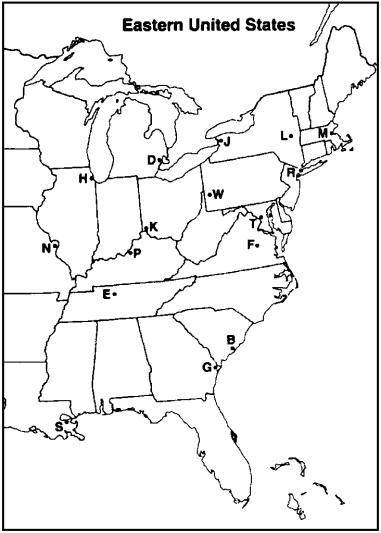
Boston, Massachusetts
Instructions: Choose the letter on the accompanying map of the eastern United States that correctly identifies each of the following:
Boston, Massachusetts
Question
MAP QUESTIONS
Instructions: Choose the letter on the accompanying map of the eastern United States that correctly identifies each of the following:
New York, New York
Instructions: Choose the letter on the accompanying map of the eastern United States that correctly identifies each of the following:
New York, New York
Question
MAP QUESTIONS
Instructions: Choose the letter on the accompanying map of the eastern United States that correctly identifies each of the following:
Cincinnati, Ohio
Instructions: Choose the letter on the accompanying map of the eastern United States that correctly identifies each of the following:
Cincinnati, Ohio
Question
MAP QUESTIONS
Instructions: Choose the letter on the accompanying map of the eastern United States that correctly identifies each of the following:
St. Louis, Missouri
Instructions: Choose the letter on the accompanying map of the eastern United States that correctly identifies each of the following:
St. Louis, Missouri
Question
MAP QUESTIONS
Instructions: Choose the letter on the accompanying map of the eastern United States that correctly identifies each of the following:
Chicago, Illinois
Instructions: Choose the letter on the accompanying map of the eastern United States that correctly identifies each of the following:
Chicago, Illinois
Question
Question
MAP QUESTIONS
Instructions: Choose the letter on the accompanying map of the eastern United States that correctly identifies each of the following:
Savannah, Georgia
Instructions: Choose the letter on the accompanying map of the eastern United States that correctly identifies each of the following:
Savannah, Georgia
Question
MAP QUESTIONS
Instructions: Choose the letter on the accompanying map of the eastern United States that correctly identifies each of the following:
Washington, D.C.
Instructions: Choose the letter on the accompanying map of the eastern United States that correctly identifies each of the following:
Washington, D.C.
Question
MAP QUESTIONS
Instructions: Choose the letter on the accompanying map of the eastern United States that correctly identifies each of the following:
Richmond, Virginia
Instructions: Choose the letter on the accompanying map of the eastern United States that correctly identifies each of the following:
Richmond, Virginia
Question
MAP QUESTIONS
Instructions: Choose the letter on the accompanying map of the eastern United States that correctly identifies each of the following:
Louisville, Kentucky
Instructions: Choose the letter on the accompanying map of the eastern United States that correctly identifies each of the following:
Louisville, Kentucky
Question
MAP QUESTIONS
Instructions: Choose the letter on the accompanying map of the eastern United States that correctly identifies each of the following:
Detroit, Michigan
Instructions: Choose the letter on the accompanying map of the eastern United States that correctly identifies each of the following:
Detroit, Michigan
Question
MAP QUESTIONS
Instructions: Choose the letter on the accompanying map of the eastern United States that correctly identifies each of the following:
New Orleans, Louisiana
Instructions: Choose the letter on the accompanying map of the eastern United States that correctly identifies each of the following:
New Orleans, Louisiana
Question
MAP QUESTIONS
Instructions: Choose the letter on the accompanying map of the eastern United States that correctly identifies each of the following:
Charleston, South Carolina
Instructions: Choose the letter on the accompanying map of the eastern United States that correctly identifies each of the following:
Charleston, South Carolina
Question
MAP QUESTIONS
Instructions: Choose the letter on the accompanying map of the eastern United States that correctly identifies each of the following:
Pittsburgh, Pennsylvania
Instructions: Choose the letter on the accompanying map of the eastern United States that correctly identifies each of the following:
Pittsburgh, Pennsylvania

Unlock Deck
Sign up to unlock the cards in this deck!
Unlock Deck
Unlock Deck
1/54

Play

Full screen (f)
Deck 11: Technology, Culture, and Everyday Life, 1840-1860
1
What was one of the advantages of the "American system" of manufacturing?
A) Inventors would have more time to develop their inventions slowly.
B) Manufacturers would have a convenient way of excluding outside investors.
C) Foreigners would have no way of copying American machines.
D) Damaged parts could be replaced easily.
E) American craftsmen could demonstrate their skills to the British.
A) Inventors would have more time to develop their inventions slowly.
B) Manufacturers would have a convenient way of excluding outside investors.
C) Foreigners would have no way of copying American machines.
D) Damaged parts could be replaced easily.
E) American craftsmen could demonstrate their skills to the British.
Damaged parts could be replaced easily.
2
Which of the following was not a popular health or scientific movement in antebellum America?
A) Hydropathy
B) Vegetarianism
C) Epidemiology
D) Phrenology
E) Temperance
A) Hydropathy
B) Vegetarianism
C) Epidemiology
D) Phrenology
E) Temperance
Epidemiology
3
What impact did technological changes have on the American worker before the Civil War?
A) Prices of many commodities rose.
B) Hourly wages rose.
C) The purchasing power of the average worker rose.
D) The purchasing power of the average worker declined.
E) Annual income declined.
A) Prices of many commodities rose.
B) Hourly wages rose.
C) The purchasing power of the average worker rose.
D) The purchasing power of the average worker declined.
E) Annual income declined.
The purchasing power of the average worker rose.
4
How did John Deere change American agriculture?
A) He invented a steel-tipped plow that made tilling much easier and less time consuming.
B) He introduced crop rotation which allowed each acre under cultivation to produce greater yields.
C) He created a conglomerate of farmers which gave them greater control over the market.
D) He persuaded Congress subsidize farmers during bad years.
E) He developed a reaper that could harvest wheat seven times as fast and with fewer works than previously.
A) He invented a steel-tipped plow that made tilling much easier and less time consuming.
B) He introduced crop rotation which allowed each acre under cultivation to produce greater yields.
C) He created a conglomerate of farmers which gave them greater control over the market.
D) He persuaded Congress subsidize farmers during bad years.
E) He developed a reaper that could harvest wheat seven times as fast and with fewer works than previously.
Unlock Deck
Unlock for access to all 54 flashcards in this deck.
Unlock Deck
k this deck
5
Which of the following statements best captures the attitude of many antebellum Americans about technology?
A) They believed that technology was democratic and would help everyone.
B) They believed that technology was a force for positive change.
C) They believed that technology was God's chosen instrument of progress.
D) They believed that technology would help to make up for a labor shortage.
E) All of these choices
A) They believed that technology was democratic and would help everyone.
B) They believed that technology was a force for positive change.
C) They believed that technology was God's chosen instrument of progress.
D) They believed that technology would help to make up for a labor shortage.
E) All of these choices
Unlock Deck
Unlock for access to all 54 flashcards in this deck.
Unlock Deck
k this deck
6
What medical development greatly advanced the image of surgeons and the success of health care in the decades before the Civil War?
A) The development of anesthesia
B) The discovery of the cause of epidemics
C) The development of new varieties of surgical steel that resulted in sharper scalpels
D) The realization of the importance of cleanliness
E) All of these choices
A) The development of anesthesia
B) The discovery of the cause of epidemics
C) The development of new varieties of surgical steel that resulted in sharper scalpels
D) The realization of the importance of cleanliness
E) All of these choices
Unlock Deck
Unlock for access to all 54 flashcards in this deck.
Unlock Deck
k this deck
7
Which of the following was not one of the causes of nationwide epidemics in the United States during the antebellum period?
A) Municipal health boards were powerless.
B) People distrusted physicians.
C) Doctors did not understand the causes of disease.
D) The transportation revolution enabled epidemics to spread.
E) The widespread use of laughing gas by young people seriously suppressed their immune systems.
A) Municipal health boards were powerless.
B) People distrusted physicians.
C) Doctors did not understand the causes of disease.
D) The transportation revolution enabled epidemics to spread.
E) The widespread use of laughing gas by young people seriously suppressed their immune systems.
Unlock Deck
Unlock for access to all 54 flashcards in this deck.
Unlock Deck
k this deck
8
How did home furniture change during the antebellum period?
A) Furniture came to reflect an informal style of life.
B) Furniture became "democratized" as rich and poor were more likely to buy the same types.
C) Furniture became more ornate.
D) Furniture became more expensive but less durable.
E) The upper classes distinguished themselves from the rising middle class through ornate furniture.
A) Furniture came to reflect an informal style of life.
B) Furniture became "democratized" as rich and poor were more likely to buy the same types.
C) Furniture became more ornate.
D) Furniture became more expensive but less durable.
E) The upper classes distinguished themselves from the rising middle class through ornate furniture.
Unlock Deck
Unlock for access to all 54 flashcards in this deck.
Unlock Deck
k this deck
9
What advance in heating and cooking occurred in antebellum America?
A) Americans adopted the open-hearth method of cooking.
B) Central heating became standard in tenement buildings.
C) Natural gas stoves became less common.
D) Coal-burning stoves were introduced
E) Electricity became common.
A) Americans adopted the open-hearth method of cooking.
B) Central heating became standard in tenement buildings.
C) Natural gas stoves became less common.
D) Coal-burning stoves were introduced
E) Electricity became common.
Unlock Deck
Unlock for access to all 54 flashcards in this deck.
Unlock Deck
k this deck
10
What was one of the results of rising urban land values in the early nineteenth-century American city?
A) Many row houses were subdivided and occupied by many families.
B) Homeownership became more common.
C) Cities expanded by annexing additional land.
D) Fewer people occupied each row house.
E) Tenements were replaced with lavish mansions.
A) Many row houses were subdivided and occupied by many families.
B) Homeownership became more common.
C) Cities expanded by annexing additional land.
D) Fewer people occupied each row house.
E) Tenements were replaced with lavish mansions.
Unlock Deck
Unlock for access to all 54 flashcards in this deck.
Unlock Deck
k this deck
11
What statement best describes life for the average American farm worker in the antebellum period?
A) Most workers found it difficult to raise enough capital to buy a farm.
B) Most agricultural workers eventually owned their own farms.
C) Small family farms were rapidly being replaced by agribusiness.
D) Unlike urban workers, agricultural workers tended to have consistent employment throughout the year.
E) Compared with urban workers, farm workers placed greater emphasis on education for their children.
A) Most workers found it difficult to raise enough capital to buy a farm.
B) Most agricultural workers eventually owned their own farms.
C) Small family farms were rapidly being replaced by agribusiness.
D) Unlike urban workers, agricultural workers tended to have consistent employment throughout the year.
E) Compared with urban workers, farm workers placed greater emphasis on education for their children.
Unlock Deck
Unlock for access to all 54 flashcards in this deck.
Unlock Deck
k this deck
12
Isaac Singer transformed American society by
A) designing a practical sanitation system that enabled cities to clean up their streets.
B) patenting a practical sewing machine that allowed for the mass production of textiles.
C) organizing inventors into specific groups which allowed them to work on projects together.
D) introducing science into farms and showed how healthier animals and larger crop yields could be produced.
E) persuading Congress to create the National Academy of Sciences.
A) designing a practical sanitation system that enabled cities to clean up their streets.
B) patenting a practical sewing machine that allowed for the mass production of textiles.
C) organizing inventors into specific groups which allowed them to work on projects together.
D) introducing science into farms and showed how healthier animals and larger crop yields could be produced.
E) persuading Congress to create the National Academy of Sciences.
Unlock Deck
Unlock for access to all 54 flashcards in this deck.
Unlock Deck
k this deck
13
In 1851 the a journal editor wrote that in this become "the great agent of civilization and progress, the most powerful instrument for good the world has yet reached." What was he referring to?
A) the locomotive
B) Hydropathy
C) American democracy
D) The New York Stock Exchange
E) Plantation slavery
A) the locomotive
B) Hydropathy
C) American democracy
D) The New York Stock Exchange
E) Plantation slavery
Unlock Deck
Unlock for access to all 54 flashcards in this deck.
Unlock Deck
k this deck
14
How did the penny press change publishing?
A) Political and commercial coverage became subordinated to human interest stories of robberies, murders, rapes, and abandoned children.
B) Many publishers were driven out of business because of overproduction and low prices.
C) Newspapers could now afford to publish more hard-core news.
D) For the first time, politicians could afford to use the presses to print leaflets and treatises.
E) None of these choices
A) Political and commercial coverage became subordinated to human interest stories of robberies, murders, rapes, and abandoned children.
B) Many publishers were driven out of business because of overproduction and low prices.
C) Newspapers could now afford to publish more hard-core news.
D) For the first time, politicians could afford to use the presses to print leaflets and treatises.
E) None of these choices
Unlock Deck
Unlock for access to all 54 flashcards in this deck.
Unlock Deck
k this deck
15
How did the McCormick reaper help the North win the Civil War?
A) It forced the South to invest more and more into slavery to keep up production
B) It proved to the border states that the North was technologically more advanced.
C) It allowed the North to keep agricultural production high even though many farmers went to fight.
D) It ensured that France would remain pro-North during the war.
E) It enabled the North to grow more corn than the South.
A) It forced the South to invest more and more into slavery to keep up production
B) It proved to the border states that the North was technologically more advanced.
C) It allowed the North to keep agricultural production high even though many farmers went to fight.
D) It ensured that France would remain pro-North during the war.
E) It enabled the North to grow more corn than the South.
Unlock Deck
Unlock for access to all 54 flashcards in this deck.
Unlock Deck
k this deck
16
Romanticism in literature was characterized by
A) show learning and refinement.
B) veneration of timeless traditions and respect for previous work.
C) emphasis on the author's inner feelings and emotions.
D) respect for kings, queens, knights, and nobles.
E) sex and violence.
A) show learning and refinement.
B) veneration of timeless traditions and respect for previous work.
C) emphasis on the author's inner feelings and emotions.
D) respect for kings, queens, knights, and nobles.
E) sex and violence.
Unlock Deck
Unlock for access to all 54 flashcards in this deck.
Unlock Deck
k this deck
17
Besides inventing the cotton gin, what did Eli Whitney do that benefited American manufacturing?
A) He developed railroad ties that were capable of supporting heavy weight.
B) He showed how water could be used to power textile mills.
C) He introduced the concept of interchangeable parts
D) He marketed American manufacturing products in Europe
E) He invented a heating process that removed impurities from iron.
A) He developed railroad ties that were capable of supporting heavy weight.
B) He showed how water could be used to power textile mills.
C) He introduced the concept of interchangeable parts
D) He marketed American manufacturing products in Europe
E) He invented a heating process that removed impurities from iron.
Unlock Deck
Unlock for access to all 54 flashcards in this deck.
Unlock Deck
k this deck
18
Which of the following statements accurately describes railroads in the United States in 1860?
A) The United States had more track than the rest of the world combined.
B) American railroads lacked government support and therefore lagged behind the rest of the world.
C) Railroad owners faced financial difficulties because they could not compete with canals.
D) The railroads brought about the decline of the once great city of Chicago.
E) They had an international reputation for punctuality.
A) The United States had more track than the rest of the world combined.
B) American railroads lacked government support and therefore lagged behind the rest of the world.
C) Railroad owners faced financial difficulties because they could not compete with canals.
D) The railroads brought about the decline of the once great city of Chicago.
E) They had an international reputation for punctuality.
Unlock Deck
Unlock for access to all 54 flashcards in this deck.
Unlock Deck
k this deck
19
What type of urban housing developed during the early nineteenth century?
A) Unattached frame houses
B) One-story brick houses
C) Row houses
D) Condominiums
E) Garden apartments
A) Unattached frame houses
B) One-story brick houses
C) Row houses
D) Condominiums
E) Garden apartments
Unlock Deck
Unlock for access to all 54 flashcards in this deck.
Unlock Deck
k this deck
20
How was the building of the railroads in the United States financed?
A) By state and local governments
B) By the federal government
C) By private investors
D) By overseas investors
E) All of these choices
A) By state and local governments
B) By the federal government
C) By private investors
D) By overseas investors
E) All of these choices
Unlock Deck
Unlock for access to all 54 flashcards in this deck.
Unlock Deck
k this deck
21
What were the goals of the Hudson River school of painters?
A) They wanted to depict natural scenes with photographic accuracy.
B) They wanted to preserve a record of a disappearing wilderness.
C) They wanted to depict scenes of ruined castles and crumbling temples.
D) They wanted to demonstrate that art could thrive outside of New York City.
E) None of these choices
A) They wanted to depict natural scenes with photographic accuracy.
B) They wanted to preserve a record of a disappearing wilderness.
C) They wanted to depict scenes of ruined castles and crumbling temples.
D) They wanted to demonstrate that art could thrive outside of New York City.
E) None of these choices
Unlock Deck
Unlock for access to all 54 flashcards in this deck.
Unlock Deck
k this deck
22
The popular minstrel show help to shape public perceptions of blacks during the antebellum period because it
A) accustomed white Americans to seeing blacks in public roles.
B) helped to convince northerners that slavery should be abolished.
C) show reinforced stereotypes of the black as stupid and clumsy.
D) exposed middle class audiences to the beauties of African-American music.
E) presented free blacks as suave and sophisticated urbanites.
A) accustomed white Americans to seeing blacks in public roles.
B) helped to convince northerners that slavery should be abolished.
C) show reinforced stereotypes of the black as stupid and clumsy.
D) exposed middle class audiences to the beauties of African-American music.
E) presented free blacks as suave and sophisticated urbanites.
Unlock Deck
Unlock for access to all 54 flashcards in this deck.
Unlock Deck
k this deck
23
Who is usually described as the father of mass entertainment in the U.S.?
A) Robert Bonner
B) Phineas T. Barnum
C) Lorenzo Fowler
D) Tom Thumb
E) James G. Bennett
A) Robert Bonner
B) Phineas T. Barnum
C) Lorenzo Fowler
D) Tom Thumb
E) James G. Bennett
Unlock Deck
Unlock for access to all 54 flashcards in this deck.
Unlock Deck
k this deck
24
During the pre-Civil War decades, what did most American painters prefer to paint?
A) Historical topics
B) Portraits
C) Mythological tales
D) Landscapes
E) Still life scenes
A) Historical topics
B) Portraits
C) Mythological tales
D) Landscapes
E) Still life scenes
Unlock Deck
Unlock for access to all 54 flashcards in this deck.
Unlock Deck
k this deck
25
Who wrote Woman in the Nineteenth Century?
A) Susan B. Anthony
B) Frances Willard
C) Margaret Fuller
D) Emily Dickinson
E) Martha Lincoln
A) Susan B. Anthony
B) Frances Willard
C) Margaret Fuller
D) Emily Dickinson
E) Martha Lincoln
Unlock Deck
Unlock for access to all 54 flashcards in this deck.
Unlock Deck
k this deck
26
Which of the following does not reflect an accurate description of the budget of a working-class family in an urban area?
A) The main breadwinner in a family typically made less than $300 per year.
B) Approximately 70 percent of a family's income went towards, food and rent.
C) To meet basic needs, many working-class children had to work.
D) Most families lived close to the margin.
E) Skyrocketing commodity prices pushed many families to the edge of starvation.
A) The main breadwinner in a family typically made less than $300 per year.
B) Approximately 70 percent of a family's income went towards, food and rent.
C) To meet basic needs, many working-class children had to work.
D) Most families lived close to the margin.
E) Skyrocketing commodity prices pushed many families to the edge of starvation.
Unlock Deck
Unlock for access to all 54 flashcards in this deck.
Unlock Deck
k this deck
27
Who was an American publisher who helped to transform newspapers and create the modern concept of news and news reporting?
A) James Gordon Bennett
B) Susan Warner
C) Sylvester Graham
D) Phineas T. Barnum
E) Edwin Forrest
A) James Gordon Bennett
B) Susan Warner
C) Sylvester Graham
D) Phineas T. Barnum
E) Edwin Forrest
Unlock Deck
Unlock for access to all 54 flashcards in this deck.
Unlock Deck
k this deck
28
Which "theory" proposed that bumps on the skull reveal an individual's personality?
A) Hydropathy
B) Phrenology
C) Miasm
D) Sanitoriumism
E) Grahamism
A) Hydropathy
B) Phrenology
C) Miasm
D) Sanitoriumism
E) Grahamism
Unlock Deck
Unlock for access to all 54 flashcards in this deck.
Unlock Deck
k this deck
29
Who was the most popular dramatist in antebellum America?
A) Edwin Forrest
B) William Shakespeare
C) Stephen Foster
D) James Fenimore Cooper
E) Lydia Sigourney
A) Edwin Forrest
B) William Shakespeare
C) Stephen Foster
D) James Fenimore Cooper
E) Lydia Sigourney
Unlock Deck
Unlock for access to all 54 flashcards in this deck.
Unlock Deck
k this deck
30
Why did movements for rural cemeteries and urban parks develop during the antebellum period?
A) There was a fear that sprawling urban growth was destroying the spiritual healing that nature provided.
B) There was a desire to meet the working-class demand for a quiet place to relax.
C) There was a desire to demonstrate that cities could support themselves.
D) There was a hope of taming the undeveloped areas that still remained within city borders.
E) There was a need to find a use for undeveloped city land.
A) There was a fear that sprawling urban growth was destroying the spiritual healing that nature provided.
B) There was a desire to meet the working-class demand for a quiet place to relax.
C) There was a desire to demonstrate that cities could support themselves.
D) There was a hope of taming the undeveloped areas that still remained within city borders.
E) There was a need to find a use for undeveloped city land.
Unlock Deck
Unlock for access to all 54 flashcards in this deck.
Unlock Deck
k this deck
31
Which of the following statements does not accurately describe railroad travel in the antebellum period?
A) Delays were frequent.
B) Trains often traveled at night to avoid bandit attacks.
C) Scheduling was a nightmare.
D) Passengers sometimes had to help stop the train.
E) Locomotives often showered passengers with sparks.
A) Delays were frequent.
B) Trains often traveled at night to avoid bandit attacks.
C) Scheduling was a nightmare.
D) Passengers sometimes had to help stop the train.
E) Locomotives often showered passengers with sparks.
Unlock Deck
Unlock for access to all 54 flashcards in this deck.
Unlock Deck
k this deck
32
Sylvester Graham was
A) a prominent health food advocate.
B) a crusader for improved public sanitation.
C) the manager of a popular hydropathic sanatorium.
D) the nation's leading phrenologist.
E) the founder of a utopian community.
A) a prominent health food advocate.
B) a crusader for improved public sanitation.
C) the manager of a popular hydropathic sanatorium.
D) the nation's leading phrenologist.
E) the founder of a utopian community.
Unlock Deck
Unlock for access to all 54 flashcards in this deck.
Unlock Deck
k this deck
33
What was one of the purposes of the lyceum lectures?
A) They were designed to introduce controversial topics.
B) They were designed to spread and popularize knowledge.
C) They were designed to teach Americans how to paint.
D) They were designed to prevent the working class from spending their free time in saloons.
E) They were designed to stimulate interest in gambling.
A) They were designed to introduce controversial topics.
B) They were designed to spread and popularize knowledge.
C) They were designed to teach Americans how to paint.
D) They were designed to prevent the working class from spending their free time in saloons.
E) They were designed to stimulate interest in gambling.
Unlock Deck
Unlock for access to all 54 flashcards in this deck.
Unlock Deck
k this deck
34
By the 1850s where was the center of modern investment firms?
A) Washington, D.C.
B) Chicago
C) New York
D) Boston
E) Pittsburgh
A) Washington, D.C.
B) Chicago
C) New York
D) Boston
E) Pittsburgh
Unlock Deck
Unlock for access to all 54 flashcards in this deck.
Unlock Deck
k this deck
35
Which of the following scents would have been present in most antebellum cities?
A) Body odor
B) Animal manure
C) Human waste
D) All of these choices
E) None of these choices
A) Body odor
B) Animal manure
C) Human waste
D) All of these choices
E) None of these choices
Unlock Deck
Unlock for access to all 54 flashcards in this deck.
Unlock Deck
k this deck
36
Which of the following statements is true concerning a typical antebellum theater?
A) Lawyers were welcomed, but prostitutes were excluded.
B) There were very few seats, and most of them were expensive.
C) Classical Greek drama was usually performed.
D) Audiences were rowdy.
E) It was not a popular form of entertainment because revivalists accused theaters of being houses of sin.
A) Lawyers were welcomed, but prostitutes were excluded.
B) There were very few seats, and most of them were expensive.
C) Classical Greek drama was usually performed.
D) Audiences were rowdy.
E) It was not a popular form of entertainment because revivalists accused theaters of being houses of sin.
Unlock Deck
Unlock for access to all 54 flashcards in this deck.
Unlock Deck
k this deck
37
In his 1837 address "The American Scholar," Ralph Waldo Emerson argued that Americans needed to
A) improve their literature by emulating European forms.
B) work for cultural autonomy.
C) create literature that conformed to universal standards of beauty and taste.
D) reform their education system.
E) to turn away from scholarship and concentrate on farming.
A) improve their literature by emulating European forms.
B) work for cultural autonomy.
C) create literature that conformed to universal standards of beauty and taste.
D) reform their education system.
E) to turn away from scholarship and concentrate on farming.
Unlock Deck
Unlock for access to all 54 flashcards in this deck.
Unlock Deck
k this deck
38
What was one of the changes that transformed American newspapers in the decades before the Civil War?
A) Publishers had to increase the price in order to maintain a profit.
B) Fewer newspapers were printed because Americans turned to other sources of information.
C) Most of them became semi-official organs of national political parties.
D) They began to print more political and commercial news rather than celebrity news.
E) They began to print "human-interest" stories rather than just political and commercial news.
A) Publishers had to increase the price in order to maintain a profit.
B) Fewer newspapers were printed because Americans turned to other sources of information.
C) Most of them became semi-official organs of national political parties.
D) They began to print more political and commercial news rather than celebrity news.
E) They began to print "human-interest" stories rather than just political and commercial news.
Unlock Deck
Unlock for access to all 54 flashcards in this deck.
Unlock Deck
k this deck
39
How did the writings of Emerson, Thoreau, and Whitman differ from those of Hawthorne, Poe, and Melville?
A) Emerson, Thoreau, and Whitman wrote only novels.
B) Hawthorne, Poe, and Melville had a pessimistic view of the human condition.
C) Emerson, Thoreau, and Whitman celebrated the aggressiveness of their countrymen.
D) Hawthorne, Poe, and Melville sought wide commercial success, while Emerson, Thoreau, and Whitman preferred to write for a small elite audience.
E) Hawthorne, Poe, and Melville wrote mainly about European themes and experiences.
A) Emerson, Thoreau, and Whitman wrote only novels.
B) Hawthorne, Poe, and Melville had a pessimistic view of the human condition.
C) Emerson, Thoreau, and Whitman celebrated the aggressiveness of their countrymen.
D) Hawthorne, Poe, and Melville sought wide commercial success, while Emerson, Thoreau, and Whitman preferred to write for a small elite audience.
E) Hawthorne, Poe, and Melville wrote mainly about European themes and experiences.
Unlock Deck
Unlock for access to all 54 flashcards in this deck.
Unlock Deck
k this deck
40
Why were novels popular among American women in the antebellum period?
A) They often contained very realistic descriptions of intimate relationships.
B) Since they were fairly expensive, owning books was a sign of status.
C) They taught women to depend upon strong males.
D) The sentimental or domestic novel addressed themes and taught lessons that spoke to middle class women.
E) Middle class women liked the escapism of sensationalist stories of murder mystery and horror.
A) They often contained very realistic descriptions of intimate relationships.
B) Since they were fairly expensive, owning books was a sign of status.
C) They taught women to depend upon strong males.
D) The sentimental or domestic novel addressed themes and taught lessons that spoke to middle class women.
E) Middle class women liked the escapism of sensationalist stories of murder mystery and horror.
Unlock Deck
Unlock for access to all 54 flashcards in this deck.
Unlock Deck
k this deck
41
MAP QUESTIONS
Instructions: Choose the letter on the accompanying map of the eastern United States that correctly identifies each of the following:
Boston, Massachusetts
Instructions: Choose the letter on the accompanying map of the eastern United States that correctly identifies each of the following:
Boston, Massachusetts
Unlock Deck
Unlock for access to all 54 flashcards in this deck.
Unlock Deck
k this deck
42
MAP QUESTIONS
Instructions: Choose the letter on the accompanying map of the eastern United States that correctly identifies each of the following:
New York, New York
Instructions: Choose the letter on the accompanying map of the eastern United States that correctly identifies each of the following:
New York, New York
Unlock Deck
Unlock for access to all 54 flashcards in this deck.
Unlock Deck
k this deck
43
MAP QUESTIONS
Instructions: Choose the letter on the accompanying map of the eastern United States that correctly identifies each of the following:
Cincinnati, Ohio
Instructions: Choose the letter on the accompanying map of the eastern United States that correctly identifies each of the following:
Cincinnati, Ohio
Unlock Deck
Unlock for access to all 54 flashcards in this deck.
Unlock Deck
k this deck
44
MAP QUESTIONS
Instructions: Choose the letter on the accompanying map of the eastern United States that correctly identifies each of the following:
St. Louis, Missouri
Instructions: Choose the letter on the accompanying map of the eastern United States that correctly identifies each of the following:
St. Louis, Missouri
Unlock Deck
Unlock for access to all 54 flashcards in this deck.
Unlock Deck
k this deck
45
MAP QUESTIONS
Instructions: Choose the letter on the accompanying map of the eastern United States that correctly identifies each of the following:
Chicago, Illinois
Instructions: Choose the letter on the accompanying map of the eastern United States that correctly identifies each of the following:
Chicago, Illinois
Unlock Deck
Unlock for access to all 54 flashcards in this deck.
Unlock Deck
k this deck
46
What happened in New Orleans in 1832 and 1833?
A) Hurricane Camille destroyed most of the city and killed 25,000 people.
B) Measles swept through the city killing 50 percent of the children under age 10.
C) An epidemic of yellow fever and cholera killed 1/5 of the population.
D) After a group of slaves attempted a rebellion, the army occupied the city and executed 250 slave leaders.
E) A fire swept through most of the housing districts killing 15,000 people.
A) Hurricane Camille destroyed most of the city and killed 25,000 people.
B) Measles swept through the city killing 50 percent of the children under age 10.
C) An epidemic of yellow fever and cholera killed 1/5 of the population.
D) After a group of slaves attempted a rebellion, the army occupied the city and executed 250 slave leaders.
E) A fire swept through most of the housing districts killing 15,000 people.
Unlock Deck
Unlock for access to all 54 flashcards in this deck.
Unlock Deck
k this deck
47
MAP QUESTIONS
Instructions: Choose the letter on the accompanying map of the eastern United States that correctly identifies each of the following:
Savannah, Georgia
Instructions: Choose the letter on the accompanying map of the eastern United States that correctly identifies each of the following:
Savannah, Georgia
Unlock Deck
Unlock for access to all 54 flashcards in this deck.
Unlock Deck
k this deck
48
MAP QUESTIONS
Instructions: Choose the letter on the accompanying map of the eastern United States that correctly identifies each of the following:
Washington, D.C.
Instructions: Choose the letter on the accompanying map of the eastern United States that correctly identifies each of the following:
Washington, D.C.
Unlock Deck
Unlock for access to all 54 flashcards in this deck.
Unlock Deck
k this deck
49
MAP QUESTIONS
Instructions: Choose the letter on the accompanying map of the eastern United States that correctly identifies each of the following:
Richmond, Virginia
Instructions: Choose the letter on the accompanying map of the eastern United States that correctly identifies each of the following:
Richmond, Virginia
Unlock Deck
Unlock for access to all 54 flashcards in this deck.
Unlock Deck
k this deck
50
MAP QUESTIONS
Instructions: Choose the letter on the accompanying map of the eastern United States that correctly identifies each of the following:
Louisville, Kentucky
Instructions: Choose the letter on the accompanying map of the eastern United States that correctly identifies each of the following:
Louisville, Kentucky
Unlock Deck
Unlock for access to all 54 flashcards in this deck.
Unlock Deck
k this deck
51
MAP QUESTIONS
Instructions: Choose the letter on the accompanying map of the eastern United States that correctly identifies each of the following:
Detroit, Michigan
Instructions: Choose the letter on the accompanying map of the eastern United States that correctly identifies each of the following:
Detroit, Michigan
Unlock Deck
Unlock for access to all 54 flashcards in this deck.
Unlock Deck
k this deck
52
MAP QUESTIONS
Instructions: Choose the letter on the accompanying map of the eastern United States that correctly identifies each of the following:
New Orleans, Louisiana
Instructions: Choose the letter on the accompanying map of the eastern United States that correctly identifies each of the following:
New Orleans, Louisiana
Unlock Deck
Unlock for access to all 54 flashcards in this deck.
Unlock Deck
k this deck
53
MAP QUESTIONS
Instructions: Choose the letter on the accompanying map of the eastern United States that correctly identifies each of the following:
Charleston, South Carolina
Instructions: Choose the letter on the accompanying map of the eastern United States that correctly identifies each of the following:
Charleston, South Carolina
Unlock Deck
Unlock for access to all 54 flashcards in this deck.
Unlock Deck
k this deck
54
MAP QUESTIONS
Instructions: Choose the letter on the accompanying map of the eastern United States that correctly identifies each of the following:
Pittsburgh, Pennsylvania
Instructions: Choose the letter on the accompanying map of the eastern United States that correctly identifies each of the following:
Pittsburgh, Pennsylvania
Unlock Deck
Unlock for access to all 54 flashcards in this deck.
Unlock Deck
k this deck
Unlock Deck
Unlock for access to all 54 flashcards in this deck.







