





 Chat with AI

Deck 12: The Strategy of International Business
Full screen (f)

Question

Question
Question
Question
Question
Question
Question
Question
Question
Question
Question
Question
Question
Question
Question
Plot the position of the following firms on Figure 12.8 - Procter Gamble, IBM, Apple, Coca-Cola, Dow Chemicals, US Steel, McDonald's. In each case, justify your answer.
Figure 12.8
Pressures for Cost Reductions and Local Responsiveness
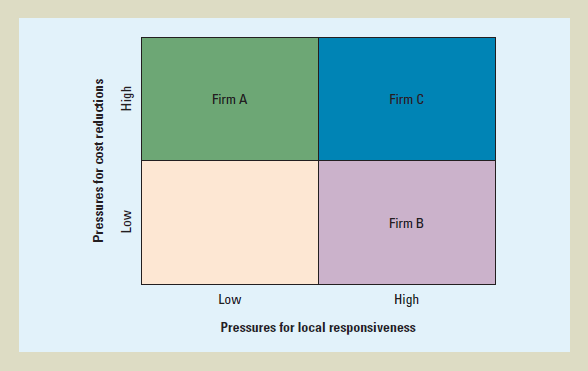
Figure 12.8
Pressures for Cost Reductions and Local Responsiveness
Question
Question
Question
Question
Question
Question
Question
Question
Question
Question
Question
Question
Question
Question
Question

Unlock Deck
Sign up to unlock the cards in this deck!
Unlock Deck
Unlock Deck
1/30

Play

Full screen (f)
Deck 12: The Strategy of International Business
1
How does a firm create value?
Value is defined as the perceived benefit or benefits that the consumer gets by acquiring any product. This value in monetary terms has to be higher than the price that the consumer pays for the product. Therefore when there are competing products at the same price, the one with the higher perceived value would be purchased in preference to the others. These benefits could be anything from convenience, to better health, to being more attractive looking or, as in the case of very expensive products, a status symbol.
Hence the aim of all firms would be to maximize this creation of value. By maximizing value it can maximize its profit, since higher the value, higher is the price that can be charged for the product.
A firm creates value by either processing a raw material or assembling components to produce a final product. By doing this it keeps on adding value at each step of the conversion process. This process is sometimes defined as the Value Chain.
Hence the aim of all firms would be to maximize this creation of value. By maximizing value it can maximize its profit, since higher the value, higher is the price that can be charged for the product.
A firm creates value by either processing a raw material or assembling components to produce a final product. By doing this it keeps on adding value at each step of the conversion process. This process is sometimes defined as the Value Chain.
2
What is the difference between the primary and support activities of a firm's value chain?
A firm's supply chain has both primary and support activities. Primary activities are those activities which are essential in the process of the firm delivering a product or service to its consumers. These normally are:
1) Research, Design and Development. This is usually the starting point of the value chain. This is because this is where decisions are taken as to what the firm's products are going to be and how they are going to be produced.
2) Production. This is the main engine that drives the entire value chain. Value is added to the inputs at every stage of the production process.
3) Marketing and Sales. This is what gets the product to the consumer. This is where the product positioning, the marketing strategy, product differentiation strategy and market feedback is collected. The feedback is important since it helps the Design people come up with more customer-centric products.
4) Customer Service. This is actually the front-end of the operation. This is where actual contact with the consumer is made and a true assessment of one's product in the market can be obtained. Also in today's world where many products like electronic goods have become commoditized, customer service if often the only differentiating factor.
However, to ensure that the primary activities are carried out efficiently and at the least cost, one has to have a series of supporting activities. In traditional organizational structures these would be classified as line and staff functions.
These supporting activities often provide the inputs for the primary activities. There are sometimes as important in the value chain, if not more important, than the primary activities
These supporting activities are:
1) Information Systems. These are in today's world the backbone of any firm's operations.
2) Communications Systems. Without the communication systems the information systems cannot function in their most efficient manner, that is, in real-time.
3) Logistics. These are inward logistics which bring in raw materials and components, and outward logistics that carry the finished products to the markets. Apart from this the logistics within the firm are important. Where goods stored and how they are moved down the value chain is also important.
4) Human Resources. This is the activity that provides the manpower required to operate the value chain efficiently. The right type of manpower can make a great difference in the ultimate competitive advantage of any firm.
5) Finance and Accounting. All the inputs for the costs of various stages of the value chain are obtained for historical financial records. So are the future trends in the market place.
Therefore it is seen that the primary activities are those that are the value-adding activities in the value chain. However it is difficult to imagine how they could function, with any degree of efficiency, without any of the supporting activities.
1) Research, Design and Development. This is usually the starting point of the value chain. This is because this is where decisions are taken as to what the firm's products are going to be and how they are going to be produced.
2) Production. This is the main engine that drives the entire value chain. Value is added to the inputs at every stage of the production process.
3) Marketing and Sales. This is what gets the product to the consumer. This is where the product positioning, the marketing strategy, product differentiation strategy and market feedback is collected. The feedback is important since it helps the Design people come up with more customer-centric products.
4) Customer Service. This is actually the front-end of the operation. This is where actual contact with the consumer is made and a true assessment of one's product in the market can be obtained. Also in today's world where many products like electronic goods have become commoditized, customer service if often the only differentiating factor.
However, to ensure that the primary activities are carried out efficiently and at the least cost, one has to have a series of supporting activities. In traditional organizational structures these would be classified as line and staff functions.
These supporting activities often provide the inputs for the primary activities. There are sometimes as important in the value chain, if not more important, than the primary activities
These supporting activities are:
1) Information Systems. These are in today's world the backbone of any firm's operations.
2) Communications Systems. Without the communication systems the information systems cannot function in their most efficient manner, that is, in real-time.
3) Logistics. These are inward logistics which bring in raw materials and components, and outward logistics that carry the finished products to the markets. Apart from this the logistics within the firm are important. Where goods stored and how they are moved down the value chain is also important.
4) Human Resources. This is the activity that provides the manpower required to operate the value chain efficiently. The right type of manpower can make a great difference in the ultimate competitive advantage of any firm.
5) Finance and Accounting. All the inputs for the costs of various stages of the value chain are obtained for historical financial records. So are the future trends in the market place.
Therefore it is seen that the primary activities are those that are the value-adding activities in the value chain. However it is difficult to imagine how they could function, with any degree of efficiency, without any of the supporting activities.
3
How can a firm increase its profitability and profit growth rate by expanding internationally?
A firm can increase its profitability as well as its growth by expanding internationally. This is due to the following factors.
1) It expands the market for its products currently sold locally only, to a larger market internationally. This means that it can take the benefit of economies of scale on a larger sales volume.
2) It can realize greater cost economies by either conducting a centralized operation or a dispersed operation as comparative economic advantage of the situation may demand. This helps in creation of greater value at a lower cost.
3) It can disperse its value creation operations to different locations on the globe. It can choose those locations where each of the operations could be conducted most efficiently and effectively.
4) It can use the learning from its foreign operations. This is leveraging it to its advantage either in the home market, or in other foreign countries where it may operate.
However these factors need to be modulated by the firms need to have in different countries, different products and strategies.
1) It expands the market for its products currently sold locally only, to a larger market internationally. This means that it can take the benefit of economies of scale on a larger sales volume.
2) It can realize greater cost economies by either conducting a centralized operation or a dispersed operation as comparative economic advantage of the situation may demand. This helps in creation of greater value at a lower cost.
3) It can disperse its value creation operations to different locations on the globe. It can choose those locations where each of the operations could be conducted most efficiently and effectively.
4) It can use the learning from its foreign operations. This is leveraging it to its advantage either in the home market, or in other foreign countries where it may operate.
However these factors need to be modulated by the firms need to have in different countries, different products and strategies.
4
How do experience effects help a firm gain a competitive advantage?
Unlock Deck
Unlock for access to all 30 flashcards in this deck.
Unlock Deck
k this deck
5
When are pressures for cost reductions likely to be strong?
Unlock Deck
Unlock for access to all 30 flashcards in this deck.
Unlock Deck
k this deck
6
What does the MTV story tell you about the tension between pressures for local responsiveness and pressures for cost reductions (see the Management Focus Feature)?
Unlock Deck
Unlock for access to all 30 flashcards in this deck.
Unlock Deck
k this deck
7
When does a global standardization strategy make sense? When does a localization strategy make sense?
Unlock Deck
Unlock for access to all 30 flashcards in this deck.
Unlock Deck
k this deck
8
Why might a firm want to pursue a transnational strategy? Why is a transnational strategy difficult to implement?
Unlock Deck
Unlock for access to all 30 flashcards in this deck.
Unlock Deck
k this deck
9
What are the advantages of strategic alliances?
Unlock Deck
Unlock for access to all 30 flashcards in this deck.
Unlock Deck
k this deck
10
Describe the steps a firm can take to ensure that its strategic alliances produce the desired benefits.
Unlock Deck
Unlock for access to all 30 flashcards in this deck.
Unlock Deck
k this deck
11
The Strategy of International Business
Use the globalEDGE Resource Desk (http://globaledge.msu.edu/Reference-Desk) to complete the following exercises:
Several classifications and rankings of the world's largest companies are prepared by a variety of sources. Find one such composite ranking system and identify the criteria that are used to rank the top global companies. Extract the list of the top 20 ranked companies, paying particular attention to their home countries.
Use the globalEDGE Resource Desk (http://globaledge.msu.edu/Reference-Desk) to complete the following exercises:
Several classifications and rankings of the world's largest companies are prepared by a variety of sources. Find one such composite ranking system and identify the criteria that are used to rank the top global companies. Extract the list of the top 20 ranked companies, paying particular attention to their home countries.
Unlock Deck
Unlock for access to all 30 flashcards in this deck.
Unlock Deck
k this deck
12
Do you think that Avon's problems in 2010 and 2011 were a result of the changes in its strategy, or were there other reasons for this?
Unlock Deck
Unlock for access to all 30 flashcards in this deck.
Unlock Deck
k this deck
13
What changes did Andrea Jung make in Avon's strategy after 2005? What were the benefits of these changes? Can you see any drawbacks?
Unlock Deck
Unlock for access to all 30 flashcards in this deck.
Unlock Deck
k this deck
14
Reread the Management Focus on Procter Gamble and then answer the following questions:
a. What strategy was Procter Gamble pursuing when it first entered foreign markets in the period up until the 1980s?
b. Why do you think this strategy became less viable in the 1990s?
c. What strategy does P G appear to be moving toward? What are the benefits of this strategy? What are the potential risks associated with it?
a. What strategy was Procter Gamble pursuing when it first entered foreign markets in the period up until the 1980s?
b. Why do you think this strategy became less viable in the 1990s?
c. What strategy does P G appear to be moving toward? What are the benefits of this strategy? What are the potential risks associated with it?
Unlock Deck
Unlock for access to all 30 flashcards in this deck.
Unlock Deck
k this deck
15
Plot the position of the following firms on Figure 12.8 - Procter Gamble, IBM, Apple, Coca-Cola, Dow Chemicals, US Steel, McDonald's. In each case, justify your answer.
Figure 12.8
Pressures for Cost Reductions and Local Responsiveness
Figure 12.8
Pressures for Cost Reductions and Local Responsiveness
Unlock Deck
Unlock for access to all 30 flashcards in this deck.
Unlock Deck
k this deck
16
Why is organization architecture so important for the attainment of high performance?
Unlock Deck
Unlock for access to all 30 flashcards in this deck.
Unlock Deck
k this deck
17
What is the difference between a low-cost strategy and a differentiation strategy?
Unlock Deck
Unlock for access to all 30 flashcards in this deck.
Unlock Deck
k this deck
18
What are the benefits of leveraging subsidiary skills?
Unlock Deck
Unlock for access to all 30 flashcards in this deck.
Unlock Deck
k this deck
19
What are location economies?
Unlock Deck
Unlock for access to all 30 flashcards in this deck.
Unlock Deck
k this deck
20
What do you see as the main organizational problems that are likely to be associated with implementation of a transnational strategy?
Unlock Deck
Unlock for access to all 30 flashcards in this deck.
Unlock Deck
k this deck
21
When are pressures for local responsiveness likely to be important?
Unlock Deck
Unlock for access to all 30 flashcards in this deck.
Unlock Deck
k this deck
22
What do we mean by the concept of strategic fit? Why does this matter?
Unlock Deck
Unlock for access to all 30 flashcards in this deck.
Unlock Deck
k this deck
23
What are the strengths and limitations of an international strategy?
Unlock Deck
Unlock for access to all 30 flashcards in this deck.
Unlock Deck
k this deck
24
Reread the Management Focus box on the alliance between Cisco and Fujitsu. What are the benefits to Cisco and Fujitsu respectively of the alliances? What are the risks to Cisco? How can Cisco mitigate those risks?
Unlock Deck
Unlock for access to all 30 flashcards in this deck.
Unlock Deck
k this deck
25
What are the risks and drawbacks associated with strategic alliances?
Unlock Deck
Unlock for access to all 30 flashcards in this deck.
Unlock Deck
k this deck
26
The Strategy of International Business
Use the globalEDGE Resource Desk (http://globaledge.msu.edu/Reference-Desk) to complete the following exercises:
The top management of your company, a manufacturer and marketer of smart phones, has decided to pursue international expansion opportunities in eastern Europe. To ensure success, management's goal is to enter into countries with a high level of global connectedness. Identify the top 3 eastern European countries in which your company can market its current product line. Prepare an executive summary to support your recommendations.
Use the globalEDGE Resource Desk (http://globaledge.msu.edu/Reference-Desk) to complete the following exercises:
The top management of your company, a manufacturer and marketer of smart phones, has decided to pursue international expansion opportunities in eastern Europe. To ensure success, management's goal is to enter into countries with a high level of global connectedness. Identify the top 3 eastern European countries in which your company can market its current product line. Prepare an executive summary to support your recommendations.
Unlock Deck
Unlock for access to all 30 flashcards in this deck.
Unlock Deck
k this deck
27
What strategy was Avon pursuing until the mid-2000s? What were the advantages of this strategy? What were the disadvantages?
Unlock Deck
Unlock for access to all 30 flashcards in this deck.
Unlock Deck
k this deck
28
In terms of the framework introduced in this chapter, what strategy was Avon pursuing by the late 2000s?
Unlock Deck
Unlock for access to all 30 flashcards in this deck.
Unlock Deck
k this deck
29
In a world of zero transportation costs, no trade barriers, and nontrivial differences between nations with regard to factor conditions, firms must expand internationally if they are to survive. Discuss.
Unlock Deck
Unlock for access to all 30 flashcards in this deck.
Unlock Deck
k this deck
30
In what kind of industries does a localization strategy make sense? When does a global standardization strategy make most sense?
Unlock Deck
Unlock for access to all 30 flashcards in this deck.
Unlock Deck
k this deck
Unlock Deck
Unlock for access to all 30 flashcards in this deck.







