





 Chat with AI

Deck 15: The Chemical Senses
Full screen (f)

Question
Consider the kinds of food that you avoid because you don't like the taste. Do these foods have anything in common that might enable you to explain these taste preferences in terms of the activity of specific types of taste receptors?
Figure The blue lines show how two neurons in the rat NST respond to a number of different taste stimuli (along the horizontal axis). The neuron in (a) responds strongly to compounds associated with salty tastes. The neuron in (b) responds to a wide range of compounds. The purple lines show how these two neurons fire after the sodium-blocker amiloride is applied to the tongue. This compound inhibits the responses to salt of neuron (a) but has little effect on neuron (b).
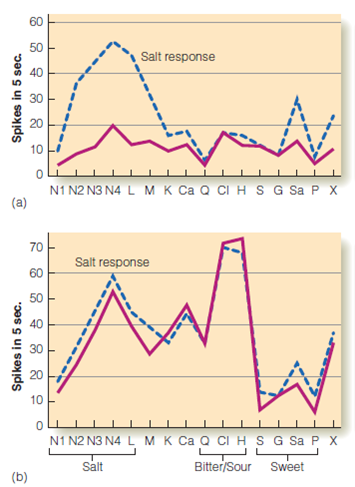
Figure The blue lines show how two neurons in the rat NST respond to a number of different taste stimuli (along the horizontal axis). The neuron in (a) responds strongly to compounds associated with salty tastes. The neuron in (b) responds to a wide range of compounds. The purple lines show how these two neurons fire after the sodium-blocker amiloride is applied to the tongue. This compound inhibits the responses to salt of neuron (a) but has little effect on neuron (b).

Question
Can you think of situations in which you have encountered a smell that triggered memories about an event or place that you hadn't thought about in years? What do you think might be the mechanism for this type of experience?
Figure Sensory-specificsatiety. Results of the O'Doherty et al. (2000) experiment. (a) Pleasantness rating for banana and vanilla odor before eating (left bars) and after eating bananas to satiety (right bars). (b) Response of the orbitofrontal cortex to banana and vanilla odors before and after eating bananas.
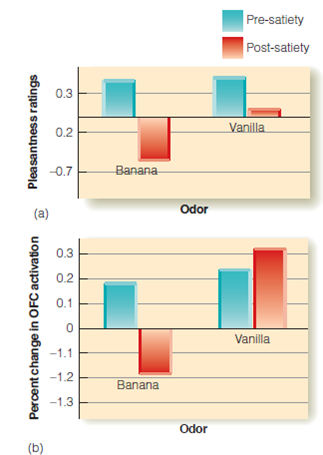
Figure Sensory-specificsatiety. Results of the O'Doherty et al. (2000) experiment. (a) Pleasantness rating for banana and vanilla odor before eating (left bars) and after eating bananas to satiety (right bars). (b) Response of the orbitofrontal cortex to banana and vanilla odors before and after eating bananas.
Question
Question
Question
Question
Question
Question
Question
Question
Question
Question
Question
Question
Question
Question
Question
Question
Question
Question
Question
Question

Unlock Deck
Sign up to unlock the cards in this deck!
Unlock Deck
Unlock Deck
1/22

Play

Full screen (f)
Deck 15: The Chemical Senses
1
Consider the kinds of food that you avoid because you don't like the taste. Do these foods have anything in common that might enable you to explain these taste preferences in terms of the activity of specific types of taste receptors?
Figure The blue lines show how two neurons in the rat NST respond to a number of different taste stimuli (along the horizontal axis). The neuron in (a) responds strongly to compounds associated with salty tastes. The neuron in (b) responds to a wide range of compounds. The purple lines show how these two neurons fire after the sodium-blocker amiloride is applied to the tongue. This compound inhibits the responses to salt of neuron (a) but has little effect on neuron (b).
Figure The blue lines show how two neurons in the rat NST respond to a number of different taste stimuli (along the horizontal axis). The neuron in (a) responds strongly to compounds associated with salty tastes. The neuron in (b) responds to a wide range of compounds. The purple lines show how these two neurons fire after the sodium-blocker amiloride is applied to the tongue. This compound inhibits the responses to salt of neuron (a) but has little effect on neuron (b).
Many stimuli are perceived differently by different observers. For instance, some people are more sensitive to certain bitter compounds such as phenylthiocarbamide (PCB). By contrast, some organisms, such as domestic cats, have lower preference for the sweetness of sugar. There are several factors that influence the differences and sensitivity and preference that make the perception of taste so different for everybody.
In cases of people who have a stronger aversion to certain bitter foods than others, a heightened sensitivity to bitterness may be responsible. This heightened sensitivity can be attributed to certain compounds that may trigger heightened sensitivity due to genetic differences. Hence, the phenylthiocarbamide (PCB) present in certain bitter foods may result in certain people developing an aversion to them.
For instance, the tongue may have a greater density of taste receptors. Additionally, certain specialized receptors on the tongue may also increase the sensitivity to PCB, hence increasing the aversion the observer has to bitter foods. Experiments have suggested that both these factors contribute to the sensitivity certain people have to PCB compared to others.
In cases of people who have a stronger aversion to certain bitter foods than others, a heightened sensitivity to bitterness may be responsible. This heightened sensitivity can be attributed to certain compounds that may trigger heightened sensitivity due to genetic differences. Hence, the phenylthiocarbamide (PCB) present in certain bitter foods may result in certain people developing an aversion to them.
For instance, the tongue may have a greater density of taste receptors. Additionally, certain specialized receptors on the tongue may also increase the sensitivity to PCB, hence increasing the aversion the observer has to bitter foods. Experiments have suggested that both these factors contribute to the sensitivity certain people have to PCB compared to others.
2
Can you think of situations in which you have encountered a smell that triggered memories about an event or place that you hadn't thought about in years? What do you think might be the mechanism for this type of experience?
Figure Sensory-specificsatiety. Results of the O'Doherty et al. (2000) experiment. (a) Pleasantness rating for banana and vanilla odor before eating (left bars) and after eating bananas to satiety (right bars). (b) Response of the orbitofrontal cortex to banana and vanilla odors before and after eating bananas.
Figure Sensory-specificsatiety. Results of the O'Doherty et al. (2000) experiment. (a) Pleasantness rating for banana and vanilla odor before eating (left bars) and after eating bananas to satiety (right bars). (b) Response of the orbitofrontal cortex to banana and vanilla odors before and after eating bananas.
Proust's explanation of how olfaction and taste unlocks memories that were not in thought for many years is called the Proust's effect. It is not an uncommon experience. A number of scientific evidence, in the form of experiments has demonstrated a connection between specific aspects of memory and odors.
Some of the memories which had freshen up old memories, like while entering the staircase in an old building, and suddenly getting hit by the smell of the cemented staircase reminded me of my school days. The smell of the wet mud in the rainy season, reminded me of the days, when me and my brother used to go to the school along with our mother in the rainy season.
The physiology behind the feeling of being brought back and the high emotionality related to the odor-elicited memories is that there are links between structures involved in both olfaction and taste to the amygdala. The amygdala is involved in emotional behavior, and with other compositions, such as the hippocampus, which plays a role in storing memories.
Jonathan Schooler and Rachel Herz had subjects to describe a personal memory related to items, like Coppertone suntan lotion, Crayola crayons, and Johnson's baby powder. After illustrating their memory related to the objects, subjects were presented with an object either in the odor form (smelling the object's odor) or in the visual form (a color photograph).
The subjects were asked to think about the incident they had illustrated and to rate it on a number of scales. The findings were that the subjects who smelled the odor rated their memories more emotional than the individuals who saw the picture.
Some of the memories which had freshen up old memories, like while entering the staircase in an old building, and suddenly getting hit by the smell of the cemented staircase reminded me of my school days. The smell of the wet mud in the rainy season, reminded me of the days, when me and my brother used to go to the school along with our mother in the rainy season.
The physiology behind the feeling of being brought back and the high emotionality related to the odor-elicited memories is that there are links between structures involved in both olfaction and taste to the amygdala. The amygdala is involved in emotional behavior, and with other compositions, such as the hippocampus, which plays a role in storing memories.
Jonathan Schooler and Rachel Herz had subjects to describe a personal memory related to items, like Coppertone suntan lotion, Crayola crayons, and Johnson's baby powder. After illustrating their memory related to the objects, subjects were presented with an object either in the odor form (smelling the object's odor) or in the visual form (a color photograph).
The subjects were asked to think about the incident they had illustrated and to rate it on a number of scales. The findings were that the subjects who smelled the odor rated their memories more emotional than the individuals who saw the picture.
3
Describe the anatomy of the taste system, including the receptors and central destinations.
The taste system constitutes three types of taste papillae, on which taste buds are present. Fungiform papillae are mushroom shaped structures present at the front of the tongue, and consist of 3-5 taste buds. Circumvallate papillae are present towards the back of the tongue and contain more than 100 taste buds.
The ridges and grooves that are present along the sides of the tongue are called as foliate papillae. It also contains more than 100 taste buds. A fourth type of papillae, known as filiform is also present, but does not contain any taste buds.
Central pathways and specialized peripheral receptors that process and relay taste information describes the taste system. The upper surface of the tongue, pharynx, soft palate, and the upper part of the esophagus are considered as the peripheral taste receptors.
The nerves involved in the taste cells synapse are the lingual branch of glossopharyngeal nerve, laryngeal branch of the vagus nerve and the petrosal branches of facial nerve. The stimulus is passed with the primary axons through the chorda tympani to the receptors in the tongue, palate, esophagus and epiglottis.
The ridges and grooves that are present along the sides of the tongue are called as foliate papillae. It also contains more than 100 taste buds. A fourth type of papillae, known as filiform is also present, but does not contain any taste buds.
Central pathways and specialized peripheral receptors that process and relay taste information describes the taste system. The upper surface of the tongue, pharynx, soft palate, and the upper part of the esophagus are considered as the peripheral taste receptors.
The nerves involved in the taste cells synapse are the lingual branch of glossopharyngeal nerve, laryngeal branch of the vagus nerve and the petrosal branches of facial nerve. The stimulus is passed with the primary axons through the chorda tympani to the receptors in the tongue, palate, esophagus and epiglottis.
4
What are the five basic taste qualities?
Unlock Deck
Unlock for access to all 22 flashcards in this deck.
Unlock Deck
k this deck
5
What is the evidence for distributed coding and specificity coding in taste? Is it possible to choose between the two?
Unlock Deck
Unlock for access to all 22 flashcards in this deck.
Unlock Deck
k this deck
6
What kinds of evidence support the idea that different people may have different taste and smell experiences? What mechanisms may be responsible for these differences?
Unlock Deck
Unlock for access to all 22 flashcards in this deck.
Unlock Deck
k this deck
7
How can genetics affect taste?
Unlock Deck
Unlock for access to all 22 flashcards in this deck.
Unlock Deck
k this deck
8
What are some of the functions of odor perception?
Unlock Deck
Unlock for access to all 22 flashcards in this deck.
Unlock Deck
k this deck
9
What is the difference between the detection threshold and the recognition threshold?
Unlock Deck
Unlock for access to all 22 flashcards in this deck.
Unlock Deck
k this deck
10
What are some of the factors that need to be taken into account when measuring the detection threshold and the difference threshold?
Unlock Deck
Unlock for access to all 22 flashcards in this deck.
Unlock Deck
k this deck
11
How well can people identify odors? What is the role of memory in odor recognition?
Unlock Deck
Unlock for access to all 22 flashcards in this deck.
Unlock Deck
k this deck
12
Describe the following components of the olfactory system: the olfactory receptors, the olfactory receptor neurons, the olfactory bulb, and the glomeruli. Be sure you understand the relation between olfactory receptors and olfactory receptor neurons, and between olfactory receptor neurons and glomeruli.
Unlock Deck
Unlock for access to all 22 flashcards in this deck.
Unlock Deck
k this deck
13
How do olfactory receptor neurons respond to different odorants, as determined by calcium imaging? What is an odorant's recognition profile?
Unlock Deck
Unlock for access to all 22 flashcards in this deck.
Unlock Deck
k this deck
14
Describe how optical imaging and the 2-deoxyglucose technique have been used to determine a chemotopic map on the olfactory bulb. What is the difference between a chemotopic map and a perceptual map?
Unlock Deck
Unlock for access to all 22 flashcards in this deck.
Unlock Deck
k this deck
15
What are the main structures in the olfactory system past the olfactory bulb?
Unlock Deck
Unlock for access to all 22 flashcards in this deck.
Unlock Deck
k this deck
16
How are odors represented in the piriform cortex? How does this representation differ from the representation in the olfactory bulb?
Unlock Deck
Unlock for access to all 22 flashcards in this deck.
Unlock Deck
k this deck
17
How has formation of the representation of odor objects in the cortex been described as being caused by experience? How is this similar to the process of forming memories?
Unlock Deck
Unlock for access to all 22 flashcards in this deck.
Unlock Deck
k this deck
18
What is flavor perception? Describe how taste and olfaction meet in the mouth and nose and then later in the nervous system.
Unlock Deck
Unlock for access to all 22 flashcards in this deck.
Unlock Deck
k this deck
19
Describe the experiment that showed how expectations about a wine's taste can influence taste judgments and brain responding.
Unlock Deck
Unlock for access to all 22 flashcards in this deck.
Unlock Deck
k this deck
20
Describe the experiment that demonstrates sensory-specific satiety.
Unlock Deck
Unlock for access to all 22 flashcards in this deck.
Unlock Deck
k this deck
21
What is the Proust effect? Is there any evidence for it?
Unlock Deck
Unlock for access to all 22 flashcards in this deck.
Unlock Deck
k this deck
22
What is the evidence that newborns can detect different taste and smell qualities? Describe the "carrot juice" experiment and how it demonstrates that what a mother consumes can influence infant taste preferences.
Unlock Deck
Unlock for access to all 22 flashcards in this deck.
Unlock Deck
k this deck
Unlock Deck
Unlock for access to all 22 flashcards in this deck.







