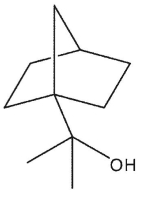
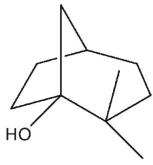
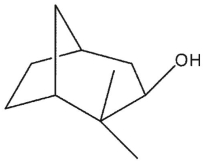
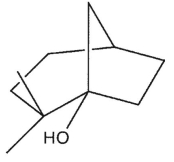
Deck 10: Electrophilic Additions to Alkenes

Full screen (f)
exit full mode
Question
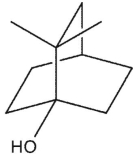
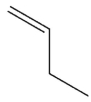
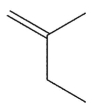
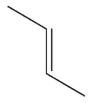
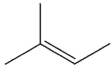
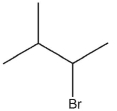
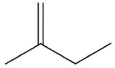
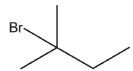
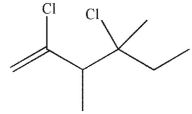
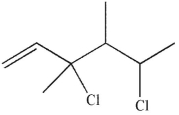
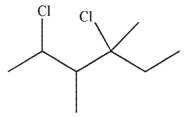
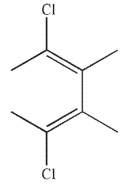
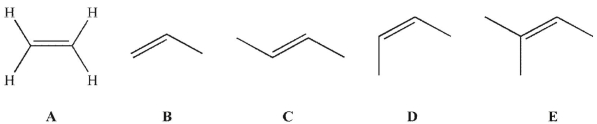
Which of the following alkenes will be protonated most rapidly by sulfuric acid?
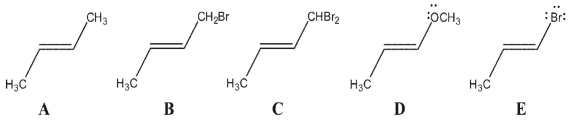
<strong>Which of the following alkenes will be protonated most rapidly by sulfuric acid?  </strong> A) A B) B C) C D) D E) E <div style=padding-top: 35px>

A) A
B) B
C) C
D) D
E) E
Use Space or
up arrow
down arrow
to flip the card.
Question
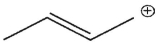
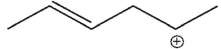
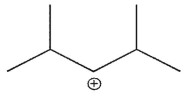
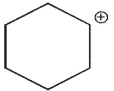
Which of the following cations is allylic?

A) <strong>Which of the following cations is allylic?</strong> A)   B)   C)   D)   E)   <div style=padding-top: 35px>
B) <strong>Which of the following cations is allylic?</strong> A)   B)   C)   D)   E)   <div style=padding-top: 35px>
C) <strong>Which of the following cations is allylic?</strong> A)   B)   C)   D)   E)   <div style=padding-top: 35px>
D) <strong>Which of the following cations is allylic?</strong> A)   B)   C)   D)   E)   <div style=padding-top: 35px>
E) <strong>Which of the following cations is allylic?</strong> A)   B)   C)   D)   E)   <div style=padding-top: 35px>
Question
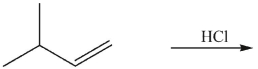
Which of the following statements about the reaction shown here is true?
<strong>Which of the following statements about the reaction shown here is true?   I. The alkene is a Brønsted base. II. The alkene is a Brønsted acid. III. The rate-limiting step is carbocation formation. IV. The rate-limiting step is nucleophilic attack by chloride ion on a carbocation.</strong> A) I, III B) I, IV C) II, III D) II, IV E) I only <div style=padding-top: 35px>
I. The alkene is a Brønsted base.
II. The alkene is a Brønsted acid.
III. The rate-limiting step is carbocation formation.
IV. The rate-limiting step is nucleophilic attack by chloride ion on a carbocation.

A) I, III
B) I, IV
C) II, III
D) II, IV
E) I only
Question
Which of the following statements is true about the reaction shown here?
<strong>Which of the following statements is true about the reaction shown here?  </strong> A) The products are diastereomers, formed in unequal amounts. B) The products are diastereomers, formed in equal amounts. C) The products are enantiomers, formed in unequal amounts. D) The products are enantiomers, formed in equal amounts. E) The products are structural isomers, formed in unequal amounts. <div style=padding-top: 35px>

A) The products are diastereomers, formed in unequal amounts.
B) The products are diastereomers, formed in equal amounts.
C) The products are enantiomers, formed in unequal amounts.
D) The products are enantiomers, formed in equal amounts.
E) The products are structural isomers, formed in unequal amounts.
Question
Which of the following is the major product of this reaction?
<strong>Which of the following is the major product of this reaction?  </strong> A)   B)   C)   D)   E)   <div style=padding-top: 35px>

A) <strong>Which of the following is the major product of this reaction?  </strong> A)   B)   C)   D)   E)   <div style=padding-top: 35px>
B) <strong>Which of the following is the major product of this reaction?  </strong> A)   B)   C)   D)   E)   <div style=padding-top: 35px>
C) <strong>Which of the following is the major product of this reaction?  </strong> A)   B)   C)   D)   E)   <div style=padding-top: 35px>
D) <strong>Which of the following is the major product of this reaction?  </strong> A)   B)   C)   D)   E)   <div style=padding-top: 35px>
E) <strong>Which of the following is the major product of this reaction?  </strong> A)   B)   C)   D)   E)   <div style=padding-top: 35px>
Question
Identify the orbitals that are mixing to stabilize the carbocation by hyperconjugation.
<strong>Identify the orbitals that are mixing to stabilize the carbocation by hyperconjugation.  </strong> A)    B)  p and sp<sup>3</sup> C) p and sp<sup>2</sup> D)   E)   <div style=padding-top: 35px>

A) <strong>Identify the orbitals that are mixing to stabilize the carbocation by hyperconjugation.  </strong> A)    B)  p and sp<sup>3</sup> C) p and sp<sup>2</sup> D)   E)   <div style=padding-top: 35px>
B) p and sp3
C) p and sp2
D) <strong>Identify the orbitals that are mixing to stabilize the carbocation by hyperconjugation.  </strong> A)    B)  p and sp<sup>3</sup> C) p and sp<sup>2</sup> D)   E)   <div style=padding-top: 35px>
E) <strong>Identify the orbitals that are mixing to stabilize the carbocation by hyperconjugation.  </strong> A)    B)  p and sp<sup>3</sup> C) p and sp<sup>2</sup> D)   E)   <div style=padding-top: 35px>
Question
Which of these guidelines would not be used for assigning weighting factors for resonance forms?

A)Resonance forms must have the same number of paired and unpaired electrons.
B)Separation of charges is preferred.
C)The more bonds in a resonance form, the more stable the form is.
D)Equivalent resonance forms contribute equally.
E)Delocalization of charge is stabilizing.
Question
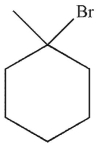
Which of these products is not the result of Markovnikov addition of HBr to an alkene?

A) <strong>Which of these products is not the result of Markovnikov addition of HBr to an alkene?</strong> A)   B)   C)   D)   E)   <div style=padding-top: 35px>
B) <strong>Which of these products is not the result of Markovnikov addition of HBr to an alkene?</strong> A)   B)   C)   D)   E)   <div style=padding-top: 35px>
C) <strong>Which of these products is not the result of Markovnikov addition of HBr to an alkene?</strong> A)   B)   C)   D)   E)   <div style=padding-top: 35px>
D) <strong>Which of these products is not the result of Markovnikov addition of HBr to an alkene?</strong> A)   B)   C)   D)   E)   <div style=padding-top: 35px>
E) <strong>Which of these products is not the result of Markovnikov addition of HBr to an alkene?</strong> A)   B)   C)   D)   E)   <div style=padding-top: 35px>
Question
What is the LUMO in the first step of the reaction shown here?
<strong>What is the LUMO in the first step of the reaction shown here?  </strong> A)    B)    C)    D)   E)   <div style=padding-top: 35px>

A) <strong>What is the LUMO in the first step of the reaction shown here?  </strong> A)    B)    C)    D)   E)   <div style=padding-top: 35px>
B) <strong>What is the LUMO in the first step of the reaction shown here?  </strong> A)    B)    C)    D)   E)   <div style=padding-top: 35px>
C) <strong>What is the LUMO in the first step of the reaction shown here?  </strong> A)    B)    C)    D)   E)   <div style=padding-top: 35px>
D) <strong>What is the LUMO in the first step of the reaction shown here?  </strong> A)    B)    C)    D)   E)   <div style=padding-top: 35px>
E) <strong>What is the LUMO in the first step of the reaction shown here?  </strong> A)    B)    C)    D)   E)   <div style=padding-top: 35px>
Question
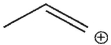
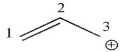
Which of the following statements about the allyl cation is false? (Refer to the numbering provided in the structure.)
<strong>Which of the following statements about the allyl cation is false? (Refer to the numbering provided in the structure.)  </strong> A) There is a node at  C 2  of the lowest unoccupied molecular orbital (LUMO). B) The positive charge equilibriates between  C 1  and  C3 . C) The positive charge is shared by  C 1  and  C 3 . D) The p-atomic orbitals combine to form three molecular orbitals. E) There are two    electrons in this system. <div style=padding-top: 35px>

A) There is a node at C 2 of the lowest unoccupied molecular orbital (LUMO).
B) The positive charge equilibriates between C 1 and C3 .
C) The positive charge is shared by C 1 and C 3 .
D) The p-atomic orbitals combine to form three molecular orbitals.
E) There are two <strong>Which of the following statements about the allyl cation is false? (Refer to the numbering provided in the structure.)  </strong> A) There is a node at  C 2  of the lowest unoccupied molecular orbital (LUMO). B) The positive charge equilibriates between  C 1  and  C3 . C) The positive charge is shared by  C 1  and  C 3 . D) The p-atomic orbitals combine to form three molecular orbitals. E) There are two    electrons in this system. <div style=padding-top: 35px> electrons in this system.
Question
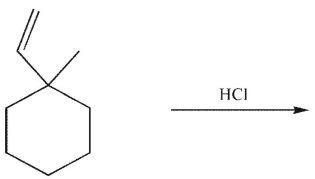
Which of the following statements about the mechanism of the addition shown below is true?
<strong>Which of the following statements about the mechanism of the addition shown below is true?  </strong> A) The transition state for the rate-determining step resembles the starting materials. B) The addition of chloride anion occurs in the rate-determining step. C) The reaction proceeds via a concerted mechanism. D) The addition of the proton is an endothermic step in the reaction mechanism. E) The  HCl  acts as the nucleophile in the addition reaction. <div style=padding-top: 35px>

A) The transition state for the rate-determining step resembles the starting materials.
B) The addition of chloride anion occurs in the rate-determining step.
C) The reaction proceeds via a concerted mechanism.
D) The addition of the proton is an endothermic step in the reaction mechanism.
E) The HCl acts as the nucleophile in the addition reaction.
Question
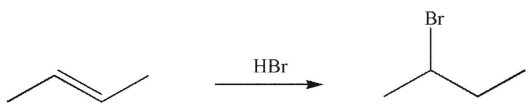
What is the HOMO in the first step of the reaction shown here?
<strong>What is the HOMO in the first step of the reaction shown here?  </strong> A)   B)   C)   D)   E)   <div style=padding-top: 35px>

A) <strong>What is the HOMO in the first step of the reaction shown here?  </strong> A)   B)   C)   D)   E)   <div style=padding-top: 35px>
B) <strong>What is the HOMO in the first step of the reaction shown here?  </strong> A)   B)   C)   D)   E)   <div style=padding-top: 35px>
C) <strong>What is the HOMO in the first step of the reaction shown here?  </strong> A)   B)   C)   D)   E)   <div style=padding-top: 35px>
D) <strong>What is the HOMO in the first step of the reaction shown here?  </strong> A)   B)   C)   D)   E)   <div style=padding-top: 35px>
E) <strong>What is the HOMO in the first step of the reaction shown here?  </strong> A)   B)   C)   D)   E)   <div style=padding-top: 35px>
Question
Which of the following statements about Markovnikov hydration is false?

A)An acid catalyst must be used.
B)A carbocation intermediate is formed in the rate-determining step of the reaction.
C)The OH group in the product is attached to the more substituted carbon of the original alkene.
D)Water acts as a base in the final step of the reaction mechanism.
E)The alkene starting material is protonated by water in the first step of the reaction.
Question
Which of the following alkenes will be protonated most rapidly by sulfuric acid?
<strong>Which of the following alkenes will be protonated most rapidly by sulfuric acid?  </strong> A) A B) B C) C D) D E) E <div style=padding-top: 35px>

A) A
B) B
C) C
D) D
E) E
Question
Which of these products would not form from the following reaction? <strong>Which of these products would not form from the following reaction?  </strong> A)   B)   C)   D)   E)   <div style=padding-top: 35px>

A)
<strong>Which of these products would not form from the following reaction?  </strong> A)   B)   C)   D)   E)   <div style=padding-top: 35px>
B)
<strong>Which of these products would not form from the following reaction?  </strong> A)   B)   C)   D)   E)   <div style=padding-top: 35px>
C)
<strong>Which of these products would not form from the following reaction?  </strong> A)   B)   C)   D)   E)   <div style=padding-top: 35px>
D)
<strong>Which of these products would not form from the following reaction?  </strong> A)   B)   C)   D)   E)   <div style=padding-top: 35px>
E)
<strong>Which of these products would not form from the following reaction?  </strong> A)   B)   C)   D)   E)   <div style=padding-top: 35px>
Question
Which alkene monomer would react with sulfuric acid to generate the following polymer?
<strong>Which alkene monomer would react with sulfuric acid to generate the following polymer?  </strong> A)   B)   C)   D)   E)   <div style=padding-top: 35px>

A)
<strong>Which alkene monomer would react with sulfuric acid to generate the following polymer?  </strong> A)   B)   C)   D)   E)   <div style=padding-top: 35px>
B)
<strong>Which alkene monomer would react with sulfuric acid to generate the following polymer?  </strong> A)   B)   C)   D)   E)   <div style=padding-top: 35px>
C)
<strong>Which alkene monomer would react with sulfuric acid to generate the following polymer?  </strong> A)   B)   C)   D)   E)   <div style=padding-top: 35px>
D)
<strong>Which alkene monomer would react with sulfuric acid to generate the following polymer?  </strong> A)   B)   C)   D)   E)   <div style=padding-top: 35px>
E)
<strong>Which alkene monomer would react with sulfuric acid to generate the following polymer?  </strong> A)   B)   C)   D)   E)   <div style=padding-top: 35px>
Question
Which of the following structures is not a possible product of the reaction shown here? <strong>Which of the following structures is not a possible product of the reaction shown here?  </strong> A)   B)   C)   D)   E)   <div style=padding-top: 35px>

A)
<strong>Which of the following structures is not a possible product of the reaction shown here?  </strong> A)   B)   C)   D)   E)   <div style=padding-top: 35px>
B)
<strong>Which of the following structures is not a possible product of the reaction shown here?  </strong> A)   B)   C)   D)   E)   <div style=padding-top: 35px>
C)
<strong>Which of the following structures is not a possible product of the reaction shown here?  </strong> A)   B)   C)   D)   E)   <div style=padding-top: 35px>
D)
<strong>Which of the following structures is not a possible product of the reaction shown here?  </strong> A)   B)   C)   D)   E)   <div style=padding-top: 35px>
E)
<strong>Which of the following structures is not a possible product of the reaction shown here?  </strong> A)   B)   C)   D)   E)   <div style=padding-top: 35px>
Question
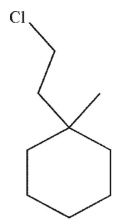
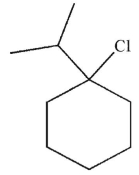
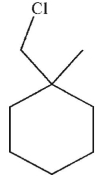
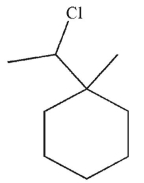
Which of the following is the least likely product of the reaction conditions shown here?
<strong>Which of the following is the least likely product of the reaction conditions shown here?  </strong> A)   B)   C)   D)   E)   <div style=padding-top: 35px>

A) <strong>Which of the following is the least likely product of the reaction conditions shown here?  </strong> A)   B)   C)   D)   E)   <div style=padding-top: 35px>
B) <strong>Which of the following is the least likely product of the reaction conditions shown here?  </strong> A)   B)   C)   D)   E)   <div style=padding-top: 35px>
C) <strong>Which of the following is the least likely product of the reaction conditions shown here?  </strong> A)   B)   C)   D)   E)   <div style=padding-top: 35px>
D) <strong>Which of the following is the least likely product of the reaction conditions shown here?  </strong> A)   B)   C)   D)   E)   <div style=padding-top: 35px>
E) <strong>Which of the following is the least likely product of the reaction conditions shown here?  </strong> A)   B)   C)   D)   E)   <div style=padding-top: 35px>
Question
Which of the following carbocations is least likely to rearrange? <strong>Which of the following carbocations is least likely to rearrange?  </strong> A) A B) B C) C D) D E) E <div style=padding-top: 35px>

A) A
B) B
C) C
D) D
E) E
Question
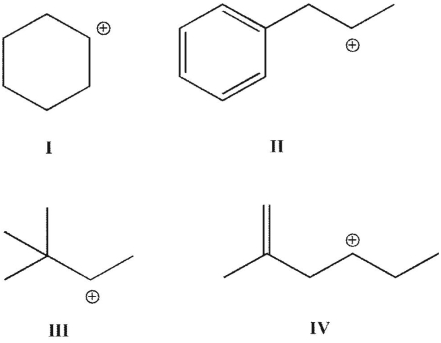
Which of the following carbocations is least likely to rearrange? <strong>Which of the following carbocations is least likely to rearrange?  </strong> A) I B) II C) III D)    II, III, and IV E) I, II and IV <div style=padding-top: 35px>

A) I
B) II
C) III
D) II, III, and IV
E) I, II and IV
Question
Which of the following methods is the correct way to synthesize the product shown from the given starting material? <strong>Which of the following methods is the correct way to synthesize the product shown from the given starting material?  </strong> A)  HCl B) 1 .   2.  HCl C) 1.   2.   3.  TsCl , pyridine 4.  NaCl D) 1.   2.  TsCl , pyridine E) The starting material cannot be transformed to the product shown. <div style=padding-top: 35px>

A) HCl
B) 1 . <strong>Which of the following methods is the correct way to synthesize the product shown from the given starting material?  </strong> A)  HCl B) 1 .   2.  HCl C) 1.   2.   3.  TsCl , pyridine 4.  NaCl D) 1.   2.  TsCl , pyridine E) The starting material cannot be transformed to the product shown. <div style=padding-top: 35px>
2. HCl
C) 1. <strong>Which of the following methods is the correct way to synthesize the product shown from the given starting material?  </strong> A)  HCl B) 1 .   2.  HCl C) 1.   2.   3.  TsCl , pyridine 4.  NaCl D) 1.   2.  TsCl , pyridine E) The starting material cannot be transformed to the product shown. <div style=padding-top: 35px>
2. <strong>Which of the following methods is the correct way to synthesize the product shown from the given starting material?  </strong> A)  HCl B) 1 .   2.  HCl C) 1.   2.   3.  TsCl , pyridine 4.  NaCl D) 1.   2.  TsCl , pyridine E) The starting material cannot be transformed to the product shown. <div style=padding-top: 35px>
3. TsCl , pyridine
4. NaCl
D) 1. <strong>Which of the following methods is the correct way to synthesize the product shown from the given starting material?  </strong> A)  HCl B) 1 .   2.  HCl C) 1.   2.   3.  TsCl , pyridine 4.  NaCl D) 1.   2.  TsCl , pyridine E) The starting material cannot be transformed to the product shown. <div style=padding-top: 35px>
2. TsCl , pyridine
E) The starting material cannot be transformed to the product shown.
Question
Which of these processes is a syn addition?

A) Hydration of an alkene using water and catalytic sulfuric acid.
B) Addition of HCI to an alkene.
C) Addition of CI2 to an alkene.
D) Hydroboration/oxidation of an alkene.
E) Both a and b.
Question
Shown here is hydroboration/oxidation reaction of an alkene.
<strong>Shown here is hydroboration/oxidation reaction of an alkene.   One of the reagents is labeled with  18O . Which of the following choices correctly shows this label?</strong> A)    B)   C)   D) Either b or c . E) Any of these is correct . <div style=padding-top: 35px>
One of the reagents is labeled with 18O . Which of the following choices correctly shows this label?

A) <strong>Shown here is hydroboration/oxidation reaction of an alkene.   One of the reagents is labeled with  18O . Which of the following choices correctly shows this label?</strong> A)    B)   C)   D) Either b or c . E) Any of these is correct . <div style=padding-top: 35px>
B) <strong>Shown here is hydroboration/oxidation reaction of an alkene.   One of the reagents is labeled with  18O . Which of the following choices correctly shows this label?</strong> A)    B)   C)   D) Either b or c . E) Any of these is correct . <div style=padding-top: 35px>
C) <strong>Shown here is hydroboration/oxidation reaction of an alkene.   One of the reagents is labeled with  18O . Which of the following choices correctly shows this label?</strong> A)    B)   C)   D) Either b or c . E) Any of these is correct . <div style=padding-top: 35px>
D) Either b or c .
E) Any of these is correct .
Question
Predict the product of the following reaction conditions. Predict the product of the following reaction conditions.  <div style=padding-top: 35px>
Question
Which of these statements about hydroboration is false?

A)Hydroboration is regiospecific.
B)The overall reaction involves the formation of a C-H bond and a C-B bond.
C)The overall reaction involves the formation of a C-B bond and a B-H bond.
D)Boron attaches to the less substituted end of an alkene.
E)The mechanism of hydroboration is believed to be concerted.
Question
Identify the HOMO and LUMO in the rate-limiting step of the reaction shown here. Identify the HOMO and LUMO in the rate-limiting step of the reaction shown here.  <div style=padding-top: 35px>
Question
Draw a mechanism to account for the formation of the product shown. Draw a mechanism to account for the formation of the product shown.  <div style=padding-top: 35px>
Question
Which of the following structures is the product of the reaction shown here? <strong>Which of the following structures is the product of the reaction shown here?  </strong> A)   B)   C)   D)   E)   <div style=padding-top: 35px>

A) <strong>Which of the following structures is the product of the reaction shown here?  </strong> A)   B)   C)   D)   E)   <div style=padding-top: 35px>
B) <strong>Which of the following structures is the product of the reaction shown here?  </strong> A)   B)   C)   D)   E)   <div style=padding-top: 35px>
C) <strong>Which of the following structures is the product of the reaction shown here?  </strong> A)   B)   C)   D)   E)   <div style=padding-top: 35px>
D) <strong>Which of the following structures is the product of the reaction shown here?  </strong> A)   B)   C)   D)   E)   <div style=padding-top: 35px>
E) <strong>Which of the following structures is the product of the reaction shown here?  </strong> A)   B)   C)   D)   E)   <div style=padding-top: 35px>
Question
Draw the π molecular orbitals of allyl cation in order of increasing energy (lowest energy at the bottom of the diagram). Include all π electrons and all nodes.
Question
Draw a mechanism illustrating the formation of the product of the reaction shown here. Draw a mechanism illustrating the formation of the product of the reaction shown here.  <div style=padding-top: 35px>
Question
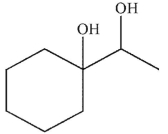
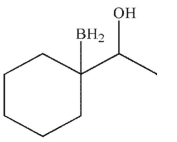
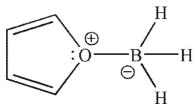
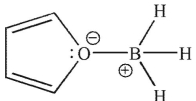
What is the correct structure of <strong>What is the correct structure of   ?</strong> A)  B)   C)   D)   E)   <div style=padding-top: 35px> ?

A)<strong>What is the correct structure of   ?</strong> A)  B)   C)   D)   E)   <div style=padding-top: 35px>
B) <strong>What is the correct structure of   ?</strong> A)  B)   C)   D)   E)   <div style=padding-top: 35px>
C) <strong>What is the correct structure of   ?</strong> A)  B)   C)   D)   E)   <div style=padding-top: 35px>
D) <strong>What is the correct structure of   ?</strong> A)  B)   C)   D)   E)   <div style=padding-top: 35px>
E) <strong>What is the correct structure of   ?</strong> A)  B)   C)   D)   E)   <div style=padding-top: 35px>
Question
Provide the correct name for the major expected addition product formed in the following
reaction. Provide the correct name for the major expected addition product formed in the following reaction.  <div style=padding-top: 35px>
Question
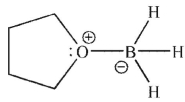
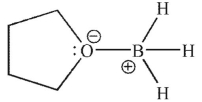
Which of the following statements about borane is true?

A)Borane is stable in its monomeric form.
B)Borane acts as a Lewis acid.
C)Borane forms a stable complex with ethers.
D)Borane adds a proton to a double bond.
E)Double bonds undergo antiaddition with boranes.
Question
Name the major addition products formed in this reaction and state their relationships to one
another. Name the major addition products formed in this reaction and state their relationships to one another.  <div style=padding-top: 35px>
Question
Predict the product of the following reaction. Predict the product of the following reaction.  <div style=padding-top: 35px>
Question
Which of these processes is an anti-Markovnikov addition?

A) Hydration of an alkene using water and catalytic nitric acid.
B) Addition of HCI to an alkene.
C) Addition of Br2 to an alkene.
D) Hydroboration/oxidation of an alkene.
E) Both c and d.
Question
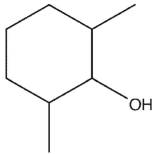
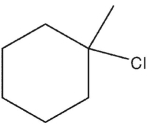
Which of the following compounds could not be synthesized from 1,3-dimethylcyclohexene by methods explored in this chapter? <strong>Which of the following compounds could not be synthesized from 1,3-dimethylcyclohexene by methods explored in this chapter?  </strong> A)   B)   C)   D)   E)   <div style=padding-top: 35px>

A) <strong>Which of the following compounds could not be synthesized from 1,3-dimethylcyclohexene by methods explored in this chapter?  </strong> A)   B)   C)   D)   E)   <div style=padding-top: 35px>
B) <strong>Which of the following compounds could not be synthesized from 1,3-dimethylcyclohexene by methods explored in this chapter?  </strong> A)   B)   C)   D)   E)   <div style=padding-top: 35px>
C) <strong>Which of the following compounds could not be synthesized from 1,3-dimethylcyclohexene by methods explored in this chapter?  </strong> A)   B)   C)   D)   E)   <div style=padding-top: 35px>
D) <strong>Which of the following compounds could not be synthesized from 1,3-dimethylcyclohexene by methods explored in this chapter?  </strong> A)   B)   C)   D)   E)   <div style=padding-top: 35px>
E) <strong>Which of the following compounds could not be synthesized from 1,3-dimethylcyclohexene by methods explored in this chapter?  </strong> A)   B)   C)   D)   E)   <div style=padding-top: 35px>
Question
Define the term regioselectivity.
Question
Which of the following structures could be the product of hydroboration/oxidation of an alkene?
<strong>Which of the following structures could be the product of hydroboration/oxidation of an alkene?  </strong> A) I B) II C) III D) I and II E) I, II and III <div style=padding-top: 35px>

A) I
B) II
C) III
D) I and II
E) I, II and III
Question
Which of the following structures could be produced on reaction of two molecules of the starting material shown in acidic conditions?
<strong>Which of the following structures could be produced on reaction of two molecules of the starting material shown in acidic conditions?  </strong> A)   B)   C)   D)   E)   <div style=padding-top: 35px>

A) <strong>Which of the following structures could be produced on reaction of two molecules of the starting material shown in acidic conditions?  </strong> A)   B)   C)   D)   E)   <div style=padding-top: 35px>
B) <strong>Which of the following structures could be produced on reaction of two molecules of the starting material shown in acidic conditions?  </strong> A)   B)   C)   D)   E)   <div style=padding-top: 35px>
C) <strong>Which of the following structures could be produced on reaction of two molecules of the starting material shown in acidic conditions?  </strong> A)   B)   C)   D)   E)   <div style=padding-top: 35px>
D) <strong>Which of the following structures could be produced on reaction of two molecules of the starting material shown in acidic conditions?  </strong> A)   B)   C)   D)   E)   <div style=padding-top: 35px>
E) <strong>Which of the following structures could be produced on reaction of two molecules of the starting material shown in acidic conditions?  </strong> A)   B)   C)   D)   E)   <div style=padding-top: 35px>
Question
What is the reverse of Markovnikov hydration, and what kind of mechanism is this?
Question
Draw the most reasonable resonance structure for the carbocation shown here.Include all lone pairs of
electrons and any nonzero formal charges. Draw the most reasonable resonance structure for the carbocation shown here.Include all lone pairs of electrons and any nonzero formal charges.  <div style=padding-top: 35px>
Question
Draw all the possible addition products formed in the reaction shown. Draw all the possible addition products formed in the reaction shown.  <div style=padding-top: 35px>
Question
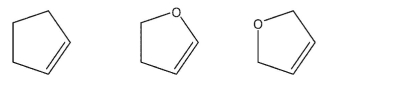
From slowest to fastest, rank these alkenes in order of their reactivity with hydrogen bromide.
Draw the expected product(s) from each reaction, indicating major and minor products. From slowest to fastest, rank these alkenes in order of their reactivity with hydrogen bromide. Draw the expected product(s) from each reaction, indicating major and minor products.  <div style=padding-top: 35px>
Question
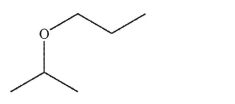
Using propene as your only carbon source, devise an efficient synthesis of the target molecule.
Show the reagents needed for each step and the product of each step. Using propene as your only carbon source, devise an efficient synthesis of the target molecule. Show the reagents needed for each step and the product of each step.  <div style=padding-top: 35px>
Question
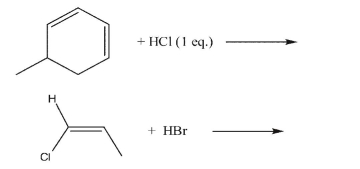
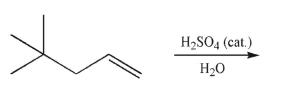
For the following reactions, indicate what product(s) would be formed.Include correct
stereochemistry when the reaction is stereoselective. For the following reactions, indicate what product(s) would be formed.Include correct stereochemistry when the reaction is stereoselective.  <div style=padding-top: 35px>
Question
Treatment of 1-methylcyclohexene with sulfuric acid and heat leads to a mixture of dimeric alkenes. Treatment of 1-methylcyclohexene with sulfuric acid and heat leads to a mixture of dimeric alkenes.   Propose a mechanism for the formation of this mixture and indicate the major and minor products.<div style=padding-top: 35px>
Propose a mechanism for the formation of this mixture and indicate the major and minor products.
Question
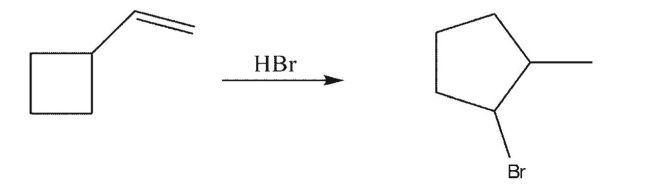
Show the mechanism by which the following reaction occurs. Show the mechanism by which the following reaction occurs.  <div style=padding-top: 35px>
Question
State the basis of Markovnikov's rule.
Question
Both of the two isomeric alkenes below react with aqueous sulfuric acid to give
1-phenyl-1-propanol as the major product.Show the mechanism of the reaction in each case. Both of the two isomeric alkenes below react with aqueous sulfuric acid to give 1-phenyl-1-propanol as the major product.Show the mechanism of the reaction in each case.  <div style=padding-top: 35px>
Question
Draw a mechanism to account for the formation of the product of the reaction shown here. Draw a mechanism to account for the formation of the product of the reaction shown here.  <div style=padding-top: 35px>
Question
Draw and name the product of Markovnikov hydration of the alkene shown here using aqueous
sulfuric acid. Draw and name the product of Markovnikov hydration of the alkene shown here using aqueous sulfuric acid.  <div style=padding-top: 35px>
Question
Dimerization of 1-methylcyclopentene generates three isomers with molecular formula C12H20.
Draw the three isomers, designate their stereochemistry (E or Z), and indicate the expected
relative amounts (most, middle, least) based on product stability. Dimerization of 1-methylcyclopentene generates three isomers with molecular formula C<sub>12</sub>H<sub>20</sub>. Draw the three isomers, designate their stereochemistry (E or Z), and indicate the expected relative amounts (most, middle, least) based on product stability.  <div style=padding-top: 35px>
Question
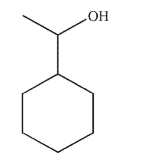
What is the structure of the most substituted alkene precursor from which the alcohol shown could
be directly synthesized? What is the structure of the most substituted alkene precursor from which the alcohol shown could be directly synthesized?  <div style=padding-top: 35px>
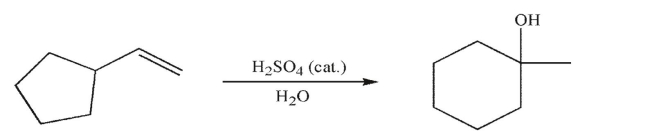
Question
Propose a mechanism to account for the formation of the observed product. Propose a mechanism to account for the formation of the observed product.  <div style=padding-top: 35px>
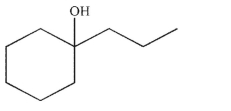
Question
Draw the structures of two alkene precusors from which the alcohol shown here could be made in
a single synthetic step. Draw the structures of two alkene precusors from which the alcohol shown here could be made in a single synthetic step.  <div style=padding-top: 35px>
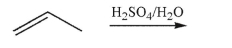
Question
Draw a mechanism for dimerization of the alkene shown here under acidic conditions. Draw a mechanism for dimerization of the alkene shown here under acidic conditions.  <div style=padding-top: 35px>
Question
Provide the correct name for the major expected product of the reaction shown here. Provide the correct name for the major expected product of the reaction shown here.  <div style=padding-top: 35px>
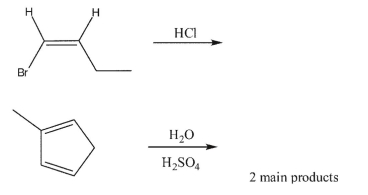
Question
Show the principal product(s) of the following reactions; include stereochemistry as needed. Show the principal product(s) of the following reactions; include stereochemistry as needed.  <div style=padding-top: 35px>
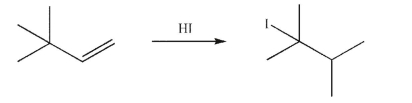
Question
Draw a mechanism to account for the formation of the product shown here. Draw a mechanism to account for the formation of the product shown here.  <div style=padding-top: 35px>
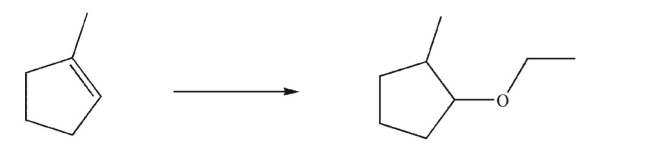
Question
Design a multistep synthesis of the target molecule from the starting material.You may use any
inorganic or organic reagents necessary.Show the reagents necessary for each step and the
product of each step. Design a multistep synthesis of the target molecule from the starting material.You may use any inorganic or organic reagents necessary.Show the reagents necessary for each step and the product of each step.  <div style=padding-top: 35px>
Question
Provide the missing structures and reagents in the following reaction sequence. Provide the missing structures and reagents in the following reaction sequence.  <div style=padding-top: 35px>
Question
Draw a mechanism for the transformation shown.Include all curved arrows, necessary lone pairs,
and nonzero formal charges. Draw a mechanism for the transformation shown.Include all curved arrows, necessary lone pairs, and nonzero formal charges.  <div style=padding-top: 35px>
Question
Devise a multistep synthesis of the target molecule from the given starting material.Show the
reagents needed for each step and the product of each step. Devise a multistep synthesis of the target molecule from the given starting material.Show the reagents needed for each step and the product of each step.  <div style=padding-top: 35px>
Question
Devise a multistep synthesis of the target molecule from the given starting material.Show the
reagents needed for each step and the product of each step. Devise a multistep synthesis of the target molecule from the given starting material.Show the reagents needed for each step and the product of each step.  <div style=padding-top: 35px>
Question
Devise a multistep synthesis of the target molecule from the given starting material.Show the
reagents needed for each step and the product of each step. Devise a multistep synthesis of the target molecule from the given starting material.Show the reagents needed for each step and the product of each step.  <div style=padding-top: 35px>
Question
Show the products of the following reactions with correct stereochemistry. Show the products of the following reactions with correct stereochemistry.  <div style=padding-top: 35px>
Question
Draw the structure of the precursor alkene to this alcohol and indicate the reagents you would use
to convert the precursor to the alcohol. Draw the structure of the precursor alkene to this alcohol and indicate the reagents you would use to convert the precursor to the alcohol.  <div style=padding-top: 35px>
Unlock Deck
Sign up to unlock the cards in this deck!
Unlock Deck
Unlock Deck
1/68
auto play flashcards
Play
simple tutorial
Full screen (f)
exit full mode
Deck 10: Electrophilic Additions to Alkenes
1
Which of the following alkenes will be protonated most rapidly by sulfuric acid?
<strong>Which of the following alkenes will be protonated most rapidly by sulfuric acid?  </strong> A) A B) B C) C D) D E) E

A) A
B) B
C) C
D) D
E) E
D
2
Which of the following cations is allylic?

A) <strong>Which of the following cations is allylic?</strong> A)   B)   C)   D)   E)
B) <strong>Which of the following cations is allylic?</strong> A)   B)   C)   D)   E)
C) <strong>Which of the following cations is allylic?</strong> A)   B)   C)   D)   E)
D) <strong>Which of the following cations is allylic?</strong> A)   B)   C)   D)   E)
E) <strong>Which of the following cations is allylic?</strong> A)   B)   C)   D)   E)
3
Which of the following statements about the reaction shown here is true?
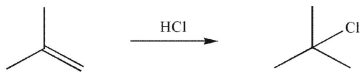
<strong>Which of the following statements about the reaction shown here is true?   I. The alkene is a Brønsted base. II. The alkene is a Brønsted acid. III. The rate-limiting step is carbocation formation. IV. The rate-limiting step is nucleophilic attack by chloride ion on a carbocation.</strong> A) I, III B) I, IV C) II, III D) II, IV E) I only
I. The alkene is a Brønsted base.
II. The alkene is a Brønsted acid.
III. The rate-limiting step is carbocation formation.
IV. The rate-limiting step is nucleophilic attack by chloride ion on a carbocation.

A) I, III
B) I, IV
C) II, III
D) II, IV
E) I only
I, III
4
Which of the following statements is true about the reaction shown here?
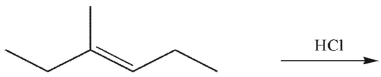
<strong>Which of the following statements is true about the reaction shown here?  </strong> A) The products are diastereomers, formed in unequal amounts. B) The products are diastereomers, formed in equal amounts. C) The products are enantiomers, formed in unequal amounts. D) The products are enantiomers, formed in equal amounts. E) The products are structural isomers, formed in unequal amounts.

A) The products are diastereomers, formed in unequal amounts.
B) The products are diastereomers, formed in equal amounts.
C) The products are enantiomers, formed in unequal amounts.
D) The products are enantiomers, formed in equal amounts.
E) The products are structural isomers, formed in unequal amounts.
Unlock Deck
Unlock for access to all 68 flashcards in this deck.
Unlock Deck
k this deck
5
Which of the following is the major product of this reaction?
<strong>Which of the following is the major product of this reaction?  </strong> A)   B)   C)   D)   E)

A) <strong>Which of the following is the major product of this reaction?  </strong> A)   B)   C)   D)   E)
B) <strong>Which of the following is the major product of this reaction?  </strong> A)   B)   C)   D)   E)
C) <strong>Which of the following is the major product of this reaction?  </strong> A)   B)   C)   D)   E)
D) <strong>Which of the following is the major product of this reaction?  </strong> A)   B)   C)   D)   E)
E) <strong>Which of the following is the major product of this reaction?  </strong> A)   B)   C)   D)   E)
Unlock Deck
Unlock for access to all 68 flashcards in this deck.
Unlock Deck
k this deck
6
Identify the orbitals that are mixing to stabilize the carbocation by hyperconjugation.
<strong>Identify the orbitals that are mixing to stabilize the carbocation by hyperconjugation.  </strong> A)    B)  p and sp<sup>3</sup> C) p and sp<sup>2</sup> D)   E)

A) <strong>Identify the orbitals that are mixing to stabilize the carbocation by hyperconjugation.  </strong> A)    B)  p and sp<sup>3</sup> C) p and sp<sup>2</sup> D)   E)
B) p and sp3
C) p and sp2
D) <strong>Identify the orbitals that are mixing to stabilize the carbocation by hyperconjugation.  </strong> A)    B)  p and sp<sup>3</sup> C) p and sp<sup>2</sup> D)   E)
E) <strong>Identify the orbitals that are mixing to stabilize the carbocation by hyperconjugation.  </strong> A)    B)  p and sp<sup>3</sup> C) p and sp<sup>2</sup> D)   E)
Unlock Deck
Unlock for access to all 68 flashcards in this deck.
Unlock Deck
k this deck
7
Which of these guidelines would not be used for assigning weighting factors for resonance forms?

A)Resonance forms must have the same number of paired and unpaired electrons.
B)Separation of charges is preferred.
C)The more bonds in a resonance form, the more stable the form is.
D)Equivalent resonance forms contribute equally.
E)Delocalization of charge is stabilizing.
Unlock Deck
Unlock for access to all 68 flashcards in this deck.
Unlock Deck
k this deck
8
Which of these products is not the result of Markovnikov addition of HBr to an alkene?

A) <strong>Which of these products is not the result of Markovnikov addition of HBr to an alkene?</strong> A)   B)   C)   D)   E)
B) <strong>Which of these products is not the result of Markovnikov addition of HBr to an alkene?</strong> A)   B)   C)   D)   E)
C) <strong>Which of these products is not the result of Markovnikov addition of HBr to an alkene?</strong> A)   B)   C)   D)   E)
D) <strong>Which of these products is not the result of Markovnikov addition of HBr to an alkene?</strong> A)   B)   C)   D)   E)
E) <strong>Which of these products is not the result of Markovnikov addition of HBr to an alkene?</strong> A)   B)   C)   D)   E)
Unlock Deck
Unlock for access to all 68 flashcards in this deck.
Unlock Deck
k this deck
9
What is the LUMO in the first step of the reaction shown here?

<strong>What is the LUMO in the first step of the reaction shown here?  </strong> A)    B)    C)    D)   E)

A) <strong>What is the LUMO in the first step of the reaction shown here?  </strong> A)    B)    C)    D)   E)
B) <strong>What is the LUMO in the first step of the reaction shown here?  </strong> A)    B)    C)    D)   E)
C) <strong>What is the LUMO in the first step of the reaction shown here?  </strong> A)    B)    C)    D)   E)
D) <strong>What is the LUMO in the first step of the reaction shown here?  </strong> A)    B)    C)    D)   E)
E) <strong>What is the LUMO in the first step of the reaction shown here?  </strong> A)    B)    C)    D)   E)
Unlock Deck
Unlock for access to all 68 flashcards in this deck.
Unlock Deck
k this deck
10
Which of the following statements about the allyl cation is false? (Refer to the numbering provided in the structure.)
<strong>Which of the following statements about the allyl cation is false? (Refer to the numbering provided in the structure.)  </strong> A) There is a node at  C 2  of the lowest unoccupied molecular orbital (LUMO). B) The positive charge equilibriates between  C 1  and  C3 . C) The positive charge is shared by  C 1  and  C 3 . D) The p-atomic orbitals combine to form three molecular orbitals. E) There are two    electrons in this system.

A) There is a node at C 2 of the lowest unoccupied molecular orbital (LUMO).
B) The positive charge equilibriates between C 1 and C3 .
C) The positive charge is shared by C 1 and C 3 .
D) The p-atomic orbitals combine to form three molecular orbitals.
E) There are two <strong>Which of the following statements about the allyl cation is false? (Refer to the numbering provided in the structure.)  </strong> A) There is a node at  C 2  of the lowest unoccupied molecular orbital (LUMO). B) The positive charge equilibriates between  C 1  and  C3 . C) The positive charge is shared by  C 1  and  C 3 . D) The p-atomic orbitals combine to form three molecular orbitals. E) There are two    electrons in this system. electrons in this system.
Unlock Deck
Unlock for access to all 68 flashcards in this deck.
Unlock Deck
k this deck
11
Which of the following statements about the mechanism of the addition shown below is true?

<strong>Which of the following statements about the mechanism of the addition shown below is true?  </strong> A) The transition state for the rate-determining step resembles the starting materials. B) The addition of chloride anion occurs in the rate-determining step. C) The reaction proceeds via a concerted mechanism. D) The addition of the proton is an endothermic step in the reaction mechanism. E) The  HCl  acts as the nucleophile in the addition reaction.

A) The transition state for the rate-determining step resembles the starting materials.
B) The addition of chloride anion occurs in the rate-determining step.
C) The reaction proceeds via a concerted mechanism.
D) The addition of the proton is an endothermic step in the reaction mechanism.
E) The HCl acts as the nucleophile in the addition reaction.
Unlock Deck
Unlock for access to all 68 flashcards in this deck.
Unlock Deck
k this deck
12
What is the HOMO in the first step of the reaction shown here?
<strong>What is the HOMO in the first step of the reaction shown here?  </strong> A)   B)   C)   D)   E)

A) <strong>What is the HOMO in the first step of the reaction shown here?  </strong> A)   B)   C)   D)   E)
B) <strong>What is the HOMO in the first step of the reaction shown here?  </strong> A)   B)   C)   D)   E)
C) <strong>What is the HOMO in the first step of the reaction shown here?  </strong> A)   B)   C)   D)   E)
D) <strong>What is the HOMO in the first step of the reaction shown here?  </strong> A)   B)   C)   D)   E)
E) <strong>What is the HOMO in the first step of the reaction shown here?  </strong> A)   B)   C)   D)   E)
Unlock Deck
Unlock for access to all 68 flashcards in this deck.
Unlock Deck
k this deck
13
Which of the following statements about Markovnikov hydration is false?

A)An acid catalyst must be used.
B)A carbocation intermediate is formed in the rate-determining step of the reaction.
C)The OH group in the product is attached to the more substituted carbon of the original alkene.
D)Water acts as a base in the final step of the reaction mechanism.
E)The alkene starting material is protonated by water in the first step of the reaction.
Unlock Deck
Unlock for access to all 68 flashcards in this deck.
Unlock Deck
k this deck
14
Which of the following alkenes will be protonated most rapidly by sulfuric acid?
<strong>Which of the following alkenes will be protonated most rapidly by sulfuric acid?  </strong> A) A B) B C) C D) D E) E

A) A
B) B
C) C
D) D
E) E
Unlock Deck
Unlock for access to all 68 flashcards in this deck.
Unlock Deck
k this deck
15
Which of these products would not form from the following reaction? <strong>Which of these products would not form from the following reaction?  </strong> A)   B)   C)   D)   E)
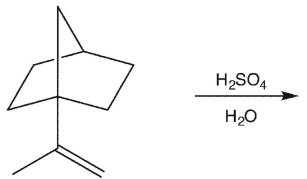
A)
<strong>Which of these products would not form from the following reaction?  </strong> A)   B)   C)   D)   E)
B)
<strong>Which of these products would not form from the following reaction?  </strong> A)   B)   C)   D)   E)
C)
<strong>Which of these products would not form from the following reaction?  </strong> A)   B)   C)   D)   E)
D)
<strong>Which of these products would not form from the following reaction?  </strong> A)   B)   C)   D)   E)
E)
<strong>Which of these products would not form from the following reaction?  </strong> A)   B)   C)   D)   E)
Unlock Deck
Unlock for access to all 68 flashcards in this deck.
Unlock Deck
k this deck
16
Which alkene monomer would react with sulfuric acid to generate the following polymer?
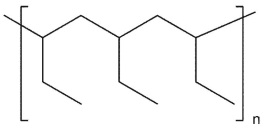
<strong>Which alkene monomer would react with sulfuric acid to generate the following polymer?  </strong> A)   B)   C)   D)   E)

A)
<strong>Which alkene monomer would react with sulfuric acid to generate the following polymer?  </strong> A)   B)   C)   D)   E)
B)
<strong>Which alkene monomer would react with sulfuric acid to generate the following polymer?  </strong> A)   B)   C)   D)   E)
C)
<strong>Which alkene monomer would react with sulfuric acid to generate the following polymer?  </strong> A)   B)   C)   D)   E)
D)
<strong>Which alkene monomer would react with sulfuric acid to generate the following polymer?  </strong> A)   B)   C)   D)   E)
E)
<strong>Which alkene monomer would react with sulfuric acid to generate the following polymer?  </strong> A)   B)   C)   D)   E)
Unlock Deck
Unlock for access to all 68 flashcards in this deck.
Unlock Deck
k this deck
17
Which of the following structures is not a possible product of the reaction shown here? <strong>Which of the following structures is not a possible product of the reaction shown here?  </strong> A)   B)   C)   D)   E)
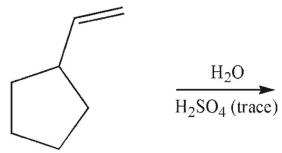
A)
<strong>Which of the following structures is not a possible product of the reaction shown here?  </strong> A)   B)   C)   D)   E)
B)
<strong>Which of the following structures is not a possible product of the reaction shown here?  </strong> A)   B)   C)   D)   E)
C)
<strong>Which of the following structures is not a possible product of the reaction shown here?  </strong> A)   B)   C)   D)   E)
D)
<strong>Which of the following structures is not a possible product of the reaction shown here?  </strong> A)   B)   C)   D)   E)
E)
<strong>Which of the following structures is not a possible product of the reaction shown here?  </strong> A)   B)   C)   D)   E)
Unlock Deck
Unlock for access to all 68 flashcards in this deck.
Unlock Deck
k this deck
18
Which of the following is the least likely product of the reaction conditions shown here?
<strong>Which of the following is the least likely product of the reaction conditions shown here?  </strong> A)   B)   C)   D)   E)

A) <strong>Which of the following is the least likely product of the reaction conditions shown here?  </strong> A)   B)   C)   D)   E)
B) <strong>Which of the following is the least likely product of the reaction conditions shown here?  </strong> A)   B)   C)   D)   E)
C) <strong>Which of the following is the least likely product of the reaction conditions shown here?  </strong> A)   B)   C)   D)   E)
D) <strong>Which of the following is the least likely product of the reaction conditions shown here?  </strong> A)   B)   C)   D)   E)
E) <strong>Which of the following is the least likely product of the reaction conditions shown here?  </strong> A)   B)   C)   D)   E)
Unlock Deck
Unlock for access to all 68 flashcards in this deck.
Unlock Deck
k this deck
19
Which of the following carbocations is least likely to rearrange? <strong>Which of the following carbocations is least likely to rearrange?  </strong> A) A B) B C) C D) D E) E
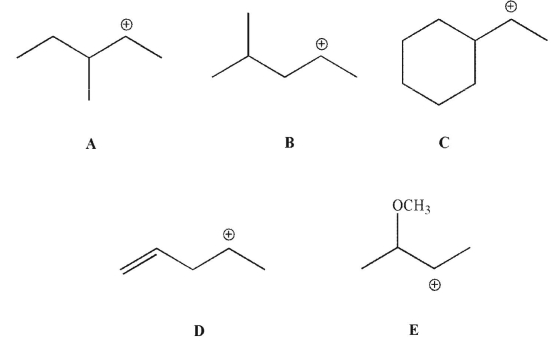
A) A
B) B
C) C
D) D
E) E
Unlock Deck
Unlock for access to all 68 flashcards in this deck.
Unlock Deck
k this deck
20
Which of the following carbocations is least likely to rearrange? <strong>Which of the following carbocations is least likely to rearrange?  </strong> A) I B) II C) III D)    II, III, and IV E) I, II and IV

A) I
B) II
C) III
D) II, III, and IV
E) I, II and IV
Unlock Deck
Unlock for access to all 68 flashcards in this deck.
Unlock Deck
k this deck
21
Which of the following methods is the correct way to synthesize the product shown from the given starting material? <strong>Which of the following methods is the correct way to synthesize the product shown from the given starting material?  </strong> A)  HCl B) 1 .   2.  HCl C) 1.   2.   3.  TsCl , pyridine 4.  NaCl D) 1.   2.  TsCl , pyridine E) The starting material cannot be transformed to the product shown.

A) HCl
B) 1 . <strong>Which of the following methods is the correct way to synthesize the product shown from the given starting material?  </strong> A)  HCl B) 1 .   2.  HCl C) 1.   2.   3.  TsCl , pyridine 4.  NaCl D) 1.   2.  TsCl , pyridine E) The starting material cannot be transformed to the product shown.
2. HCl
C) 1. <strong>Which of the following methods is the correct way to synthesize the product shown from the given starting material?  </strong> A)  HCl B) 1 .   2.  HCl C) 1.   2.   3.  TsCl , pyridine 4.  NaCl D) 1.   2.  TsCl , pyridine E) The starting material cannot be transformed to the product shown.
2. <strong>Which of the following methods is the correct way to synthesize the product shown from the given starting material?  </strong> A)  HCl B) 1 .   2.  HCl C) 1.   2.   3.  TsCl , pyridine 4.  NaCl D) 1.   2.  TsCl , pyridine E) The starting material cannot be transformed to the product shown.
3. TsCl , pyridine
4. NaCl
D) 1. <strong>Which of the following methods is the correct way to synthesize the product shown from the given starting material?  </strong> A)  HCl B) 1 .   2.  HCl C) 1.   2.   3.  TsCl , pyridine 4.  NaCl D) 1.   2.  TsCl , pyridine E) The starting material cannot be transformed to the product shown.
2. TsCl , pyridine
E) The starting material cannot be transformed to the product shown.
Unlock Deck
Unlock for access to all 68 flashcards in this deck.
Unlock Deck
k this deck
22
Which of these processes is a syn addition?

A) Hydration of an alkene using water and catalytic sulfuric acid.
B) Addition of HCI to an alkene.
C) Addition of CI2 to an alkene.
D) Hydroboration/oxidation of an alkene.
E) Both a and b.
Unlock Deck
Unlock for access to all 68 flashcards in this deck.
Unlock Deck
k this deck
23
Shown here is hydroboration/oxidation reaction of an alkene.
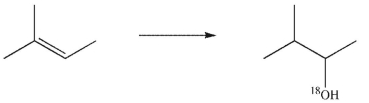
<strong>Shown here is hydroboration/oxidation reaction of an alkene.   One of the reagents is labeled with  18O . Which of the following choices correctly shows this label?</strong> A)    B)   C)   D) Either b or c . E) Any of these is correct .
One of the reagents is labeled with 18O . Which of the following choices correctly shows this label?

A) <strong>Shown here is hydroboration/oxidation reaction of an alkene.   One of the reagents is labeled with  18O . Which of the following choices correctly shows this label?</strong> A)    B)   C)   D) Either b or c . E) Any of these is correct .
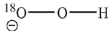
B) <strong>Shown here is hydroboration/oxidation reaction of an alkene.   One of the reagents is labeled with  18O . Which of the following choices correctly shows this label?</strong> A)    B)   C)   D) Either b or c . E) Any of these is correct .
C) <strong>Shown here is hydroboration/oxidation reaction of an alkene.   One of the reagents is labeled with  18O . Which of the following choices correctly shows this label?</strong> A)    B)   C)   D) Either b or c . E) Any of these is correct .
D) Either b or c .
E) Any of these is correct .
Unlock Deck
Unlock for access to all 68 flashcards in this deck.
Unlock Deck
k this deck
24
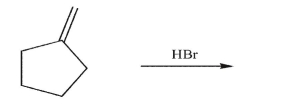
Predict the product of the following reaction conditions. Predict the product of the following reaction conditions.
Unlock Deck
Unlock for access to all 68 flashcards in this deck.
Unlock Deck
k this deck
25
Which of these statements about hydroboration is false?

A)Hydroboration is regiospecific.
B)The overall reaction involves the formation of a C-H bond and a C-B bond.
C)The overall reaction involves the formation of a C-B bond and a B-H bond.
D)Boron attaches to the less substituted end of an alkene.
E)The mechanism of hydroboration is believed to be concerted.
Unlock Deck
Unlock for access to all 68 flashcards in this deck.
Unlock Deck
k this deck
26
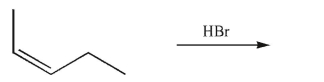
Identify the HOMO and LUMO in the rate-limiting step of the reaction shown here. Identify the HOMO and LUMO in the rate-limiting step of the reaction shown here.
Unlock Deck
Unlock for access to all 68 flashcards in this deck.
Unlock Deck
k this deck
27
Draw a mechanism to account for the formation of the product shown. Draw a mechanism to account for the formation of the product shown.

Unlock Deck
Unlock for access to all 68 flashcards in this deck.
Unlock Deck
k this deck
28
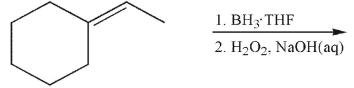
Which of the following structures is the product of the reaction shown here? <strong>Which of the following structures is the product of the reaction shown here?  </strong> A)   B)   C)   D)   E)
A) <strong>Which of the following structures is the product of the reaction shown here?  </strong> A)   B)   C)   D)   E)
B) <strong>Which of the following structures is the product of the reaction shown here?  </strong> A)   B)   C)   D)   E)
C) <strong>Which of the following structures is the product of the reaction shown here?  </strong> A)   B)   C)   D)   E)
D) <strong>Which of the following structures is the product of the reaction shown here?  </strong> A)   B)   C)   D)   E)
E) <strong>Which of the following structures is the product of the reaction shown here?  </strong> A)   B)   C)   D)   E)
Unlock Deck
Unlock for access to all 68 flashcards in this deck.
Unlock Deck
k this deck
29
Draw the π molecular orbitals of allyl cation in order of increasing energy (lowest energy at the bottom of the diagram). Include all π electrons and all nodes.
Unlock Deck
Unlock for access to all 68 flashcards in this deck.
Unlock Deck
k this deck
30
Draw a mechanism illustrating the formation of the product of the reaction shown here. Draw a mechanism illustrating the formation of the product of the reaction shown here.

Unlock Deck
Unlock for access to all 68 flashcards in this deck.
Unlock Deck
k this deck
31
What is the correct structure of <strong>What is the correct structure of   ?</strong> A)  B)   C)   D)   E)   ?

A)<strong>What is the correct structure of   ?</strong> A)  B)   C)   D)   E)
B) <strong>What is the correct structure of   ?</strong> A)  B)   C)   D)   E)
C) <strong>What is the correct structure of   ?</strong> A)  B)   C)   D)   E)
D) <strong>What is the correct structure of   ?</strong> A)  B)   C)   D)   E)
E) <strong>What is the correct structure of   ?</strong> A)  B)   C)   D)   E)
Unlock Deck
Unlock for access to all 68 flashcards in this deck.
Unlock Deck
k this deck
32
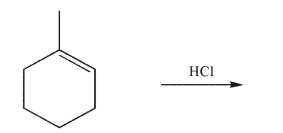
Provide the correct name for the major expected addition product formed in the following
reaction. Provide the correct name for the major expected addition product formed in the following reaction.
Unlock Deck
Unlock for access to all 68 flashcards in this deck.
Unlock Deck
k this deck
33
Which of the following statements about borane is true?

A)Borane is stable in its monomeric form.
B)Borane acts as a Lewis acid.
C)Borane forms a stable complex with ethers.
D)Borane adds a proton to a double bond.
E)Double bonds undergo antiaddition with boranes.
Unlock Deck
Unlock for access to all 68 flashcards in this deck.
Unlock Deck
k this deck
34
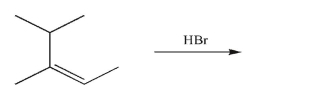
Name the major addition products formed in this reaction and state their relationships to one
another. Name the major addition products formed in this reaction and state their relationships to one another.
Unlock Deck
Unlock for access to all 68 flashcards in this deck.
Unlock Deck
k this deck
35
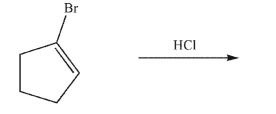
Predict the product of the following reaction. Predict the product of the following reaction.
Unlock Deck
Unlock for access to all 68 flashcards in this deck.
Unlock Deck
k this deck
36
Which of these processes is an anti-Markovnikov addition?

A) Hydration of an alkene using water and catalytic nitric acid.
B) Addition of HCI to an alkene.
C) Addition of Br2 to an alkene.
D) Hydroboration/oxidation of an alkene.
E) Both c and d.
Unlock Deck
Unlock for access to all 68 flashcards in this deck.
Unlock Deck
k this deck
37
Which of the following compounds could not be synthesized from 1,3-dimethylcyclohexene by methods explored in this chapter? <strong>Which of the following compounds could not be synthesized from 1,3-dimethylcyclohexene by methods explored in this chapter?  </strong> A)   B)   C)   D)   E)
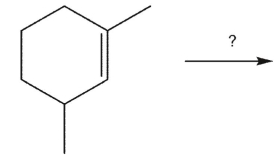
A) <strong>Which of the following compounds could not be synthesized from 1,3-dimethylcyclohexene by methods explored in this chapter?  </strong> A)   B)   C)   D)   E)
B) <strong>Which of the following compounds could not be synthesized from 1,3-dimethylcyclohexene by methods explored in this chapter?  </strong> A)   B)   C)   D)   E)
C) <strong>Which of the following compounds could not be synthesized from 1,3-dimethylcyclohexene by methods explored in this chapter?  </strong> A)   B)   C)   D)   E)
D) <strong>Which of the following compounds could not be synthesized from 1,3-dimethylcyclohexene by methods explored in this chapter?  </strong> A)   B)   C)   D)   E)
E) <strong>Which of the following compounds could not be synthesized from 1,3-dimethylcyclohexene by methods explored in this chapter?  </strong> A)   B)   C)   D)   E)
Unlock Deck
Unlock for access to all 68 flashcards in this deck.
Unlock Deck
k this deck
38
Define the term regioselectivity.
Unlock Deck
Unlock for access to all 68 flashcards in this deck.
Unlock Deck
k this deck
39
Which of the following structures could be the product of hydroboration/oxidation of an alkene?
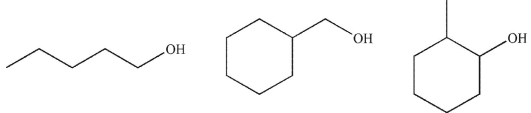
<strong>Which of the following structures could be the product of hydroboration/oxidation of an alkene?  </strong> A) I B) II C) III D) I and II E) I, II and III

A) I
B) II
C) III
D) I and II
E) I, II and III
Unlock Deck
Unlock for access to all 68 flashcards in this deck.
Unlock Deck
k this deck
40
Which of the following structures could be produced on reaction of two molecules of the starting material shown in acidic conditions?
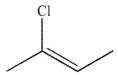
<strong>Which of the following structures could be produced on reaction of two molecules of the starting material shown in acidic conditions?  </strong> A)   B)   C)   D)   E)

A) <strong>Which of the following structures could be produced on reaction of two molecules of the starting material shown in acidic conditions?  </strong> A)   B)   C)   D)   E)
B) <strong>Which of the following structures could be produced on reaction of two molecules of the starting material shown in acidic conditions?  </strong> A)   B)   C)   D)   E)
C) <strong>Which of the following structures could be produced on reaction of two molecules of the starting material shown in acidic conditions?  </strong> A)   B)   C)   D)   E)
D) <strong>Which of the following structures could be produced on reaction of two molecules of the starting material shown in acidic conditions?  </strong> A)   B)   C)   D)   E)
E) <strong>Which of the following structures could be produced on reaction of two molecules of the starting material shown in acidic conditions?  </strong> A)   B)   C)   D)   E)
Unlock Deck
Unlock for access to all 68 flashcards in this deck.
Unlock Deck
k this deck
41
What is the reverse of Markovnikov hydration, and what kind of mechanism is this?
Unlock Deck
Unlock for access to all 68 flashcards in this deck.
Unlock Deck
k this deck
42
Draw the most reasonable resonance structure for the carbocation shown here.Include all lone pairs of
electrons and any nonzero formal charges. Draw the most reasonable resonance structure for the carbocation shown here.Include all lone pairs of electrons and any nonzero formal charges.
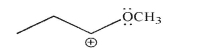
Unlock Deck
Unlock for access to all 68 flashcards in this deck.
Unlock Deck
k this deck
43
Draw all the possible addition products formed in the reaction shown. Draw all the possible addition products formed in the reaction shown.
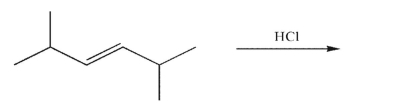
Unlock Deck
Unlock for access to all 68 flashcards in this deck.
Unlock Deck
k this deck
44
From slowest to fastest, rank these alkenes in order of their reactivity with hydrogen bromide.
Draw the expected product(s) from each reaction, indicating major and minor products. From slowest to fastest, rank these alkenes in order of their reactivity with hydrogen bromide. Draw the expected product(s) from each reaction, indicating major and minor products.
Unlock Deck
Unlock for access to all 68 flashcards in this deck.
Unlock Deck
k this deck
45
Using propene as your only carbon source, devise an efficient synthesis of the target molecule.
Show the reagents needed for each step and the product of each step. Using propene as your only carbon source, devise an efficient synthesis of the target molecule. Show the reagents needed for each step and the product of each step.
Unlock Deck
Unlock for access to all 68 flashcards in this deck.
Unlock Deck
k this deck
46
For the following reactions, indicate what product(s) would be formed.Include correct
stereochemistry when the reaction is stereoselective. For the following reactions, indicate what product(s) would be formed.Include correct stereochemistry when the reaction is stereoselective.
Unlock Deck
Unlock for access to all 68 flashcards in this deck.
Unlock Deck
k this deck
47
Treatment of 1-methylcyclohexene with sulfuric acid and heat leads to a mixture of dimeric alkenes. Treatment of 1-methylcyclohexene with sulfuric acid and heat leads to a mixture of dimeric alkenes.   Propose a mechanism for the formation of this mixture and indicate the major and minor products.

Propose a mechanism for the formation of this mixture and indicate the major and minor products.
Unlock Deck
Unlock for access to all 68 flashcards in this deck.
Unlock Deck
k this deck
48
Show the mechanism by which the following reaction occurs. Show the mechanism by which the following reaction occurs.
Unlock Deck
Unlock for access to all 68 flashcards in this deck.
Unlock Deck
k this deck
49
State the basis of Markovnikov's rule.
Unlock Deck
Unlock for access to all 68 flashcards in this deck.
Unlock Deck
k this deck
50
Both of the two isomeric alkenes below react with aqueous sulfuric acid to give
1-phenyl-1-propanol as the major product.Show the mechanism of the reaction in each case. Both of the two isomeric alkenes below react with aqueous sulfuric acid to give 1-phenyl-1-propanol as the major product.Show the mechanism of the reaction in each case.
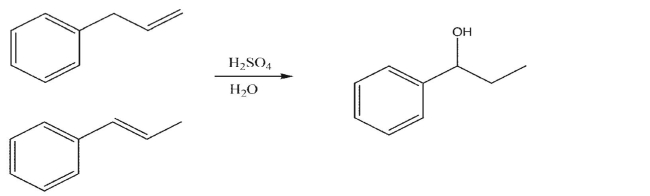
Unlock Deck
Unlock for access to all 68 flashcards in this deck.
Unlock Deck
k this deck
51
Draw a mechanism to account for the formation of the product of the reaction shown here. Draw a mechanism to account for the formation of the product of the reaction shown here.
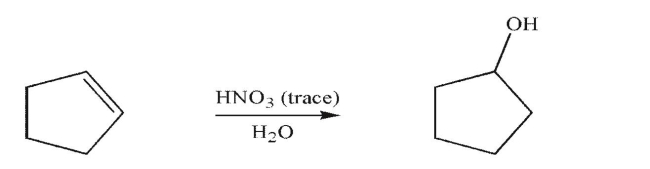
Unlock Deck
Unlock for access to all 68 flashcards in this deck.
Unlock Deck
k this deck
52
Draw and name the product of Markovnikov hydration of the alkene shown here using aqueous
sulfuric acid. Draw and name the product of Markovnikov hydration of the alkene shown here using aqueous sulfuric acid.
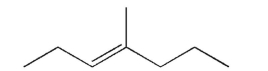
Unlock Deck
Unlock for access to all 68 flashcards in this deck.
Unlock Deck
k this deck
53
Dimerization of 1-methylcyclopentene generates three isomers with molecular formula C12H20.
Draw the three isomers, designate their stereochemistry (E or Z), and indicate the expected
relative amounts (most, middle, least) based on product stability. Dimerization of 1-methylcyclopentene generates three isomers with molecular formula C<sub>12</sub>H<sub>20</sub>. Draw the three isomers, designate their stereochemistry (E or Z), and indicate the expected relative amounts (most, middle, least) based on product stability.
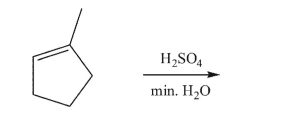
Unlock Deck
Unlock for access to all 68 flashcards in this deck.
Unlock Deck
k this deck
54
What is the structure of the most substituted alkene precursor from which the alcohol shown could
be directly synthesized? What is the structure of the most substituted alkene precursor from which the alcohol shown could be directly synthesized?
Unlock Deck
Unlock for access to all 68 flashcards in this deck.
Unlock Deck
k this deck
55
Propose a mechanism to account for the formation of the observed product. Propose a mechanism to account for the formation of the observed product.
Unlock Deck
Unlock for access to all 68 flashcards in this deck.
Unlock Deck
k this deck
56
Draw the structures of two alkene precusors from which the alcohol shown here could be made in
a single synthetic step. Draw the structures of two alkene precusors from which the alcohol shown here could be made in a single synthetic step.
Unlock Deck
Unlock for access to all 68 flashcards in this deck.
Unlock Deck
k this deck
57
Draw a mechanism for dimerization of the alkene shown here under acidic conditions. Draw a mechanism for dimerization of the alkene shown here under acidic conditions.
Unlock Deck
Unlock for access to all 68 flashcards in this deck.
Unlock Deck
k this deck
58
Provide the correct name for the major expected product of the reaction shown here. Provide the correct name for the major expected product of the reaction shown here.
Unlock Deck
Unlock for access to all 68 flashcards in this deck.
Unlock Deck
k this deck
59
Show the principal product(s) of the following reactions; include stereochemistry as needed. Show the principal product(s) of the following reactions; include stereochemistry as needed.
Unlock Deck
Unlock for access to all 68 flashcards in this deck.
Unlock Deck
k this deck
60
Draw a mechanism to account for the formation of the product shown here. Draw a mechanism to account for the formation of the product shown here.
Unlock Deck
Unlock for access to all 68 flashcards in this deck.
Unlock Deck
k this deck
61
Design a multistep synthesis of the target molecule from the starting material.You may use any
inorganic or organic reagents necessary.Show the reagents necessary for each step and the
product of each step. Design a multistep synthesis of the target molecule from the starting material.You may use any inorganic or organic reagents necessary.Show the reagents necessary for each step and the product of each step.
Unlock Deck
Unlock for access to all 68 flashcards in this deck.
Unlock Deck
k this deck
62
Provide the missing structures and reagents in the following reaction sequence. Provide the missing structures and reagents in the following reaction sequence.
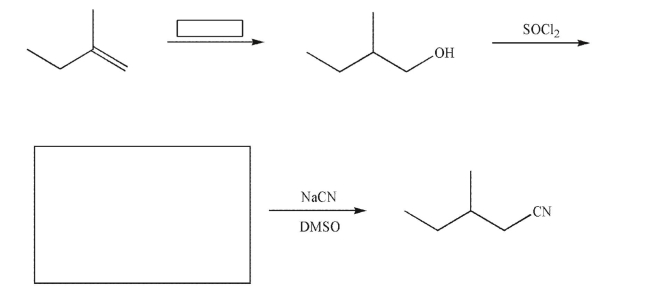
Unlock Deck
Unlock for access to all 68 flashcards in this deck.
Unlock Deck
k this deck
63
Draw a mechanism for the transformation shown.Include all curved arrows, necessary lone pairs,
and nonzero formal charges. Draw a mechanism for the transformation shown.Include all curved arrows, necessary lone pairs, and nonzero formal charges.
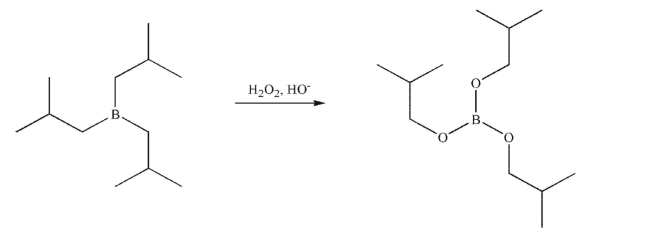
Unlock Deck
Unlock for access to all 68 flashcards in this deck.
Unlock Deck
k this deck
64
Devise a multistep synthesis of the target molecule from the given starting material.Show the
reagents needed for each step and the product of each step. Devise a multistep synthesis of the target molecule from the given starting material.Show the reagents needed for each step and the product of each step.

Unlock Deck
Unlock for access to all 68 flashcards in this deck.
Unlock Deck
k this deck
65
Devise a multistep synthesis of the target molecule from the given starting material.Show the
reagents needed for each step and the product of each step. Devise a multistep synthesis of the target molecule from the given starting material.Show the reagents needed for each step and the product of each step.
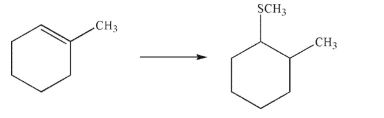
Unlock Deck
Unlock for access to all 68 flashcards in this deck.
Unlock Deck
k this deck
66
Devise a multistep synthesis of the target molecule from the given starting material.Show the
reagents needed for each step and the product of each step. Devise a multistep synthesis of the target molecule from the given starting material.Show the reagents needed for each step and the product of each step.
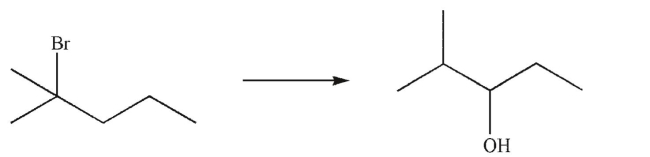
Unlock Deck
Unlock for access to all 68 flashcards in this deck.
Unlock Deck
k this deck
67
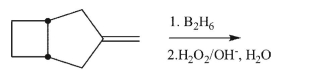
Show the products of the following reactions with correct stereochemistry. Show the products of the following reactions with correct stereochemistry.
Unlock Deck
Unlock for access to all 68 flashcards in this deck.
Unlock Deck
k this deck
68
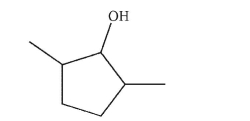
Draw the structure of the precursor alkene to this alcohol and indicate the reagents you would use
to convert the precursor to the alcohol. Draw the structure of the precursor alkene to this alcohol and indicate the reagents you would use to convert the precursor to the alcohol.
Unlock Deck
Unlock for access to all 68 flashcards in this deck.
Unlock Deck
k this deck
locked card icon
Unlock Deck
Unlock for access to all 68 flashcards in this deck.