





 Chat with AI

Deck 26: Art of Africa and the Pacific Islands
Full screen (f)

Question

Question
Question
Question
Question
Question
Question
Question
Question
Question
Question
Question
Question
Question
Question
Question
Question
Question
Question
Question
Question
Question
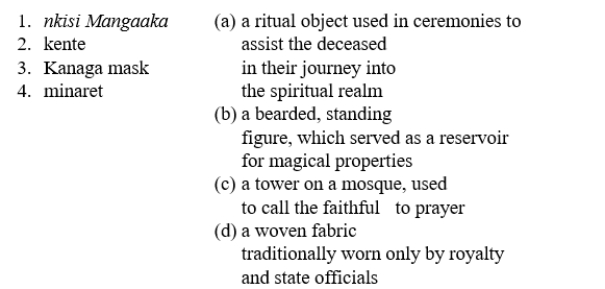
Match the term with its definition:
Question
Question
Question
Question
Question
Question
Question
Question
Question
Question
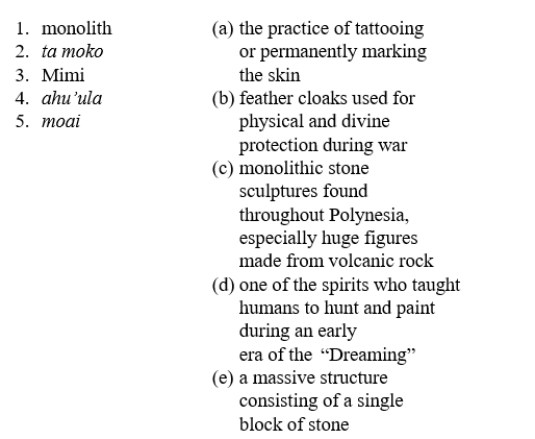
Match the term with its definition:

Unlock Deck
Sign up to unlock the cards in this deck!
Unlock Deck
Unlock Deck
1/32

Play

Full screen (f)
Deck 26: Art of Africa and the Pacific Islands
1
The Great Mosque at Djenné in Mali is:
A) not a mosque at all
B) the largest mud-brick building in the world
C) no longer standing
D) designed to look like a porcupine
E) underground
A) not a mosque at all
B) the largest mud-brick building in the world
C) no longer standing
D) designed to look like a porcupine
E) underground
B
2
Twin figures were traditionally made by the Yoruba of western Nigeria:
A) because there is a high infant mortality rate for twins amongst the Yoruba
B) so that if one twin died, the sculpture could be cared for along with the surviving infant
C) because the dolls would help Yoruba children, especially girls, learn to care for babies
D) all of the previous answers
E) none of the previous answers
A) because there is a high infant mortality rate for twins amongst the Yoruba
B) so that if one twin died, the sculpture could be cared for along with the surviving infant
C) because the dolls would help Yoruba children, especially girls, learn to care for babies
D) all of the previous answers
E) none of the previous answers
D
3
Consider the Nok head (3.102), Yoruba twin figure (3.103), and Yombe nkisi Mangaaka (3.104). All three of these sculptures are figurative representations of the human form, but also contain some geometric stylizations. Discuss the stylized aspects of each of these figures. Why has the artist chosen to depict these aspects in this way? Are there any areas of pattern, or abstraction, on the sculptures?
Personal Stories and Symbolism
4
Terracotta heads with prominent holes in the pupils, nostrils, mouth, and ears were made by the ________ culture of ________.
A) Nok . . . Nigeria
B) Yoruba . . . Nigeria
C) Fon . . . Benin
D) Akan . . . Ghana
E) Maori . . . New Zealand
A) Nok . . . Nigeria
B) Yoruba . . . Nigeria
C) Fon . . . Benin
D) Akan . . . Ghana
E) Maori . . . New Zealand
Unlock Deck
Unlock for access to all 32 flashcards in this deck.
Unlock Deck
k this deck
5
Cowrie shells in artworks by both African and Pacific Island peoples often represent:
A) shelter
B) rain
C) fertility
D) food
E) none of the other answers
A) shelter
B) rain
C) fertility
D) food
E) none of the other answers
Unlock Deck
Unlock for access to all 32 flashcards in this deck.
Unlock Deck
k this deck
6
The medium of the Yoruba twin figure (3.103) is ________.
A) stone
B) bronze
C) terracotta
D) wood
E) all of the other answers
A) stone
B) bronze
C) terracotta
D) wood
E) all of the other answers
Unlock Deck
Unlock for access to all 32 flashcards in this deck.
Unlock Deck
k this deck
7
The artistic traditions of Africa and the Pacific Islands share:
A) a tendency to integrate and respond to the environment
B) a prominence given to mythological beliefs, ancestor worship, and lineage
C) a reliance on traditional methods of construction and decoration
D) all of the previous answers
E) none of the previous answers
A) a tendency to integrate and respond to the environment
B) a prominence given to mythological beliefs, ancestor worship, and lineage
C) a reliance on traditional methods of construction and decoration
D) all of the previous answers
E) none of the previous answers
Unlock Deck
Unlock for access to all 32 flashcards in this deck.
Unlock Deck
k this deck
8
"Mimis" in Australian rock art represent:
A) kangaroos
B) houses
C) grandmothers
D) spirits
E) bus drivers
A) kangaroos
B) houses
C) grandmothers
D) spirits
E) bus drivers
Unlock Deck
Unlock for access to all 32 flashcards in this deck.
Unlock Deck
k this deck
9
Because art from Africa and the Pacific Islands follows traditional methods, it:
A) tends to look the same over long periods of time
B) changes frequently with each new generation of artists
C) never develops a distinctive stylistic appearance
D) is always made from wood
E) none of the other answers
A) tends to look the same over long periods of time
B) changes frequently with each new generation of artists
C) never develops a distinctive stylistic appearance
D) is always made from wood
E) none of the other answers
Unlock Deck
Unlock for access to all 32 flashcards in this deck.
Unlock Deck
k this deck
10
The objects made by the Pacific Island cultures often have both ________.
A) practical usefulness and sacred significance
B) medical and political power
C) landscapes and sea monsters depicted on them
D) purple and gold on them
E) all of the other answers
A) practical usefulness and sacred significance
B) medical and political power
C) landscapes and sea monsters depicted on them
D) purple and gold on them
E) all of the other answers
Unlock Deck
Unlock for access to all 32 flashcards in this deck.
Unlock Deck
k this deck
11
Sacred Yombe objects are called minkisi nkisi. The singular nkisi means ________.
A) little man
B) sacred medicine
C) hungry beast
D) magic tree
E) divine person
A) little man
B) sacred medicine
C) hungry beast
D) magic tree
E) divine person
Unlock Deck
Unlock for access to all 32 flashcards in this deck.
Unlock Deck
k this deck
12
According to the Shona, sculptures at the Great Zimbabwe represent birds (3.109), which they consider to be:
A) the most desired meal
B) the indicators of the truth
C) the messengers of the spirits
D) the key to a good night's sleep
E) the best pets to own
A) the most desired meal
B) the indicators of the truth
C) the messengers of the spirits
D) the key to a good night's sleep
E) the best pets to own
Unlock Deck
Unlock for access to all 32 flashcards in this deck.
Unlock Deck
k this deck
13
Kente cloth is now worn by non-royal members of the Asante and Akan groups as well as people living entirely outside of Ghana.
Unlock Deck
Unlock for access to all 32 flashcards in this deck.
Unlock Deck
k this deck
14
The parts of the Great Zimbabwe in southern Africa that remain are made of:
A) mud-brick
B) wood
C) stone
D) gold
E) reinforced concrete
A) mud-brick
B) wood
C) stone
D) gold
E) reinforced concrete
Unlock Deck
Unlock for access to all 32 flashcards in this deck.
Unlock Deck
k this deck
15
The cross bars on the Kanaga mask made by the Dogon people of Mali (3.106) represent ________.
A) railroad tracks crossing West Africa
B) the upper realm of the sky and the realm of the earth below
C) the branches of two trees that have grown together
D) the alter ego of the performer
E) all of the other answers
A) railroad tracks crossing West Africa
B) the upper realm of the sky and the realm of the earth below
C) the branches of two trees that have grown together
D) the alter ego of the performer
E) all of the other answers
Unlock Deck
Unlock for access to all 32 flashcards in this deck.
Unlock Deck
k this deck
16
African masks are most meaningful to the groups that made them:
A) when they are being stored between performances
B) when they are displayed on museum walls
C) when they are being used in ceremonial performances or masquerades
D) before they are ever made
E) none of the other answers
A) when they are being stored between performances
B) when they are displayed on museum walls
C) when they are being used in ceremonial performances or masquerades
D) before they are ever made
E) none of the other answers
Unlock Deck
Unlock for access to all 32 flashcards in this deck.
Unlock Deck
k this deck
17
There are ________ placed on the spires of the Great Mosque at Djenné in Mali.
A) torches
B) ostrich eggs
C) water glasses
D) wind socks
E) none of the other answers
A) torches
B) ostrich eggs
C) water glasses
D) wind socks
E) none of the other answers
Unlock Deck
Unlock for access to all 32 flashcards in this deck.
Unlock Deck
k this deck
18
Over time, the Nok sculptures of human figures have:
A) remained exactly as they looked when they were first made
B) had parts broken off many of them
C) all been smashed to bits and cannot be put back together
D) ceased to exist
E) none of the other answers
A) remained exactly as they looked when they were first made
B) had parts broken off many of them
C) all been smashed to bits and cannot be put back together
D) ceased to exist
E) none of the other answers
Unlock Deck
Unlock for access to all 32 flashcards in this deck.
Unlock Deck
k this deck
19
A ________ would activate a nkisi Mangaaka by ________.
A) king . . .setting it on fire
B) ritual specialist . . . driving metal objects into it
C) dog . . . peeing on it
D) child . . . breaking it
E) none of the other answers
A) king . . .setting it on fire
B) ritual specialist . . . driving metal objects into it
C) dog . . . peeing on it
D) child . . . breaking it
E) none of the other answers
Unlock Deck
Unlock for access to all 32 flashcards in this deck.
Unlock Deck
k this deck
20
Abstract designs and patterns can convey information that is as important, recognizable, and specific as both representational and narrative imagery.
Unlock Deck
Unlock for access to all 32 flashcards in this deck.
Unlock Deck
k this deck
21
For the Abelam of Papua New Guinea, the person who grows the largest yams:
A) gets to eat whatever he or she wants for an entire year
B) achieves higher social status and secures prosperity for the village
C) wins a vacation to the destination of his or her choice
D) is required to dance in the town center on festival night
E) none of the other answers
A) gets to eat whatever he or she wants for an entire year
B) achieves higher social status and secures prosperity for the village
C) wins a vacation to the destination of his or her choice
D) is required to dance in the town center on festival night
E) none of the other answers
Unlock Deck
Unlock for access to all 32 flashcards in this deck.
Unlock Deck
k this deck
22
Match the term with its definition:
Unlock Deck
Unlock for access to all 32 flashcards in this deck.
Unlock Deck
k this deck
23
The moai of Easter Island represent:
A) animals at the top of the food chain
B) abstract designs based on the sea
C) deified ancestors who were chiefs
D) hieroglyphic texts with important historical information
E) none of the other answers
A) animals at the top of the food chain
B) abstract designs based on the sea
C) deified ancestors who were chiefs
D) hieroglyphic texts with important historical information
E) none of the other answers
Unlock Deck
Unlock for access to all 32 flashcards in this deck.
Unlock Deck
k this deck
24
Hawaiian feather cloaks could be:
A) passed from generation to generation
B) collected by enemies as war trophies
C) presented as political gifts
D) all of the previous answers
E) none of the previous answers
A) passed from generation to generation
B) collected by enemies as war trophies
C) presented as political gifts
D) all of the previous answers
E) none of the previous answers
Unlock Deck
Unlock for access to all 32 flashcards in this deck.
Unlock Deck
k this deck
25
The most prized feather cloaks made by Hawaiians are ________ in color.
A) red
B) yellow
C) blue
D) indigo
E) white
A) red
B) yellow
C) blue
D) indigo
E) white
Unlock Deck
Unlock for access to all 32 flashcards in this deck.
Unlock Deck
k this deck
26
Choose two or three artworks from this chapter that represent ancestors or relate to families and lineage. In each case, describe how the artwork represents a particular ancestor, or group of ancestors, and why this might be important to the artist or community who made it. Why might depicting ancestors in art be especially important to cultures who have no formal, written language?
Unlock Deck
Unlock for access to all 32 flashcards in this deck.
Unlock Deck
k this deck
27
The Easter Island moai figures are identical, with no unique individual features.
Unlock Deck
Unlock for access to all 32 flashcards in this deck.
Unlock Deck
k this deck
28
The Abelam of Papua New Guinea hold festivals in which:
A) mummies are carried into the streets
B) water is collected for several months at a time
C) yams wear masks
D) dangerous spirits are called to dinner
E) none of the other answers
A) mummies are carried into the streets
B) water is collected for several months at a time
C) yams wear masks
D) dangerous spirits are called to dinner
E) none of the other answers
Unlock Deck
Unlock for access to all 32 flashcards in this deck.
Unlock Deck
k this deck
29
Figures in Australian rock art are only ever depicted in outline.
Unlock Deck
Unlock for access to all 32 flashcards in this deck.
Unlock Deck
k this deck
30
The cult houses of the Abelam of Papua New Guinea are used as part of the initiation cycle for male members of the community. These ceremonies take place over the course of ________.
A) twenty to thirty years
B) one calendar year
C) one day from sunrise to sunset
D) the same hour as the one when the initiate was born
E) none of the other answers
A) twenty to thirty years
B) one calendar year
C) one day from sunrise to sunset
D) the same hour as the one when the initiate was born
E) none of the other answers
Unlock Deck
Unlock for access to all 32 flashcards in this deck.
Unlock Deck
k this deck
31
The cult houses of the Abelam of Papua New Guinea are designed to:
A) self-destruct at sunset
B) impress initiates with the power and complexity of their culture's deities and traditions
C) be so confusing that they weed out unprepared initiates
D) look like they are under water
E) mimic the spring located at the place where humans were believed to originate
A) self-destruct at sunset
B) impress initiates with the power and complexity of their culture's deities and traditions
C) be so confusing that they weed out unprepared initiates
D) look like they are under water
E) mimic the spring located at the place where humans were believed to originate
Unlock Deck
Unlock for access to all 32 flashcards in this deck.
Unlock Deck
k this deck
32
Match the term with its definition:
Unlock Deck
Unlock for access to all 32 flashcards in this deck.
Unlock Deck
k this deck
Unlock Deck
Unlock for access to all 32 flashcards in this deck.







