





 Chat with AI

Deck 18: Business Acquisitions and Divestitures-Assets Versus Shares
Full screen (f)

Question

Question
Question
Question
Question
Question

Unlock Deck
Sign up to unlock the cards in this deck!
Unlock Deck
Unlock Deck
1/6

Play

Full screen (f)
Deck 18: Business Acquisitions and Divestitures-Assets Versus Shares
1
The Flower Company is for sale. The anticipated average profits for the next five years of the business have been calculated at $150,000. The business has been valued at $750,000 using the earnings method. The net tangible assets have been appraised at
$625,000. Which of the following is TRUE for the Flower Company?
A) The company is expected to yield a 24% return for the purchaser, and goodwill of $125,000 is present.
B) The company is expected to yield a 24% return for the purchaser, and goodwill of $475,000 is present.
C) The company is expected to yield a 20% return for the purchaser, and the cost of the business is too low.
D) The company is expected to yield a 20% return for the purchaser, and goodwill of $125,000 is present.
$625,000. Which of the following is TRUE for the Flower Company?
A) The company is expected to yield a 24% return for the purchaser, and goodwill of $125,000 is present.
B) The company is expected to yield a 24% return for the purchaser, and goodwill of $475,000 is present.
C) The company is expected to yield a 20% return for the purchaser, and the cost of the business is too low.
D) The company is expected to yield a 20% return for the purchaser, and goodwill of $125,000 is present.
D
2
When deciding whether to purchase the shares or assets in business acquisitions, which of the following are the three major tax considerations that the purchaser will consider?
A) Future interest rates, impact on cash flow, potential tax liability after share acquisition if new assets are purchased
B) Future tax rates, impact on cash flow, potential tax liability after share acquisition if assets are sold
C) Future interest rates, impact on cash flow, potential tax liability after share acquisition if assets are sold
D) Future tax rates, impact on cash flow, potential tax liability after share acquisition if new assets are purchased
A) Future interest rates, impact on cash flow, potential tax liability after share acquisition if new assets are purchased
B) Future tax rates, impact on cash flow, potential tax liability after share acquisition if assets are sold
C) Future interest rates, impact on cash flow, potential tax liability after share acquisition if assets are sold
D) Future tax rates, impact on cash flow, potential tax liability after share acquisition if new assets are purchased
B
3
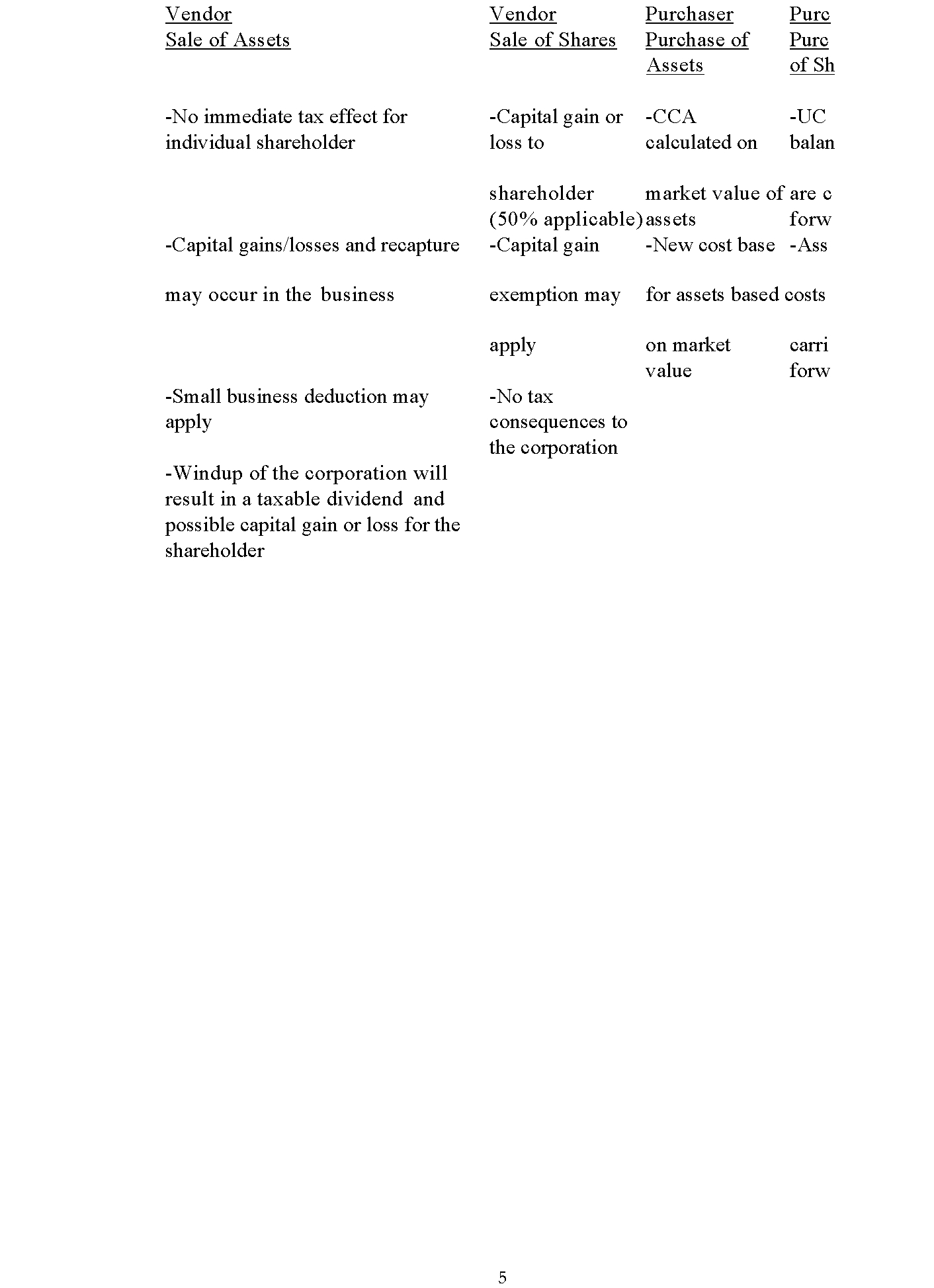
Identify the main tax effects for 1) the vendor and 2) the purchaser when a
business divestiture and acquisition involves a) the sale of assets, and b) the sale of shares.
business divestiture and acquisition involves a) the sale of assets, and b) the sale of shares.
4
A purchaser has agreed to purchase all of the shares of Tee Co., a CCPC. Tee Co. owns fifteen significant capital assets, some of which have appreciated in value. Which of the following is TRUE?
A) The capital cost allowance on the assets will be higher for the purchaser than it was for the vendor.
B) The purchaser will obtain a cost base of the assets equal to fair market value.
C) The purchaser will be responsible for the liabilities of Tee Co.
D) The sale will result in business income for the vendor.
A) The capital cost allowance on the assets will be higher for the purchaser than it was for the vendor.
B) The purchaser will obtain a cost base of the assets equal to fair market value.
C) The purchaser will be responsible for the liabilities of Tee Co.
D) The sale will result in business income for the vendor.
Unlock Deck
Unlock for access to all 6 flashcards in this deck.
Unlock Deck
k this deck
5
Sam Sherwood wishes to purchase Kitchen Cabinets, Inc. (KCI), from its sole shareholder, Steve Oaks. Which of the following is TRUE if Sam purchases the assets rather than the shares of the corporation?
A) Sam will have no choice but to assume the liabilities of KCI.
B) Sam will have to acquire all of the assets of KCI.
C) Kitchen Cabinets Inc. may be subject to business income and capital gains.
D) Payment of the purchase price will flow directly to Steve Oaks.
A) Sam will have no choice but to assume the liabilities of KCI.
B) Sam will have to acquire all of the assets of KCI.
C) Kitchen Cabinets Inc. may be subject to business income and capital gains.
D) Payment of the purchase price will flow directly to Steve Oaks.
Unlock Deck
Unlock for access to all 6 flashcards in this deck.
Unlock Deck
k this deck
6
Stick Co. owns land with a fair market value of $100,000, a building with a fair market value of $75,000, and equipment with a fair market value of $25,000. These assets are used for active business conducted in Canada. Which of the following would disqualify Stick Co. from being a small business corporation?
A) Stick Co. also owns shares in Leaf Co., (a public corporation), which have a fair market value of $5,000.
B) Stick Co. also owns 40% of the shares of Rock Co. (a small business corporation), which have a fair market value of $20,000.
C) Stick Co. also has long-term investments valued at $30,000.
D) Stick Co. sold the equipment and used the funds to purchase 35% of the shares of Tree Co., a small business corporation.
A) Stick Co. also owns shares in Leaf Co., (a public corporation), which have a fair market value of $5,000.
B) Stick Co. also owns 40% of the shares of Rock Co. (a small business corporation), which have a fair market value of $20,000.
C) Stick Co. also has long-term investments valued at $30,000.
D) Stick Co. sold the equipment and used the funds to purchase 35% of the shares of Tree Co., a small business corporation.
Unlock Deck
Unlock for access to all 6 flashcards in this deck.
Unlock Deck
k this deck
Unlock Deck
Unlock for access to all 6 flashcards in this deck.







