





 Chat with AI

Deck 18: Nuclear Reactions
Full screen (f)

Question

Question
Question
Question
Question
Question
Which of the following types of radiation will pass through a piece of paper,but will be stopped by 0.5 cm of lead?
A) α
B) β
C)
D) γ
E) All of the above will pass through 0.5 cm of lead.
A) α
B) β
C)
D) γ
E) All of the above will pass through 0.5 cm of lead.
Question
Question
Question
Question
Question
Question
Question
Question
Question
Question
Question
Question
Question
Question
Question
Question
Question
Question
The energy change for a nuclear reaction can be calculated from which of the following equations?
A)
B) ΔE = hv
C) ΔE = cΔm2
D) ΔE = c2Δm
E)
A)
B) ΔE = hv
C) ΔE = cΔm2
D) ΔE = c2Δm
E)
Question
An extremely sensitive method has recently been developed for measuring  concentrations in organic materials.What is this method?
A) acid titration
B) nuclear magnetic resonance
C) gas chromatography
D) atomic absorption spectrometry
E) mass spectrometry
concentrations in organic materials.What is this method?A) acid titration
B) nuclear magnetic resonance
C) gas chromatography
D) atomic absorption spectrometry
E) mass spectrometry
Question
The half-life of  is 9.5 × 10¹² s.How many atoms of
  are present in a sample with an activity of 3.9 × 10⁹ atoms/s?
A) 1.9 × 10⁻²³ atoms
B) 4.1 × 10⁻⁴ atoms
C) 2.4 × 10³ atoms
D) 9.1 × 10¹⁶ atoms
E) 5.3 × 10²² atoms
is 9.5 × 10¹² s.How many atoms of are present in a sample with an activity of 3.9 × 10⁹ atoms/s?A) 1.9 × 10⁻²³ atoms
B) 4.1 × 10⁻⁴ atoms
C) 2.4 × 10³ atoms
D) 9.1 × 10¹⁶ atoms
E) 5.3 × 10²² atoms
Question
A 1.00 g sample of carbon taken from a living plant has an activity of 13.6 atoms/min.If 1.00 g of an organic sample is found to have an activity of 6.27 atoms/min,what is the age of the sample? The decay constant of  is 1.21 × 10⁻⁴ yr−1.
A) 2.64 × 10³ yr
B) 5.28 × 10³ yr
C) 6.40 × 10³ yr
D) 8.18 × 10³ yr
E) 1.07 × 10⁴ yr
is 1.21 × 10⁻⁴ yr−1.A) 2.64 × 10³ yr
B) 5.28 × 10³ yr
C) 6.40 × 10³ yr
D) 8.18 × 10³ yr
E) 1.07 × 10⁴ yr
Question
Question
Question
Question
Carbon dating can be applied to organic materials up to 5.0 × 10⁴ years old.What percentage of the original  is present in a sample after this much time? The half-life of
  is 5730 yr.
A) 0.0011%
B) 0.24%
C) 0.89%
D) 6.0%
E) 8.7%
is present in a sample after this much time? The half-life of is 5730 yr.A) 0.0011%
B) 0.24%
C) 0.89%
D) 6.0%
E) 8.7%
Question
Question
How long does it take for 105 mg of tritium,  ,to decay to 35.0 mg? The half-life of tritium is 12.3 yr.
A) 12.3 yr
B) 14.2 yr
C) 19.5 yr
D) 24.6 yr
E) 36.9 yr
,to decay to 35.0 mg? The half-life of tritium is 12.3 yr.A) 12.3 yr
B) 14.2 yr
C) 19.5 yr
D) 24.6 yr
E) 36.9 yr
Question
Question
Question
What is the relationship between the rate constant and the half-life for nuclear decay?
A) rate = kt1/2
B)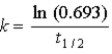
C) k = ln (0.693t1/2)
D)
E) k = 0.693t1/2
A) rate = kt1/2
B)
C) k = ln (0.693t1/2)
D)
E) k = 0.693t1/2
Question
The decay constant,k,for  is 1.37 × 10⁻¹¹ s−1.What mass of
  has an activity of 1.06 × 10⁹ atoms/s?
A) 6.60 × 10⁻⁶ g
B) 1.49 × 10⁻³ g
C) 2.90 × 10⁻² g
D) 3.44 × 101 g
E) 8.97 × 10² g
is 1.37 × 10⁻¹¹ s−1.What mass of has an activity of 1.06 × 10⁹ atoms/s?A) 6.60 × 10⁻⁶ g
B) 1.49 × 10⁻³ g
C) 2.90 × 10⁻² g
D) 3.44 × 101 g
E) 8.97 × 10² g
Question
Question
A 1.00 g sample of  decays to 0.87 g in 1.9 hr.What is the half-life of
  ?
?
A) 0.073 hr
B) 0.11 hr
C) 4.5 hr
D) 9.5 hr
E) 14 hr
decays to 0.87 g in 1.9 hr.What is the half-life of ?A) 0.073 hr
B) 0.11 hr
C) 4.5 hr
D) 9.5 hr
E) 14 hr
Question
All of the following statements concerning radiocarbon dating are true EXCEPT
A) radiocarbon dating is used to determine the age of meteorites.
B) the decay of is used for radiocarbon dating.
C) radioactive carbon is produced by the reaction of cosmic radiation and nitrogen-14.
D) radioactive carbon decays into a nitrogen-14 atom and a beta particle.
E) radiocarbon dating is limited to objects less than 50,000 years old.
A) radiocarbon dating is used to determine the age of meteorites.
B) the decay of
is used for radiocarbon dating.C) radioactive carbon is produced by the reaction of cosmic radiation and nitrogen-14.
D) radioactive carbon decays into a nitrogen-14 atom and a beta particle.
E) radiocarbon dating is limited to objects less than 50,000 years old.
Question
Question
Question
Question
Question
Question
Question
Question
Question
Question
Question

Unlock Deck
Sign up to unlock the cards in this deck!
Unlock Deck
Unlock Deck
1/51

Play

Full screen (f)
Deck 18: Nuclear Reactions
1
Complete the following nuclear fission reaction.
A)
B)
C)
D)
E)
A)
B)
C)
D)
E)
2
If a nucleus emits a beta particle,its atomic number
A) decreases by 2.
B) decreases by 1.
C) remains the same.
D) increases by 1.
E) increases by 2.
A) decreases by 2.
B) decreases by 1.
C) remains the same.
D) increases by 1.
E) increases by 2.
increases by 1.
3
Complete the following fusion reaction. ------
A)
B)
C)
D)
E)
A)
B)
C)
D)
E)
4
Which of the following reactions is an example of beta particle emission?
A)
B)
C)
D)
E)
A)
B)
C)
D)
E)
Unlock Deck
Unlock for access to all 51 flashcards in this deck.
Unlock Deck
k this deck
5
Write the balanced nuclear equation for the formation of from beta emission.
A)
B)
C)
D)
E)
A)
B)
C)
D)
E)
Unlock Deck
Unlock for access to all 51 flashcards in this deck.
Unlock Deck
k this deck
6
Which of the following types of radiation will pass through a piece of paper,but will be stopped by 0.5 cm of lead?
A) α
B) β
C)
D) γ
E) All of the above will pass through 0.5 cm of lead.
A) α
B) β
C)
D) γ
E) All of the above will pass through 0.5 cm of lead.
Unlock Deck
Unlock for access to all 51 flashcards in this deck.
Unlock Deck
k this deck
7
Complete the following nuclear fission reaction. ------
A)
B)
C)
D)
E)
A)
B)
C)
D)
E)
Unlock Deck
Unlock for access to all 51 flashcards in this deck.
Unlock Deck
k this deck
8
If a nucleus decays by successive α,β,β particle emissions,its atomic number will
A) decrease by four.
B) decrease by two.
C) increase by four.
D) increase by two.
E) be unchanged.
A) decrease by four.
B) decrease by two.
C) increase by four.
D) increase by two.
E) be unchanged.
Unlock Deck
Unlock for access to all 51 flashcards in this deck.
Unlock Deck
k this deck
9
Write a balanced nuclear equation for the positron emission reaction undergone by .
A)
B)
C)
D)
E)
A)
B)
C)
D)
E)
Unlock Deck
Unlock for access to all 51 flashcards in this deck.
Unlock Deck
k this deck
10
Complete the following nuclear reaction.
A)
B)
C)
D)
E)
A)
B)
C)
D)
E)
Unlock Deck
Unlock for access to all 51 flashcards in this deck.
Unlock Deck
k this deck
11
A plot of the number of neutrons versus the number of protons in nuclei shows a narrow band of stable isotopes.By what method(s)can isotopes with a low proton-neutron ratio (i.e. ,ones that fall below the band of stability)decay to form elements that are more stable?
A) positron emission or electron capture.
B) positron emission or neutron capture.
C) beta emission or electron capture.
D) gamma ray emission or beta emission.
E) neutron capture or alpha emission.
A) positron emission or electron capture.
B) positron emission or neutron capture.
C) beta emission or electron capture.
D) gamma ray emission or beta emission.
E) neutron capture or alpha emission.
Unlock Deck
Unlock for access to all 51 flashcards in this deck.
Unlock Deck
k this deck
12
All of the following statements are true EXCEPT
A) gamma emission can accompany nuclear decay,such as beta emission.
B) gamma rays can be used to extend the shelf life of food products.
C) gamma rays have the same properties as electrons.
D) gamma emission consists of high energy photons.
E) gamma rays move at the speed of light.
A) gamma emission can accompany nuclear decay,such as beta emission.
B) gamma rays can be used to extend the shelf life of food products.
C) gamma rays have the same properties as electrons.
D) gamma emission consists of high energy photons.
E) gamma rays move at the speed of light.
Unlock Deck
Unlock for access to all 51 flashcards in this deck.
Unlock Deck
k this deck
13
If a nucleus captures an electron,its atomic number
A) decreases by 2.
B) decreases by 1.
C) remains the same.
D) increases by 1.
E) increases by 2.
A) decreases by 2.
B) decreases by 1.
C) remains the same.
D) increases by 1.
E) increases by 2.
Unlock Deck
Unlock for access to all 51 flashcards in this deck.
Unlock Deck
k this deck
14
What element is produced by the alpha decay of ?
A)
B)
C)
D)
E)
A)
B)
C)
D)
E)
Unlock Deck
Unlock for access to all 51 flashcards in this deck.
Unlock Deck
k this deck
15
If a nucleus emits an alpha particle,its mass number
A) decreases by 4.
B) decreases by 2.
C) remains the same.
D) increases by 1.
E) decreases by 2..
A) decreases by 4.
B) decreases by 2.
C) remains the same.
D) increases by 1.
E) decreases by 2..
Unlock Deck
Unlock for access to all 51 flashcards in this deck.
Unlock Deck
k this deck
16
Complete the following nuclear decay reaction.
A)
B)
C)
D)
E)
A)
B)
C)
D)
E)
Unlock Deck
Unlock for access to all 51 flashcards in this deck.
Unlock Deck
k this deck
17
What nucleus decays by successive ?,?,? emissions to produce uranium-236?
A)
B)
C)
D)
E)
A)
B)
C)
D)
E)
Unlock Deck
Unlock for access to all 51 flashcards in this deck.
Unlock Deck
k this deck
18
Which of the following reactions is an example of positron emission?
A)
B)
C)
D)
E)
A)
B)
C)
D)
E)
Unlock Deck
Unlock for access to all 51 flashcards in this deck.
Unlock Deck
k this deck
19
What nucleus decays by beta emission to produce antimony-121?
A)
B)
C)
D)
E)
A)
B)
C)
D)
E)
Unlock Deck
Unlock for access to all 51 flashcards in this deck.
Unlock Deck
k this deck
20
Which of the following reactions is an example of K-electron capture?
A)
B)
C)
D)
E)
A)
B)
C)
D)
E)
Unlock Deck
Unlock for access to all 51 flashcards in this deck.
Unlock Deck
k this deck
21
The half-life of americium-241 is 457 years.What is the activity in curies of a 0.010 g sample of Am-241? (1 Ci = 3.700 × 10¹⁰ atom/s)
A) 0.032 Ci
B) 1.0 Ci
C) 1.0 × 10⁶ Ci
D) 1.0 × 10⁹ Ci
E) 3.79 × 10¹⁶ Ci
A) 0.032 Ci
B) 1.0 Ci
C) 1.0 × 10⁶ Ci
D) 1.0 × 10⁹ Ci
E) 3.79 × 10¹⁶ Ci
Unlock Deck
Unlock for access to all 51 flashcards in this deck.
Unlock Deck
k this deck
22
All of the following statements are true EXCEPT
A) a nucleus weighs less than the protons and neutrons from which it is composed.
B) the difference in mass between a nucleus and its individual protons and neutrons is called the mass defect.
C) the process in which a nucleus decomposes to form two or more lighter nuclei is called nuclear fission.
D) nuclear fission evolves more energy than ordinary chemical reactions,such as the combustion of gasoline.
E) nuclear fission evolves more energy than nuclear fusion.
A) a nucleus weighs less than the protons and neutrons from which it is composed.
B) the difference in mass between a nucleus and its individual protons and neutrons is called the mass defect.
C) the process in which a nucleus decomposes to form two or more lighter nuclei is called nuclear fission.
D) nuclear fission evolves more energy than ordinary chemical reactions,such as the combustion of gasoline.
E) nuclear fission evolves more energy than nuclear fusion.
Unlock Deck
Unlock for access to all 51 flashcards in this deck.
Unlock Deck
k this deck
23
The following reaction is an example of ____.
A) fusion
B) fission
C) gamma radiation emission
D) beta emission
E) neutron bombardment
A) fusion
B) fission
C) gamma radiation emission
D) beta emission
E) neutron bombardment
Unlock Deck
Unlock for access to all 51 flashcards in this deck.
Unlock Deck
k this deck
24
The energy change for a nuclear reaction can be calculated from which of the following equations?
A)
B) ΔE = hv
C) ΔE = cΔm2
D) ΔE = c2Δm
E)
A)
B) ΔE = hv
C) ΔE = cΔm2
D) ΔE = c2Δm
E)
Unlock Deck
Unlock for access to all 51 flashcards in this deck.
Unlock Deck
k this deck
25
An extremely sensitive method has recently been developed for measuring concentrations in organic materials.What is this method?
A) acid titration
B) nuclear magnetic resonance
C) gas chromatography
D) atomic absorption spectrometry
E) mass spectrometry
concentrations in organic materials.What is this method?A) acid titration
B) nuclear magnetic resonance
C) gas chromatography
D) atomic absorption spectrometry
E) mass spectrometry
Unlock Deck
Unlock for access to all 51 flashcards in this deck.
Unlock Deck
k this deck
26
The half-life of is 9.5 × 10¹² s.How many atoms of are present in a sample with an activity of 3.9 × 10⁹ atoms/s?
A) 1.9 × 10⁻²³ atoms
B) 4.1 × 10⁻⁴ atoms
C) 2.4 × 10³ atoms
D) 9.1 × 10¹⁶ atoms
E) 5.3 × 10²² atoms
is 9.5 × 10¹² s.How many atoms of are present in a sample with an activity of 3.9 × 10⁹ atoms/s?A) 1.9 × 10⁻²³ atoms
B) 4.1 × 10⁻⁴ atoms
C) 2.4 × 10³ atoms
D) 9.1 × 10¹⁶ atoms
E) 5.3 × 10²² atoms
Unlock Deck
Unlock for access to all 51 flashcards in this deck.
Unlock Deck
k this deck
27
A 1.00 g sample of carbon taken from a living plant has an activity of 13.6 atoms/min.If 1.00 g of an organic sample is found to have an activity of 6.27 atoms/min,what is the age of the sample? The decay constant of is 1.21 × 10⁻⁴ yr−1.
A) 2.64 × 10³ yr
B) 5.28 × 10³ yr
C) 6.40 × 10³ yr
D) 8.18 × 10³ yr
E) 1.07 × 10⁴ yr
is 1.21 × 10⁻⁴ yr−1.A) 2.64 × 10³ yr
B) 5.28 × 10³ yr
C) 6.40 × 10³ yr
D) 8.18 × 10³ yr
E) 1.07 × 10⁴ yr
Unlock Deck
Unlock for access to all 51 flashcards in this deck.
Unlock Deck
k this deck
28
A 1.00 g sample of carbon taken from a fossilized plant has an activity of 0.19 atoms/s.What mass of is present? The decay constant of is 3.8 × 10?12 s?1.
A) 4.6 × 10?34 g
B) 5.0 × 10?14 g
C) 1.2 × 10?12 g
D) 6.1 × 10?12 g
E) 3.2 × 10?11 g
A) 4.6 × 10?34 g
B) 5.0 × 10?14 g
C) 1.2 × 10?12 g
D) 6.1 × 10?12 g
E) 3.2 × 10?11 g
Unlock Deck
Unlock for access to all 51 flashcards in this deck.
Unlock Deck
k this deck
29
The point of maximum stability in the binding energy curve occurs in the vicinity of which one of the following isotopes?
A)
B)
C)
D)
E)
A)
B)
C)
D)
E)
Unlock Deck
Unlock for access to all 51 flashcards in this deck.
Unlock Deck
k this deck
30
The following nuclear reaction is an example of ____.
A) fusion
B) fission
C) gamma radiation emission
D) beta emission
E) hydrogen combustion
A) fusion
B) fission
C) gamma radiation emission
D) beta emission
E) hydrogen combustion
Unlock Deck
Unlock for access to all 51 flashcards in this deck.
Unlock Deck
k this deck
31
Carbon dating can be applied to organic materials up to 5.0 × 10⁴ years old.What percentage of the original is present in a sample after this much time? The half-life of is 5730 yr.
A) 0.0011%
B) 0.24%
C) 0.89%
D) 6.0%
E) 8.7%
is present in a sample after this much time? The half-life of is 5730 yr.A) 0.0011%
B) 0.24%
C) 0.89%
D) 6.0%
E) 8.7%
Unlock Deck
Unlock for access to all 51 flashcards in this deck.
Unlock Deck
k this deck
32
The half-life of mercury-203 is 46.6 days.What percentage of mercury-203 remains in a sample after 365 days?
A) 3.72 × 10⁻⁴ %
B) 0.439%
C) 1.49%
D) 5.43%
E) 12.8%
A) 3.72 × 10⁻⁴ %
B) 0.439%
C) 1.49%
D) 5.43%
E) 12.8%
Unlock Deck
Unlock for access to all 51 flashcards in this deck.
Unlock Deck
k this deck
33
How long does it take for 105 mg of tritium, ,to decay to 35.0 mg? The half-life of tritium is 12.3 yr.
A) 12.3 yr
B) 14.2 yr
C) 19.5 yr
D) 24.6 yr
E) 36.9 yr
,to decay to 35.0 mg? The half-life of tritium is 12.3 yr.A) 12.3 yr
B) 14.2 yr
C) 19.5 yr
D) 24.6 yr
E) 36.9 yr
Unlock Deck
Unlock for access to all 51 flashcards in this deck.
Unlock Deck
k this deck
34
How many atoms decay in 12 hours in a 3.5 × 10⁻⁸ Ci source? (1 Ci = 3.700 × 10¹⁰ atom/s)
A) 4.1 × 10⁻¹⁴ atoms
B) 1.6 × 10⁴ atoms
C) 5.0 × 10⁴ atoms
D) 5.6 × 10⁷ atoms
E) 4.6 × 10²² atoms
A) 4.1 × 10⁻¹⁴ atoms
B) 1.6 × 10⁴ atoms
C) 5.0 × 10⁴ atoms
D) 5.6 × 10⁷ atoms
E) 4.6 × 10²² atoms
Unlock Deck
Unlock for access to all 51 flashcards in this deck.
Unlock Deck
k this deck
35
The rate constant for the decay of copper-62 is 9.8 minutes−1.What is the half-life of this isotope?
A) 0.071 m.
B) 1.6 m.
C) 14 m.
D) 0.10 m.
E) 9.8 m.
A) 0.071 m.
B) 1.6 m.
C) 14 m.
D) 0.10 m.
E) 9.8 m.
Unlock Deck
Unlock for access to all 51 flashcards in this deck.
Unlock Deck
k this deck
36
What is the relationship between the rate constant and the half-life for nuclear decay?
A) rate = kt1/2
B)
C) k = ln (0.693t1/2)
D)
E) k = 0.693t1/2
A) rate = kt1/2
B)
C) k = ln (0.693t1/2)
D)
E) k = 0.693t1/2
Unlock Deck
Unlock for access to all 51 flashcards in this deck.
Unlock Deck
k this deck
37
The decay constant,k,for is 1.37 × 10⁻¹¹ s−1.What mass of has an activity of 1.06 × 10⁹ atoms/s?
A) 6.60 × 10⁻⁶ g
B) 1.49 × 10⁻³ g
C) 2.90 × 10⁻² g
D) 3.44 × 101 g
E) 8.97 × 10² g
is 1.37 × 10⁻¹¹ s−1.What mass of has an activity of 1.06 × 10⁹ atoms/s?A) 6.60 × 10⁻⁶ g
B) 1.49 × 10⁻³ g
C) 2.90 × 10⁻² g
D) 3.44 × 101 g
E) 8.97 × 10² g
Unlock Deck
Unlock for access to all 51 flashcards in this deck.
Unlock Deck
k this deck
38
Uranium-235 has a half-life of 7.04 × 10⁸ years.How many years will it take for 99.9% of a U-235 sample to decay?
A) 7.0 × 10⁵ yr
B) 1.0 × 10⁶ yr
C) 4.7 × 10⁹ yr
D) 4.9 × 10⁹ yr
E) 7.0 × 10⁹ yr
A) 7.0 × 10⁵ yr
B) 1.0 × 10⁶ yr
C) 4.7 × 10⁹ yr
D) 4.9 × 10⁹ yr
E) 7.0 × 10⁹ yr
Unlock Deck
Unlock for access to all 51 flashcards in this deck.
Unlock Deck
k this deck
39
A 1.00 g sample of decays to 0.87 g in 1.9 hr.What is the half-life of ?
A) 0.073 hr
B) 0.11 hr
C) 4.5 hr
D) 9.5 hr
E) 14 hr
decays to 0.87 g in 1.9 hr.What is the half-life of ?A) 0.073 hr
B) 0.11 hr
C) 4.5 hr
D) 9.5 hr
E) 14 hr
Unlock Deck
Unlock for access to all 51 flashcards in this deck.
Unlock Deck
k this deck
40
All of the following statements concerning radiocarbon dating are true EXCEPT
A) radiocarbon dating is used to determine the age of meteorites.
B) the decay of is used for radiocarbon dating.
C) radioactive carbon is produced by the reaction of cosmic radiation and nitrogen-14.
D) radioactive carbon decays into a nitrogen-14 atom and a beta particle.
E) radiocarbon dating is limited to objects less than 50,000 years old.
A) radiocarbon dating is used to determine the age of meteorites.
B) the decay of
is used for radiocarbon dating.C) radioactive carbon is produced by the reaction of cosmic radiation and nitrogen-14.
D) radioactive carbon decays into a nitrogen-14 atom and a beta particle.
E) radiocarbon dating is limited to objects less than 50,000 years old.
Unlock Deck
Unlock for access to all 51 flashcards in this deck.
Unlock Deck
k this deck
41
Human exposure to radiation comes primarily from
A) medical x-rays.
B) sitting too close to the television.
C) nuclear fallout from bomb tests.
D) radon gas.
E) using cellular telephones.
A) medical x-rays.
B) sitting too close to the television.
C) nuclear fallout from bomb tests.
D) radon gas.
E) using cellular telephones.
Unlock Deck
Unlock for access to all 51 flashcards in this deck.
Unlock Deck
k this deck
42
All of the following statements are true EXCEPT
A) for a nuclear fission chain reaction to occur,one neutron must be produced for each one consumed.
B) in a light water nuclear reactor,steam drives the turbines used to generate electricity.
C) in a fission reactor, reacts with a neutron to produce more neutrons and products of lower mass.
D) many of the fission products of are radioactive.
E) one function of the water in a light water reactor is to slow down neutrons given off by fission.
A) for a nuclear fission chain reaction to occur,one neutron must be produced for each one consumed.
B) in a light water nuclear reactor,steam drives the turbines used to generate electricity.
C) in a fission reactor, reacts with a neutron to produce more neutrons and products of lower mass.
D) many of the fission products of are radioactive.
E) one function of the water in a light water reactor is to slow down neutrons given off by fission.
Unlock Deck
Unlock for access to all 51 flashcards in this deck.
Unlock Deck
k this deck
43
Calculate the energy change per mole for the following reaction? The mass of is 2.01355 amu and the mass of is 4.00150 amu.
A) 2.30 × 10⁹ kJ/mol
B) 9.00 × 10⁹ kJ/mol
C) 1.79 × 10¹¹ kJ/mol
D) 3.52 × 10¹² kJ/mol
E) 2.84 × 10¹³ kJ/mol
A) 2.30 × 10⁹ kJ/mol
B) 9.00 × 10⁹ kJ/mol
C) 1.79 × 10¹¹ kJ/mol
D) 3.52 × 10¹² kJ/mol
E) 2.84 × 10¹³ kJ/mol
Unlock Deck
Unlock for access to all 51 flashcards in this deck.
Unlock Deck
k this deck
44
The molar nuclear mass of fluorine-19 is 18.99840 g/mol.The molar mass of a proton is 1.007825 g/mol.The molar mass of a neutron is 1.008665 g/mol.Calculate the binding energy (in kJ/mol)of F-19.(c = 2.998 × 10⁸ m/s)
A) 6.753 × 10⁹ kJ/mol
B) 7.131 × 10⁹ kJ/mol
C) 1.426 × 10¹⁰ kJ/mol
D) 8.609 × 10¹¹ kJ/mol
E) 8.538 × 10¹¹ kJ/mol
A) 6.753 × 10⁹ kJ/mol
B) 7.131 × 10⁹ kJ/mol
C) 1.426 × 10¹⁰ kJ/mol
D) 8.609 × 10¹¹ kJ/mol
E) 8.538 × 10¹¹ kJ/mol
Unlock Deck
Unlock for access to all 51 flashcards in this deck.
Unlock Deck
k this deck
45
Marie Curie was the first person in history to
A) discover radioactivity.
B) die from leukemia.
C) win two Nobel Prizes.
D) name an element.
E) discover the neutron.
A) discover radioactivity.
B) die from leukemia.
C) win two Nobel Prizes.
D) name an element.
E) discover the neutron.
Unlock Deck
Unlock for access to all 51 flashcards in this deck.
Unlock Deck
k this deck
46
Most of the nuclear power on earth is produced primarily from
A) nuclear fission of 235U.
B) nuclear fusion of 235U.
C) nuclear fission of 1H.
D) nuclear fusion of 1H.
E) nuclear fusion of 2H.
A) nuclear fission of 235U.
B) nuclear fusion of 235U.
C) nuclear fission of 1H.
D) nuclear fusion of 1H.
E) nuclear fusion of 2H.
Unlock Deck
Unlock for access to all 51 flashcards in this deck.
Unlock Deck
k this deck
47
All of the following statements are true EXCEPT
A) the Sun's energy comes primarily from the fusion of hydrogen.
B) fusion reactions have high activation barriers due to repulsion of nuclei.
C) fission reactions have relatively low activation barriers because uncharged neutrons used to initiate the reactions are not repelled by nuclei.
D) magnetic fields can be used to confine nuclei during a fusion reaction.
E) many fission reactors have been replaced by fusion reactors,which produce more energy and fewer waste products.
A) the Sun's energy comes primarily from the fusion of hydrogen.
B) fusion reactions have high activation barriers due to repulsion of nuclei.
C) fission reactions have relatively low activation barriers because uncharged neutrons used to initiate the reactions are not repelled by nuclei.
D) magnetic fields can be used to confine nuclei during a fusion reaction.
E) many fission reactors have been replaced by fusion reactors,which produce more energy and fewer waste products.
Unlock Deck
Unlock for access to all 51 flashcards in this deck.
Unlock Deck
k this deck
48
Radioactive elements have been used
A) to determine the age of artifacts.
B) to treat food to reduce spoilage.
C) in smoke detectors.
D) both a and b
E) all of the above
A) to determine the age of artifacts.
B) to treat food to reduce spoilage.
C) in smoke detectors.
D) both a and b
E) all of the above
Unlock Deck
Unlock for access to all 51 flashcards in this deck.
Unlock Deck
k this deck
49
The following fusion reaction releases 2.16 × 10⁹ kJ per mole of deuterium reacted. How much mass is lost in the reaction per mole of deuterium reacted?
A) 1.2 × 10?5 g
B) 2.4 × 10?5 g
C) 1.2 × 10?2 g
D) 2.4 × 10?2 g
E) 1.2 × 10?1 g
A) 1.2 × 10?5 g
B) 2.4 × 10?5 g
C) 1.2 × 10?2 g
D) 2.4 × 10?2 g
E) 1.2 × 10?1 g
Unlock Deck
Unlock for access to all 51 flashcards in this deck.
Unlock Deck
k this deck
50
Calculate the energy released (per mole of deuterium consumed)for the following fusion reaction, given the following molar masses of nucleons and nuclei.
(c = 2.998 × 10⁸ m/s) particle
A) 5.63 × 10³ kJ/mol
B) 1.69 × 10¹² kJ/mol
C) 4.62 × 10¹⁰ kJ/mol
D) 8.44 × 10⁸ kJ/mol
E) 1.69 × 10⁹ kJ/mol
(c = 2.998 × 10⁸ m/s) particle
A) 5.63 × 10³ kJ/mol
B) 1.69 × 10¹² kJ/mol
C) 4.62 × 10¹⁰ kJ/mol
D) 8.44 × 10⁸ kJ/mol
E) 1.69 × 10⁹ kJ/mol
Unlock Deck
Unlock for access to all 51 flashcards in this deck.
Unlock Deck
k this deck
51
Most of the sun's energy is produced primarily from
A) nuclear fission of 235U.
B) nuclear fusion of 235U.
C) nuclear fission of 1H.
D) nuclear fusion of 1H.
E) nuclear fusion of 2H.
A) nuclear fission of 235U.
B) nuclear fusion of 235U.
C) nuclear fission of 1H.
D) nuclear fusion of 1H.
E) nuclear fusion of 2H.
Unlock Deck
Unlock for access to all 51 flashcards in this deck.
Unlock Deck
k this deck
Unlock Deck
Unlock for access to all 51 flashcards in this deck.







