





 Chat with AI

Deck 11: Capital Budgeting
Full screen (f)

Question

Question
Question
Question
Question
Question
Question
Question
Question
Question
Question
Question
Question
Question
Question
Question
Question
Question
Question
Question
Question
Question
Question
Question
Question
Question
Question
Question
Question
Question
Question
Question
Question
Question
Question
Question
Question
Question
Question
Question
Question
Question
Question
Question
Question
Question
Question
Question
Question
Question
Question
Question
Question
Question
Question
Question
Question
Question
Question
Question
Question
Question
Question
Question
Question
Question
Question
Question
Question
Question
Norwood, Inc. is considering three different independent investment opportunities. The present value of future cash flows, initial investment, net present value, and profitability index for each of the projects are as follows: 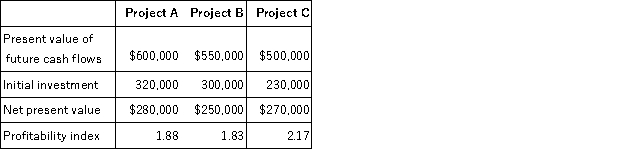 In what order should Norwood prioritize investment in the projects?
A) A, B, C
B) C, B, A
C) A, C, B
D) C, A, B
In what order should Norwood prioritize investment in the projects?A) A, B, C
B) C, B, A
C) A, C, B
D) C, A, B
Question
Question
Question
Question
Carmen, Inc. is considering three different independent investment opportunities. The present value of future cash flows, initial investment, net present value, and profitability index for each of the projects are as follows: 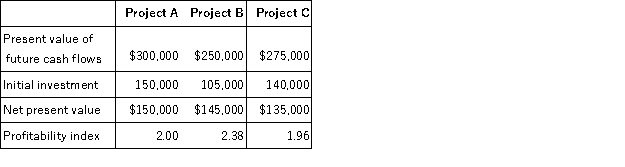 In what order should Carmen prioritize investment in the projects?
A) A, C, B
B) B, C, A
C) A, B, C
D) B, A, C
In what order should Carmen prioritize investment in the projects?A) A, C, B
B) B, C, A
C) A, B, C
D) B, A, C
Question
Question
Question
Question
Question
Question
Boxwood, Inc. is considering three different independent investment opportunities. The present value of future cash flows, initial investment, and net present value for each of the projects are as follows: 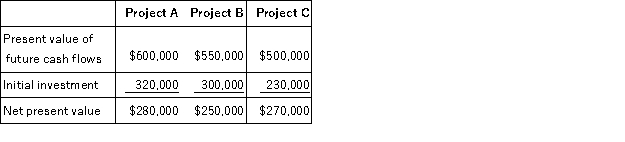 In what order should Boxwood prioritize investment in the projects?
A) A, B, C
B) C, B, A
C) A, C, B
D) C, A, B
In what order should Boxwood prioritize investment in the projects?A) A, B, C
B) C, B, A
C) A, C, B
D) C, A, B

Unlock Deck
Sign up to unlock the cards in this deck!
Unlock Deck
Unlock Deck
1/111

Play

Full screen (f)
Deck 11: Capital Budgeting
1
Projects that involve a choice among competing alternatives, where selection of one project implies rejection of all the other alternatives, are:
A) mutually exclusive projects.
B) screening projects.
C) independent projects.
D) preference projects.
A) mutually exclusive projects.
B) screening projects.
C) independent projects.
D) preference projects.
A
2
A decision that requires managers to choose from among a set of alternative capital investment opportunities is a(n):
A) preference decision.
B) capital decision.
C) screening decision.
D) incremental decision.
A) preference decision.
B) capital decision.
C) screening decision.
D) incremental decision.
A
3
Preference decisions compare an investment with some minimum criteria
False
4
When deciding between mutually exclusive investments, a manager should choose the option with the lowest depreciation
Unlock Deck
Unlock for access to all 111 flashcards in this deck.
Unlock Deck
k this deck
5
To find the present value of a single amount, you only need to know the amount to be received in the future, the interest rate and the number of periods until the amount will be received
Unlock Deck
Unlock for access to all 111 flashcards in this deck.
Unlock Deck
k this deck
6
The payback period is defined as the average net income divided by the initial investment
Unlock Deck
Unlock for access to all 111 flashcards in this deck.
Unlock Deck
k this deck
7
The payback period method ignores the time value of money
Unlock Deck
Unlock for access to all 111 flashcards in this deck.
Unlock Deck
k this deck
8
An annuity is a series of consecutive payments that are equal in dollar amount, have interest periods of equal length, and earn an equal interest rate each period
Unlock Deck
Unlock for access to all 111 flashcards in this deck.
Unlock Deck
k this deck
9
A decision that occurs when managers evaluate a proposed capital investment to determine whether it meets some minimum criteria is a(n):
A) preference decision.
B) capital decision.
C) screening decision.
D) incremental decision.
A) preference decision.
B) capital decision.
C) screening decision.
D) incremental decision.
Unlock Deck
Unlock for access to all 111 flashcards in this deck.
Unlock Deck
k this deck
10
The accounting rate of return is the only method that focuses on net income rather than cash flow
Unlock Deck
Unlock for access to all 111 flashcards in this deck.
Unlock Deck
k this deck
11
The internal rate of return method uses cash flows rather than net income
Unlock Deck
Unlock for access to all 111 flashcards in this deck.
Unlock Deck
k this deck
12
Independent projects are unrelated to one another, so that investing in one project does not affect the choice about investing in another project
Unlock Deck
Unlock for access to all 111 flashcards in this deck.
Unlock Deck
k this deck
13
The internal rate of return is the rate of return that yields a zero net present value
Unlock Deck
Unlock for access to all 111 flashcards in this deck.
Unlock Deck
k this deck
14
The profitability index is calculated as the present value of future cash flows divided by the initial investment
Unlock Deck
Unlock for access to all 111 flashcards in this deck.
Unlock Deck
k this deck
15
When managers must choose among independent projects, they should prioritize projects according to their net present value
Unlock Deck
Unlock for access to all 111 flashcards in this deck.
Unlock Deck
k this deck
16
Which of the following statements is correct about capital assets?
A) For managerial accounting purposes, "capital assets" are defined more narrowly than for financial accounting purposes.
B) Human capital and research and development are both considered capital assets for financial accounting purposes, but not for managerial accounting purposes.
C) Capital assets are only those that can be depreciated, whether using managerial or financial accounting.
D) For managerial accounting purposes, "capital assets" are defined more broadly than for financial accounting purposes.
A) For managerial accounting purposes, "capital assets" are defined more narrowly than for financial accounting purposes.
B) Human capital and research and development are both considered capital assets for financial accounting purposes, but not for managerial accounting purposes.
C) Capital assets are only those that can be depreciated, whether using managerial or financial accounting.
D) For managerial accounting purposes, "capital assets" are defined more broadly than for financial accounting purposes.
Unlock Deck
Unlock for access to all 111 flashcards in this deck.
Unlock Deck
k this deck
17
Projects that are unrelated to one another, so that investing in one project does not preclude or affect the choice about investing in the other alternatives, are:
A) mutually exclusive projects.
B) screening projects.
C) independent projects.
D) preference projects.
A) mutually exclusive projects.
B) screening projects.
C) independent projects.
D) preference projects.
Unlock Deck
Unlock for access to all 111 flashcards in this deck.
Unlock Deck
k this deck
18
The net present value method compares a project's future net income to the initial investment
Unlock Deck
Unlock for access to all 111 flashcards in this deck.
Unlock Deck
k this deck
19
An example of a future value of a single amount problem would be finding how much the right to receive a certain amount in the future would be worth today
Unlock Deck
Unlock for access to all 111 flashcards in this deck.
Unlock Deck
k this deck
20
Sensitivity analysis helps determine whether changing the underlying assumptions would affect the decision
Unlock Deck
Unlock for access to all 111 flashcards in this deck.
Unlock Deck
k this deck
21
Addison Corp. is considering the purchase of a new piece of equipment. The equipment will have an initial cost of $900,000, a 6-year life, and no salvage value. If the accounting rate of return for the project is 5%, what is the annual increase in net cash flow? Ignore income taxes.
A) $45,000
B) $105,000
C) $150,000
D) $195,000
A) $45,000
B) $105,000
C) $150,000
D) $195,000
Unlock Deck
Unlock for access to all 111 flashcards in this deck.
Unlock Deck
k this deck
22
Which of the following would be included in net income but not in annual cash flows?
A) Sales revenue
B) Depreciation
C) Initial investment
D) Direct labor
A) Sales revenue
B) Depreciation
C) Initial investment
D) Direct labor
Unlock Deck
Unlock for access to all 111 flashcards in this deck.
Unlock Deck
k this deck
23
The method that compares the present value of a project's future cash flows to the initial investment is:
A) accounting rate of return.
B) payback period.
C) net present value.
D) internal rate of return.
A) accounting rate of return.
B) payback period.
C) net present value.
D) internal rate of return.
Unlock Deck
Unlock for access to all 111 flashcards in this deck.
Unlock Deck
k this deck
24
If cash flows are not equal each year, the payback period:
A) cannot be calculated.
B) is calculated by dividing the initial investment by the average cash flows.
C) is calculated by subtracting each year's cash flows from the initial investment until zero is reached.
D) is calculated by dividing the total years in the project by two.
A) cannot be calculated.
B) is calculated by dividing the initial investment by the average cash flows.
C) is calculated by subtracting each year's cash flows from the initial investment until zero is reached.
D) is calculated by dividing the total years in the project by two.
Unlock Deck
Unlock for access to all 111 flashcards in this deck.
Unlock Deck
k this deck
25
Which of the following capital budgeting methods does not use discounted cash flows?
A) Net present value
B) Internal rate of return
C) Payback period
D) Profitability index
A) Net present value
B) Internal rate of return
C) Payback period
D) Profitability index
Unlock Deck
Unlock for access to all 111 flashcards in this deck.
Unlock Deck
k this deck
26
The payback method:
A) is a complex method of analysis.
B) is infrequently used.
C) incorporates the time value of money.
D) ignores benefits and costs that occur after the project has paid for itself.
A) is a complex method of analysis.
B) is infrequently used.
C) incorporates the time value of money.
D) ignores benefits and costs that occur after the project has paid for itself.
Unlock Deck
Unlock for access to all 111 flashcards in this deck.
Unlock Deck
k this deck
27
Which of the following capital budgeting methods focuses on net income rather than cash flows?
A) Payback period
B) Accounting rate of return
C) Net present value
D) Internal rate of return
A) Payback period
B) Accounting rate of return
C) Net present value
D) Internal rate of return
Unlock Deck
Unlock for access to all 111 flashcards in this deck.
Unlock Deck
k this deck
28
The accounting rate of return is also called all of the following except:
A) annual rate of return.
B) required rate of return.
C) simple rate of return.
D) unadjusted rate of return.
A) annual rate of return.
B) required rate of return.
C) simple rate of return.
D) unadjusted rate of return.
Unlock Deck
Unlock for access to all 111 flashcards in this deck.
Unlock Deck
k this deck
29
Which of the following statement regarding the payback method is incorrect?
A) The payback period is the amount of time it takes for a capital investment to "pay for itself."
B) In general, projects with longer payback periods are safer investments than those with shorter payback periods.
C) When cash flows are equal each year, the payback period is calculated by dividing the initial investment in the project by its annual cash flow.
D) The payback method is often used as a screening tool for potential investments.
A) The payback period is the amount of time it takes for a capital investment to "pay for itself."
B) In general, projects with longer payback periods are safer investments than those with shorter payback periods.
C) When cash flows are equal each year, the payback period is calculated by dividing the initial investment in the project by its annual cash flow.
D) The payback method is often used as a screening tool for potential investments.
Unlock Deck
Unlock for access to all 111 flashcards in this deck.
Unlock Deck
k this deck
30
The accounting rate of return is calculated as:
A) initial investment divided by annual net income.
B) initial investment divided by required rate of return.
C) annual net income divided by initial investment.
D) annual net income divided by required rate of return.
A) initial investment divided by annual net income.
B) initial investment divided by required rate of return.
C) annual net income divided by initial investment.
D) annual net income divided by required rate of return.
Unlock Deck
Unlock for access to all 111 flashcards in this deck.
Unlock Deck
k this deck
31
Homer Corp. is considering the purchase of a new piece of equipment. The cost savings from the equipment would result in an annual increase in net income after tax of $100,000. The equipment will have an initial cost of $400,000 and have a 5-year life. If the salvage value of the equipment is estimated to be $75,000, what is the annual net cash flow?
A) $25,000
B) $35,000
C) $165,000
D) $175,000
A) $25,000
B) $35,000
C) $165,000
D) $175,000
Unlock Deck
Unlock for access to all 111 flashcards in this deck.
Unlock Deck
k this deck
32
Cortland Corp. is considering the purchase of a new piece of equipment. The cost savings from the equipment would result in an annual increase in net cash flows of $100,000. The equipment will have an initial cost of $400,000 and have a 5-year life. If the salvage value of the equipment is estimated to be $75,000, what is the annual net income? Ignore income taxes.
A) $25,000
B) $35,000
C) $165,000
D) $175,000
A) $25,000
B) $35,000
C) $165,000
D) $175,000
Unlock Deck
Unlock for access to all 111 flashcards in this deck.
Unlock Deck
k this deck
33
When cash flows are equal each year, the payback period is calculated as:
A) Initial investment × Annual net cash flow.
B) Initial investment/Annual net cash flow.
C) Annual net cash flow/Initial investment.
D) Annual net cash flow - Initial investment/Project life.
A) Initial investment × Annual net cash flow.
B) Initial investment/Annual net cash flow.
C) Annual net cash flow/Initial investment.
D) Annual net cash flow - Initial investment/Project life.
Unlock Deck
Unlock for access to all 111 flashcards in this deck.
Unlock Deck
k this deck
34
How does the accounting rate of return differ from the return on investment formula?
A) They are not different; both are calculated by dividing net operating income by initial investment.
B) The numerator in each formula differs; accounting rate of return divides net operating income by initial investment, and return on investment divides gross operating income by initial investment.
C) The numerator in each formula differs; accounting rate of return divides net operating income by average invested assets, while return on investment divides gross operating income by average invested assets.
D) The denominator in each formula differs; accounting rate of return divides net operating income by initial investment, while return on investment divides net operating income by average invested assets.
A) They are not different; both are calculated by dividing net operating income by initial investment.
B) The numerator in each formula differs; accounting rate of return divides net operating income by initial investment, and return on investment divides gross operating income by initial investment.
C) The numerator in each formula differs; accounting rate of return divides net operating income by average invested assets, while return on investment divides gross operating income by average invested assets.
D) The denominator in each formula differs; accounting rate of return divides net operating income by initial investment, while return on investment divides net operating income by average invested assets.
Unlock Deck
Unlock for access to all 111 flashcards in this deck.
Unlock Deck
k this deck
35
Which of the following is not a limitation of using the accounting rate of return method for capital budgeting?
A) The accounting rate of return method does not incorporate time value of money.
B) The accounting rate of return method is based on accounting income, rather than cash flow.
C) Net income-on which the accounting rate of return method is based-is more objective than cash flow.
D) The accounting rate of return method is subject to potential manipulation based on accounting choices made by management (e.g., the method used to depreciate a capital asset).
A) The accounting rate of return method does not incorporate time value of money.
B) The accounting rate of return method is based on accounting income, rather than cash flow.
C) Net income-on which the accounting rate of return method is based-is more objective than cash flow.
D) The accounting rate of return method is subject to potential manipulation based on accounting choices made by management (e.g., the method used to depreciate a capital asset).
Unlock Deck
Unlock for access to all 111 flashcards in this deck.
Unlock Deck
k this deck
36
Which of the following statements is correct about the net present value method?
A) It is a discounted cash flow method based on net income.
B) It is a non-discounted method based on net income.
C) It is a discounted cash flow method based on cash flow.
D) It is a non-discounted method based on cash flow.
A) It is a discounted cash flow method based on net income.
B) It is a non-discounted method based on net income.
C) It is a discounted cash flow method based on cash flow.
D) It is a non-discounted method based on cash flow.
Unlock Deck
Unlock for access to all 111 flashcards in this deck.
Unlock Deck
k this deck
37
The total time to recover an original investment is the:
A) net present value.
B) internal rate of return.
C) accounting rate of return.
D) payback perioD.
The payback period is the amount of time needed for a capital investment to pay for itself.
A) net present value.
B) internal rate of return.
C) accounting rate of return.
D) payback perioD.
The payback period is the amount of time needed for a capital investment to pay for itself.
Unlock Deck
Unlock for access to all 111 flashcards in this deck.
Unlock Deck
k this deck
38
Which of the following is the formula for accounting rate of return?
A) Initial investment/net income
B) Annual net cash flow/Initial investment
C) Initial investment/Annual net cash flow
D) Annual net income/Initial investment
A) Initial investment/net income
B) Annual net cash flow/Initial investment
C) Initial investment/Annual net cash flow
D) Annual net income/Initial investment
Unlock Deck
Unlock for access to all 111 flashcards in this deck.
Unlock Deck
k this deck
39
Which of the following methods is calculated as annual net income as a percentage of the original investment in assets?
A) Accounting rate of return
B) Payback period
C) Net present value
D) Internal rate of return
A) Accounting rate of return
B) Payback period
C) Net present value
D) Internal rate of return
Unlock Deck
Unlock for access to all 111 flashcards in this deck.
Unlock Deck
k this deck
40
Fletcher Corp. is considering the purchase of a new piece of equipment. The equipment will have an initial cost of $400,000, a 5-year life, and a salvage value of $75,000. If the accounting rate of return for the project is 10%, what is the annual increase in net cash flow? Ignore income taxes.
A) $25,000
B) $40,000
C) $65,000
D) $105,000
A) $25,000
B) $40,000
C) $65,000
D) $105,000
Unlock Deck
Unlock for access to all 111 flashcards in this deck.
Unlock Deck
k this deck
41
Lawrence Corp. is considering the purchase of a new piece of equipment. When discounted at a hurdle rate of 8%, the project has a net present value of $24,580. When discounted at a hurdle rate of 10%, the project has a net present value of ($28,940). The internal rate of return of the project is:
A) zero.
B) between zero and 8%.
C) between 8% and 10%.
D) greater than 10%.
A) zero.
B) between zero and 8%.
C) between 8% and 10%.
D) greater than 10%.
Unlock Deck
Unlock for access to all 111 flashcards in this deck.
Unlock Deck
k this deck
42
The minimum required rate of return for a project is the:
A) annual rate of return.
B) accounting rate of return.
C) hurdle rate.
D) internal rate of return.
A) annual rate of return.
B) accounting rate of return.
C) hurdle rate.
D) internal rate of return.
Unlock Deck
Unlock for access to all 111 flashcards in this deck.
Unlock Deck
k this deck
43
When comparing mutually exclusive capital investments, managers should:
A) choose the option with the lowest cost on a net present value basis.
B) choose the option with the lowest undiscounted cost.
C) not use net present value because it cannot be used to compare investments.
D) not use sensitivity analysis.
A) choose the option with the lowest cost on a net present value basis.
B) choose the option with the lowest undiscounted cost.
C) not use net present value because it cannot be used to compare investments.
D) not use sensitivity analysis.
Unlock Deck
Unlock for access to all 111 flashcards in this deck.
Unlock Deck
k this deck
44
Newport Corp. is considering the purchase of a new piece of equipment. The cost savings from the equipment would result in an annual increase in cash flow of $200,000. The equipment will have an initial cost of $900,000 and have a 6-year life. There is no salvage value for the equipment. If the hurdle rate is 8%, what is the approximate net present value? Ignore income taxes.
A) $924,580
B) $24,580
C) $900,000
D) $300,000
A) $924,580
B) $24,580
C) $900,000
D) $300,000
Unlock Deck
Unlock for access to all 111 flashcards in this deck.
Unlock Deck
k this deck
45
Olive Corp. is considering the purchase of a new piece of equipment. The cost savings from the equipment would result in an annual increase in cash flow of $250,000. The equipment will have an initial cost of $1,300,000 and have an 8-year life. There is no salvage value for the equipment. If the hurdle rate is 10%, what is the internal rate of return? Ignore income taxes.
A) Between 6% and 8%
B) Between 8% and 10%
C) Greater than 10%
D) Less than zero
A) Between 6% and 8%
B) Between 8% and 10%
C) Greater than 10%
D) Less than zero
Unlock Deck
Unlock for access to all 111 flashcards in this deck.
Unlock Deck
k this deck
46
When making screening decisions using the net present value method, a project is acceptable if:
A) the NPV is greater than the hurdle rate.
B) the NPV is greater than the IRR.
C) the NPV is positive.
D) the NPV is negative.
A) the NPV is greater than the hurdle rate.
B) the NPV is greater than the IRR.
C) the NPV is positive.
D) the NPV is negative.
Unlock Deck
Unlock for access to all 111 flashcards in this deck.
Unlock Deck
k this deck
47
A profitability index greater than ____________ means that a project has a positive NPV.
A) negative one
B) zero
C) one
D) the hurdle rate
A) negative one
B) zero
C) one
D) the hurdle rate
Unlock Deck
Unlock for access to all 111 flashcards in this deck.
Unlock Deck
k this deck
48
The internal rate of return is a measure of:
A) the rate actually earned by the project, considering the time value of money.
B) the rate actually earned by the project, based on accounting income.
C) the rate used to discount the future cash flows to reflect the time value of money.
D) the firm's cost of capital.
A) the rate actually earned by the project, considering the time value of money.
B) the rate actually earned by the project, based on accounting income.
C) the rate used to discount the future cash flows to reflect the time value of money.
D) the firm's cost of capital.
Unlock Deck
Unlock for access to all 111 flashcards in this deck.
Unlock Deck
k this deck
49
Newport Corp. is considering the purchase of a new piece of equipment. The cost savings from the equipment would result in an annual increase in cash flow of $200,000. The equipment will have an initial cost of $900,000 and have a 6-year life. There is no salvage value for the equipment. If the hurdle rate is 10%, what is the approximate net present value? Ignore income taxes.
A) Negative $28,940
B) Positive $28,940
C) Zero
D) Positive $300,000
A) Negative $28,940
B) Positive $28,940
C) Zero
D) Positive $300,000
Unlock Deck
Unlock for access to all 111 flashcards in this deck.
Unlock Deck
k this deck
50
Byron Corp. is considering the purchase of a new piece of equipment. The cost savings from the equipment would result in an annual increase in cash flow of $100,000. The equipment will have an initial cost of $400,000 and have a 5-year life. The salvage value of the equipment is estimated to be $75,000. If the hurdle rate is 15%, what is the approximate net present value? Ignore income taxes.
A) Negative $27,490
B) Zero
C) Positive $400,000
D) Positive $75,000
A) Negative $27,490
B) Zero
C) Positive $400,000
D) Positive $75,000
Unlock Deck
Unlock for access to all 111 flashcards in this deck.
Unlock Deck
k this deck
51
Byron Corp. is considering the purchase of a new piece of equipment. The cost savings from the equipment would result in an annual increase in cash flow of $100,000. The equipment will have an initial cost of $400,000 and have a 5-year life. The salvage value of the equipment is estimated to be $75,000. If the hurdle rate is 10%, what is the approximate net present value? Ignore income taxes.
A) $25,648
B) $100,000
C) $175,000
D) ($20,291)
A) $25,648
B) $100,000
C) $175,000
D) ($20,291)
Unlock Deck
Unlock for access to all 111 flashcards in this deck.
Unlock Deck
k this deck
52
Wilson Corp. is considering the purchase of a new piece of equipment. The cost savings from the equipment would result in an annual increase in net income after tax of $50,000. The equipment will have an initial cost of $600,000 and have an 8-year life. The salvage value of the equipment is estimated to be $100,000. If the hurdle rate is 10%, what is the internal rate of return?
A) Less than zero
B) Between zero and 10%
C) Between 10% and 15%
D) More than 15%
A) Less than zero
B) Between zero and 10%
C) Between 10% and 15%
D) More than 15%
Unlock Deck
Unlock for access to all 111 flashcards in this deck.
Unlock Deck
k this deck
53
If the hurdle rate is greater than the internal rate of return, the net present value will be:
A) positive.
B) negative.
C) zero.
D) equal to the hurdle rate.
A) positive.
B) negative.
C) zero.
D) equal to the hurdle rate.
Unlock Deck
Unlock for access to all 111 flashcards in this deck.
Unlock Deck
k this deck
54
Newport Corp. is considering the purchase of a new piece of equipment. The cost savings from the equipment would result in an annual increase in cash flow of $200,000. The equipment will have an initial cost of $900,000 and have a 6-year life. There is no salvage value for the equipment. If the hurdle rate is 10%, what is the internal rate of return? Ignore income taxes.
A) Between 6% and 8%
B) Between 8% and 10%
C) Between 10% and 12%
D) Less than zero
A) Between 6% and 8%
B) Between 8% and 10%
C) Between 10% and 12%
D) Less than zero
Unlock Deck
Unlock for access to all 111 flashcards in this deck.
Unlock Deck
k this deck
55
Grace Corp., whose required rate of return is10%, is considering the purchase of a new piece of equipment. The internal rate of return of the project, which has a life of 8 years, is 12%. The project would have:
A) an accounting rate of return greater than 10%.
B) a payback period more than 8 years.
C) a net present value of zero.
D) a net present value greater than zero.
A) an accounting rate of return greater than 10%.
B) a payback period more than 8 years.
C) a net present value of zero.
D) a net present value greater than zero.
Unlock Deck
Unlock for access to all 111 flashcards in this deck.
Unlock Deck
k this deck
56
Byron Corp. is considering the purchase of a new piece of equipment. The cost savings from the equipment would result in an annual increase in cash flow of $100,000. The equipment will have an initial cost of $400,000 and have a 5-year life. The salvage value of the equipment is estimated to be $75,000. If the hurdle rate is 10%, what is the internal rate of return?
A) Between 6% and 8%
B) Between 8% and 10%
C) Between 10% and 12%
D) Between 12% and 14%
A) Between 6% and 8%
B) Between 8% and 10%
C) Between 10% and 12%
D) Between 12% and 14%
Unlock Deck
Unlock for access to all 111 flashcards in this deck.
Unlock Deck
k this deck
57
If a project has a positive net present value, it means the project is expected to provide returns that are ___________ the cost of capital.
A) greater than
B) less than
C) equal to
D) not connected to
A) greater than
B) less than
C) equal to
D) not connected to
Unlock Deck
Unlock for access to all 111 flashcards in this deck.
Unlock Deck
k this deck
58
The discount rate that would return a net present value equal to zero is the:
A) annual rate of return.
B) accounting rate of return.
C) hurdle rate.
D) internal rate of return.
A) annual rate of return.
B) accounting rate of return.
C) hurdle rate.
D) internal rate of return.
Unlock Deck
Unlock for access to all 111 flashcards in this deck.
Unlock Deck
k this deck
59
A positive net present value indicates that a project will:
A) generate a return in excess of the firm's cost of capital.
B) generate more cash than is initially invested.
C) generate more cash than alternative projects.
D) generate a return in excess of alternative projects.
A) generate a return in excess of the firm's cost of capital.
B) generate more cash than is initially invested.
C) generate more cash than alternative projects.
D) generate a return in excess of alternative projects.
Unlock Deck
Unlock for access to all 111 flashcards in this deck.
Unlock Deck
k this deck
60
Wilson Corp. is considering the purchase of a new piece of equipment. The cost savings from the equipment would result in an annual increase in net income after tax of $50,000. The equipment will have an initial cost of $600,000 and have an 8-year life. The salvage value of the equipment is estimated to be $100,000. If the hurdle rate is 10%, what is the approximate net present value?
A) Less than zero
B) $100,000
C) $500,000
D) $46,826
A) Less than zero
B) $100,000
C) $500,000
D) $46,826
Unlock Deck
Unlock for access to all 111 flashcards in this deck.
Unlock Deck
k this deck
61
Frank Inc. is trying to decide whether to lease or purchase a piece of equipment needed for the next ten years. The equipment would cost $45,000 to purchase, and maintenance costs would be $5,000 per year. After ten years, Frank estimates it could sell the equipment for $20,000. If Frank leased the equipment, it would pay a set annual fee that would include all maintenance costs. Frank has determined after a net present value analysis that at its hurdle rate of 10%, it would be better off by $5,700 if it buys the equipment. What would the approximate annual cost be if Frank were to lease the equipment?
A) $9,000
B) $7,000
C) $12,000
D) $13,250
A) $9,000
B) $7,000
C) $12,000
D) $13,250
Unlock Deck
Unlock for access to all 111 flashcards in this deck.
Unlock Deck
k this deck
62
Independent projects should be prioritized according to their:
A) profitability index.
B) net present value.
C) payback period.
D) total cash flows.
A) profitability index.
B) net present value.
C) payback period.
D) total cash flows.
Unlock Deck
Unlock for access to all 111 flashcards in this deck.
Unlock Deck
k this deck
63
A problem in which you must calculate how much money you will have in the future as a result of investing a certain amount in the present is a:
A) future value of a single amount problem.
B) present value of a single amount problem.
C) future value of an annuity problem.
D) present value of an annuity problem.
A) future value of a single amount problem.
B) present value of a single amount problem.
C) future value of an annuity problem.
D) present value of an annuity problem.
Unlock Deck
Unlock for access to all 111 flashcards in this deck.
Unlock Deck
k this deck
64
An analysis that reveals whether changing the underlying assumptions would affect the decision is a:
A) net present value analysis.
B) internal rate of return analysis.
C) payback period analysis.
D) sensitivity analysis.
A) net present value analysis.
B) internal rate of return analysis.
C) payback period analysis.
D) sensitivity analysis.
Unlock Deck
Unlock for access to all 111 flashcards in this deck.
Unlock Deck
k this deck
65
Randall Corp. is trying to decide whether to lease or purchase a piece of equipment needed for the next five years. The equipment would cost $100,000 to purchase, and maintenance costs would be $10,000 per year. After five years, Randall estimates it could sell the equipment for $30,000. If Randall leases the equipment, it would pay $30,000 each year, which would include all maintenance costs. If the hurdle rate for Randall is 12%, Randall should:
A) lease the equipment, as net present value of cost is about $11,000 less.
B) buy the equipment, as net present value of cost is about $11,000 less.
C) lease the equipment, as net present value of cost is about $30,000 less.
D) buy the equipment, as net present value of cost is about $30,000 less.
A) lease the equipment, as net present value of cost is about $11,000 less.
B) buy the equipment, as net present value of cost is about $11,000 less.
C) lease the equipment, as net present value of cost is about $30,000 less.
D) buy the equipment, as net present value of cost is about $30,000 less.
Unlock Deck
Unlock for access to all 111 flashcards in this deck.
Unlock Deck
k this deck
66
You are saving for a car that costs $28,000 that you hope to purchase in five years. How much will you need to deposit today in a savings account that earns 8%, compounded annually, to withdraw enough for the purchase?
A) $16,800
B) $19,057
C) $25,760
D) $41,140
A) $16,800
B) $19,057
C) $25,760
D) $41,140
Unlock Deck
Unlock for access to all 111 flashcards in this deck.
Unlock Deck
k this deck
67
Devon Corp. is trying to decide whether to lease or purchase a piece of equipment. The total cost lease the equipment will be $150,000 over its estimated life, while the total cost to buy the equipment will be $120,000 over its estimated life. At Devon's required rate of return, the net present value of the cost of leasing the equipment is $108,000 and the net present value of the cost of buying the equipment is $119,000. Based on financial factors, Devon should:
A) lease the equipment, saving $30,000 over buying.
B) buy the equipment, saving $30,000 over leasing.
C) lease the equipment, saving $11,000 over buying.
D) buy the equipment, saving $11,000 over leasing.
A) lease the equipment, saving $30,000 over buying.
B) buy the equipment, saving $30,000 over leasing.
C) lease the equipment, saving $11,000 over buying.
D) buy the equipment, saving $11,000 over leasing.
Unlock Deck
Unlock for access to all 111 flashcards in this deck.
Unlock Deck
k this deck
68
A problem in which you must calculate the worth to you today of receiving a certain amount at some time in the future is a:
A) future value of a single amount problem.
B) present value of a single amount problem.
C) future value of an annuity problem.
D) present value of an annuity problem.
A) future value of a single amount problem.
B) present value of a single amount problem.
C) future value of an annuity problem.
D) present value of an annuity problem.
Unlock Deck
Unlock for access to all 111 flashcards in this deck.
Unlock Deck
k this deck
69
If you invest $10,000 today in a savings account that earns 5% interest, compounded annually, how much would be in the account at the end of ten years?
A) $6,139
B) $16,289
C) $77,217
D) $125,779
A) $6,139
B) $16,289
C) $77,217
D) $125,779
Unlock Deck
Unlock for access to all 111 flashcards in this deck.
Unlock Deck
k this deck
70
Norwood, Inc. is considering three different independent investment opportunities. The present value of future cash flows, initial investment, net present value, and profitability index for each of the projects are as follows: In what order should Norwood prioritize investment in the projects?
A) A, B, C
B) C, B, A
C) A, C, B
D) C, A, B
In what order should Norwood prioritize investment in the projects?A) A, B, C
B) C, B, A
C) A, C, B
D) C, A, B
Unlock Deck
Unlock for access to all 111 flashcards in this deck.
Unlock Deck
k this deck
71
You have $10,000 that you can invest in a savings account that earns 7% interest, compounded annually. If you want to withdraw at least $18,000 at some point in the future, how long will you need to keep the money invested?
A) 9 years
B) 10 years
C) 11 years
D) 12 years
A) 9 years
B) 10 years
C) 11 years
D) 12 years
Unlock Deck
Unlock for access to all 111 flashcards in this deck.
Unlock Deck
k this deck
72
Heidi Inc. is considering whether to lease or purchase a piece of equipment. The total cost to lease the equipment will be $120,000 over its estimated life, while the total cost to buy the equipment will be $75,000 over its estimated life. At Heidi's required rate of return, the net present value of the cost of leasing the equipment is $73,700 and the net present value of the cost of buying the equipment is $68,000. Based on financial factors, Heidi should:
A) lease the equipment, saving $45,000 over buying.
B) buy the equipment, saving $45,000 over leasing.
C) lease the equipment, saving $5,700 over buying.
D) buy the equipment, saving $5,700 over leasing.
A) lease the equipment, saving $45,000 over buying.
B) buy the equipment, saving $45,000 over leasing.
C) lease the equipment, saving $5,700 over buying.
D) buy the equipment, saving $5,700 over leasing.
Unlock Deck
Unlock for access to all 111 flashcards in this deck.
Unlock Deck
k this deck
73
Foster Inc. is trying to decide whether to lease or purchase a piece of equipment needed for the next ten years. The equipment would cost $45,000 to purchase, and maintenance costs would be $5,000 per year. After ten years, Foster estimates it could sell the equipment for $20,000. If Foster leases the equipment, it would pay $12,000 each year, which would include all maintenance costs. If the hurdle rate for Foster is 10%, Foster should:
A) lease the equipment, as net present value of cost is about $5,700 less.
B) buy the equipment, as net present value of cost is about $5,700 less.
C) lease the equipment, as net present value of cost is about $2,000 less.
D) buy the equipment, as net present value of cost is about $45,000 less.
A) lease the equipment, as net present value of cost is about $5,700 less.
B) buy the equipment, as net present value of cost is about $5,700 less.
C) lease the equipment, as net present value of cost is about $2,000 less.
D) buy the equipment, as net present value of cost is about $45,000 less.
Unlock Deck
Unlock for access to all 111 flashcards in this deck.
Unlock Deck
k this deck
74
Carmen, Inc. is considering three different independent investment opportunities. The present value of future cash flows, initial investment, net present value, and profitability index for each of the projects are as follows: In what order should Carmen prioritize investment in the projects?
A) A, C, B
B) B, C, A
C) A, B, C
D) B, A, C
In what order should Carmen prioritize investment in the projects?A) A, C, B
B) B, C, A
C) A, B, C
D) B, A, C
Unlock Deck
Unlock for access to all 111 flashcards in this deck.
Unlock Deck
k this deck
75
The value today of cash flow to be received in the future is called:
A) present value.
B) cash value.
C) future value.
D) accounting value.
A) present value.
B) cash value.
C) future value.
D) accounting value.
Unlock Deck
Unlock for access to all 111 flashcards in this deck.
Unlock Deck
k this deck
76
You purchase a home for $200,000 that you expect to appreciate 6% in value on an annual basis. How much will the home be worth in ten years?
A) $111,680
B) $358,120
C) $1,472,020
D) $2,636,160
A) $111,680
B) $358,120
C) $1,472,020
D) $2,636,160
Unlock Deck
Unlock for access to all 111 flashcards in this deck.
Unlock Deck
k this deck
77
Dallas Corp. is trying to decide whether to lease or purchase a piece of equipment needed for the next five years. The equipment would cost $100,000 to purchase, and maintenance costs would be $10,000 per year. After five years, Dallas estimates it could sell the equipment for $30,000. If Dallas leased the equipment, it would pay a set annual fee that would include all maintenance costs. Dallas has determined after a net present value analysis that at its hurdle rate of 12% it would be better off by $11,000 if it leases the equipment. What would the approximate annual cost be if Dallas were to lease the equipment?
A) $21,800
B) $27,800
C) $30,000
D) $34,700
A) $21,800
B) $27,800
C) $30,000
D) $34,700
Unlock Deck
Unlock for access to all 111 flashcards in this deck.
Unlock Deck
k this deck
78
When a project has a positive net present value, it has a profitability index:
A) greater than zero.
B) less than zero.
C) greater than one.
D) less than one.
A) greater than zero.
B) less than zero.
C) greater than one.
D) less than one.
Unlock Deck
Unlock for access to all 111 flashcards in this deck.
Unlock Deck
k this deck
79
How much would you need to deposit in a savings account that earns 7%, compounded annually, to withdraw $20,000 eight years from now?
A) $11,640
B) $18,600
C) $18,692
D) $34,364
A) $11,640
B) $18,600
C) $18,692
D) $34,364
Unlock Deck
Unlock for access to all 111 flashcards in this deck.
Unlock Deck
k this deck
80
Boxwood, Inc. is considering three different independent investment opportunities. The present value of future cash flows, initial investment, and net present value for each of the projects are as follows: In what order should Boxwood prioritize investment in the projects?
A) A, B, C
B) C, B, A
C) A, C, B
D) C, A, B
In what order should Boxwood prioritize investment in the projects?A) A, B, C
B) C, B, A
C) A, C, B
D) C, A, B
Unlock Deck
Unlock for access to all 111 flashcards in this deck.
Unlock Deck
k this deck
Unlock Deck
Unlock for access to all 111 flashcards in this deck.







